Photo by Tom Russo | AIM Media Indiana
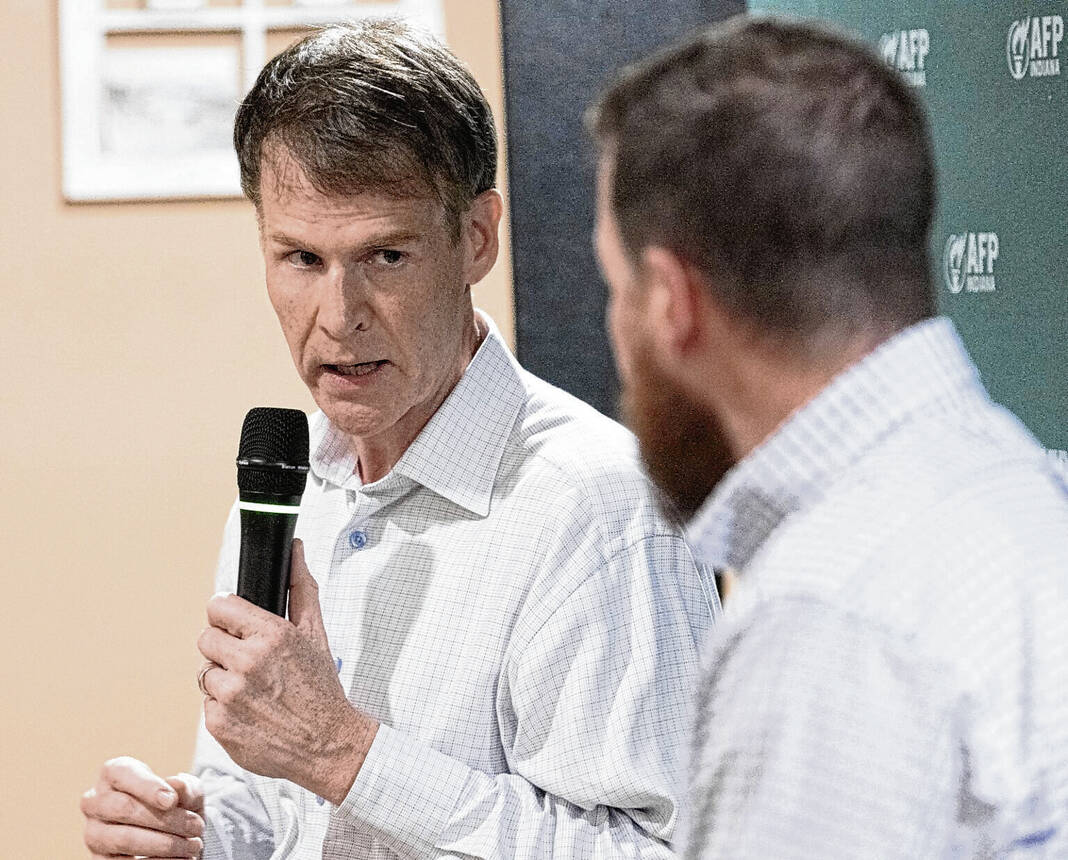
Congressman Jefferson Shreve answers questions during a gathering in Greenfield on Aug. 15, 2025.
U.S. House members representing parts of Bartholomew County have expressed support for redrawing Indiana’s congressional maps ahead of the 2026 midterm elections — putting them at odds with state lawmakers representing Bartholomew County.
Rep. Jefferson Shreve, R-Indiana, has said “I support the president’s call” for early redistricting and that “Hoosiers can help turn this tide” in the midterms, while Rep. Erin Houchin, R-Indiana, has said “it’s time to redraw Indiana’s congressional map” to help ensure “Hoosiers have the strongest possible conservative voices in Washington.”
The comments from the two U.S. House members representing Bartholomew County stand in contrast to state lawmakers representing the county — Sen. Greg Walker, R-Columbus; Rep. Ryan Lauer, R-Columbus; and Rep. Jim Lucas, R-Seymour — who have characterized the idea of redistricting as ranging from “ridiculous” and “ill-advised” to “optically terrible.”
The divide among Republicans comes as President Donald Trump and his allies continue to ramp up pressure on GOP-led states, including Indiana, to redraw their congressional maps, which are normally revised once a decade after the census. The Trump administration recently dispatched Vice President JD Vance to Indiana to build support for early redistricting.
The administration has also invited all Republican state lawmakers from Indiana to visit the White House next week. So far, Lucas is the only state lawmaker representing part of Bartholomew County who has confirmed he has accepted the invitation and plans to make the trip.
Shreve’s staff said the first-term congressman was unavailable to answer questions about his support for early redistricting despite the opposition from state lawmakers in his district. Instead, they repeatedly pointed to his public statement.
“I support the president’s call to counterbalance radical blue states governors like (California Gov.) Gavin Newson and (Illinois Gov.) JB Pritzker who’ve long manipulated districts in California and Illinois,” Shreve said in the statement. “Their gerrymandering efforts undercut fair representation. Hoosiers can help turn this tide.”
Houchin also expressed support for redrawing Indiana’s congressional districts ahead of the midterm elections.
“Democrats will stop at nothing to push their radical agenda,” Houchin said in a statement on X. “Republicans can’t accept that any longer. Indiana can act to guarantee that all Hoosiers have the strongest possible conservative voices in Washington. I’m standing with President Trump — it’s time to redraw Indiana’s congressional map.”
The effort targets Democratic-held districts, aiming to shift them in Republicans’ favor by redrawing their boundaries in hopes of retaining the GOP’s slim majority in the House following the 2024 midterm elections.
While Gov. Mike Braun would have to call a special session to start the redistricting process, state lawmakers have sole power in Indiana to draw new maps — and legislators representing parts of Bartholomew County have said they are not on board with the idea.
Walker characterized the idea of early redistricting in Indiana as “ridiculous” and pointed to comments from former Indiana Gov. Mitch Daniels — also a Republican — who recently told Politico that he didn’t “see the point” of doing so in the Hoosier State and that it “would be just wrong.”
“I think it’s a ridiculous idea, and I think it would backfire,” Walker told The Republic.
Lauer said he thinks early redistricting would be “ill-advised” and described Indiana’s current congressional district maps as “very fair.”
“I think it would be ill-advised. I’m not for changing the maps,” Lauer said. “…From constituents reaching out to me, I think the consensus is that we should continue with the tradition of redistricting every 10 years unless there are extraordinary circumstances. But I don’t see this as an extraordinary circumstance.”
Lucas said called early redistricting “highly unusual and politically optically horrible.”
“I don’t believe Republicans should stoop to the level of Democrats on this issue,” Lucas said in a Facebook post. “Republicans hold about 90% of all local offices statewide and once the voter rolls get purged of illegals, we will hold an even more commanding lead. Democrats can’t compete with their Socialist policies and ideology, and if there are seats that need targeted, we should do it the old-fashioned way and campaign harder in those districts.”
The issue of early redistricting ahead of next year’s elections started in Texas, which has been the epicenter of Trump’s push to gerrymander congressional maps to shore up Republicans’ narrow House majority in 2026, The Associated Press reported.
At a time when competitive House districts number just several dozen, Democrats are three seats short of a House majority under the current maps, according to wire reports. Trump has said he is “entitled” to five more seats out of Texas to potentially avoid a repeat of the 2018 midterms, when Democrats reclaimed the House and proceeded to thwart his agenda and impeach him twice.
The redistricting fight has since spread to Democratic-run California and now seems to be mushrooming, according to wire reports.
Last week, Newsom said his state will hold a Nov. 4 special election to seek approval of redrawn districts intended to give Democrats five more U.S. House seats in the fight for control of Congress, in response to redistricting efforts in Texas.
Trump allies have also urged state leaders in Ohio, South Carolina, and Missouri to focus on the few remaining Democratic-held districts, according to CNN. In Florida, Republicans have taken an initial step toward potential mid-cycle redistricting by creating a House committee to study the issue.
The dynamics could embroil the 2026 midterm campaign in legislative and court battles testing Trump’s power over the Republican Party, Democrats’ ability to mount opposition and the durability of the U.S. system of federalism that balances power between Washington and individual states, according to wire reports.
So far, Braun — a staunch Trump ally — has been noncommittal on early redistricting, even after Trump dispatched Vance to Indianapolis to meet with the governor and other Republican leaders last week.
Currently, Republican U.S. representatives outnumber Democrats in Indiana 7-2. Any efforts to the change the state’s congressional maps ahead of the midterms would likely focus on a district in northwest Indiana and one in Indianapolis, according to the Indiana Capital Chronicle.
Indiana’s Republican legislative leaders have also been accused of gerrymandering — including when drawing up what are now the state’s current districts for federal and state offices four years ago.
The current maps faced intense criticism in 2021 as diluting the influence of minority and urban voters in favor of white voters living in rural areas to bolster the election prospects for Republicans, according to the AP. That came after the 2020 census found that the state’s white and rural populations both dropped over the previous 10 years.
Republican state lawmakers maintained that the maps were fair and that they followed federal and state laws to match Indiana’s population shifts while avoiding splitting counties and cities between multiple districts as much as possible.
Democrats and civil rights groups countered by pointing to the shifting of increasingly diverse parts of Indianapolis from the congressional district narrowly won in 2020 by Republican U.S. Rep. Victoria Spartz into the solidly Democratic district held by Rep. Andre Carson, according to wire reports.
At the time, George Washington University political scientist Christopher Warshaw told WFYI that the move was “one of the most extreme gerrymanders in history.”
Objections were also raised about the fragmenting of Fort Wayne’s large Black and Latino communities among three likely Republican state Senate districts that will have rural white voters making up the majorities and making similar splits in the urban areas of Evansville and Lafayette-West Lafayette.
In the 2024 election, Republican candidates collectively won 58% of the votes cast in Indiana’s congressional races but secured 78% of the state’s U.S. House seats, according to records from the Indiana Secretary of State’s Office. Democrats received 38% of the vote but captured 22% of the seats.
Still, Republicans hold a supermajority in the Indiana General Assembly, meaning Democrats cannot thwart a special session on redistricting by refusing to attend, as Texas Democrats temporarily did.
“Statehouse Dems will do everything within our power to work with Hoosiers to make sure the checks and balances remain and we remain to be the firewall not just for Indiana but for the entire country,” said state Senate minority leader Shelli Yoder, though she acknowledged there is little the party could do to stop redistricting if Indiana Republicans choose to please Trump.
Trump already is flouting U.S. political traditions with such a widespread, aggressive push for mid-decade redistricting, according to wire reports. He added another variable with a social media post on Thursday calling for “new and highly accurate CENSUS” that does not count U.S. residents who are not citizens, permanent residents or otherwise legal immigrants.
He did not offer any timeline or details for such a massive undertaking, and his post raises constitutional questions about the once-a-decade process that apportions the U.S. House of Representatives among the states and sets distribution formulas for nearly $3 trillion in federal spending programs.
The incumbent president’s party typically loses House seats in midterm elections. For instance, the Democrats won a net gain of 40 seats in the 2018 midterm elections during Trump’s first term, while the Republicans won a net gain nine seats in the 2022 midterm elections when Democrat Joe Biden was president.