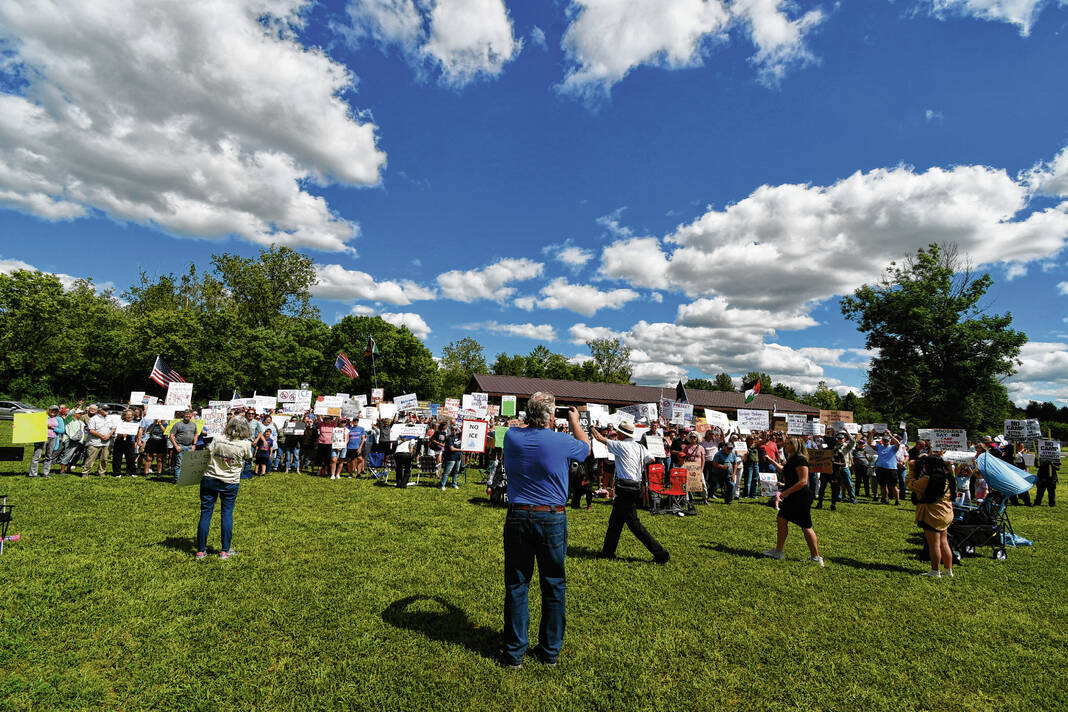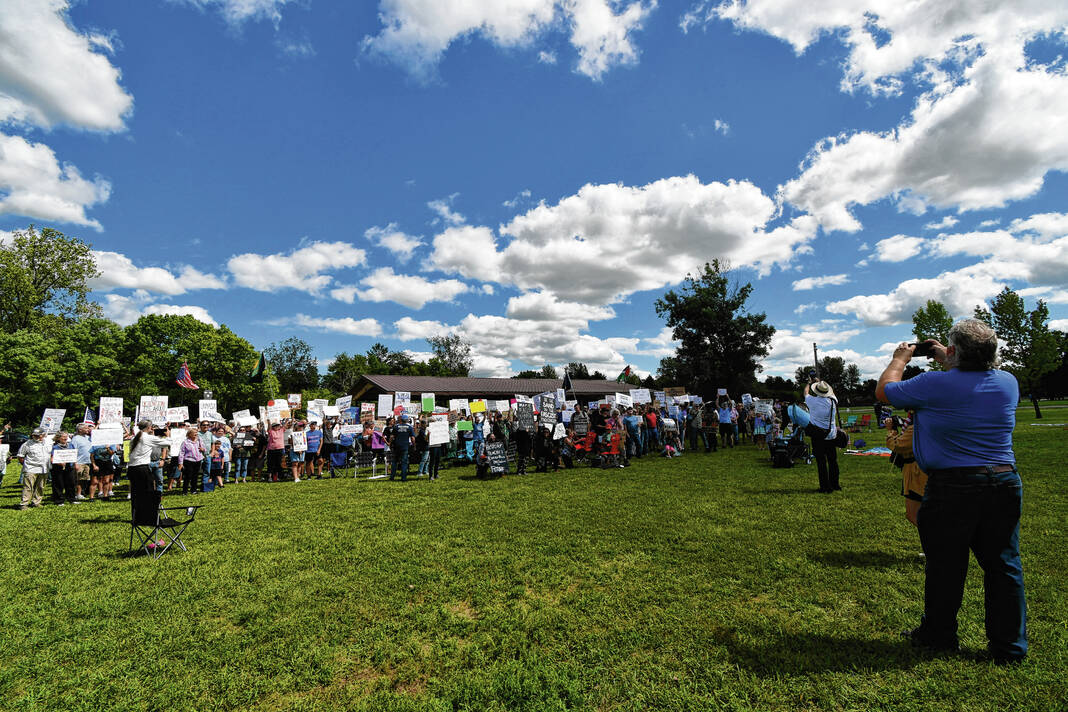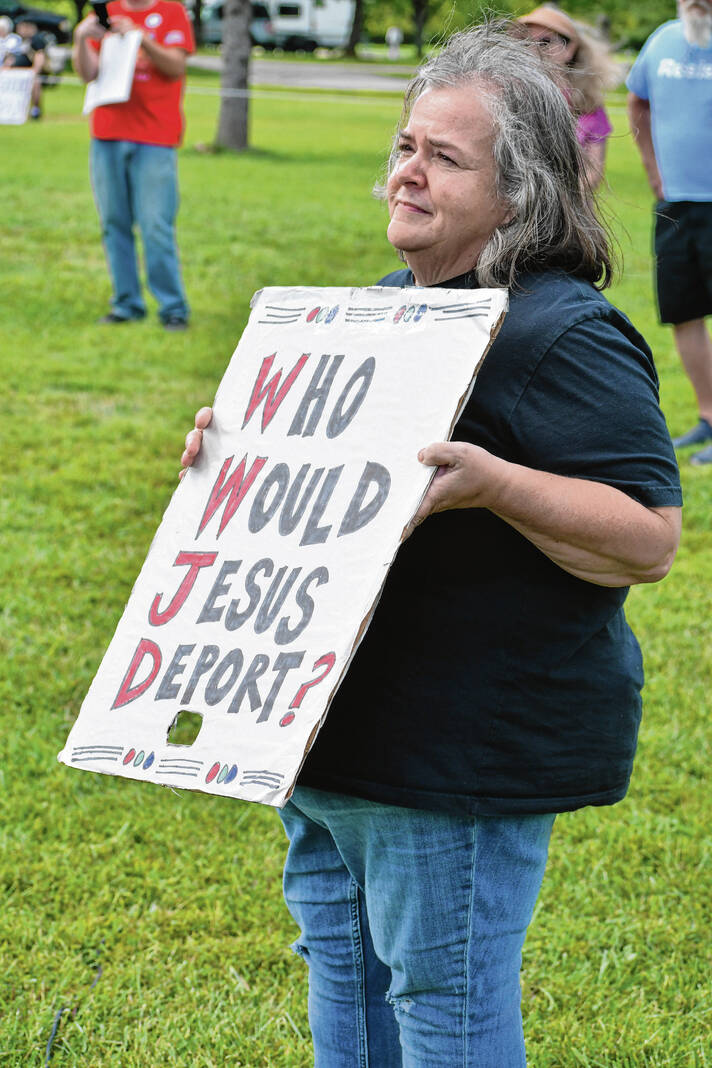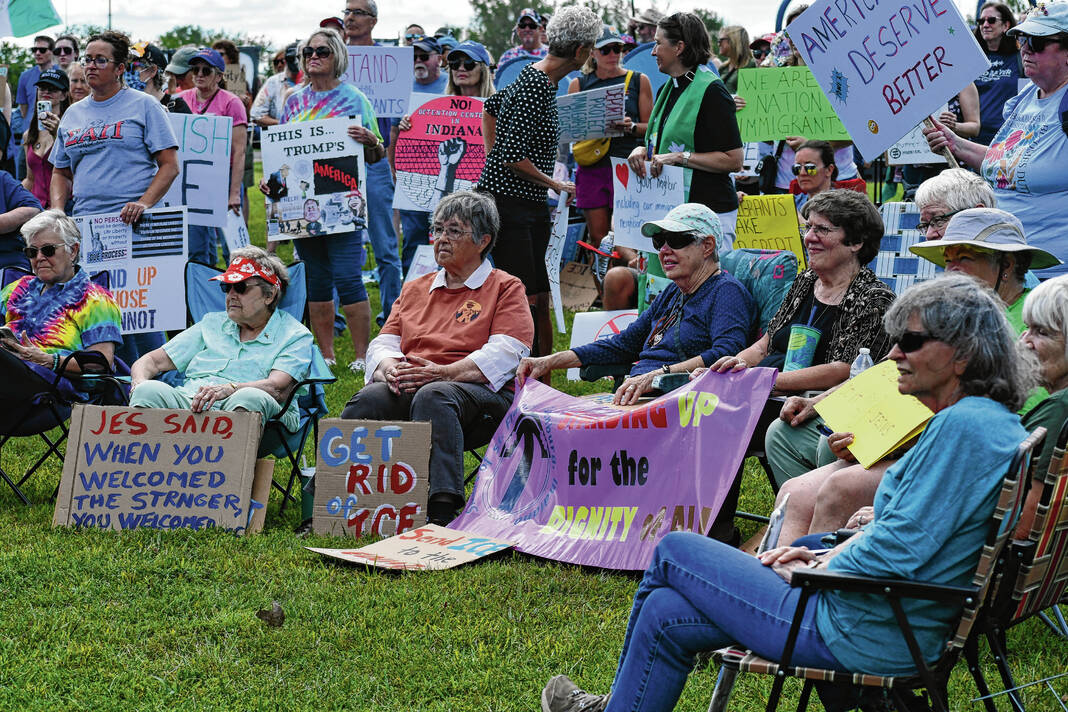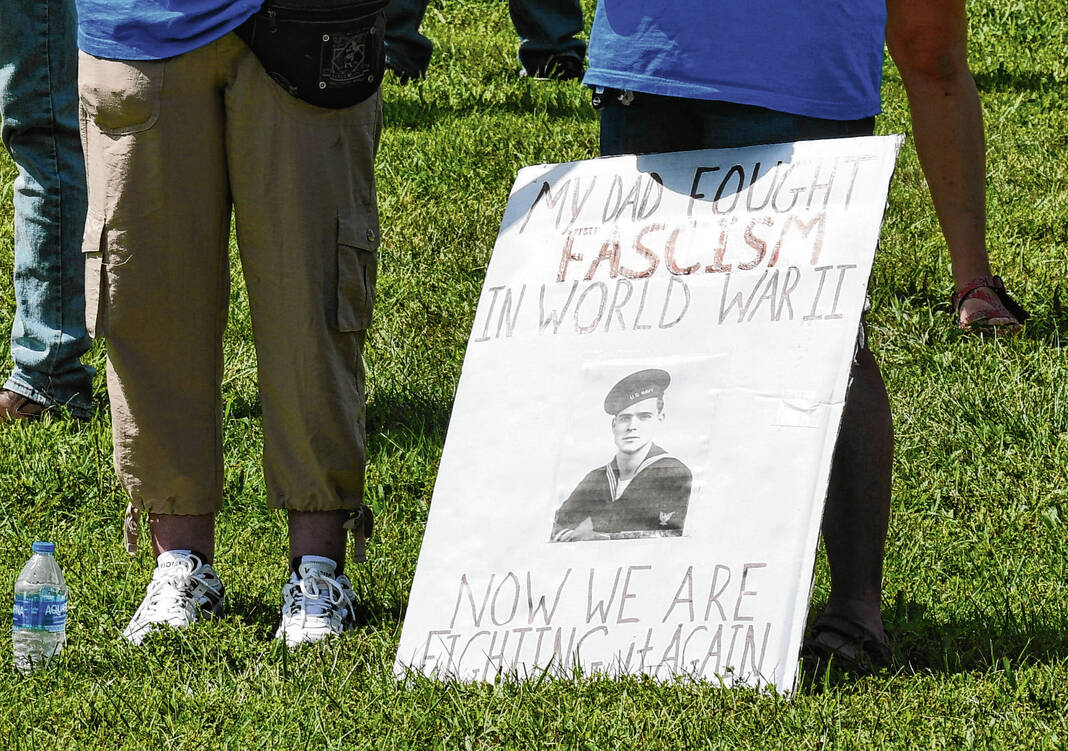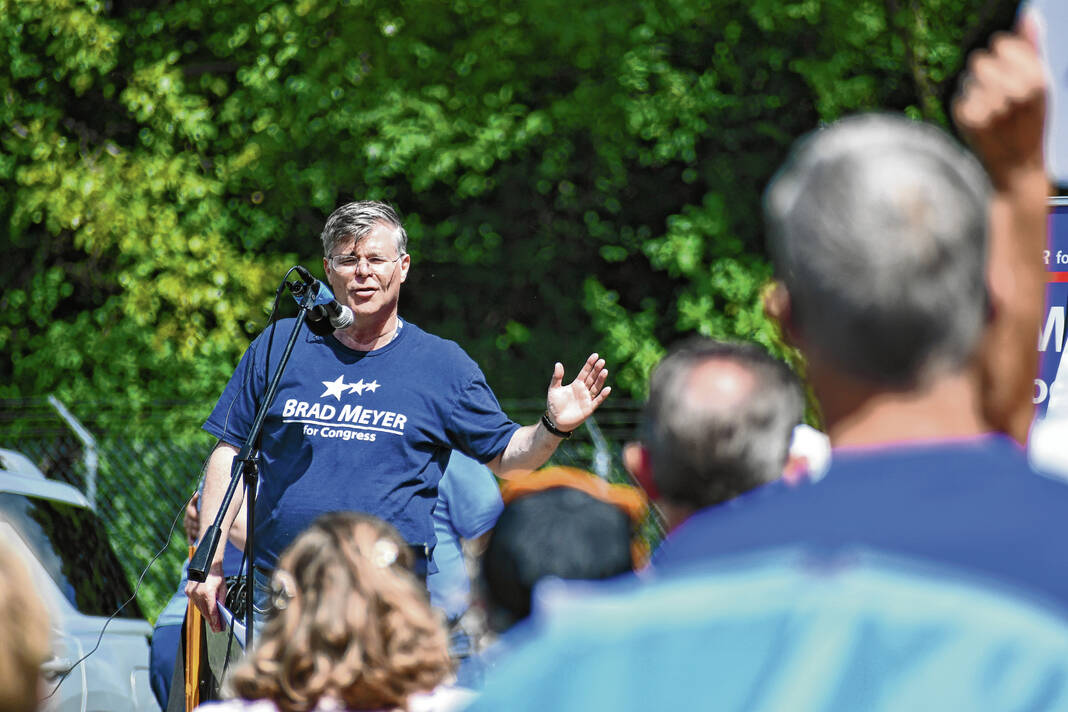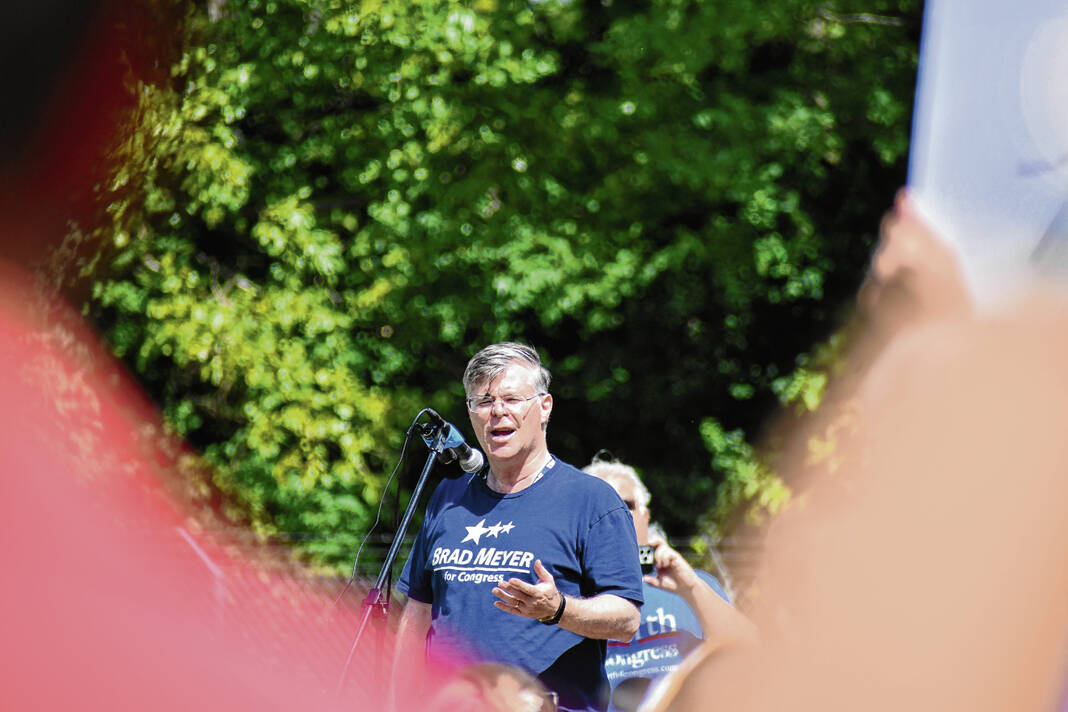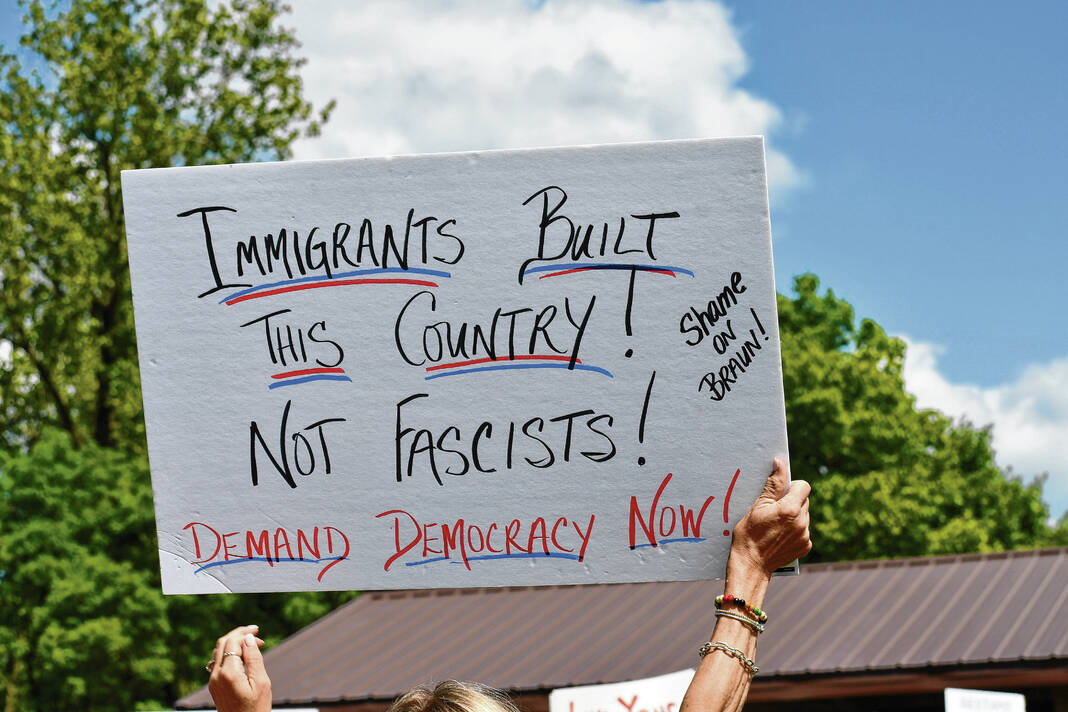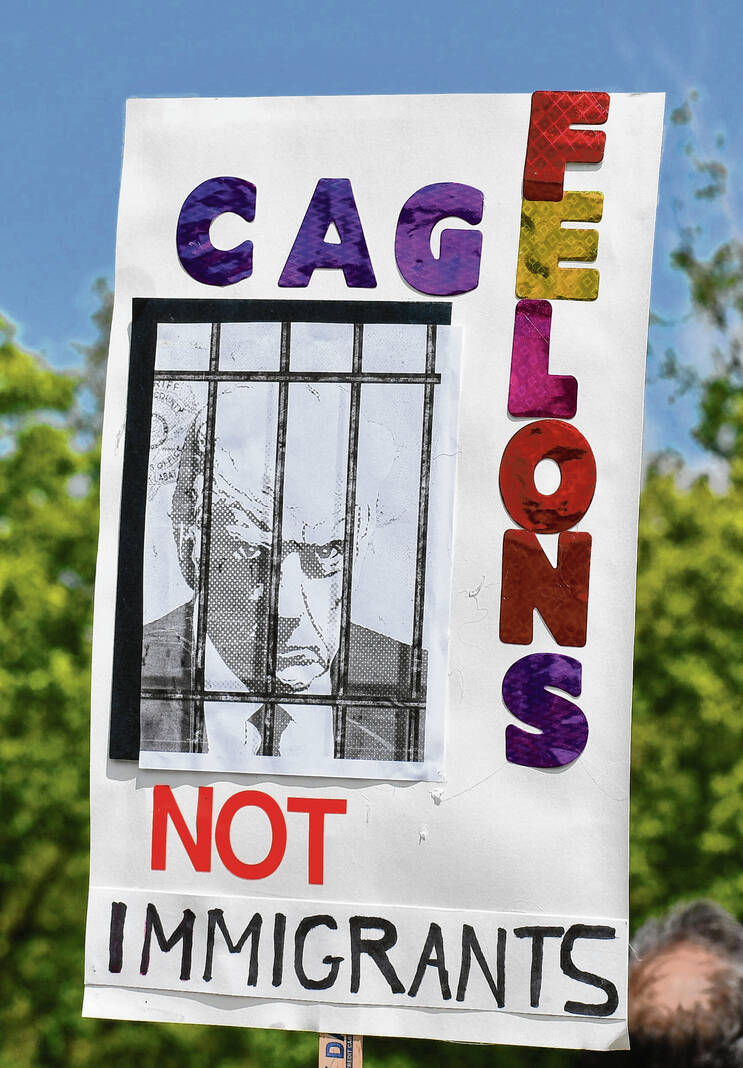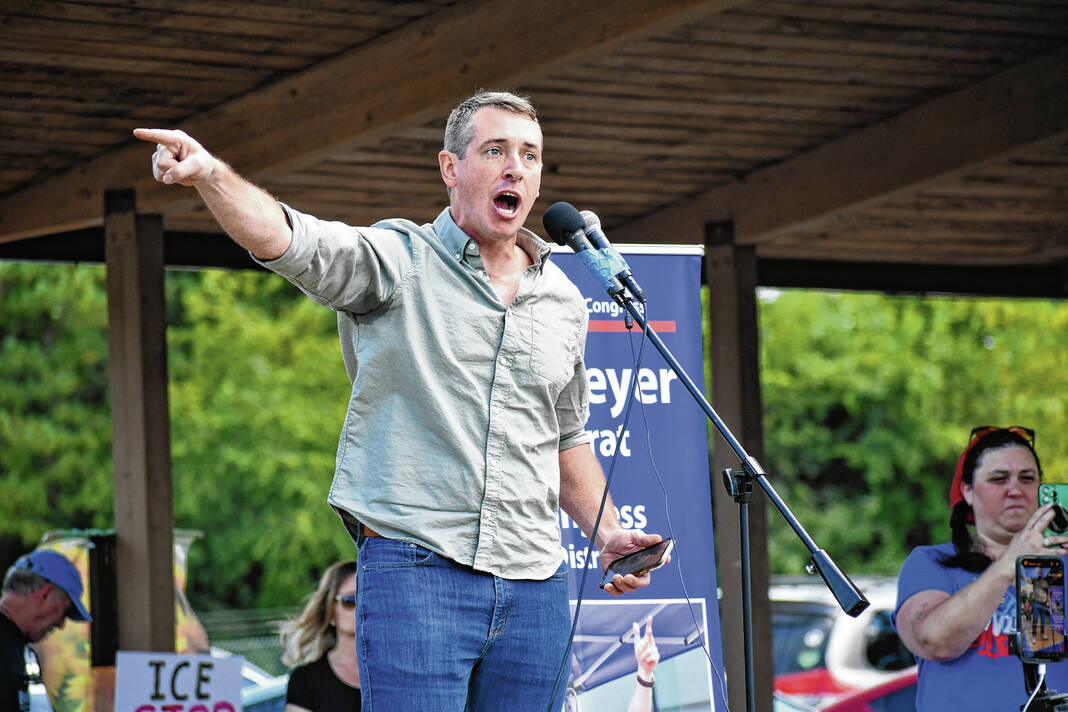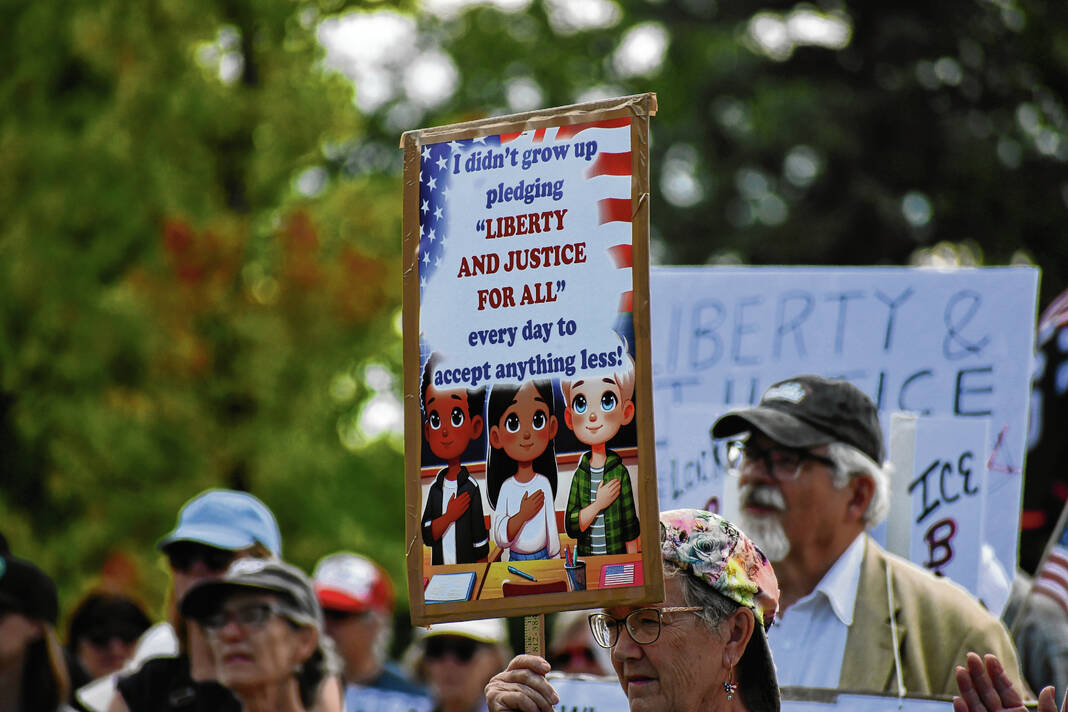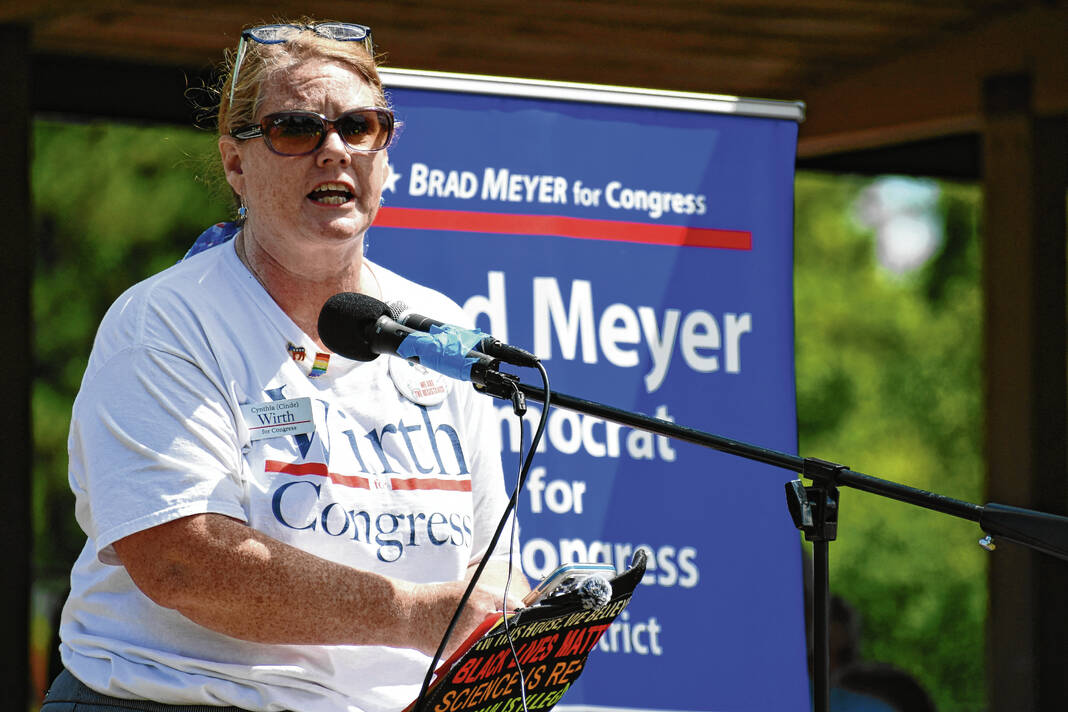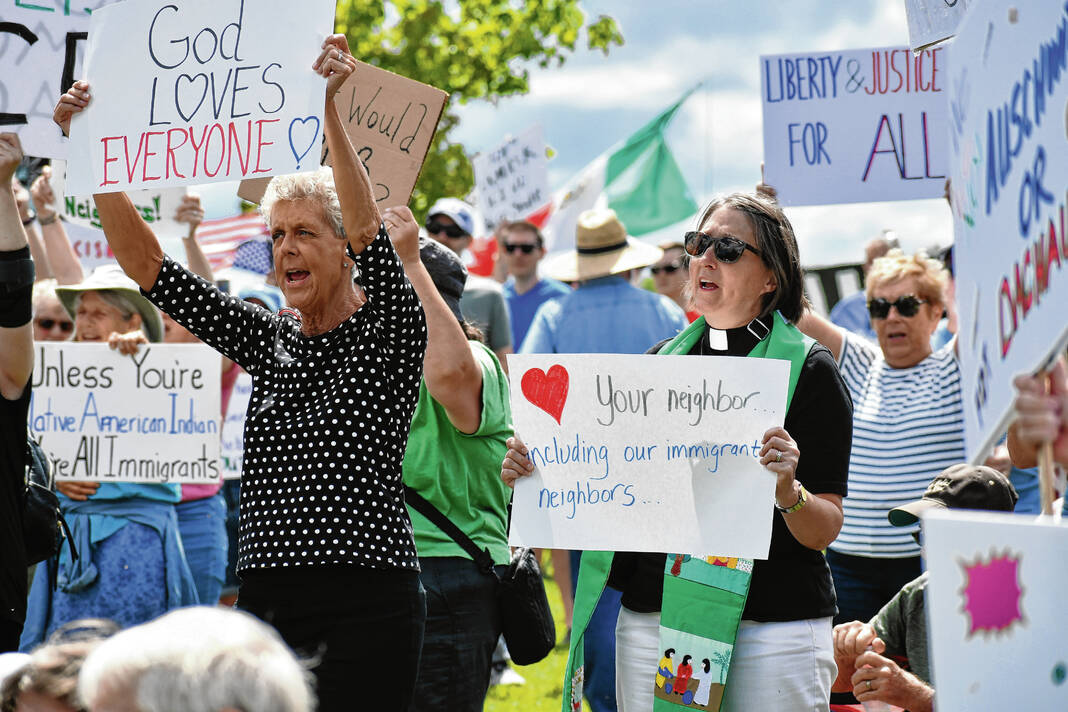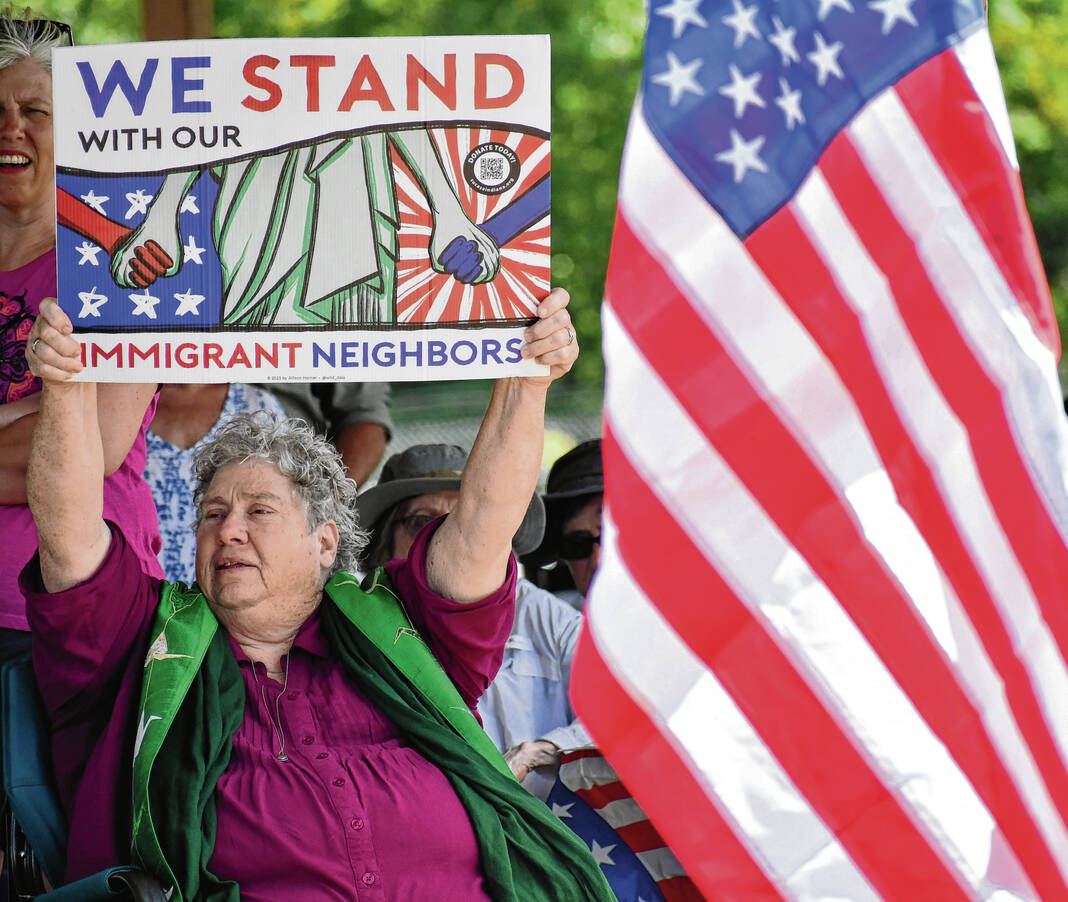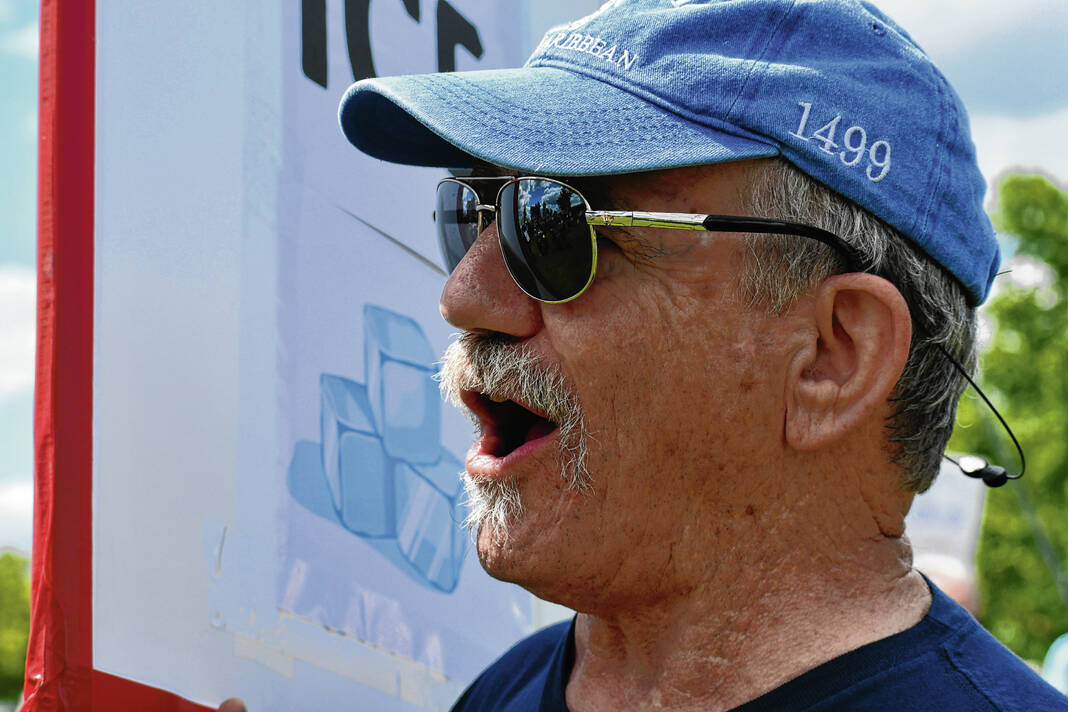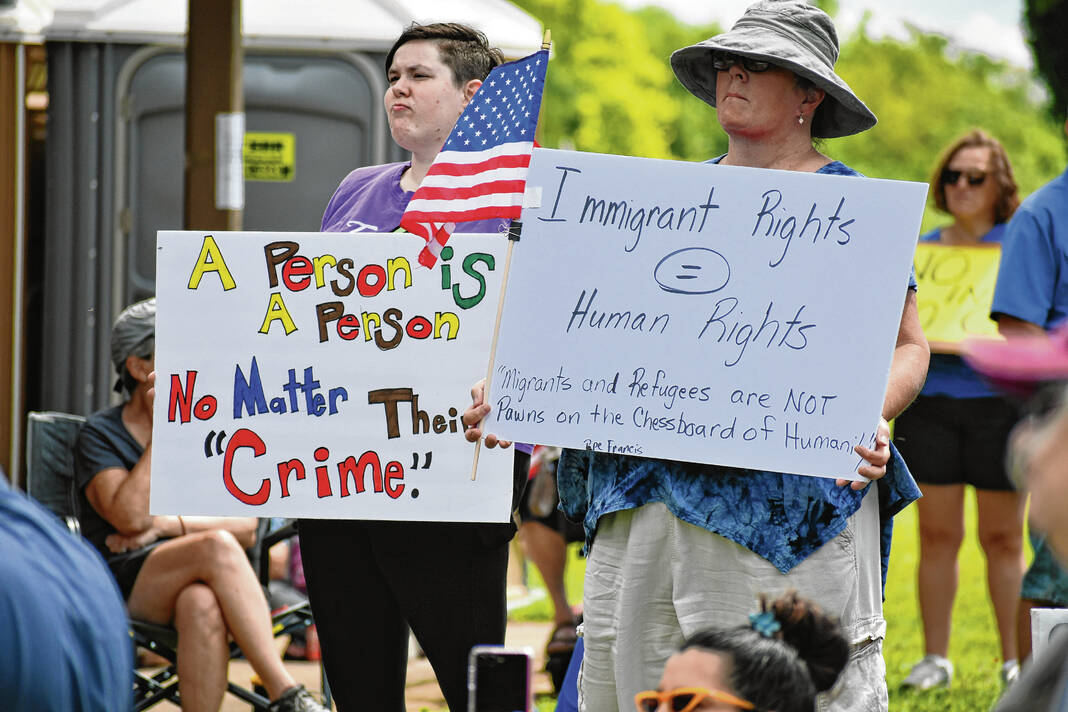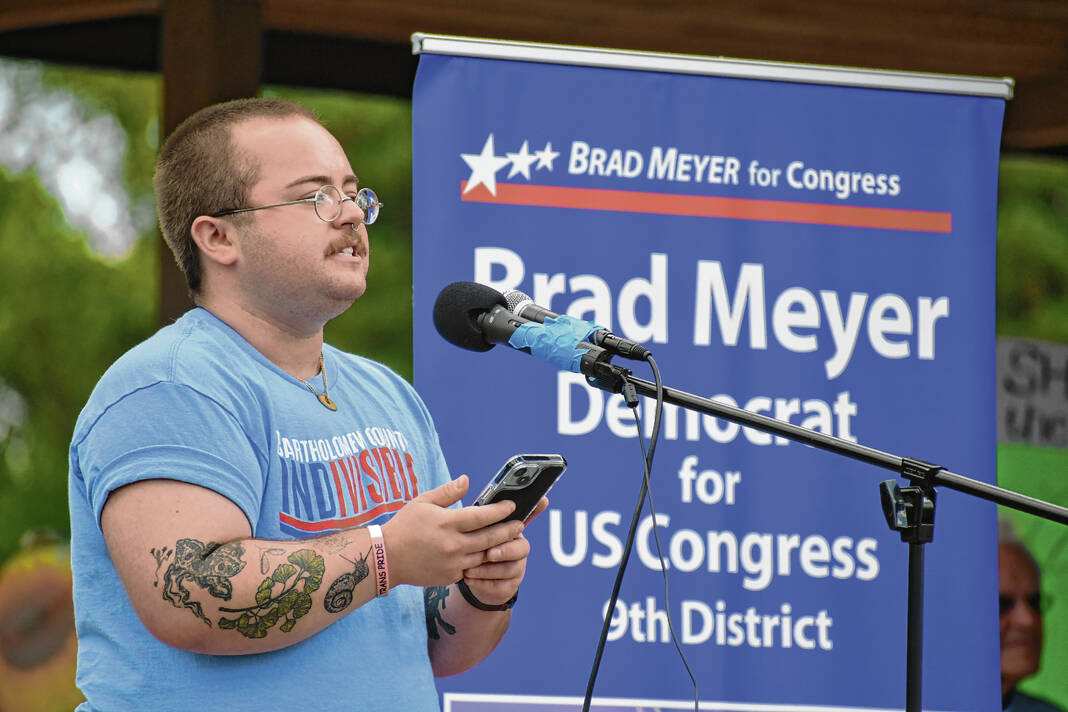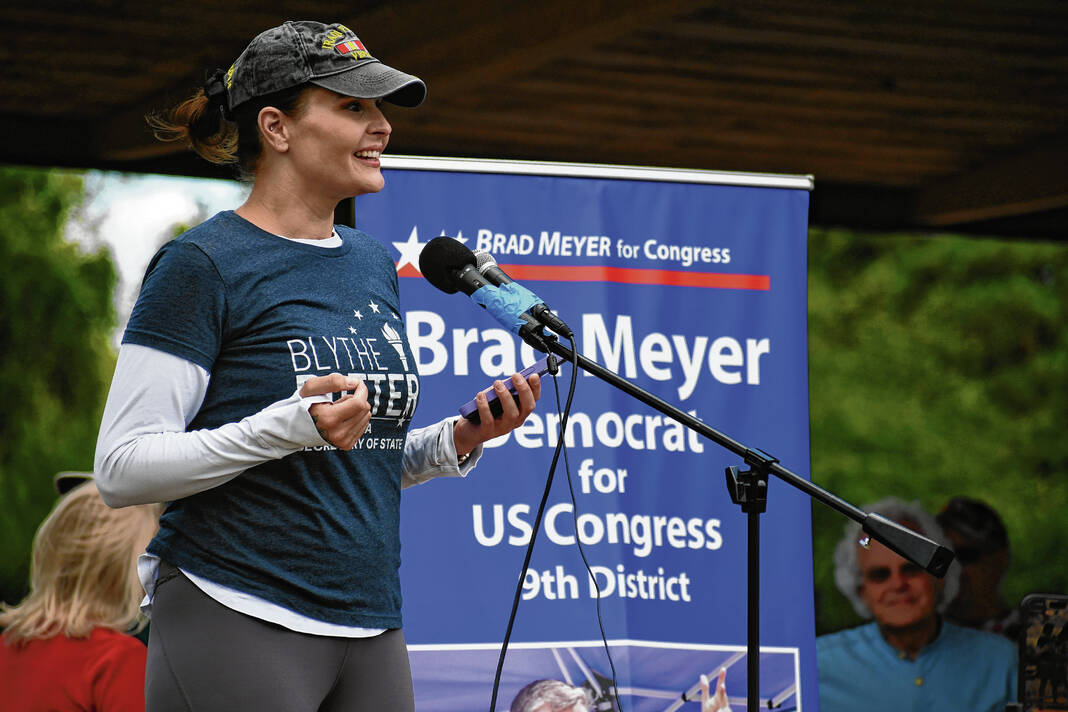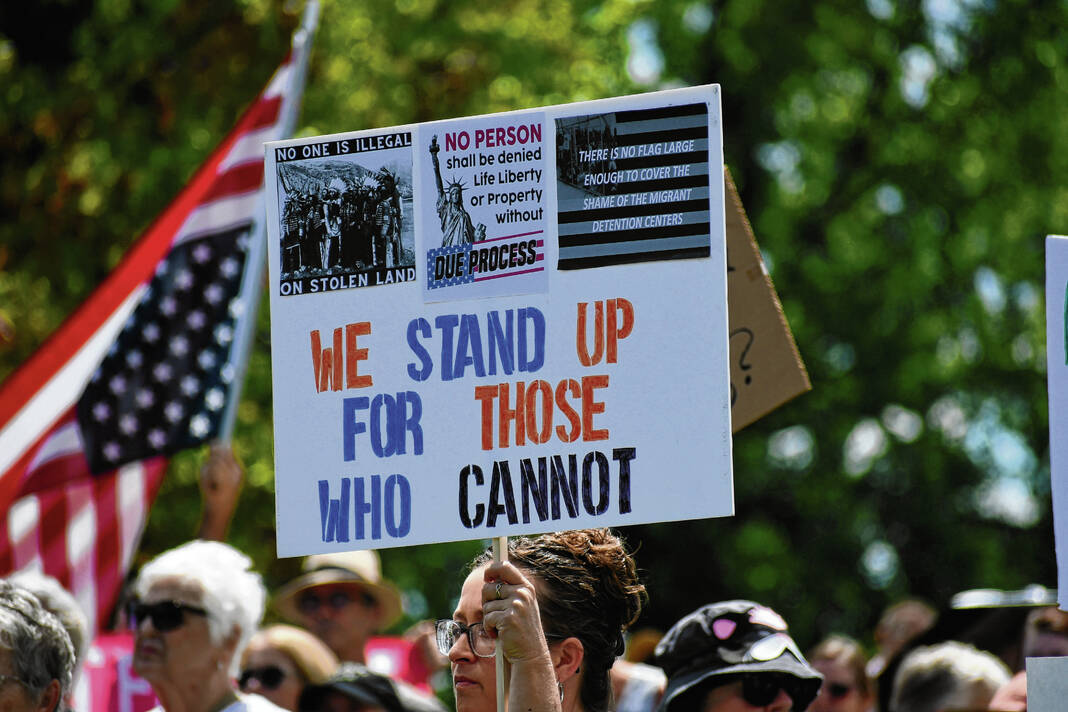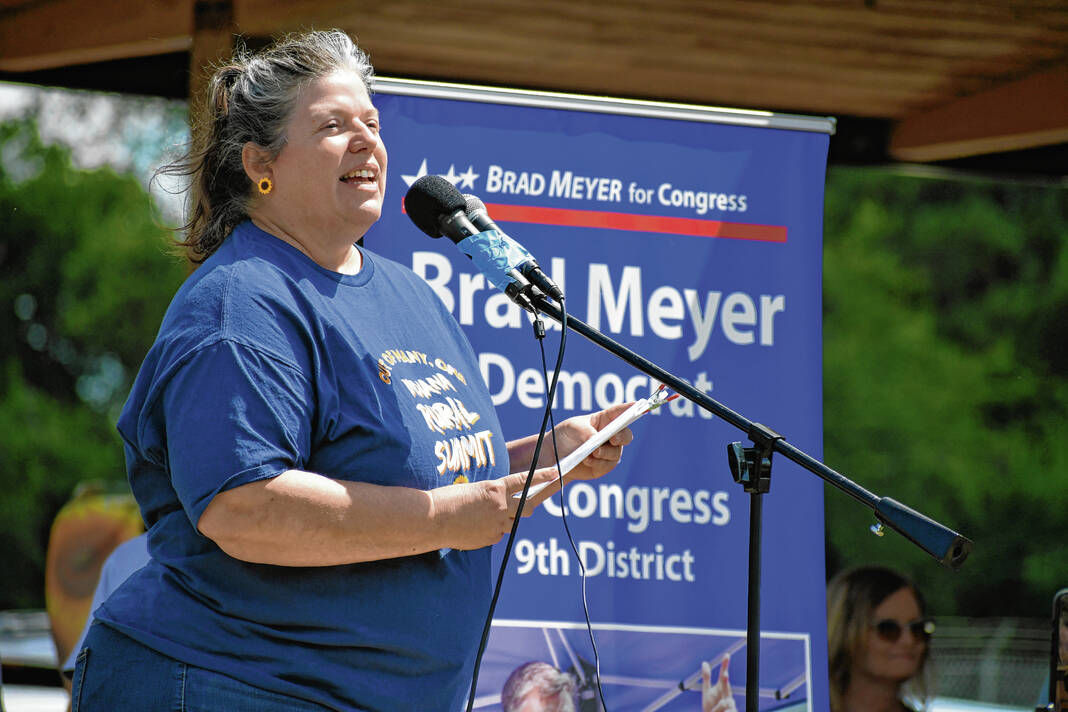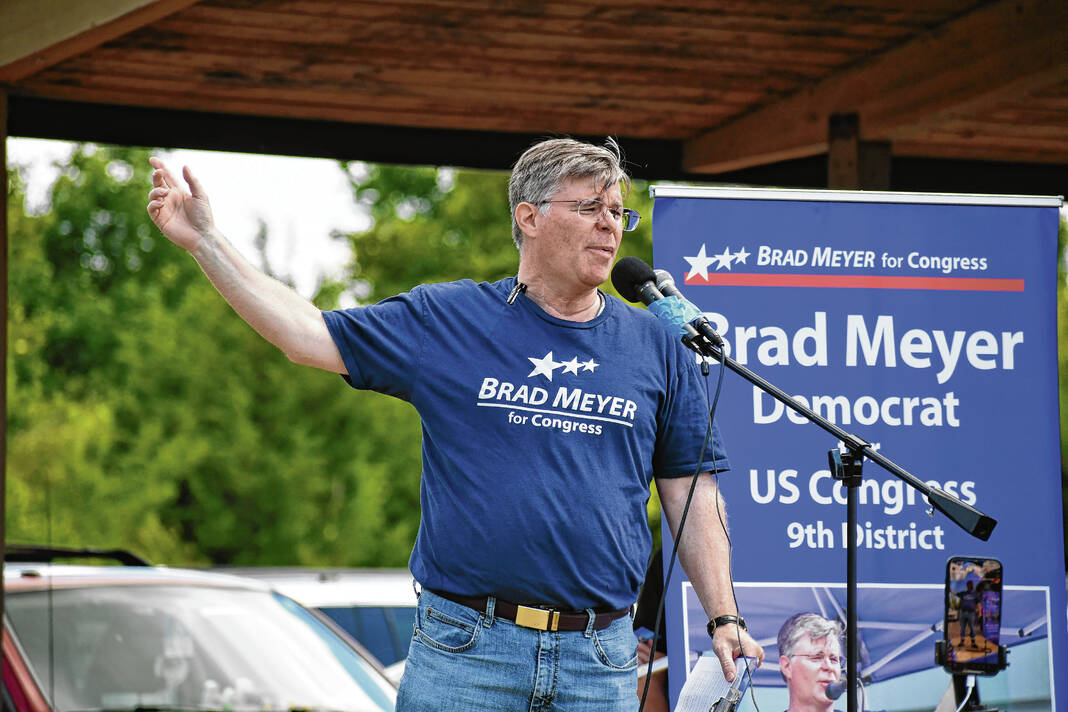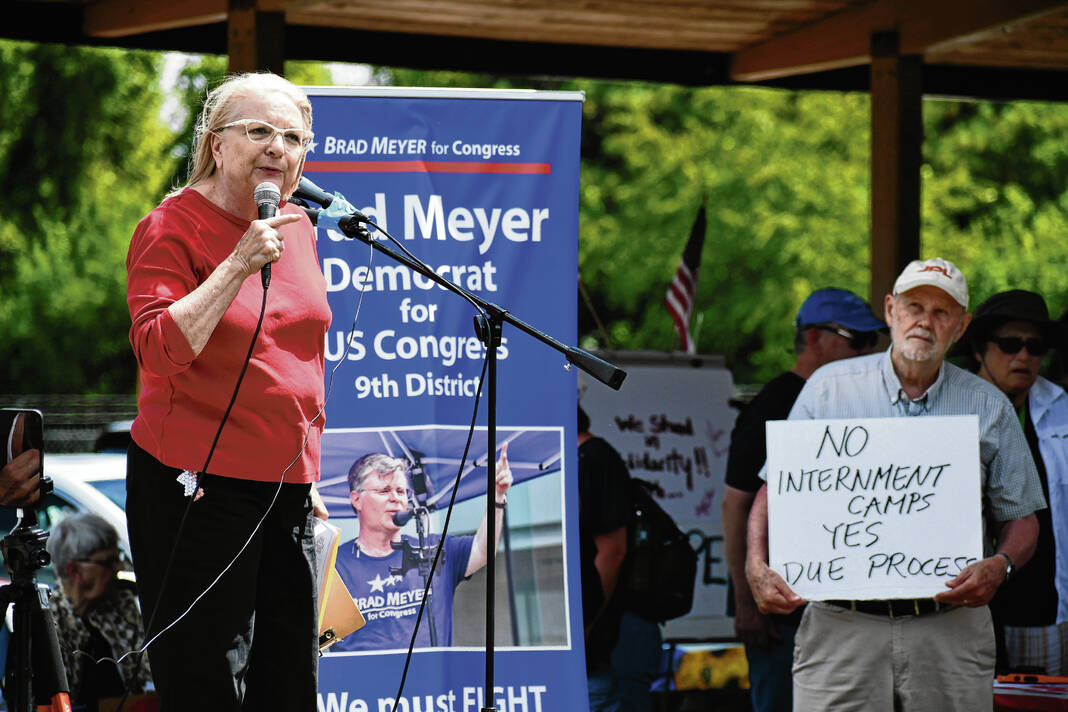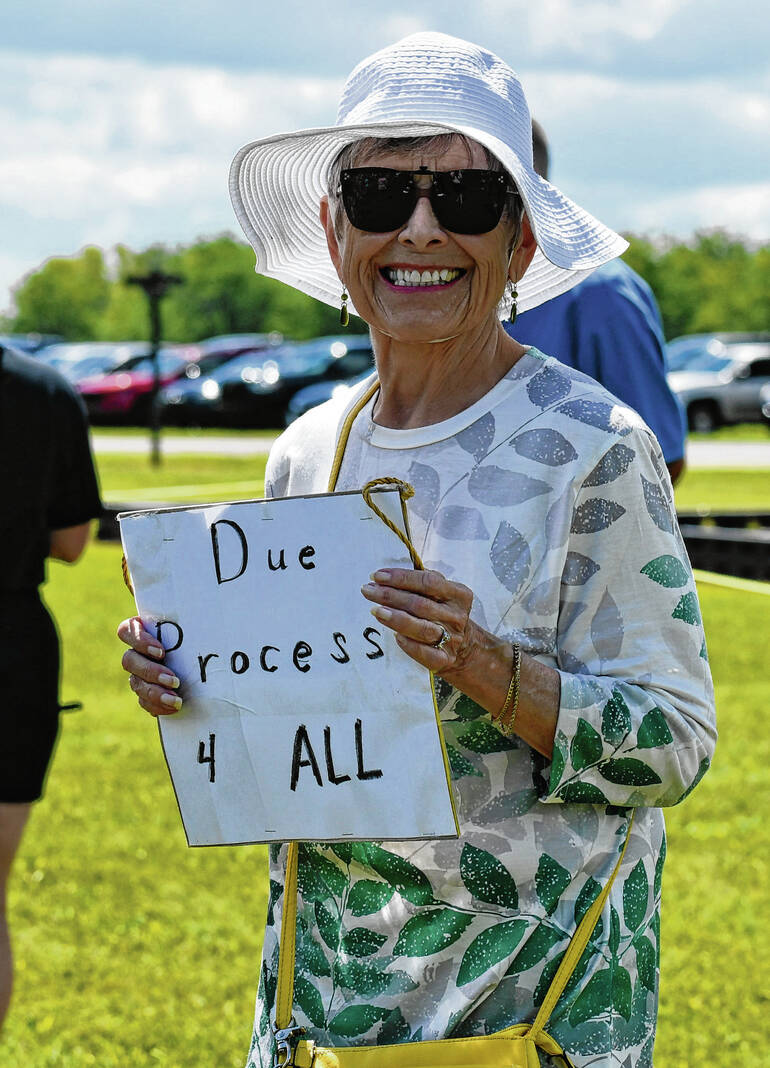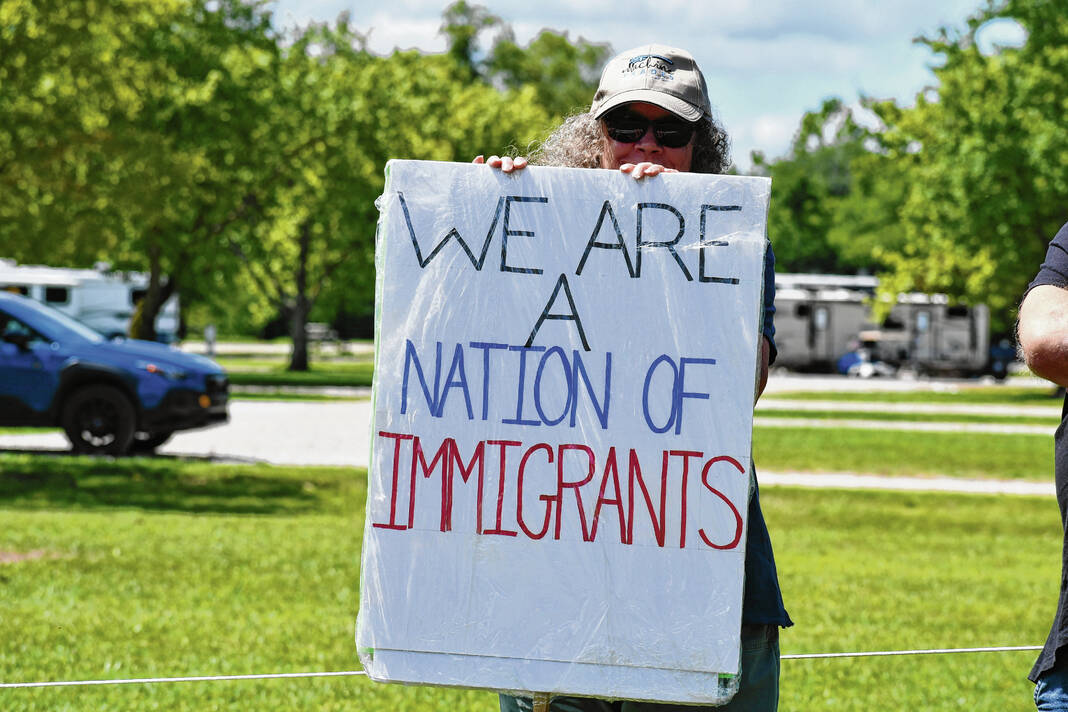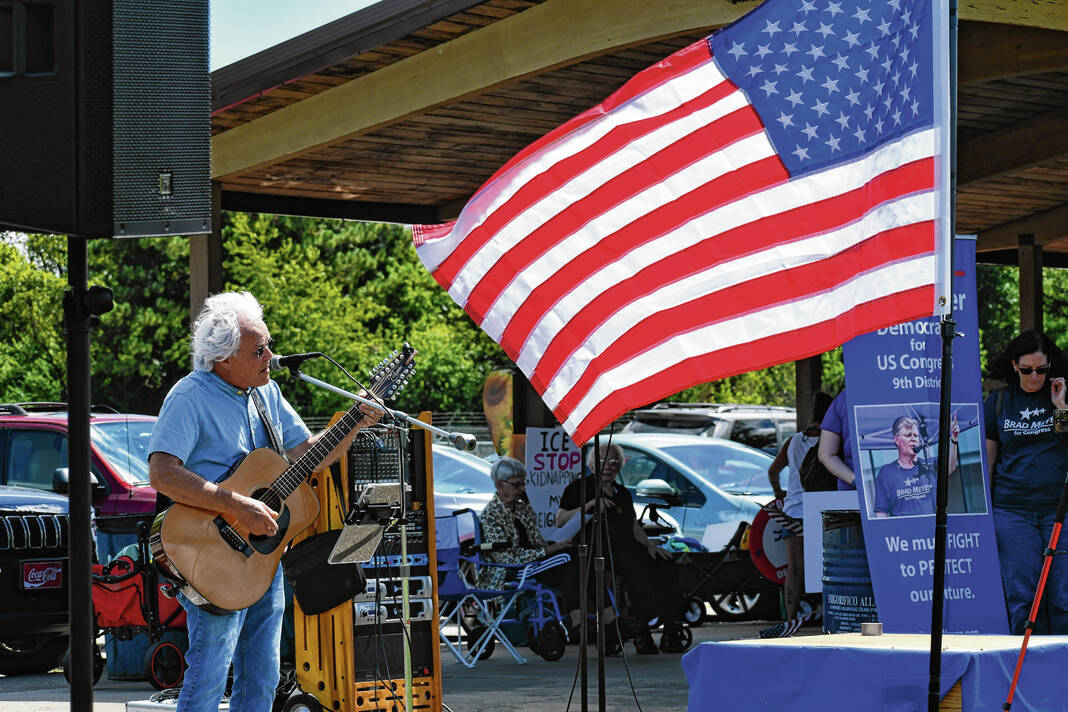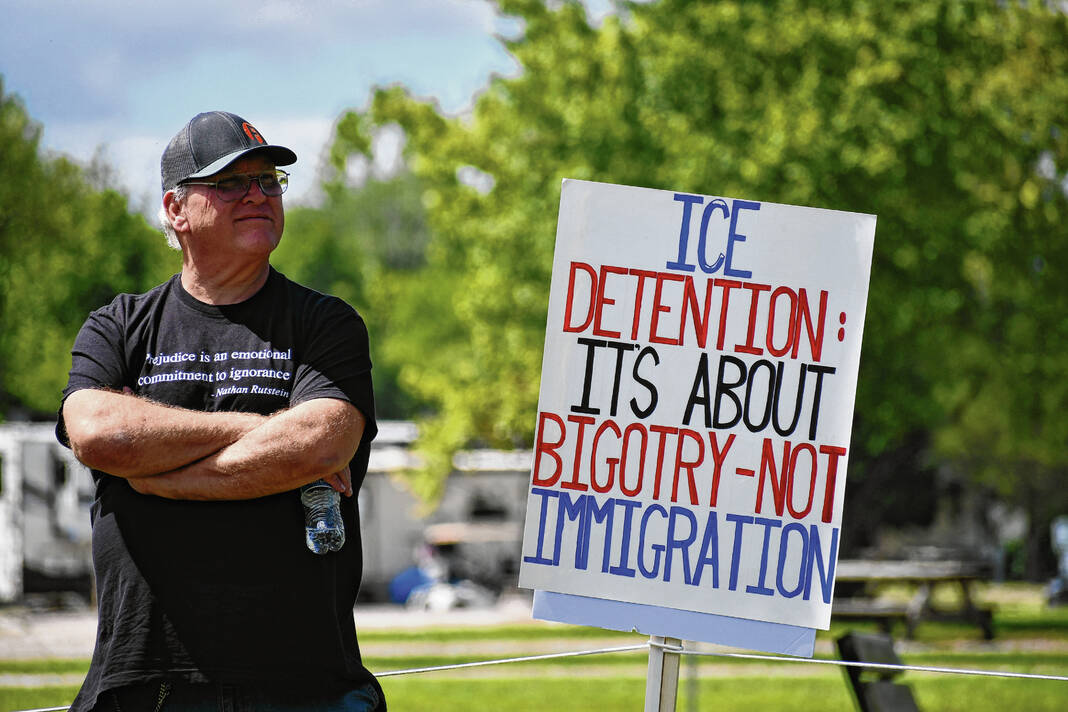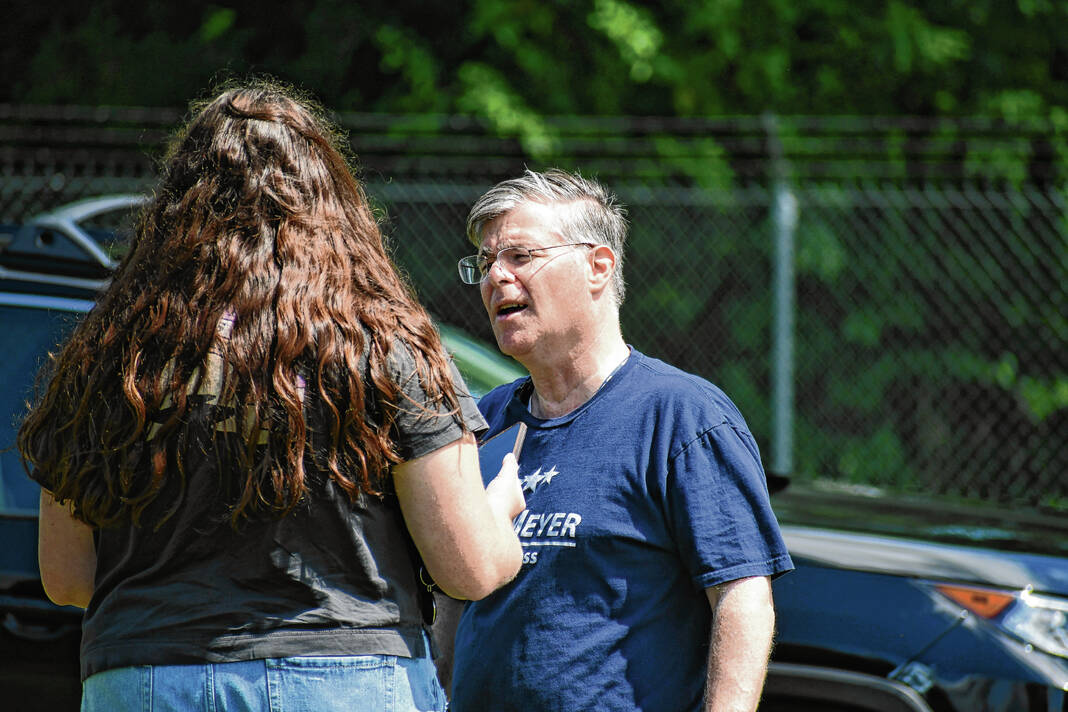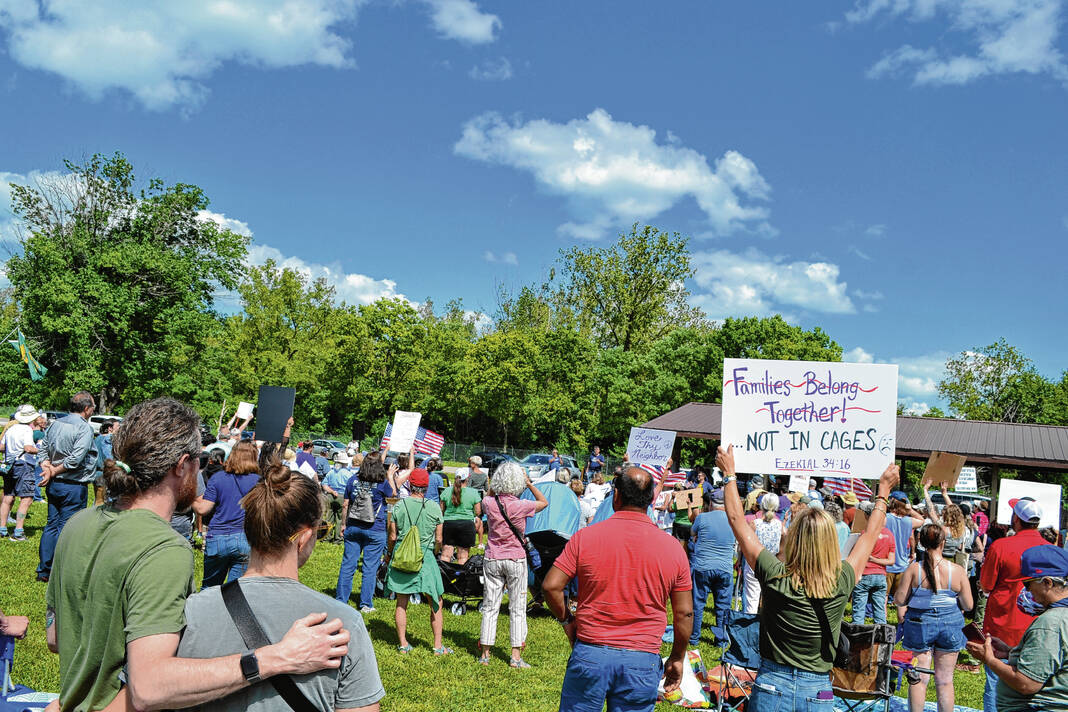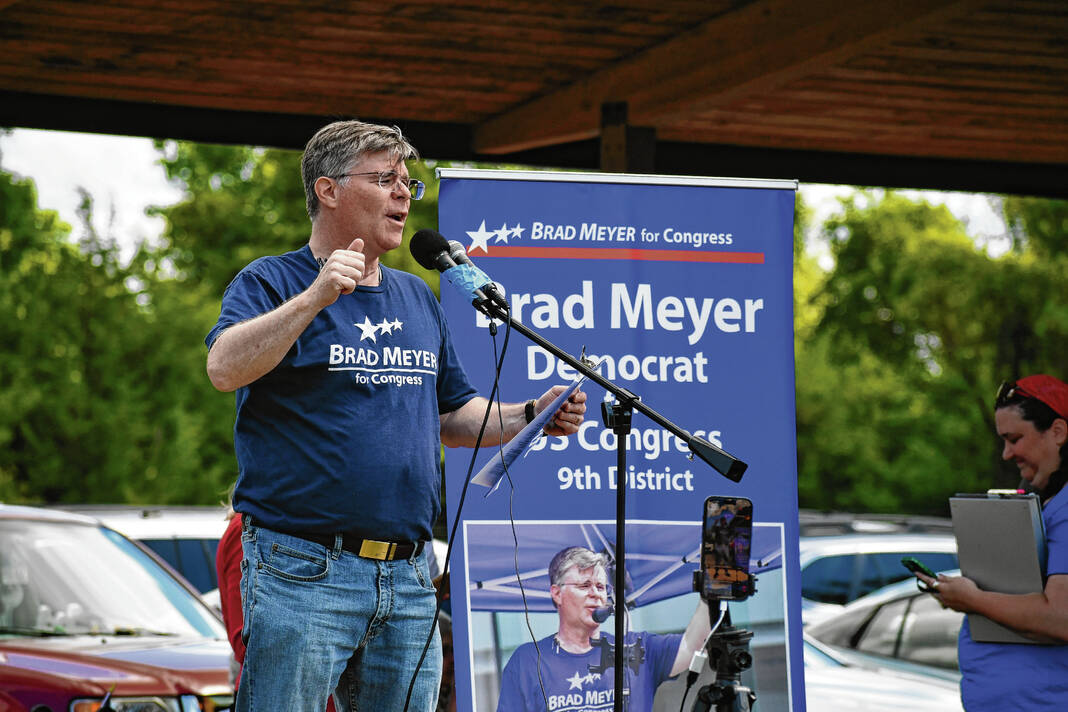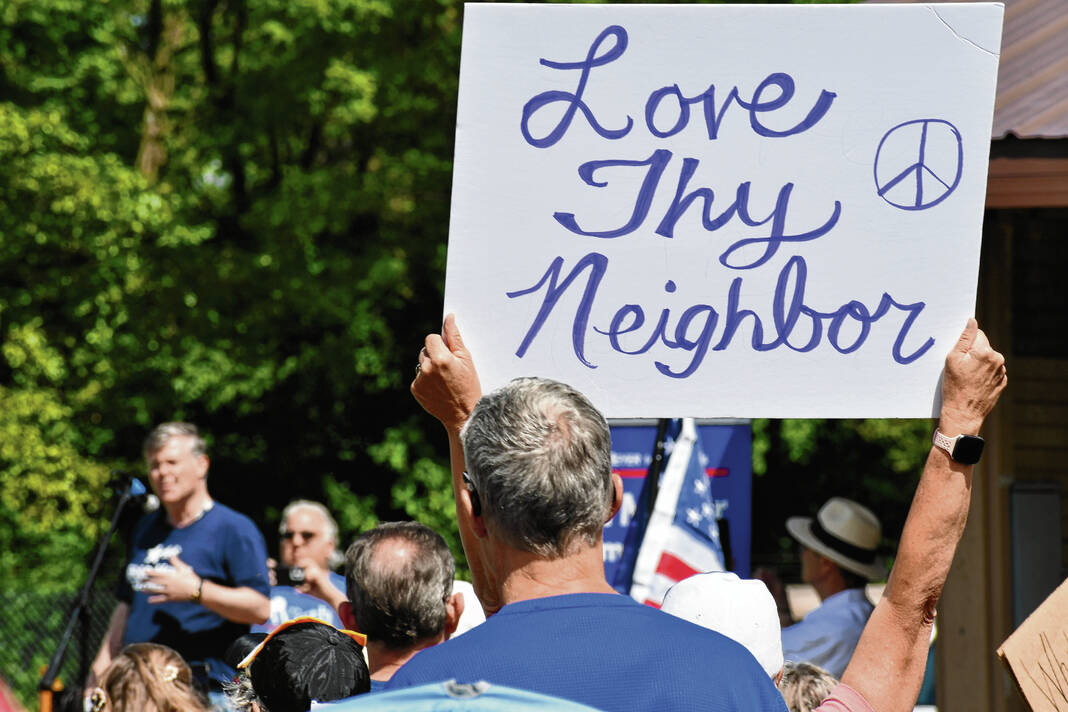
A person hoists a sign saying “love thy neighbor” as Brad Meyer, Democratic candidate for Congress in District 9, speaks to the crowd during the protest against ICE at Johnson County Park on Sunday.
Leeann Doerflein | Daily Journal
By Erika Malone | Daily Journal
emalone@dailyjournal.net
For The Republic
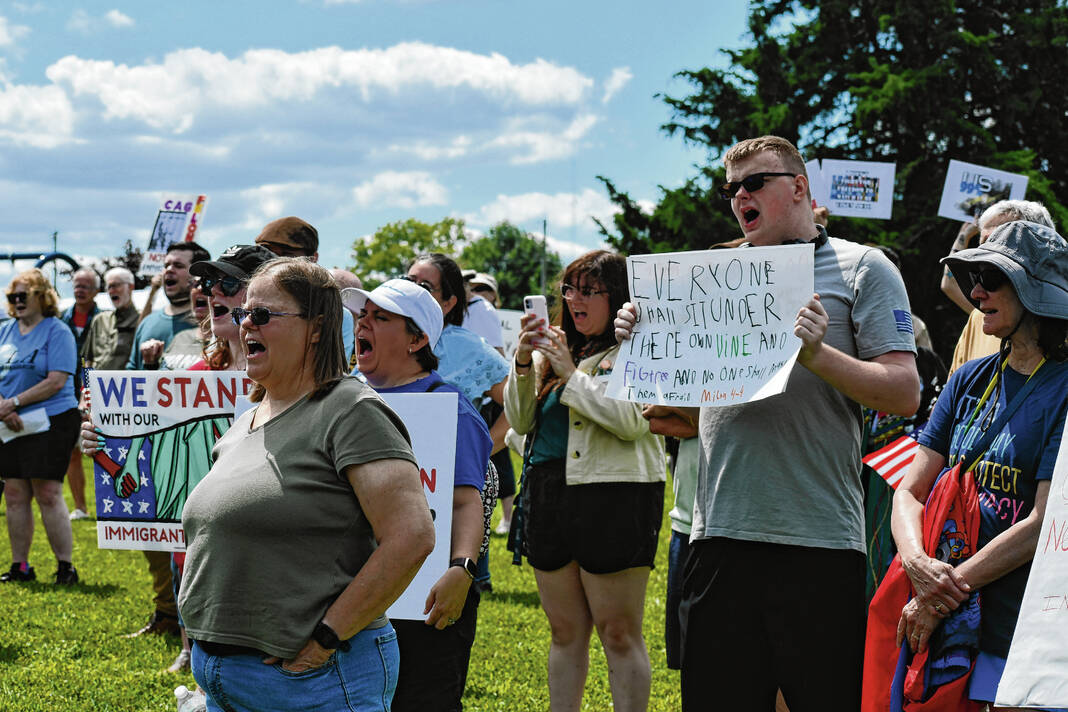
CAMP ATTERBURY — Cries of “We say justice, we say peace, no more ICE in our streets,” and “Say it loud, say it clear, immigrants are welcomed here,” rang out through the Johnson County Park on Sunday.
More than 200 people gathered at the park that afternoon to protest the potential use of Camp Atterbury as an illegal immigrant detention center to be operated by the U.S. Department of Homeland Security and Immigration and Customs Enforcement, or ICE. A July 15 letter revealed that Camp Atterbury, along with Joint Base McGuire-Dix Lakehurst in New Jersey, has been preliminarily certified as sites that could house immigrant detainees.
Officials at Camp Atterbury say they don’t know when an ICE detention center will open in Johnson County, but Hoosiers are concerned the camp could be the next Alligator Alcatraz.
9th District Congressional candidate Brad Meyer, a Democrat of the Bloomington area, led the protest to “build connections and unity inside and outside the party to apply effective pressure on people to change policies,” he said.
No portion of Camp Atterbury or Johnson County is in the 9th District, but Meyer said he coordinated with Democrats in the district and notified officials from Camp Atterbury and the Johnson County Sheriff’s Office. Meyer recognized Johnson County Sheriff Duane Burgess, a Republican, for his civil behavior amid the lack of civility displayed in politics today.
“The first words out of their mouth was, ‘that is your constitutional right and they’ve been good to work with,” he said. “This is a national issue, not just a local issue. What I’m protesting against is the ICE immigration policy.”
Candidates, advocates speak out
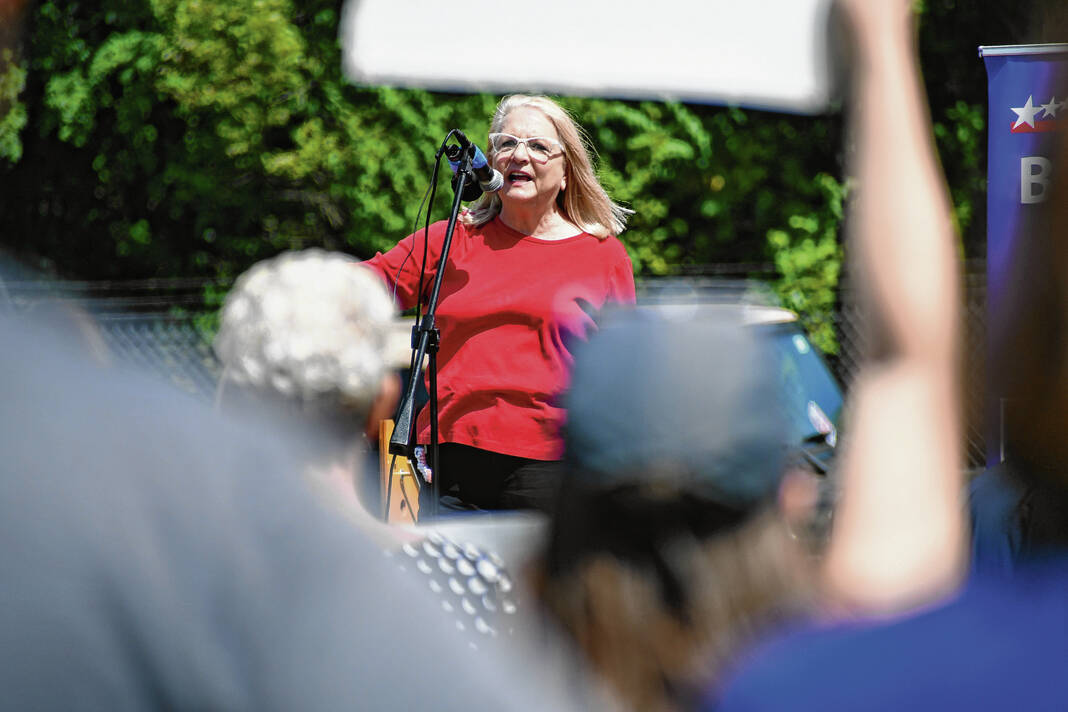
Trish Whitcomb, a former Democratic candidate for Indiana House District 69, introduced speakers throughout the protest, highlighting the economic and moral implications of detention centers. Other advocates shared personal stories of immigrants affected by other detention centers in the U.S., calling for compassion, action and solidarity.
During Meyer’s speech, he said there is a problem with a “MAGA” ICE policy that does not respect “our rights.”
“The rights that are supposed to protect immigrants also protect me, you and everyone,” he said. “It is the rights of all people — white, Black, brown, Asian, straight, LGBTQ — all of those rights apply to all of us and if we stand idle and allow the government to start separating and isolating some people and stripping their rights we will fall as well.”
He called on everyday people and those in power to stand up for democracy and the rights given to everyone in the United States by the Constitution —not just citizens.
“What we’re seeing in the federal government is they are pulling us from democracy to autocracy and using brutality to separate us, we must stand up,” he said. “If we don’t stand up for our democracy, we’re going to have to kneel to dictators in the future. Are you gonna knee; for a dictator?”
Michelle Higgs, founder of the Indiana Rural Summit and Democrat candidate for Indiana House District 60, spoke about the decision to raise ICE’s budget by 265% to $170 billion.
“That decision came at the expense of health care, housing and food security,” she said. “They funnel taxpayer dollars into government contracts for prisons and detention centers benefiting billionaire donors while our neighbors are detained without due process.”
Higgs said public schools are also being affected by this, in addition to the hits they’ve taken as the state continues to expand vouchers.
“Indiana deserves leaders who invest in health care, in schools and local economies, not in fear, detention and corporate profit,” she said. “A nation founded on the belief of life, liberty and the pursuit of happiness, turning Camp Atterbury once the starting point for our Afghan allies is being turned into a nightmare that betrays who we aspire to be as a nation.”
Higgs ended her speech leading a chant in belief of the national motto “E Pluribus Unum,” which means “Out of many, one.”
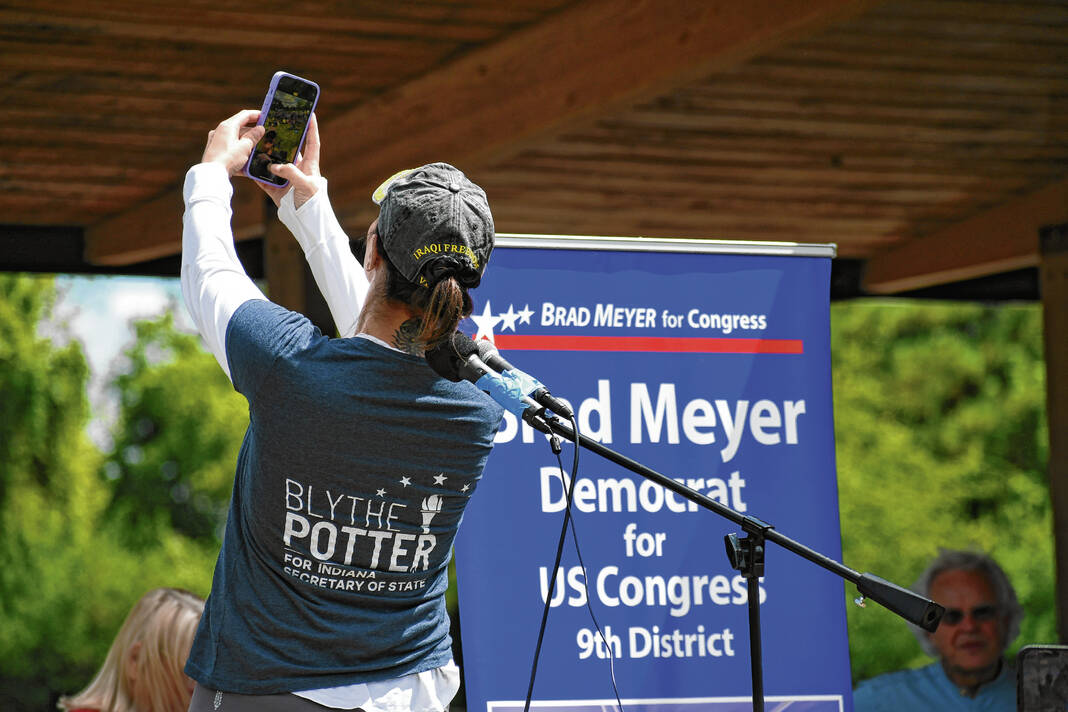
Blythe Potter, former military police with the Indiana National Guard Reserves and a Democrat running for Secretary of State, spoke about how those currently serving in the military are in a conflicting position.
“It’s horrible to see my fellow sisters and brothers in arms being told that they are going to be federalized and taking our immigrant neighbors who pick our food, grow our food, repair our homes, our streets and locking them up in places that already have a terrible history. This is total garbage, and this is not due process,” she said.
Potter, of Bargersville, said she is unsure of what rights officers or commanders of the National Guard have to “say no,” but said their position is very conflicting.
“Having taken that oath, but also knowing what it’s like to get an order is very conflicting,” she said. “We need our leaders in the military, our national guard, people regardless of their rank to start using their voices and I know saying that would likely risk a lot for them, perhaps even their lives.”
Gabe Walters, co-founder of Rise Up Columbus, an activist group that fights against the current administration’s actions towards minorities, spoke about conditions of other detention centers and the political theory called the Overton Window.
Noting conditions of the detention center built in eight days in the Florida Everglades, also coined “Alligator Alcatraz,” Walters questioned if living conditions would be any different. The detention center has since been ordered to shut down.
“What we have seen as a result is unsanitary living conditions, medical emergencies and a lack of proper space for people in these centers to meet with lawyers,” he said. “We have seen the state representatives be denied entry due to unsafe conditions while they simultaneously still house those detained. Why should we think the conditions at Camp Atterbury will be any different?”
To understand what is potentially at stake, Walters mentioned the Overton Window theory that describes a range of ideas that are considered acceptable in public discourse. He said at any given time ideas can shift and what once seemed unthinkable can, overtime, become normalized.
“That’s how the Overton Window moves, not by waiting for permission, but by demanding something better,” he said. “Let this be our stand not just for Camp Atterbury, but for every place where a wall threatens to go up instead of a welcome mat. History is watching, the next generation is watching and we’re not here to push back, we’re here to shape the future.”
Cinde Wirth, Democratic congressional candidate for Indiana’s 6th District, spoke about the economic impact statewide and how the expense of building a detention center will fall on taxpayers.
The Florida detention center cost taxpayers over $450 million. Wirth said Hoosiers could see the same at Camp Atterbury and listed various education, housing and employment opportunities that could be funded with this money.
“We have so many other neat, valuable and needed things that we could spend this $450 million on, besides terrorizing people, abusing them and committing human rights violations,” she said.
Ethan Sweetland-May, a candidate for Indiana State Senate District 47, told the parable of the Good Samaritan and criticized the question “Who is my neighbor?”
“You know who you’re about to exclude from the question,” he said. “Who is my neighbor is wrong and it’s somebody that Jesus looks at and says, that is your neighbor.”
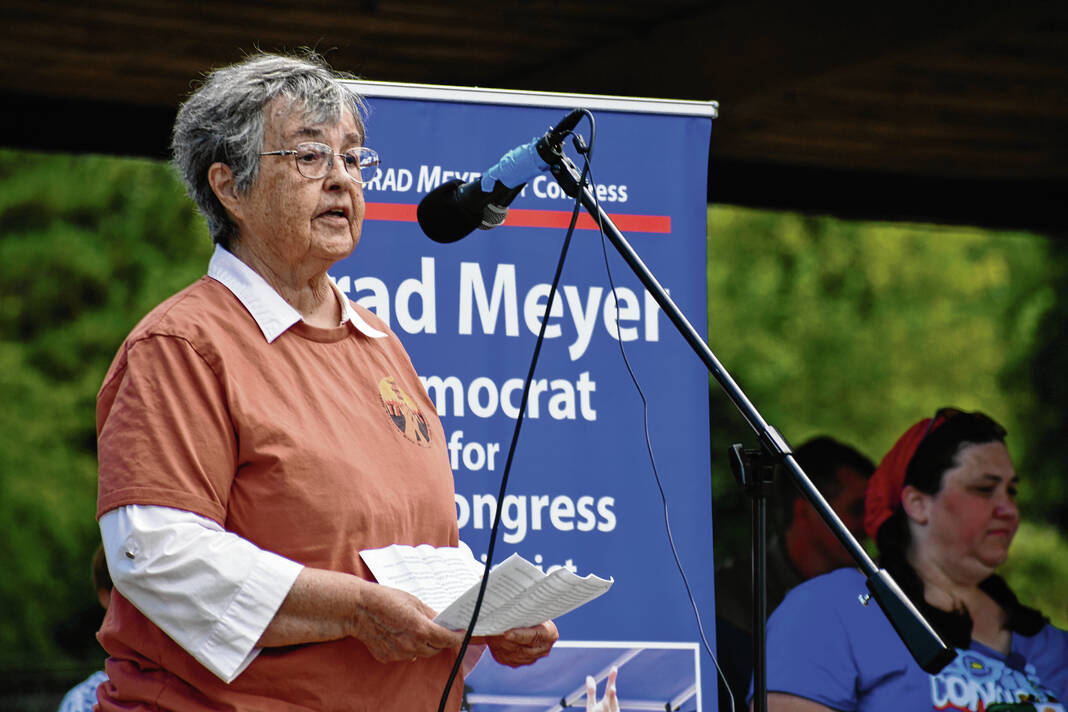
Sister Noella of St. Francis from Oldenburg shared the stories of ICE detainees she visits weekly at the Clay County Jail in Brazil.
One of many stories she told included a man named Oscar, his pregnant wife and their 18-month-old daughter. She said Oscar worked hard, paid taxes and was anticipating the birth of his daughter, but was deported before she was born.
“I say ‘yes’ to showing (the Trump administration) these immigrant sisters and brothers that many of us do care about them,” she said. “They are not alone and they are not forgotten.”
Meyer concluded the speeches, asking those to get involved in local politics, calling Democracy a “team sport.”
Voices from the crowd
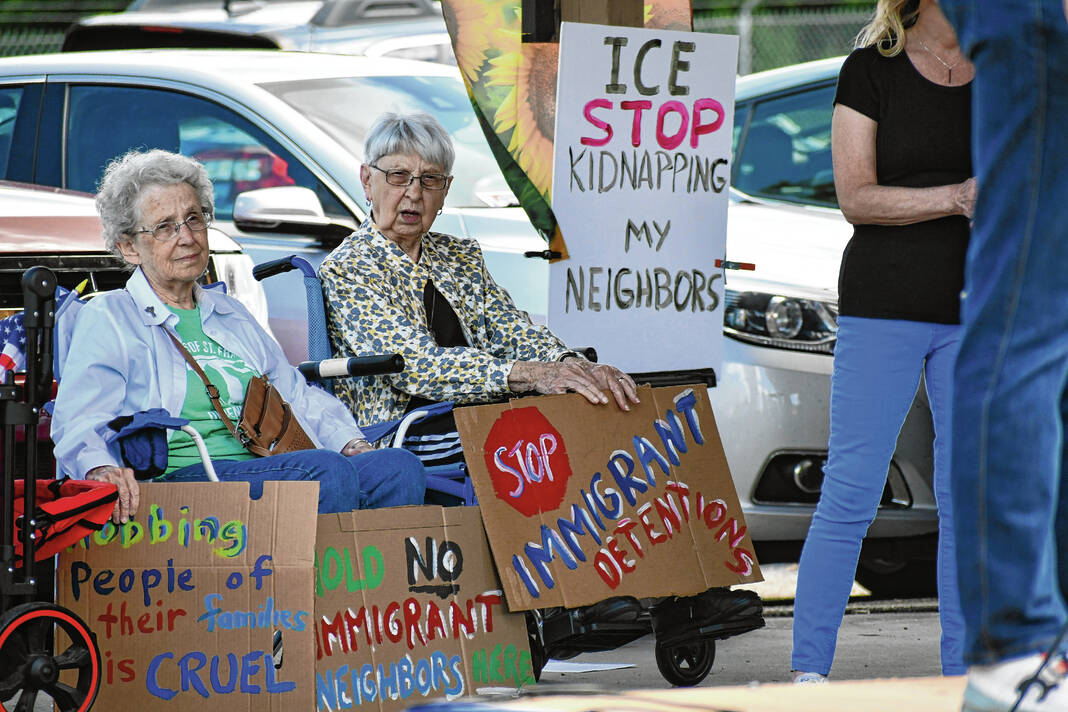
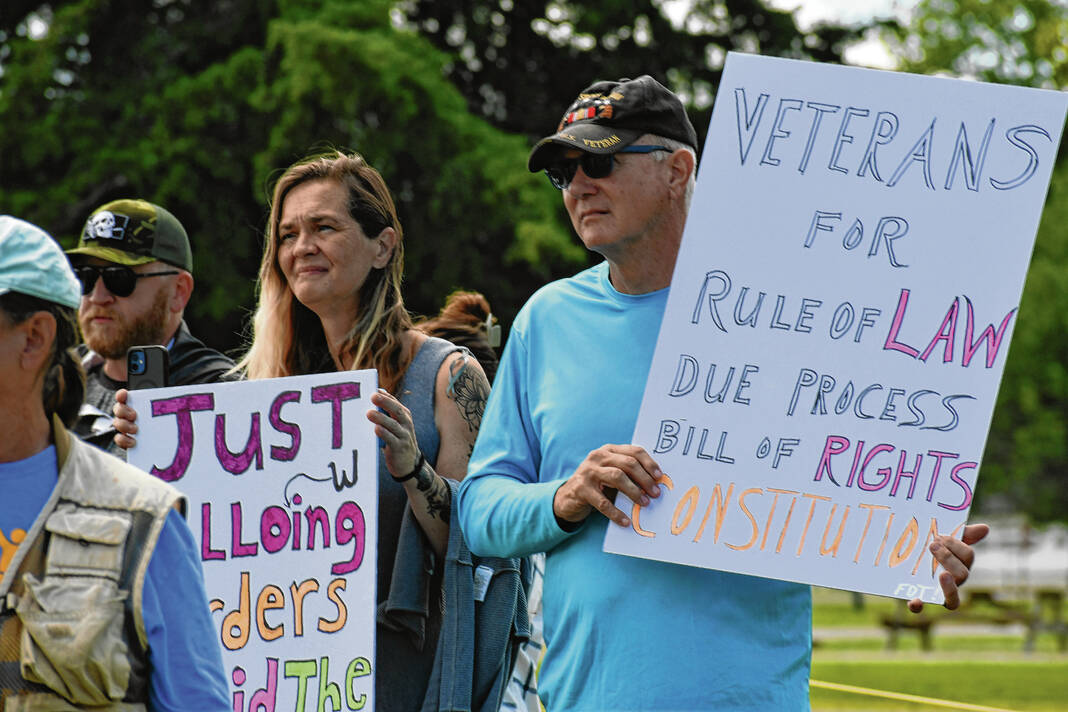
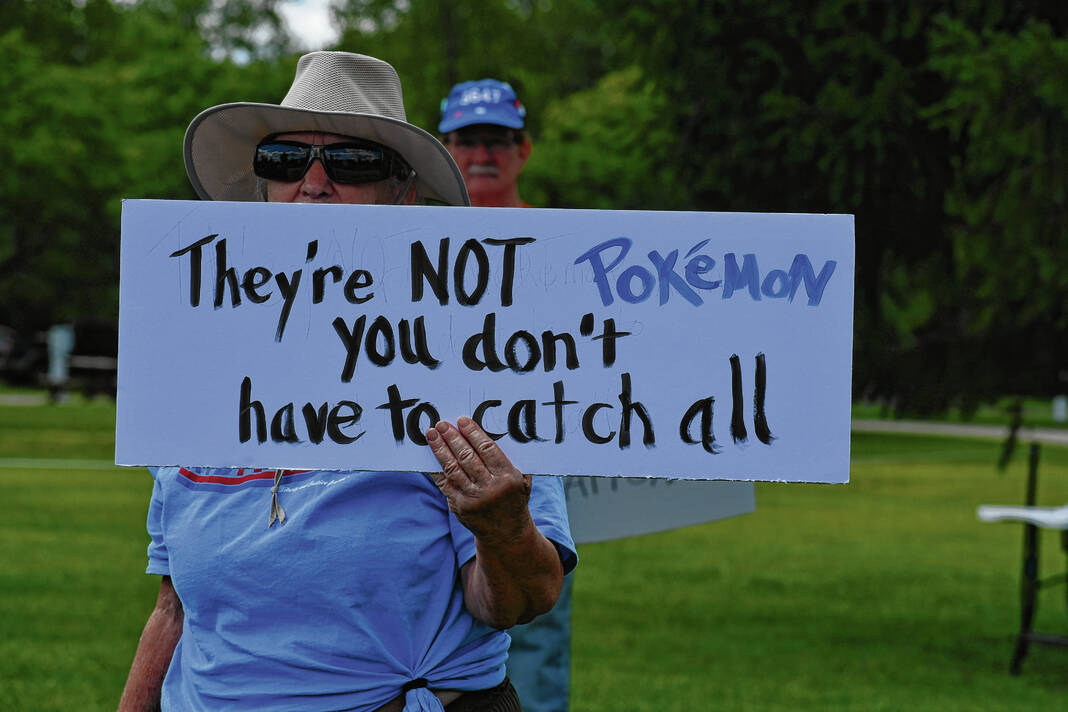
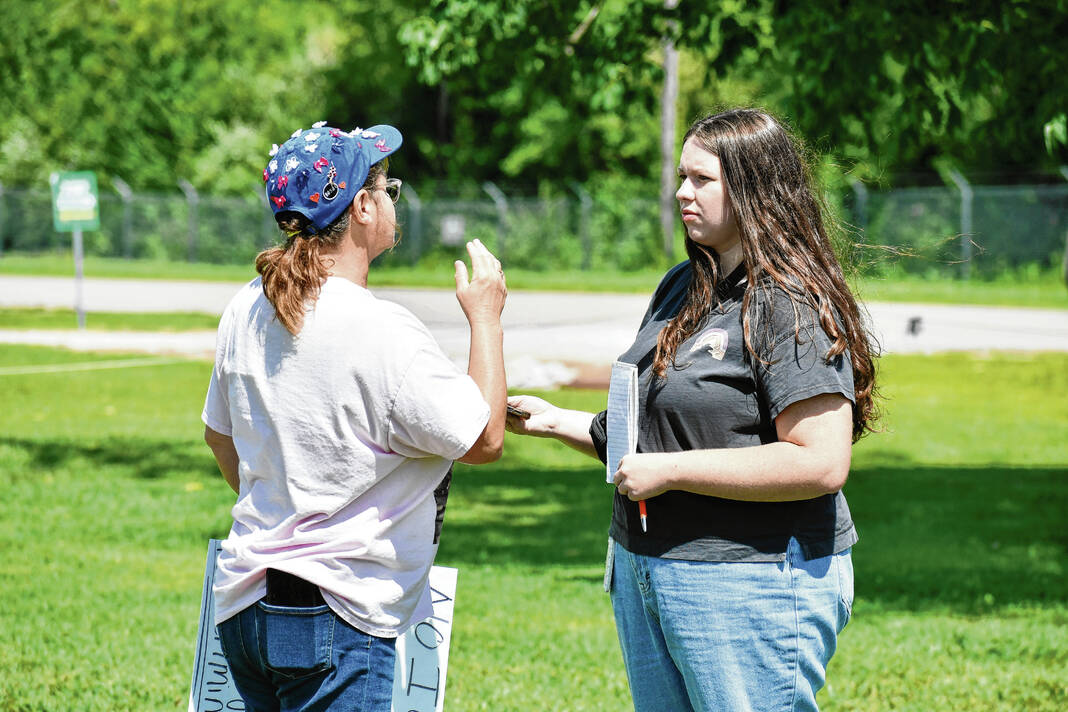
Concerned citizens gathered from all over the state to ensure their voice was heard, from activists to church groups speaking out against ICE and its possible use of Camp Atterbury. People of all ages, from senior citizens to 20-somethings, turned out for the protest, along with children and dogs who came along for the ride.
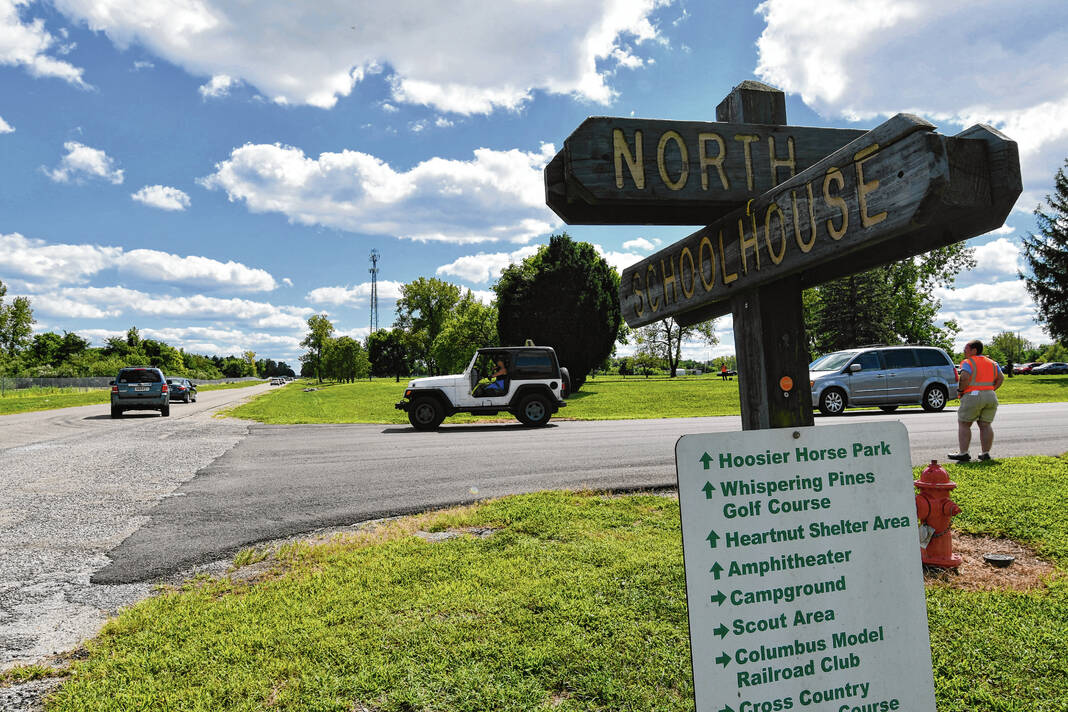
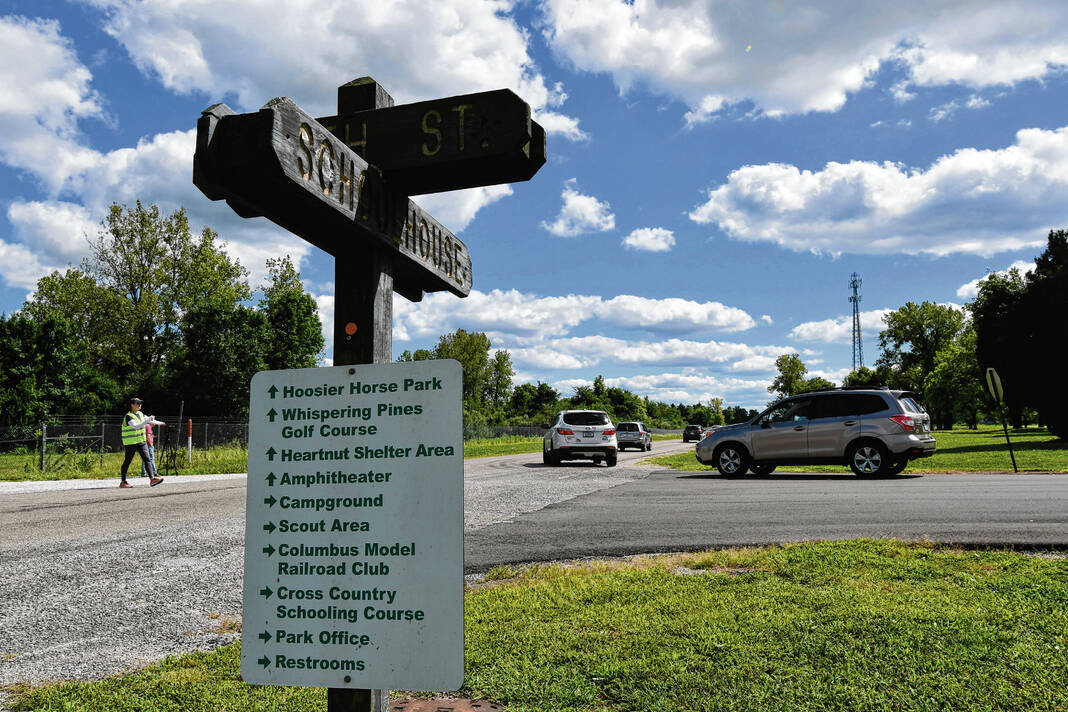
The group was energetic and passionate, but peaceful. Protesters followed the rules set out by the sheriff’s office and county park and kept the protest inside the roped-off area surrounding the large shelterhouse on Schoolhouse Road. The crowd listened to remarks and chanted along with the call and response, then a smaller group of the protesters took their advocacy mobile.
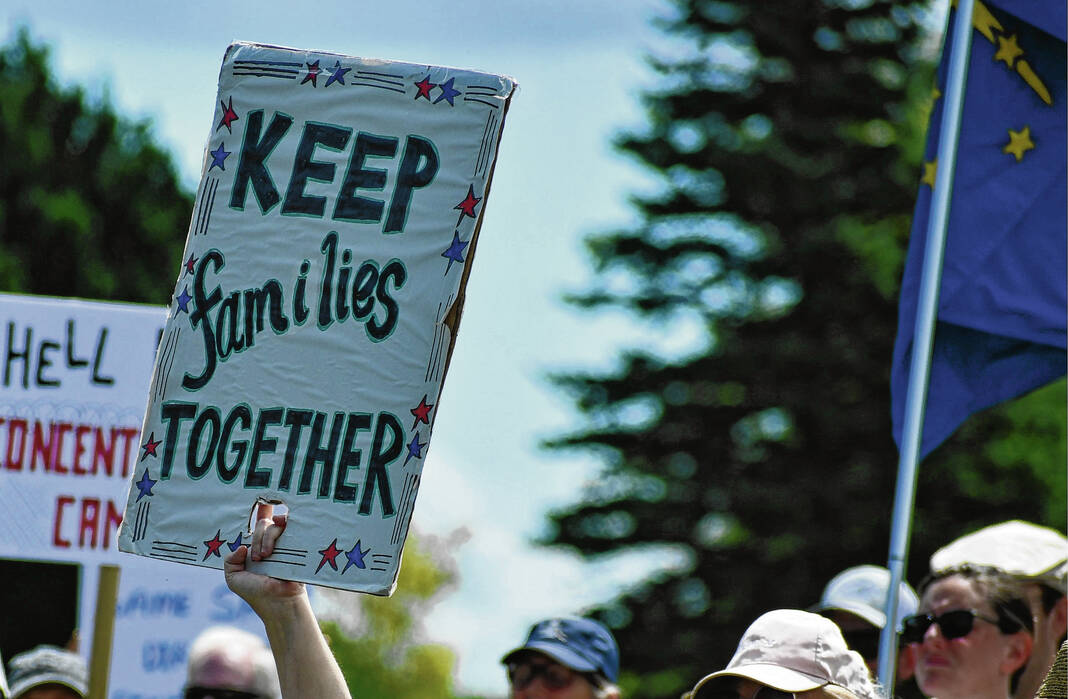
Dozens of cars joined the “mobile protest” where they formed a procession like “a funeral for our democracy” and rolled past Camp Atterbury, honking, waving flags and hoisting protest signs.
Gigi Shook and Vicki Heidenreich from Tapestry Church, located in Bargersville, said they got involved as Christians called to welcome and love everyone, they said.
“That’s been the glory of the United States, that a rich history of different groups coming for different reasons and we’re shutting the door on our history,” Shook said.
Cynthia Stephen, an activist from Jamestown, has traveled to Indiana, Kentucky and Washington, D.C., protesting the ICE immigration policy, saying “we are all immigrants”.
Jo Korycinski of Madison County and Allyson Broadstreet of Hamilton County said they enjoyed the protest and are riled up in “a good way.”
For Broadstreet, this was her first protest and she remembers going to Girl Scout Camp at Camp Atterbury.
“To put it bluntly, it’s disgusting and it hurts,” she said. “It very much matters to me the treatment of humans and seeing how humans are being treated in the present day is heartbreaking and sickening.”
As younger generations watch history unfold, it is important for them to get involved, Korycinski and Broadstreet said.
“If you’re not wanting to go to a protest alone, find a friend,” Broadstreet said. “Protests can be a cathartic experience and absolutely powerful moments to have our voices be heard in a way that is not being heard by our representatives.”