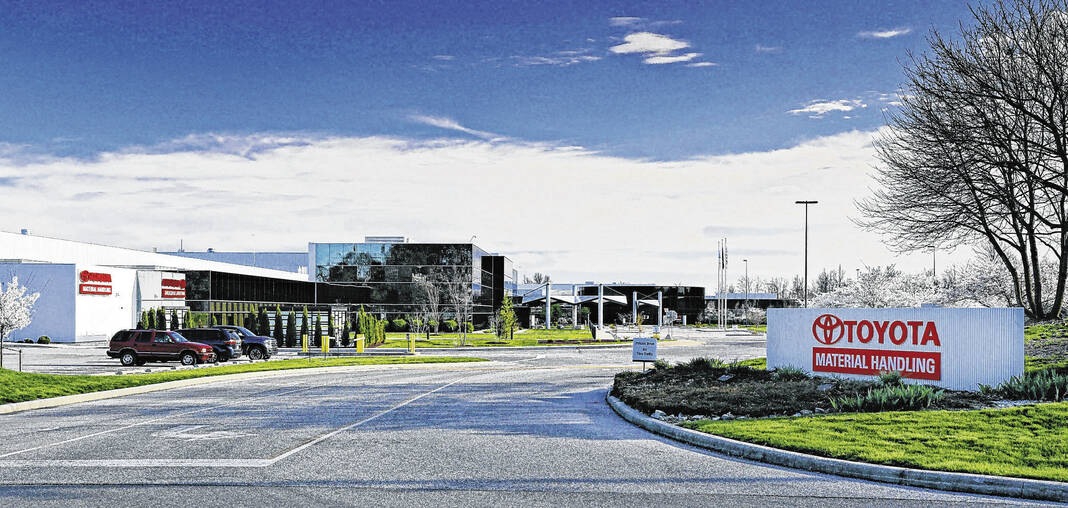
Photo provided The Toyota Material Handling entrance is shown.
SAN FRANCISCO — A federal judge has delayed a case management conference in a proposed class-action lawsuit over allegations of emissions cheating in several forklift engines to allow Toyota Material Handling and other Toyota-affiliated companies to continue settlement talks.
The lawsuit, made public in September, was initially filed in U.S. District Court in San Francisco by forklift buyers in California, New Jersey and New York. The list of plaintiffs had grown to 22 businesses in 17 states as of February, according to court filings.
Toyota Motor Corp., Toyota Industries Corp. (TICO) and Toyota Material Handling North America and Toyota Material Handling Inc. are named as defendants. TICO is an affiliate of Toyota Motor Corp. and the parent company of Columbus-based Toyota Material Handling North America.
U.S. District Judge Jacqueline Scott Corley recently vacated a Sept. 3 case management conference “in light of the parties’ mediation efforts” and has ordered them to provide a status statement by Oct. 10.
The judge’s decision came after the parties asked for the delay “to allow time for the mediation to proceed, and to provide a further report to the court regarding the status of settlement discussions within 45 days,” according to court records.
The parties had previously agreed to hold a mediation session on Aug. 27 before mediator Layn R. Phillips of California, a former U.S. judge. Phillips served as mediator in a proposed $765 million settlement of thousands of concussion-related claims brought by former NFL players about a decade ago.
Earlier this year, the Toyota defendants argued in a court filing that the lawsuit should be dismissed because, among other reasons, the plaintiffs lack standing to bring the claims and failed to state a claim. The companies also have denied the allegations in the lawsuit.
An amended complaint filed in December alleges that TICO and the other Toyota-affiliated defendants “manipulated and falsified” engine tests and emissions test data for forklifts sold in the United States and misled customers to believe the forklifts met U.S. emissions standards.
The lawsuit cites a January 2024 report from Toyota in which the Japanese automotive giant details findings from an internal probe by a “special investigation committee” into irregularities in emissions data for forklift engines.
Reuters reported that the report found that the company’s employees sometimes were falsifying emissions results, manipulating software and switching out engines during emissions testing, which allowed forklifts to perform better than they otherwise would.
Currently, it is unclear the extent to which local employees were involved with the misconduct detailed in the report, if at all, as the report largely focuses on events that transpired in Japan.
However, the lawsuit alleges that “the investigations leading to Toyota’s admissions of misconduct in Japan originated in the United States,” and claims that TICO received an inquiry from U.S. environmental regulators in 2020 with questions over testing data submitted for its engines and forklifts.
In April 2021, TICO announced that it was suspending shipments of forklift shipments made in the United States by Toyota Material Handling due to “delays in obtaining U.S. engine emissions certification,” the complaint alleges.
A few months later, Toyota Material Handling announced that it was “voluntarily suspending production and sales” of certain diesel forklift models as company officials worked to “confirm the compliance of these products with EPA standards,” according to the amended complaint.
“The misconduct first surfaced in the United States, not Japan, based on U.S. regulators’ investigations into misconduct that affected vehicles sold in the U.S. market,” the lawsuit alleges. “…The U.S. investigation is still underway several years later, and soon after it began, Toyota was forced to issue two different forklift stop sales in (the) U.S.”
The Toyota defendants, for their part, have denied the allegations in the lawsuit, emphasizing that the special investigation committee “was convened to audit TICO’s internal processes and issue a report relating to compliance with Japanese emissions standards,” not U.S. emissions rules.
“Although the (special investigation committee) report relates to compliance with testing of engines for compliance with Japanese emissions standards, plaintiffs content that Japanese and U.S. emissions standards are similar and, therefore, the alleged misconduct highlighted in the (special investigation committee) report is equally applicable to engines certified to be sold in the U.S. and demonstrates a failure to comply with U.S. emissions standards. …The (amended complaint), however, contains no facts demonstrating that any (U.S.) regulatory agency has taken final action against defendants,” the Toyota defendants state in their motion to dismiss.
It is currently unclear if any of the forklift engines named in the lawsuit were ever made in Columbus. Some of the model years of the engines date back more than a decade.
In a statement to The Republic in September, Toyota Material Handling North America said it was aware of the lawsuit but did not say if any of the engines were ever made locally.
“Toyota Material Handling’s mission is to build the industry’s best products for the benefit of our customers,” said company spokesman Justin Albers. “We are aware of the filing and will respond to the allegations in the proper legal forum. Importantly, the January 2024 announcement by our parent company, TICO, and the special investigation committee report referenced in the lawsuit have no impact on TMH’s current manufacturing and distribution of its new products in the U.S.”
Claims made in filing a lawsuit represent only one side of the case and may be contested in later court action.