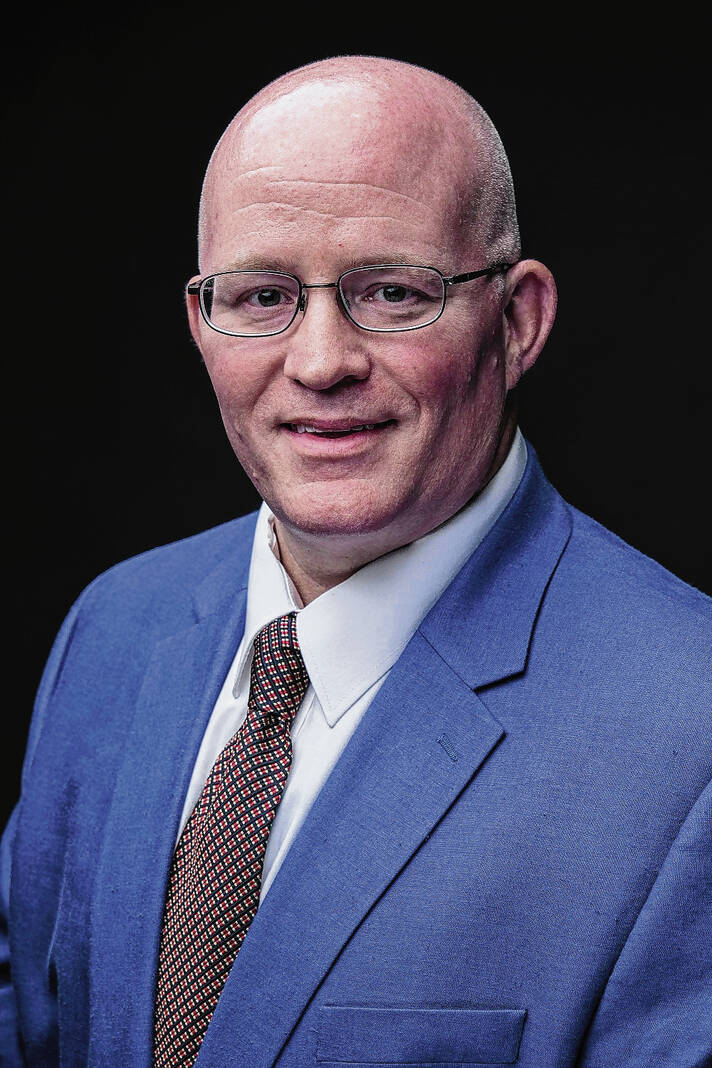
Tony London
A Republican Bartholomew County commissioner called on a Bartholomew Consolidated School Board member to resign from his position within the local GOP and apologize after he and two colleagues made murky and unfounded assertions about “a back room deal” involving the commissioner’s company, the local teacher’s union and two other school board members.
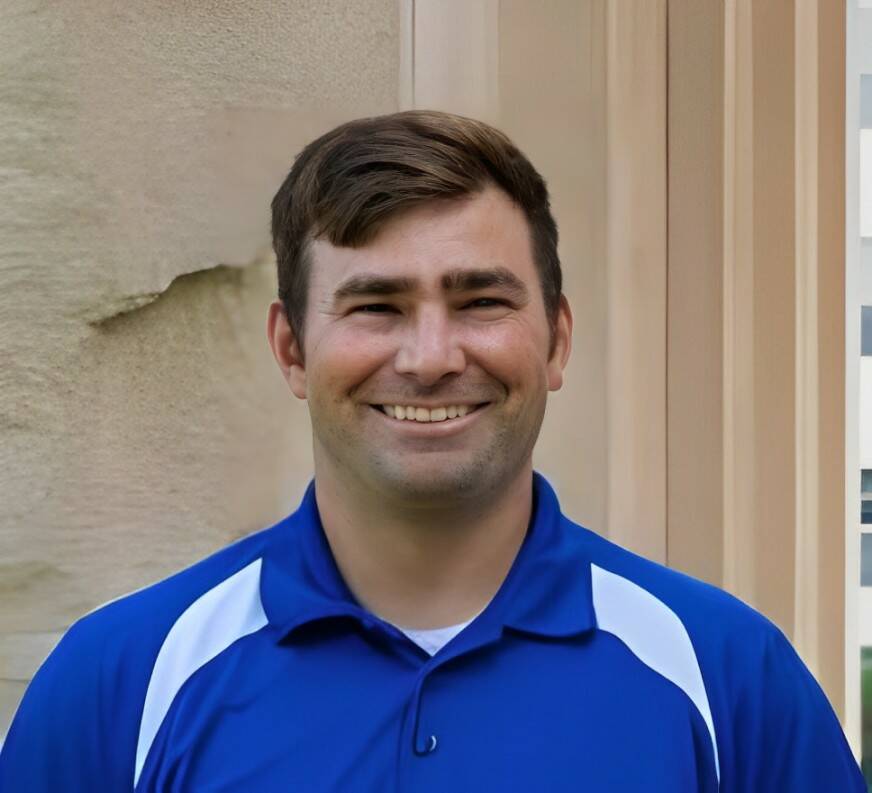
Bartholomew County Commissioner Tony London, R-District 3, asked for Jason Major, District 1, to resign as secretary from the Bartholomew County GOP and apologize during the public comment portion of Monday’s school board meeting. Major said he had no plans of resigning or apologizing.
Three board members, Major, Tom Glick, District 5, and Logan Schulz, District 6— implied in an earlier work session that School Board President Nikki Wheeldon, District 7, and Whittney Loyd, District 3, were involved in the appearance of a “quid pro quo,” or some type of impropriety, although they steered away from explicitly making a specific accusation and instead couched it in a series of hypotheticals.
It’s the latest in the increasingly fractured dynamic on the school board, where meetings often turn into political jousting matches, at the behest of Major and Schulz in particular, and an environment of “us versus them.”
The divisive nature of the school board has continued on, even as the district has distinguished itself through increasing student achievement reflected by improvements in IREAD scores and graduation rates.
London said he “was, and still am, beyond offended by the blatantly defamatory comments made by some members of this board. It was classless, irresponsible, potentially destructive and most of all, just wrong.”
“Some of you attempted to use me, my wife, and my business as a pawn in your attempt to further your own agenda, and you didn’t seem to care where the chips fell,” he said at Monday night’s board meeting. “Fortunately for me, no one with half a brain believed your nonsense.”
“To those of you who already reached out to apologize, thank you. For the rest of you, my advice is this: if you have an idea you would like implemented by this board, but you don’t have the support you need, don’t lash out at those who disagree with you. Try having better ideas,” London said.
That dynamic between school board members intensified since the board voted to add just W.D. Richard and Mt. Healthy elementary schools at this time to a federal program that provides free meals at no costs to students in the Community Eligibility Provision (CEP). Major, Schulz and Glick pushed for the CEP to be extended to all elementary schools, which would cost anywhere between an estimated $781,053.88 and $955,893.30 annually.
All of this is against a backdrop where legislative changes for how public schools are funded will see the BCSC’s annual budget go down in 2026 resulting in the district being forced to restrict costs.
The matter is a continuation of a conversation that began during the school board meeting on Aug. 11 and escalated during a work session on Aug. 25 as the group works through policy approvals.
Major, Schulz and Glick’s allegations stem from Wheeldon and Loyd receiving contributions during their 2024 campaigns from the Indiana Political Action Committee for Education (I-PACE).
I-PACE has representation from a number of teacher unions across districts in the state, and a member of the Columbus Education’s Association (CEA) sits on the I-PACE board and has a hand in endorsements. Amy London, the president of CEA, is also the wife of Tony London, although she is not the CEA representative on the I-PACE board. Loyd and Wheeldon received endorsements from I-PACE and used campaign contributions to enlist Tony London Co. to print campaign materials.
I-PACE contributed somewhere between $15,000 and $20,000 to Loyd, Wheeldon and Leigh Britt, who ran against Glick in 2024, Wheeldon told The Republic, adding that the funds were split evenly between each campaign.
“Logan had reached to me in an email and was really pretty clear that in his mind and in the mind of others —there’s always this allusion to others, I’m not sure where it came from — that because I was supported in my campaign by I-PACE that I was sort of in the pockets of the teacher’s union,” Wheeldon said.
“In their minds, the fact that I voted against free lunches for all was this ah-ha moment that I was clearly leaning in the direction of the teacher’s union at all costs because I had been ‘bought.’ That was the idea. It led to them feeling like I was not the right person to participate in the bargaining process with the administration and the union.”
During the work session on Aug. 25 in discussion about BCSC policy A125: Nepotism, Conflicts of Interest, Schulz asked that a revision be made to restrict conflicts of interest that derive “political benefit” in addition to financial benefit. The board ultimately opted to not make that change.
Wheeldon, in her capacity as president, is the board representative during collective bargaining with CEA, which got started with public comment on the process on Monday.
The policy as written was informed by attorneys and based on the enforceability of state statute, but Schulz wanted an additional layer to be added, with a specific reason in mind.
“It seems that it restricts the conflict of interest of deriving a financial benefit from the contract in which you are voting on. Rather than, political and/or financial benefit from prior to or from a direct result of that contract,” Schulz explained on Aug. 25. “And so cleaning up that language to protect against essentially situations where one may give a gift in which one is hoping to win political favor over, and then in result receive a vote in favor of themselves.”
Schulz didn’t spell out specifically who or what he was talking about, but it was suspected he was referring to Wheeldon and Loyd. After Wheeldon pressed Schulz twice to delve in further and explain what he was talking about, he used another example.
“Last month, we voted on Maple Grove Elementary. If Pepper Construction gave me $2,000 in my campaign, could I, in good faith, vote without a conflict of interest on that within the policy as it’s written today?” he asked.
Wheeldon again asked that Schulz explain what is driving his request to which he refused, saying it’s “regardless of a specific situation.”
“I think what you are worried about, is that in elections, that some board members could be supported by a PAC,” Wheeldon said at the time. “And that PAC was supported by teachers, maybe in the district, maybe out of the district. And because that teacher PAC was supporting a board member (it means) that they (a given board member) could not participate in any activities related to things that could financially benefit teachers.”
Glick claimed it “goes a little bit deeper” than a PAC just providing financial support because “the money from the PAC went to another member of the union’s family business,” referring to Tony London Co.
“That’s kind of where the workaround is in terms of a conflict of interest,” Glick said. “And if you don’t see it, either you have blinders on or maybe you don’t understand conflict of interest.”
Major added later: “I think the perception is what I think is important here with conflict of interest is: what would the average individual think was happening with this? And I think that’s where the concern is. When you see this, boy, it sure feels like pay to play.”
BCSC Attorney Michael McIver said repeatedly that in the specific case of Wheeldon and Loyd, as well as the hypothetical Schulz put forward, that it would not be considered a conflict of interest by definition.
Part of the back and forth stems from when school board members were considering adding the CEP to all 11 elementary schools and Amy London spoke to the board how she didn’t feel as though directing tax dollars to expanding the CEP “fits the needs for all our of students,” considering varying income levels and changes to how schools are funded after the passage of Senate Bill 1 last legislative session.
She noted that “there are several things that we need to put our tax dollars toward.” The board then voted 4-3 to add just W.D. Richards and Mt. Healthy to the program at this time.
Major, Schulz and Glick pointed to this as evidence of their colleagues being “bought for” by the teacher’s union.
Wheeldon and Loyd have said their decision was informed by the unknowns around how schools will be funded going forward in practice, and refuted that London’s comment influenced their decision.
“In their minds, I only voted that way because Amy raised her hand and I just thought: ‘Can we really not see the logic in a no vote for other reasons?’ And that’s where we’re apart,” Wheeldon said.
When asked after the meeting whether he really believes the actions and votes of his colleagues were influenced by contributions made by I-PACE during the last campaign, Major said: “I can’t say that they’re not.”
“What they’ve done is weaponized this against us,” Major went on. “Why can’t Nikki maintain the position of chief negotiator for the board and bring Logan with her?”
Wheeldon said that because of the nature of the last campaign, she knew her second term on the board would be different than the first.
“The campaign process conditioned me to almost anticipate and expect that it was going to be a different kind of term,” she said. “And although I believe in my own integrity, and of course, I’m trying to make all the right decisions for all the right reasons, I won’t say that it’s not disappointing when I’m called out like that in public. But I also try really hard not to let it sway my behaviors or my decisions.”