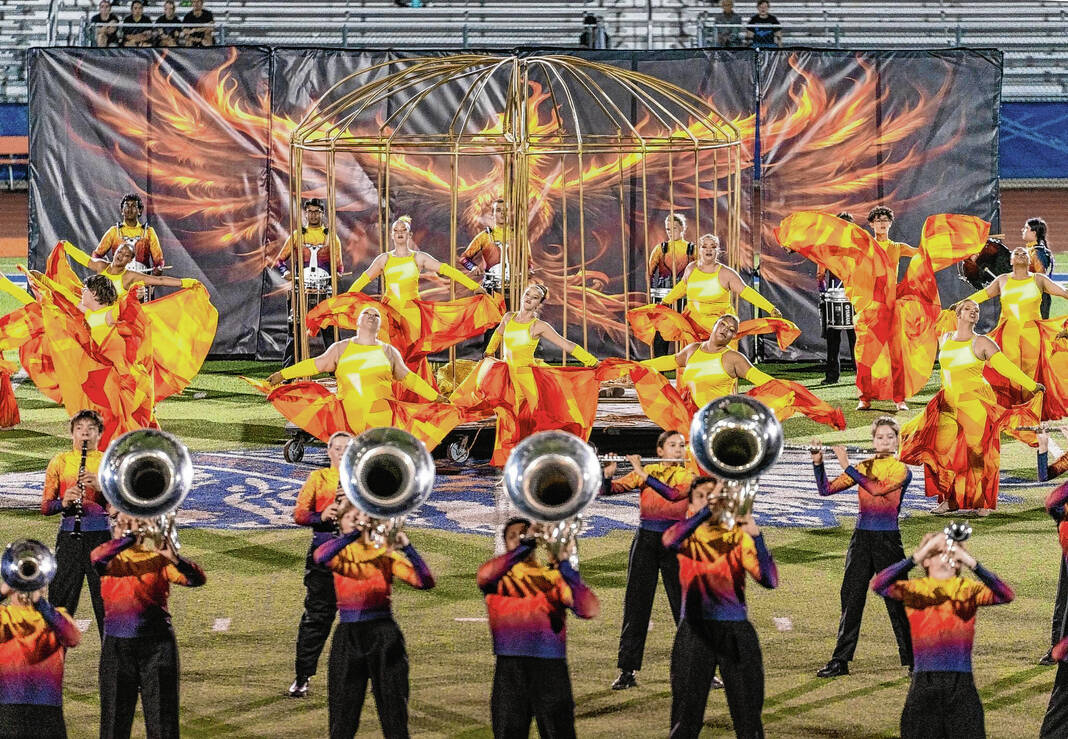
Photo provided The Sound and Spirit of Columbus perform their previous competition show “From the Ashes.”
Students, teachers and families involved in Sound and Spirit of Columbus made impassioned pleas to school board members on Monday to look for ways to continue funding its summer band program.
The Indiana Department of Education (IDOE) in January did away with the mechanism that BCSC used to fund summer band camp, which has operated in the form of a summer class.
According to state regulations, summer school courses are any IDOE-approved class offered outside the regular school year for which a district seeks state reimbursement of instructional costs. Through that reimbursement, BCSC had paid for band camp.
But in a memo to district’s across the state at the start of the year, IDOE said that: “Given that the total summer school reimbursement requests submitted by schools have exceeded the state summer school appropriation for several years, future summer school funding will be refocused.”
That refocusing means “prioritizing core courses that help drive key priorities such as early literacy, math, science, as well as ensuring students have the academic credits necessary for high school graduation.”
An appendix in the memo lists courses approved for state summer school reimbursement, but missing are fine arts courses including band and theater. It does go on to say that schools can continue to offer any summer school courses they choose, they would just have to pay for it out of their own budget.
During public comment on Monday ahead of the collective bargaining process with the Columbus Educator’s Association (CEA), the vast majority of those who spoke were involved in Sound and Spirit of Columbus and pleaded for the summer programs to continue.
Denise Sharpe, the booster president for North’s band and co-booster president of Sound and Spirit of Columbus, said summer band programs from elementary through high school “have given my children and countless others a safe place to go to express themselves, to build lasting friendships, and to discover their creativity.”
“These programs are not just activities, they are essential to the future of students who love music and the performing arts in our community,” Sharpe said.
Claudia Thomas, a sophomore at North, said the two weeks of her first summer band program “changed the way I viewed playing the trumpet forever and being a musician as a whole.”
“We all complain about band camp, but my groaning is always followed by a laugh and achy legs from marching, matched with achy cheeks from smiling,” she went on.
Thomas said the summer programs are a chief reason why Sound and Spirit is able to compete with much larger schools and how: “Not being able to have the support that allows us to spend that crucial time in the summer learning vital skills would undeniably cripple our show, and leave us with a product we are significantly less proud of.”
Just before the final speakers went up over 30 minutes of public comment, recent graduate Jack Kerr dramatically strolled from the back of the room, walking up to the microphone sporting blue sunglasses to the excitement of the Sound and Spirit-faithful.
Kerr said he and others were able to forge bonds during the summer program that only add to their band experience as time goes on.
“Which is why it would really suck to see all the newer people, all the new smiles that are going to come to band, not be as big and as bright as what I experienced in my section,” Kerr said. “So please, if you could protect the summer funding for our band, this would mean the world to not just me, but to every single new band member, every single current band member (and) every single band member that is to come in the future.”
The announcement in January came as band directors had already done preparations to hold band camp this past summer, so instead of not having it at all, BCSC agreed to pay for it out of pocket.
This comes as Senate Bill 1, passed by state lawmakers last session, changed the way public schools are funded, forcing districts to reduce costs. BCSC’s preliminary budget for 2026, discussed during a workshop on Monday, shows a decrease from $168 million in 2025 to $165 million in 2026 after years of steady increases.
Every two years, the Indiana General Assembly sets aside a fixed dollar amount in the state budget for summer school reimbursement.
The state has maintained a consistent appropriation for summer school reimbursement —approximately $18.3 million annually — since the early 2000s. Despite inflation and growing demand, the funding has not increased over that period.
In 2023, districts across the state submitted final cost reports totaling about $28.14 million, with $18.36 million, or about 65% of that reimbursed by the state.
The 2025–2027 biennial budget cuts the summer school appropriation by $900,000, bringing it down to $17.4 million per year.
BCSC officials did not provide how much was paid to hold the summer program this past summer by press time.
Board President Nikki Wheeldon, District 7, noted the Terrace Room in the Administration Building was as packed as it has been for something school board-related since COVID and thanked those who came to share what they’d like to see out of the bargaining process, which gets started in earnest next week.
But she also emphasized that BCSC does support band, and that the decision to defund the reimbursement for the program came from the state.
“Of course, collective bargaining, budgeting, all of these things need to occur,” Wheeldon said. “But I did want to highlight that this administration and this board does support the band in many ways.”
She noted the district is providing new uniforms, allocated money for a new trailer, and added a sixth band director for this school year.