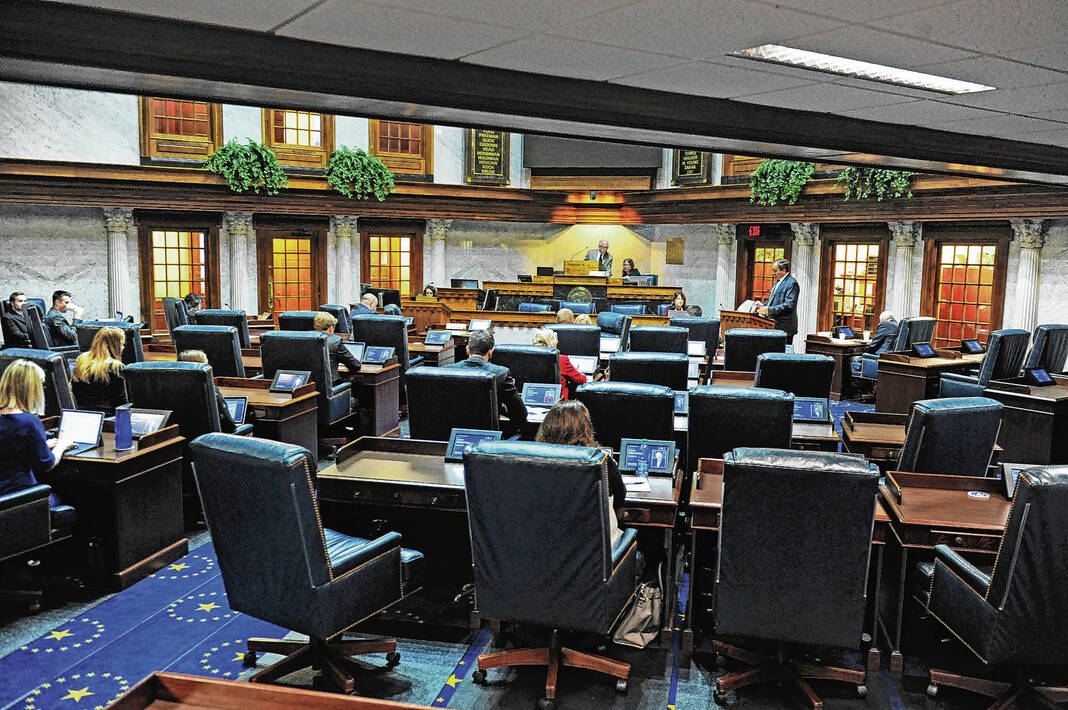
Republic file photo The Indiana Senate in session in Indianapolis.
State lawmakers representing parts of Bartholomew County have had different responses to the White House-led push to redraw Indiana’s congressional maps ahead of the 2026 midterm elections as Gov. Mike Braun suggests the effort is gaining momentum.
Braun said on Monday that Indiana lawmakers could return for a special session in November to redraw congressional boundaries, according to the Indiana Capital Chronicle. He also said some Indiana Republicans have changed their views on early redistricting and expects others “will come around.”
The effort targets Democratic-held congressional districts, aiming to shift them in Republicans’ favor by redrawing their boundaries in hopes of retaining the GOP’s slim majority in the House following the 2024 midterm elections. Redistricting is typically only done after the decennial census.
Vice President JD Vance visited the Indiana Statehouse in early August to meet with GOP leaders about redistricting, and later that month, a group of Republican lawmakers traveled to Washington, D.C., to meet with Vance and other federal officials about the same issue.
Since then, Rep. Jim Lucas, R-Seymour, has gone from what he said was a “’hard no’ to a ‘hell yes’” on early redistricting.
“…When you look at immigration reform, health care reform, voter reform, there are just so many things that have been neglected for so long by both parties. I feel that this is the last great opportunity we’re going to have to make any meaningful effect. And those changes do positively affect all Hoosiers,” he said.
Rep. Ryan Lauer, R-Columbus, who initially called early redistricting “ill-advised” before acknowledging its likelihood had “increased somewhat” following the White House visit, did not responded to multiple phone calls and text messages seeking comment on where he stands now.
Sen. Greg Walker, R-Columbus, who initially said early redistricting is “a ridiculous idea” that “would backfire,” declined to comment last week as Senate Republicans prepared to meet to discuss the issue.
Braun’s comments come amid ongoing deliberations among Indiana’s Republican supermajorities. GOP senators held a closed-door caucus last week to discuss redistricting, but did not comment publicly afterward. House Republicans also caucused virtually on Friday and have met previously in person.
In an interview with Fort Wayne’s WOWO radio, Braun said the state is “in the process where we will evolve in that direction,” and continued to emphasize — as he has in recent weeks — that he wants Hoosier legislative leaders to take the lead on the issue, according to the Indiana Capital Chronicle.
“I want it to be where it wasn’t forced upon our legislature, have our leaders talk to their own caucus members,” Braun said. “Some have already changed their point of view when they look at what good comes from it.”
Braun expressed confidence that reluctant members would ultimately align, telling the radio station that “You’re going to find that, probably, the legislators will come around to it. I’m going to give them time. I think eventually we’ll get there.”
He also tied Indiana’s timeline to national GOP politics, warning of “consequences” for the state if it were to “drag our feet” and not work with the Trump administration “as tightly as we should.”
So far, legislative leadership has largely remained silent on the issue. Outside the Statehouse, opposition is also mounting. A coalition of advocacy groups delivered nearly 9,000 signatures last week urging lawmakers not to pursue early redistricting.
Currently, it is unclear whether Lauer and Walker will shift their views.
Last month, Lauer said he believed the likelihood of Indiana lawmakers redrawing the state’s congressional maps before the midterm elections had “increased somewhat” following a meeting at the White House between a delegation of Indiana Republicans and senior officials in the Trump administration.
“It was a small part of the conversation, but it was an eye-opening conversation,” Lauer said following the White House meeting, referring to early redistricting. “We certainly got a lot of new information. …I think there was a strong case, from a national perspective made by the administration. And we certainly heard that and are reviewing a lot of the information they provided. …I would say the possibility of addressing this in Indiana has increased somewhat, and the administration did make a strong case from a national perspective. So, I’m sure there will be more discussions going forward.”
When asked last month if his position on early redistricting had evolved after the White House meeting, Lauer said, “I stand with Hoosiers. I stand with my constituents. I’m certainly listening. There was a lot of good information that was presented from the White House, and it is a serious issue. From my constituents’ perspective, I wouldn’t say anything has changed. I think there may be an increased possibility of that (to) occur in Indiana, but we’ll just wait and see.”
At the same time, U.S. Rep. Jefferson Shreve, R-Indiana, and Rep. Erin Houchin, R-Indiana, have expressed support for redrawing the maps.
“I support the president’s call to counterbalance radical blue states governors like (California Gov.) Gavin Newson and (Illinois Gov.) JB Pritzker who’ve long manipulated districts in California and Illinois,” Shreve said in a statement. “Their gerrymandering efforts undercut fair representation. Hoosiers can help turn this tide.”
Houchin also expressed support for redrawing Indiana’s congressional districts ahead of the midterm elections.
“Democrats will stop at nothing to push their radical agenda,” Houchin said in a statement. “Republicans can’t accept that any longer. Indiana can act to guarantee that all Hoosiers have the strongest possible conservative voices in Washington. I’m standing with President Trump — it’s time to redraw Indiana’s congressional map.”
Braun raised the possibility of lawmakers returning before the end of the year.
“We’ll have to do that either at the very beginning of the next (legislative) session we have in ‘26, or probably more ideally sometime in November,” he said in the radio interview. The next regularly scheduled legislative session, for 2026, begins in January.
Waiting until 2026 would be complicated by the filing period for congressional primaries starting in January.
The governor is the only one empowered to call a special session, according to the Indiana Capital Chronicle. A two-week special session in Indiana in 2022 cost about $240,000.
— The Indiana Capital Chronicle contributed to this story. To learn more, visit indianacapitalchronicle.com.