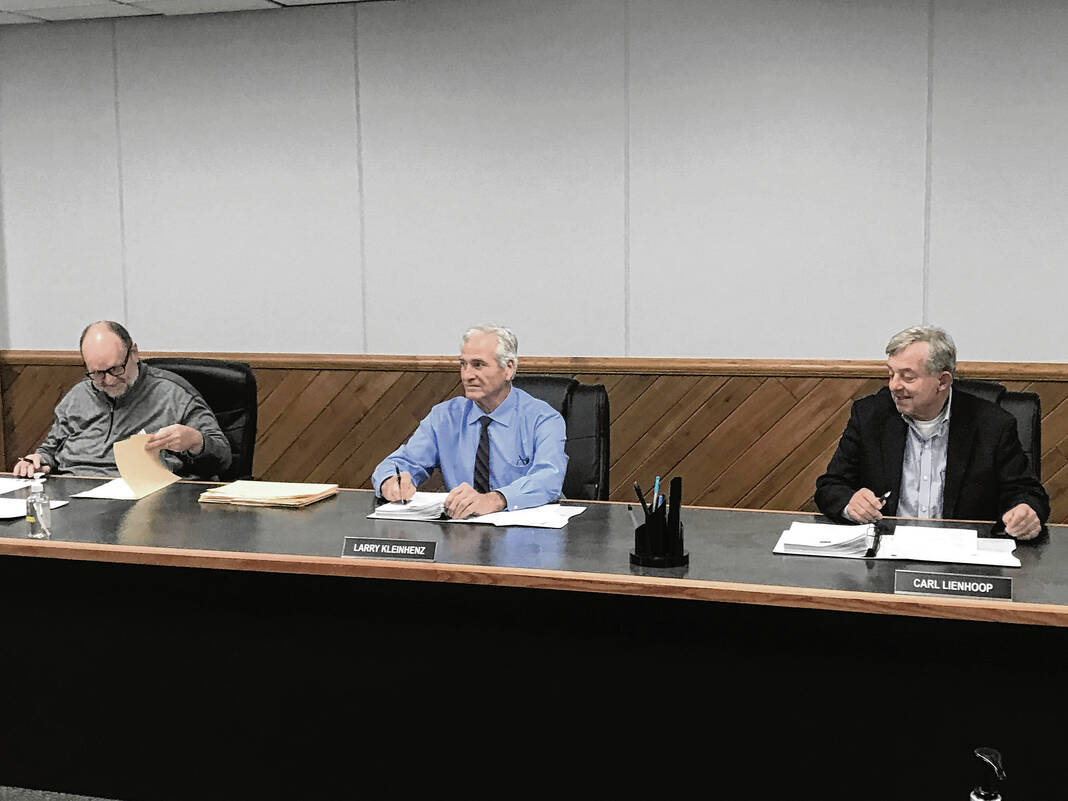
A special judge has allowed part of a lawsuit challenging a Bartholomew County ordinance restricting out-of-county biosolids to move forward.
Jackson Superior Court 1 Judge Amy Marie Travis, who is serving as special judge in the case, partially granted and partially denied a motion Friday by the Bartholomew County commissioners seeking to dismiss the lawsuit.
The lawsuit, filed by Biocycle LLC in February, alleges that the ordinance unfairly restricts its business, caused potential partners to back out of deals and gives unjust preferential treatment to local biosolids, according to a copy of the complaint.
The ordinance bars the import, storage and non-residential application of biosolids originating outside of Bartholomew County unless it is processed by Columbus City Utilities’ wastewater treatment plant.
The company received a permit in July 2024 from state environmental regulators to accept biosolids and industrial waste at a facility southeast of Columbus and apply them to agricultural land in Bartholomew, Decatur, Jackson, Jennings, Johnson and Shelby counties. However, the facility had not received any biosolids or industrial waste products as of August, according to records with the Indiana Department of Environmental Management.
Biosolids are organic materials produced during the treatment of human sewage at wastewater treatment plants.
While Travis dismissed several of Biocycle’s claims, she allowed other arguments to proceed, including, among others, the claim that the ordinance is void because it is preempted by state law and not subject to Indiana’s Home Rule Doctrine.
The order on the motion to dismiss is not the final ruling in the case.
Biocycle has argued that the regulation of biosolids falls into an exception to the Indiana’s Home Rule Doctrine that allegedly stipulates that local governments do not have the “power to regulate conduct that is regulated by a state agency, except as expressly granted by statute,” according to the order.
The county, for its part, has argued that the ordinance is expressly allowed by state statute, pointing to a provision in the Indiana Administrative Code that says local governments are not prohibited from “imposing requirements for the use or disposal of a biosolid … more stringent than the requirements in this article … or from imposing additional requirements for the use or disposal of a biosolid.”
The county also has cited another provision that states that “the determination of the manner in which biosolid, industrial waste product or pollutant-bearing water is used or disposed is a local determination.”
Travis states in the order on the motion to dismiss that the court is “required to consider the pleadings in the light most favorable to the plaintiff, but also draw every reasonable inference in favor of the non-moving party.”
“(The court) must consider the following: When the state opts to not have exclusive jurisdiction in a regulatory area, local government units ‘may impose additional, reasonable regulations … provided the additional burdens are logically consistent with the statutory purpose,’” Travis states in the order.
“Here, the county has not articulated its regulatory purpose for restricting the sourcing of biosolids solely to intra-county, and it is unclear whether this furthers the state’s goals of ‘protecting and enhancing the quality of Indiana’s environment and protecting the health, safety and well-being of its citizens,” Travis continues. “This is especially true considering IDEM’s stance that Biocycle ‘may take biosolids from any municipal or semi-public wastewater treatment facility within the state … because all biosolids are generated using a similar process and … biosolids quality is similar throughout the state.’”
The commissioners have argued in court filings that, among other things, municipalities have broad authority under state law to its affairs, including regulating biosolids.
The commissioners further contend the ordinance does not conflict with the permit issued to Biocycle and that the lawsuit should be dismissed for failure to state a claim.
“The language of the permit itself … confirms that the ordinance does not conflict with anything the state has approved,” the commissioners state in court filings. “It expressly regulates the application of biosolids to land in various counties, not the import or processing of biosolids from other counties into Bartholomew County. The permit does not purport to regulate or authorize where Biocycle sources its biosolids, so there is no conflict.”
According to a July 16 notice of decision from IDEM, Biocycle LLC’s permit allows it to “accept biosolids and industrial waste products at their storage structure in Bartholomew County for blending and to land apply the blended biosolids and/or industrial waste products to agricultural land in Bartholomew, Decatur, Jackson, Jennings, Johnson and Shelby counties.”
County officials say public concerns range from other counties using Bartholomew as a sewer sludge dumping ground to potential adverse environmental effects. Some residents are concerned an unpleasant smell could permeate nearby residences and recreational activities.
Bartholomew County Commissioner Larry Kleinhenz said previously the commissioners intend to “protect our citizens against the hazards” of out-of-county biosolids but said he was unable to comment further, citing the pending lawsuit.
“We did pass an ordinance in 2024 prohibiting import and field applications of out-of-county biosolids generated in other counties,” Kleinhenz said previously. “Our intent is to protect our citizens against the hazards of such. I cannot comment further as advised by counsel.”
Claims made in filing a lawsuit represent only one side of the case and may be contested in later court action.