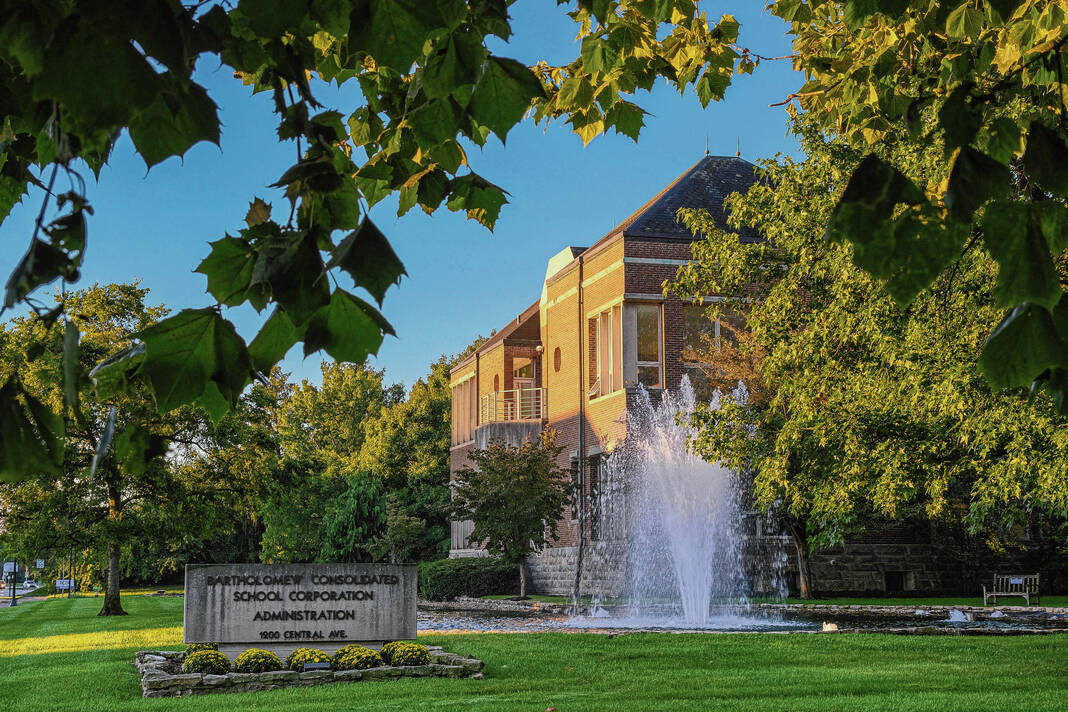
Bartholomew Consolidated School Corp. board members gave legal authorization for the district to issue a $2.5 million general obligation (GO) bond that will go towards the purchase of new buses and IT supplies including Chromebooks.
The board approved a project resolution, preliminary bond resolution and an accompanying declaration of official intent to reimburse expenditures associated with the bond 5-2, with members Tom Glick, District 5, and Logan Schulz, District 7, voting against.
BCSC officials said the driver of the move is in part because recent state legislation changed how public schools are funded, restricting the amount of property tax dollars that would typically go towards such a purchase.
BCSC Treasurer Jamie Brinegar said that the $2.5 million bond will have 4% interest, but will cost ultimately cost the district between $20,000 to $30,000.
“The GO bond that we’re proposing is a $2.5 million GO bond with interest of about $100,000. That’s a 4% interest,” Brinegar told school board members. “We will also earn interest on that money until we spend it all down. We’ll probably earn between $70,000 and $80,000, so the cost is going to be about $20,000 for us to have this $2.5 million.”
“While we have that money in our possession, we will invest that money, have it sitting, earning interest until we spend it,” Brinegar continued. “And so the net amount will be $20,000 to $30,000.”
More specifically, Brinegar said that $1.78 million would be used to purchase IT supplies, $700,000 will go along with referendum money to replace old buses and $70,000 will pay for vehicles for the operations department.
According to the proposed 2026 budget, the district’s debt service fund is down $3 million from last year so the tax rate for the debt service fund will remain flat, Brinegar pointed out.
“So we’re getting a lot of great things for what will be about a $20,000 cost,” Brinegar said.
Normally these types of purchases would be through the district’s operations fund. But the state limits how much that fund can grow year over year, capping it at a maximum levy growth quotient of 4%, which the district already reached. Even if assessed property values in a district rise more than 4%, the operations fund levy cannot grow faster than that.
“This is our only way right now to raise additional funds beyond that,” Brinegar said. “Long-term, this is not going to be our best plan. But as we look into what SB1 has done, this is our short-term answer, and we are working on a long-term answer to that.”
BCSC and all school districts across the state are dealing with the impacts of Senate Enrolled Act (SEA) 1, passed this past legislative session. More specifically, the bill’s property tax provisions mean that districts will see a reduced amount of property tax revenue the districts can collect within their operations fund.
Brinegar said that there is $3.6 million in property tax cap losses within the operations fund in 2026, a 50% increase from the previous year as a result of SEA 1. He also noted that “a lot of other school corporations are doing this exact same thing right now, doing GO bonds for short-term while we make plans for the long-term.”
BCSC’s proposed 2026 budget shows that the operations fund is down over 12% from last year, from $23.3 million in 2025 to a proposed $20.3 million in 2026.
Including the GO bond, BCSC’s overall proposed budget is $162.6 million, down from $168.5 million last school year.
School board Jason Major said that “at some point, you can’t do bonds every year” and asked what the plan is over the long-term.
“Right now, as things are, the only way you’re going to increase revenue is through a tax increase. And I know that’s not popular, but at the same time, neither is losing good teachers,” Major said. “So we have to figure out: how are we going to pay for everything? Or as requested a month ago, what is it that we can live without, and where can we identify savings?”
Superintendent Chad Phillips observed that unless state lawmakers make changes, the district “will just continue to decline in our cash balance until we run out of cash,” saying that he has begun to meet with cabinet members to identify potential savings in the lead-up to 2027’s budget.
“We are digging into each one of their budgets so that as we go through the next six months, five months or so, we can go into the 2026-27 school year with at least taking action on the items that are the furthest away from the classroom,” Phillips said. ” … We will also have a list of possible actions to consider when we go to start building 2027’s budget in June, if we start to see things have not turned around and/or ADM (average daily membership) is down again in the fall.”
“We’re (the state’s school districts) all in a similar situation, but like we planned well ahead enough to have this cash balance that we aren’t cutting programs right now, we want to be planning well ahead enough for next school year that we aren’t reacting.”
Glick said he recognized the need for buses and IT supplies, but said “that’s part of what we took the referendum for.”
Schulz questioned why the GO bond resolutions were being considered now, given what Phillips said about meeting with individual cabinet members to look for savings.
“If we’re going to invest it, why would we not just plan to cut where we need to cut between now and then,” Schulz said, concerned about the interest on the bond. “My assumption would be is you wouldn’t need the $2.5 million by the time we go to March.”
Phillips said with respect to the buses and IT supplies, “that would not be the case.”
“The technology replacement and buses, those are needed regardless,” Phillips said. “We’re looking at all of the expenditures. But I think to your point, we can push off closing on the bonds. The board still has to approve the payments for the calendar year 2026 as part of this budget, but we can talk to the financial advisors and say: ‘When is the latest we can push out closing on them to save as much in interest as possible?’”