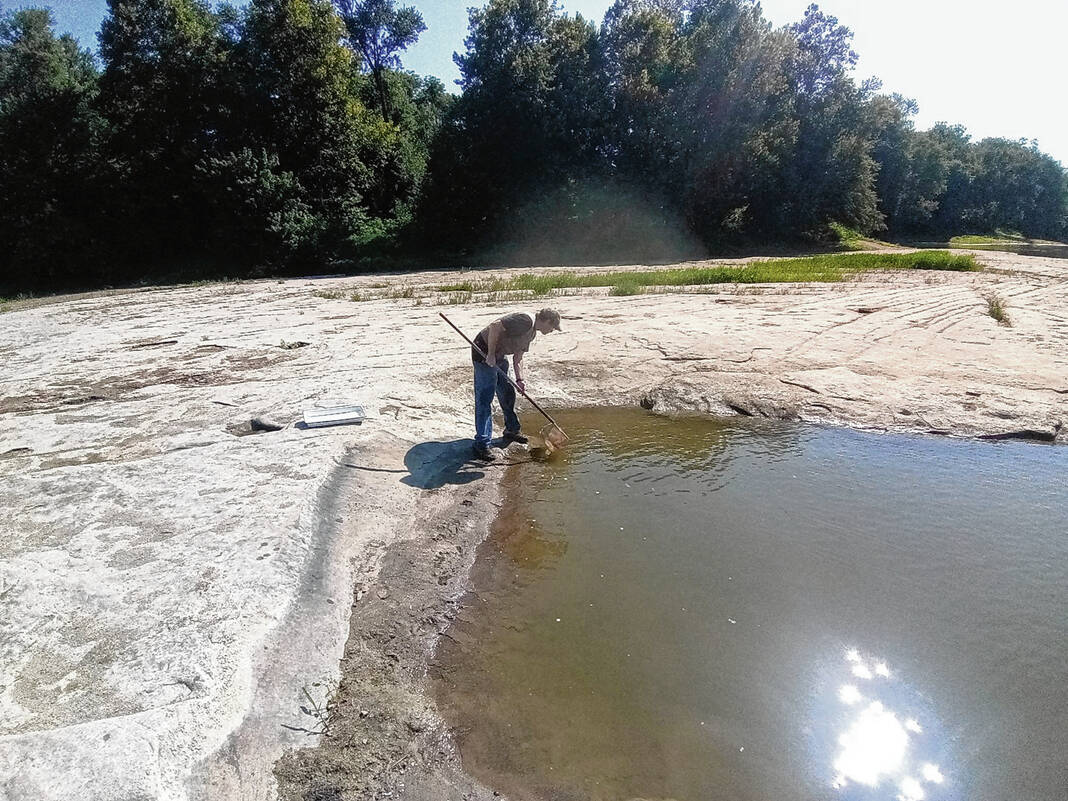
Photo provided IU Columbus Professor Luke Jacobus collects samples at Hindostan Falls, where he helped identify a previously unknown genus and species of freshwater fungus.
Photo provided IU Columbus Professor Luke Jacobus collects samples at Hindostan Falls, where he helped identify a previously unknown genus and species of freshwater fungus.
The fungus is among us in Indiana, even though we may not always pay too much attention to it. But maybe we should— fungus can have meaningful applications towards human health, including a new type that a local professor discovered on the East Fork of the White River.
Luke Jacobus, an IU Columbus professor, was one of two scientists who helped identify a previously unknown freshwater fungus: Atromagnispora indianensis. Jacobus is an entomologist — a person who studies insects — and the foray in the world of fungi was new to him.
“Fungus is something that we don’t appreciate enough in general,” Jacobus said. “Only with some of the growths in DNA technology in the last few years has science really been able to start addressing a lot of questions about how many different fungi we have on our planet.”
Jacobus got connected with Huzefa Raja, a mycologist from the University of North Carolina at Greensboro, who had secured a grant through the Indianapolis Zoo to look for aquatic fungi.
The type of fungi Raja and his colleagues were studying live in streams, lakes, ponds and wetlands, where Jacobus does a significant amount of fieldwork, which is how their collaboration came to be. The Indianapolis Zoo, knowing Jacobus’ expertise, invited him to meet Raja to discuss the endeavor.
“He (Raja) taught me what to look for, how to collect it and how to handle it,” Jacobus said. “So now, whenever I’m out and about in streams in Indiana, I look for the kind of habitat that is home to the fungus that they study. And I pick up samples that might be promising for having something growing on it that they’re interested in.”
What that meant in practice is Jacobus would send out a box of deadwood every few months for analysis. The most ideal places to look for samples are areas that are ideally minimally impacted by people and where the water isn’t degraded in some way, something that Jacobus said is almost impossible to find.
The search was kind of like going mushroom hunting, only on a microscopic level in the river, Jacobus said.
Hindostan Falls on the East Fork of the White River in Martin County is where Jacobus ultimately made his discovery.
The area is currently maintained by the Indiana Department of Natural Resources as a public fishing site, but a few years after Indiana became the nation’s 19th state in 1816 it was home to what looked to be headed towards becoming a burgeoning city.
But Jacobus said an illness led the settlement to become a ghost town: “If you look around, you can see the old signs of human activity and habitation, economy and industry there, which is kind of cool.”
The area is well known to entomologists for being a place where rare insects have been found over time, so Jacobus visits periodically. But it also has easy access to the river and is the type of habitat Raja said would be best for the type of fungi he was interested in studying.
The process of the discovery involved the type of delayed gratification that is common in science. Even though Jacobus had collected something that looked promising, “you don’t know until somebody with a very trained eye and more experience than me with fungus looks at it.”
“Basically, I got trained to fetch a stick and now I’m fetching the right sticks and generating some good results.”
The fungus Jacobus discovered belongs to the Lindgomycetaceae family of fungi, which wasn’t even discovered until about 15 years ago, Jacobus said. Some of its nearest relatives are out in the oceans “so it’s pretty unusual in biological terms.”
Fungus is important for human health for a number a reasons, one of the more prominent being that a lot of the inspiration for pharmaceuticals come from fungi, Jacobus explained.
“Fungi do a lot of chemical warfare and they kill some of their enemies and digest their food by putting chemicals out into the environment that kill bacteria,” Jacobus said. “… And sometimes those compounds are very effective against microbes that would do humans harm.”
“Some of the relatives of this fungus, for example, have compounds that have been effective with some bacteria that otherwise are resistant to our drugs,” Jacobus went on. “That gives some hope that even this— what would seem like a minor discovery in some ways— could hold really important medical breakthroughs in time.”