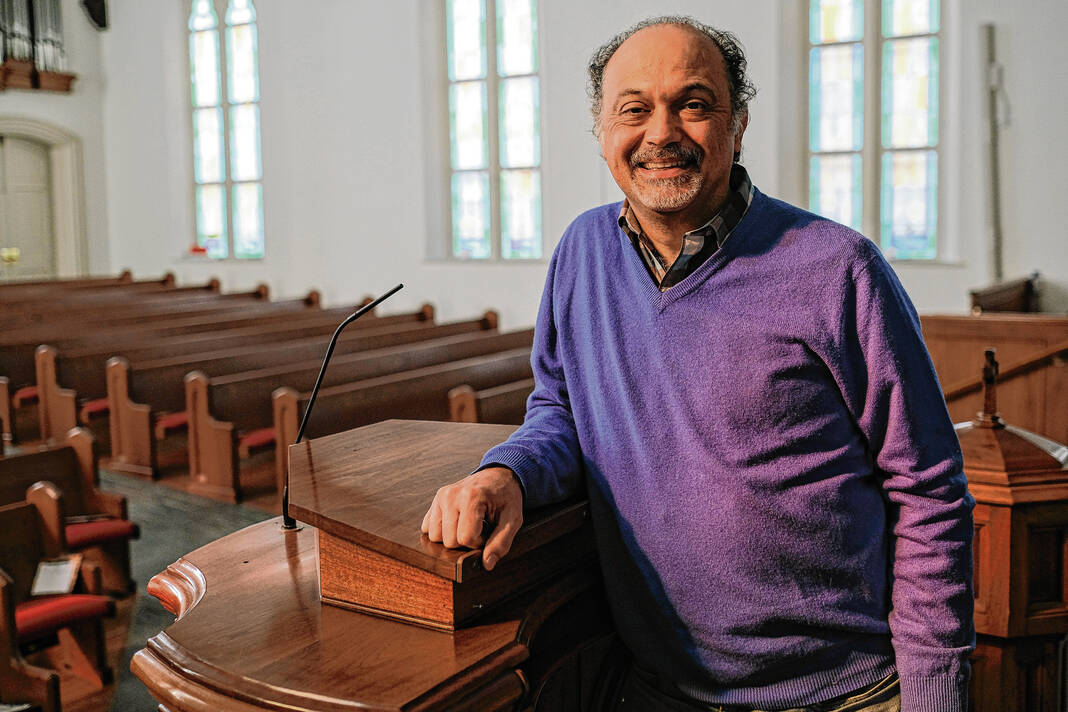
Mike Wolanin | The Republic Pastor Felipe Martinez poses for a portrait at First Presbyterian church in downtown Columbus, Ind., Monday, Feb. 12, 2024.
Thanks to donations from First Presbyterian Church families, a $10,000 gift has been multiplied to abolish just over $1.78 million in medical debt for almost 1,500 individuals across Bartholomew, Jackson and Brown counties.
That initial gift was multiplied through Undue Medical Debt in a partnership between this nonprofit and First Presbyterian Church as part of their 200th anniversary celebration. Undue Medical Debt converts every $1 contributed into an average of $100 of debt relief.
“This is about bringing hope and healing in a very practical way,” First Presbyterian Church Pastor Felipe Martinez said in a news release. “Our bicentennial is not only a time to look back with gratitude but also to look forward with compassion. We wanted to ease a burden many families were carrying.”
Within Bartholomew County, $1.03 million was relieved for 916 individuals. In Brown County, $237,000 was relieved for 225 individuals and in Jackson County, $507,000 was relieved for 347 individuals.
How it works is Undue Medical Debt uses donations to buy medical debt in large and bundled portfolios at a steep discount, according to unduemedicaldebt.org. Individuals whose debt is being abolished will soon receive letters directly from Undue Medical Debt which signifies that their debt has been fully eliminated and that their debt will be removed from their credit records.
“One of the challenges with this, of course, is that medical debt is one of the primary reasons for people going into bankruptcy,” Martinez said. “So for that reason, having this debt paid off and having the credit bureaus know about it will help them more than just getting the debt out of their hair but also then being able to go forward in their life.”
First Presbyterian Church also has another $10,000 in donations reserved to abolish more debt when the next purchase becomes available. While this is not a fundraising campaign, church leaders hope their example will inspire other faith communities and nonprofit organizations to consider how they might also stand alongside families struggling with medical debt.
“I hope that they feel encouraged and in fact, this family who donated this money, they themselves had read about another congregation doing the same thing, so they were inspired by another congregation doing what we’re doing,” Martinez said. “We hope that our actions can maybe make somebody think, ‘hey, we could do that too.”