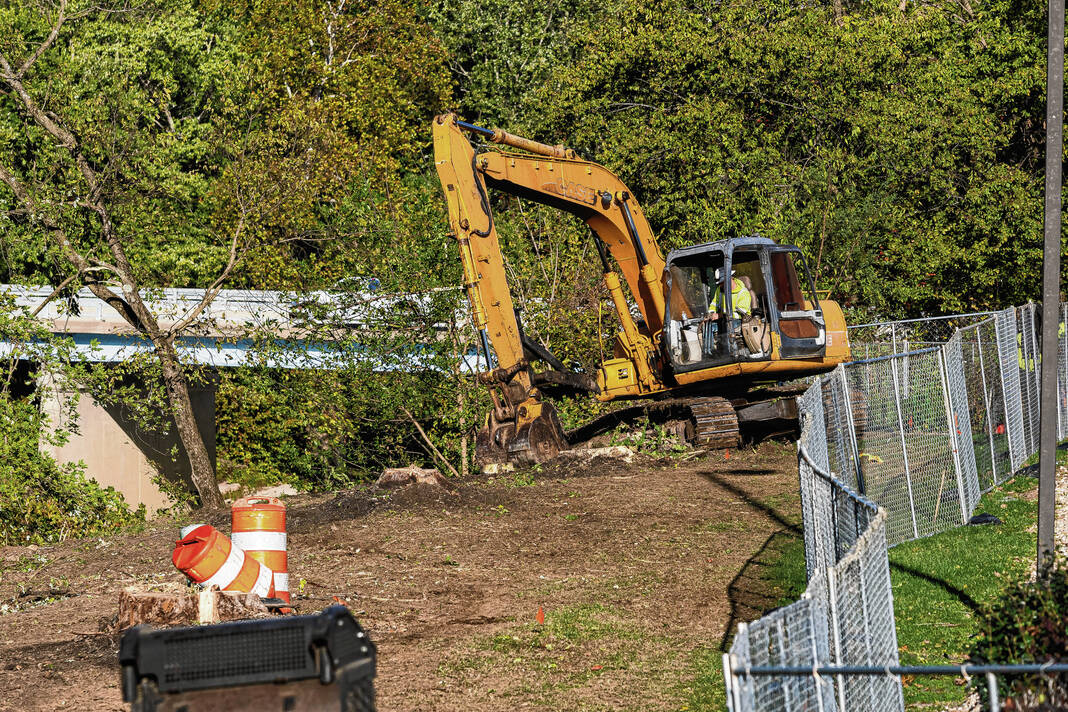
Mike Wolanin | The Republic Trees are being removed from the riverbank near Upland Columbus Pump House to make way for the riverfront project, Wednesday, Oct. 22, 2025 in Columbus, Indiana.
The ongoing remake of the city’s riverfront in the past month has involved the most visual progress to date, as swaths of trees along the East Fork White River near the project site have been removed.
Milestone Contractors was chosen in July to do construction primarily on the east side of the bank, and that work got started in earnest at the start of October.
Milestone will stabilize and re-landscape the east side of the bank, institute a connection to the People Trail from Mill Race Park to Water Street and construct a plaza that will provide access to the river. The contractor will also fix a wash out on the west bank.
The project, which has been in the works since 2016, seeks to address safety concerns on the riverfront. In particular, it will involve the removal of the failing low-head dam in the East Fork White River, make way for a pedestrian connection to the 1821 Trail and Mill Race Park, while also providing safe access to the river for emergency personnel and community members.
The sight of trees being removed can be disconcerting, but city officials emphasize it’s necessary and for the long-term improvement of the area. The trees that were removed are invasive, and will be replaced by native plantings, informed by a comprehensive restoration plan, with specifications for trees, grass and ground cover, according to city officials.
“We’ve tried to remove a limited number of trees, but still meet environmental and engineering standards so that we have enough room to sufficiently make the bank stable and the connection safe,” Director of Redevelopment Heather Pope told The Republic.
She noted that now is the time when the area will be the most unsightly, but that will be remedied as progress continues over the next several months and as the native plantings begin to mature.
Site clearing will be completed around Nov. 7, followed by Milestone going in and creating access to the river, which will take about a month. If all goes according to plan, construction on the plaza will occur from mid-December to the end of April 2026, although much of this is weather dependent.
Site clearing starts south of the Robert N. Stewart Bridge, where river access is readily available and continues northeast under the Third Street Bridge, ultimately clearing the way for a connection to the People Trail in Mill Race Park.
City officials say the People Trail connection will help alleviate a high rate of issues between vehicles and pedestrians/bicyclists at the corner of Lindsey and Third streets.
Milestone will be doing initial erosion control measures as well, placing erosion control mats that will stabilize the bank before native planting material is incorporated.
The “Our River…Our Riverfront” project also plays into other ongoing city projects including the Second Street Thoroughfare Project and remake of the downtown entrance into the city, city officials said.
The project is divided up into three parts — work to the west side and east side of the riverfront and then the removal of the deteriorating low-head dam in the East Fork White River.
Redevelopment officials in January hired EDCO Contractors for $454,318 to provide west bank access for the eventual removal of the low-head dam and bank stabilization, which involved the removal of trees, implementation of a construction access road and filling in a scour area at the location of the former landfill located there. That portion is already finished.
Among the more crucial aspects of the project is the removal of the low-head dam, which will assist in keeping the west bank from further eroding and exposing the former city landfill, which is a delisted IDEM Superfund Site.
Notably, a couple of years ago, a tree on the east bank fell over and struck the Robert N. Stewart Bridge, something city officials said would happen with more regularity if the bank stabilization was not addressed.
“The bank was unstable just because of the age of the vegetation,” Pope said. “We’re stabilizing the bank and making it safer for everyone to enjoy the river. But every time we had a flood event, it could have easily happened again.”
The design of the remade riverfront by Hitchcock Design Group accommodates flooding, city officials say. On average, the river is flooded less than 10% of the time during a calendar year, according to data from the Army Corps of Engineers. But the design of the trail makes way for machinery needed to clean after a flood event. In addition, railing along the riverfront that connects to the plaza will be able to be removed and replaced in sections, during instances where flooding could cause damage.
The railing will look similar to that along the State Street Bridge. There will also be a pedestrian gate on the south end of the trail that will close during flooding events.
Regarding the plaza, it will be immediately north of an existing old bridge abutment near Upland Columbus Pumphouse. The plaza will provide people a place to easily get near the river, and will be eligible for events or just as a place to relax, city officials said.
The dam removal will be done by Jerry Sweeten of Ecosystems Connections Institute. That will take place during the summer of 2026, also making the river safer for boats, canoes, and anyone who wants to use the river for recreation.
Grant funding from the Indiana Department of Natural Resources and U.S. Fish and Wildlife Service becomes available just as Sweeten will begin the process of removing the dam. Jason Larrison of consulting firm J.S. Held told the redevelopment commission in July that “the anticipation is that the majority of that (removal of the low-head dam) cost will be covered by state dollars.”
The project wouldn’t have been eligible for the type of grants Sweeten is seeking with the in-river features originally included in the scope, redevelopment officials said. The grants will also likely require some sort of local match.
Sweeten came highly recommended by the Indiana Department of Natural Resources, according Larrison, who called Sweeten “the expert in Indiana when it comes to low-head dam removal.”
Sweeten has helped remove “dozens and dozens” of dams throughout the state, Larrison said, including Edinburgh’s Thompson Mill Dam in 2024.
The “Our River…Our Riverfront” project has seen several iterations in its design, with the most recent involving the removal in-river recreation component that included a recreation channel, rock riffle ramp and fish habitat structures.
After bids on the project came in higher than expected at the start of 2024, redevelopment officials said they went back to do some value engineering and broke down the project into seven separate bid packages in hopes it would attract different contractors and bring down the cost. But bids came in higher than expected yet another time in fall of 2024, so a guiding team including city council members was put together to re-evaluate the project. Out of that it was determined to seek a project without in-river features.
Milestone’s part of the project is being done for an amount not to exceed $11.8 million. Redevelopment said that over half of the work Milestone is doing is being paid for through state and federal grant dollars.
Overall, the project has access to about $18.9 million in approved funds, made up of $11.5 million in tax-increment-financing (TIF) funding, $5.6 million in Regional Economic Acceleration and Development Initiative (READI) funds and $1.8 million from various funding sources including a $1.72 million Next Level Trails Grant from the Indiana Department of Natural Resources, along with contributions from Duke Energy and the Columbus Park Foundation.
The portion Milestone is doing will use up READI and grant funding first, followed by just over $4 million in TIF funding.