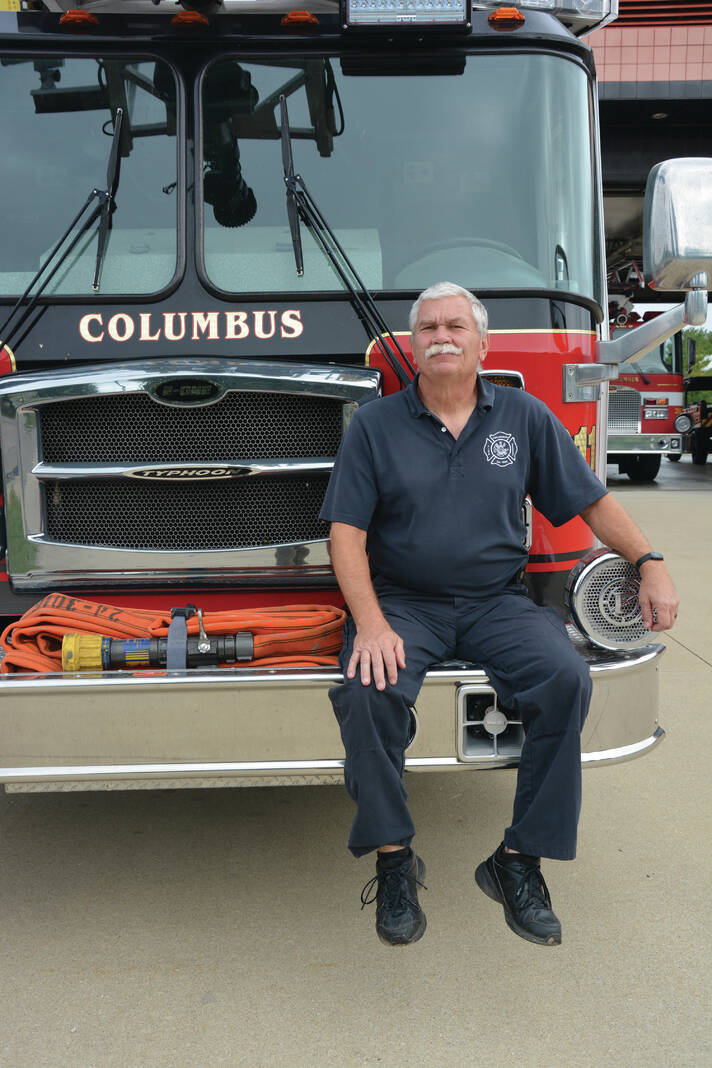
Capt. Dave Dwyer works out of Station 2 located by the airport on Arnold St. There he oversees the three shifts, station maintenance, and scheduling and documenting training for personnel. Katelin Gephart | The Republic
The history of the Columbus Fire Department is a long one beginning with its start as a volunteer brigade back in 1835 with the town’s incorporation. Before any of the safety equipment and trucks that we know today bucket brigades were used to put out any fires that arose. The 190 years since this incorporation has seen not just great improvements in safety, efficiency and scope of practice of the fire department, but the careers of hundreds of brave individuals of call this city home. With October being home to not just Fire Prevention Month, but also First Responders Day, October 28, we are highlighting one of those firefighters who has spent his four decades as a firefighter serving the community.
To start our story we travel over to the airport to Station 2. This station built in 2006 and replaces the original station 2 built in 1908. The original building now houses the United Way of Bartholomew County. The new station houses specialized equipment for fighting plane fires and standard trucks that the firefighters use to respond to vehicle accidents, medical emergencies and fires. It is here we find Capt. Dave Dwyer.
For Capt. Dwyer, fighting fires is more than just a career; it’s a part of his life. Growing up, Capt. Dwyer was exposed to his father being a firefighter with the Bedford Fire Department. Visiting his father at the station, which was only eight blocks away from their home at the time, allowed him to see firsthand what it meant to be a firefighter.
“I like the idea of helping people and, you know, giving back to the community and I like the idea of giving back to the public and then additionally the job security and then the retirement benefits. Those are the things that are attractive to me. It provides stability and security for my family.”
With 47 years under his belt in January, Capt. Dwyer has been in many different positions throughout his career as a firefighter. From being on the ambulance service after finishing paramedic school in 1983 to being a captain on CFD Capt. Dwyer says each job position has served its purpose to get him to where he is today.
“Every role that I’ve had has been something that I enjoyed and it wasn’t one over the other. You know, I’m pretty content where I’m at. I’m getting close to retirement.”
In his current position, Capt. Dwyer oversees Station 2, its apparatus and the three different shifts at the station, ensuring the workloads are carried out evenly between the three shifts. In addition, he arranges for minor maintenance of the station and handles Columbus Municipal Airport’s firefighting personnel’s training scheduling and documentation to verify their certifications are up to date and active.
Within the past few years, Capt. Dwyer’s job description has experienced some changes. In an effort to distribute the workload a bit more evenly, different jobs were given to all the captains at the different stations, like Captain Dwyer’s work with the airport personnel training.
“This has only been in place for about a year and a half. This is something that the chief tried to implement to try to equalize the responsibilities out. Previously, one battalion chief took care of all the stations, and it was significant trying to take care of these stations.”
Almost a third of Capt. Dwyer’s life has been spent at a fire station. During those years he has seen lots of changes, from the execution of new strategies to the influence of new technology.
“We rode on the back of the firetrucks, so we rode what they call tailboard, and we rode on the back. And while that was exciting, especially in the summer months, it was really nice to stand back there on the back of the truck, and you could see things and wave at people, and it was not very safe at all,” says Capt. Dwyer. “That was stopped about 1993, I think, or ‘94. And the trucks now all have automatic transmission. They all have air conditioning. They didn’t in the past.”
Along with the firetrucks, other equipment on the front-line being modernized helps speed up the fire fighting process, while keeping the firefighters safer than ever before.
“Our breathing apparatus is better. Our protective clothing is better. We have more personnel on fire now than we used to have, which makes the workload not quite as hard and it’s also a lot safer instead of trying to do the job with seven or eight guys, you’re doing it with 16-18. Which means that the fire goes out quicker and everyone gets back in service quicker and no one has to work to death and injuries are less.”
Back at the station, you can find modern changes too. Previously, fire stations were built mainly out of concrete blocks, but now they are being built with a variety of materials, including steel, concrete, and brick.
“We had dormitory bedrooms back then and now we have a bedroom with three beds in it so there’s one guy in each bedroom, so you have some privacy that we didn’t have previously. Everybody is on cellphones now, that didn’t used to be. There are some changes, but it’s been good. Some of the things are good, some of the things are bad. It’s just part of it.”
As retirement nears closer for Capt. Dwyer, he looks forward to the time he will spend traveling with his wife. The two plan on traveling the United States and visiting every National Park and Major League Baseball Park. They would also like to visit Iceland and travel Europe for a summer. “We’ve got some pretty big goals and hopefully we can get those done,” he says. “Even though my career is not over, it has been a pleasure serving the citizens of Columbus. I didn’t grow up here, but this is my home.”