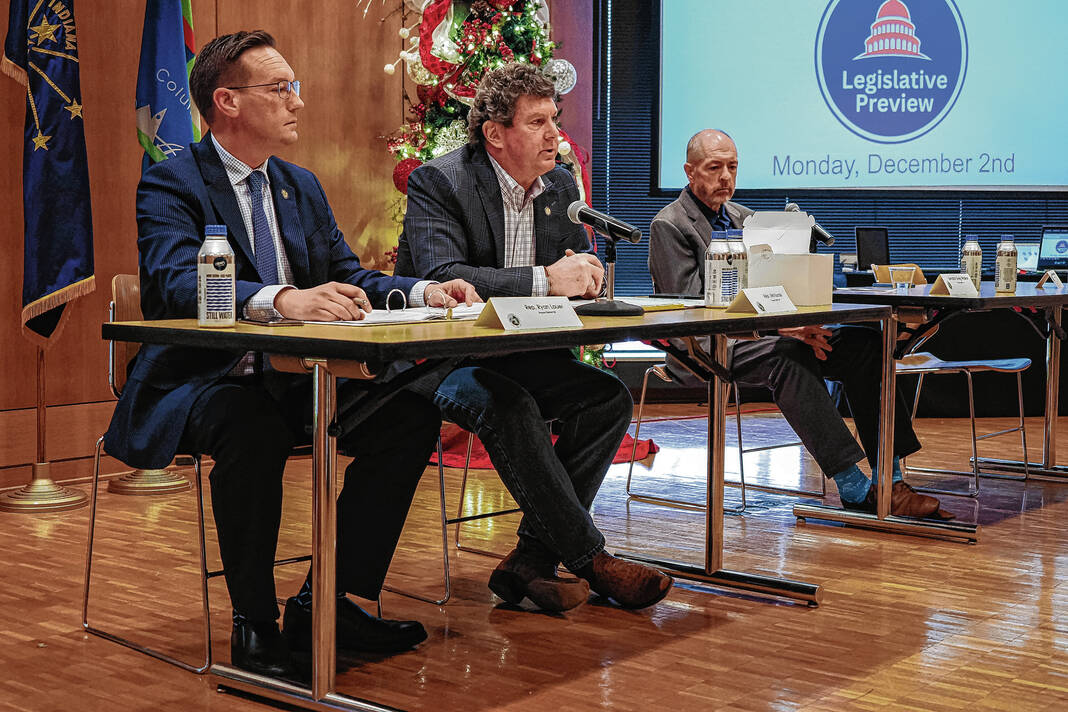
Mike Wolanin | The Republic State Representatives Ryan Lauer, from left, Jim Lucas and State Sen. Greg Walker take part in a legislative preview session at Columbus City Hall in Columbus, Ind., Monday, Dec.2, 2024.
State lawmakers representing parts of Bartholomew County have staked out different positions on midcycle redistricting after Gov. Mike Braun called a special session to redraw the state’s congressional map.
Sen. Greg Walker, R-Columbus, said Monday that he remains opposed to midcycle redistricting, while Rep. Jim Lucas, R-Seymour, said he is “heavily” in favor of it and Rep. Ryan Lauer, R-Columbus, said he is “open to it.”
At the same time, all three lawmakers said they were unsure how the special session will play out.
After weeks of pressure from President Donald Trump and his allies, Braun on Monday called a special legislative session on Nov. 3 for state lawmakers to consider redrawing Indiana’s congressional map — a process typically done once a decade after the U.S. census.
The move is part of a broader effort led by the White House that seeks to preserve the GOP’s narrow majority in the U.S. House of Representatives that started in Texas and spread to several other states.
Republicans currently hold seven of Indiana’s nine U.S. House seats, while Democrats control districts in Indianapolis and northwestern Indiana. The effort in Indiana would target Democratic-held districts, aiming to shift them in Republicans’ favor by redrawing their boundaries.
Vice President JD Vance and Trump have met separately with Indiana Republicans in recent months, The Associated Press reported. Braun is a staunch Trump ally in a state the president won by 19 percentage points in 2024, but said previously he did not want to call a special session until he was certain lawmakers would back a new map.
Indiana Republicans hold a supermajority in both chambers.
“I am calling a special legislative session to protect Hoosiers from efforts in other states that seek to diminish their voice in Washington and ensure their representation in Congress is fair,” Braun said in a statement on Monday.
Sen. Greg Walker
Walker said he remains opposed to early redistricting and does not currently see enough support in the Senate — “unless several (lawmakers) are intending to make a last-minute switch” or their positions on the issue have been misinterpreted.
Walker initially characterized the prospect of midcycle redistricting in Indiana as a “ridiculous idea” that “would backfire.”
“I don’t know how this will play out because from my understanding of conversations we’ve had — without naming any names — I would conclude that there’s not an opportunity to move a bill through the Senate regarding midterm redistricting,” Walker told The Republic on Monday.
“If the House wants to originate a bill (on redistricting) and send it over (to the Senate), we don’t have to give it a hearing, and that’s normal process,” Walker added. “But I would think it would be a monumental waste of time and, again, eroding voter confidence in our government if we can’t even plan our work any better than that. Whereas if we’re at odds, then the old refrain is, ‘Kill the bill if you can’t get it passed.’”
Under state law, the legislative process during a special session is the same as during a regular session, state lawmakers said. A Senate committee would at some point need to consider a bill that would redraw the state’s congressional district boundaries, state lawmakers said.
Walker is currently ranking member of the Senate Elections Committee, one possible destination for a redistricting bill passed by the House.
“I would look at the current makeup of that committee and argue there are not enough votes to get that through committee,” Walker said. “But, you know, things can change. No bill has to be sent to elections just because the topic is elections. You could go to rules. You could go to other committees with a bill. But currently, I don’t know which of our standing committees has enough support to move language like this to the floor without, again, some surprises. I thought we were supposed to avoid surprises. I thought we were supposed to use common sense, good judgment and deliberation instead of surprises. But I’ll be surprised (if a redistricting bill clears committee) is all I can say. I anticipate being surprised, if you know what I’m saying.”
Rep. Jim Lucas
Lucas said he remains “heavily” in favor of early redistricting but does not have a good gauge on the chances that the House passes a redistricting bill, particularly with many lawmakers not making public comments on the issue.
“There are (lawmakers) that aren’t saying anything,” Lucas told The Republic on Monday. “…It is (a) big (issue). There’s no denying that. But there are a lot of people keeping their thoughts to themselves. That’s not my style. So, there are some for it, some against it, and an argument can be made either way. And it will be very interesting to see how this plays out.”
Lucas’s position on early redistricting has evolved over the past couple months, going from what he has described previously as a “‘hard no’ to a ‘hell yes.’”
“When you look at immigration reform, health care reform, voter reform, there are just so many things that have been neglected for so long by both parties,” Lucas said previously. “I feel that this is the last great opportunity we’re going to have to make any meaningful effect. And those changes do positively affect all Hoosiers,” he said.
Rep. Ryan Lauer
Lauer said he is “open” to the idea of redrawing the state’s congressional map but said it is too soon to speculate on the chances that a new map would clear the House.
When asked about his stance on early redistricting, Lauer told The Republic, “I am open to it.”
“I’ll just reiterate I will participate in the process, and we vote on bills in front of us, questions in front of us, and in this particular case, a map in front of us,” Lauer said. “And at this point, there’s no map (in front of us). …The conversations have been ongoing now for some time, and I’ve gotten a lot of information, a lot of facts, and the national stage is what’s motivating many other states (to redistrict). …So, I am open to it. And it is my belief that Indiana is a strong Republican state. That’s what Indiana is sending to Washington. And I think the argument that, on a national level, that when you’re looking at how other states have been doing this and do it for the last, let’s say, 40 years, I do think that Republicans are and have been at a disadvantage electorally.”
Initially, Lauer said he thought early redistricting would be “ill-advised” and described Indiana’s current congressional district maps as “very fair.” “I think it would be ill-advised. I’m not for changing the maps … unless there are extraordinary circumstances. But I don’t see this as an extraordinary circumstance,” he said previously.
Lauer later said the chances of early redistricting in Indiana had “increased somewhat” after a delegation of Indiana Republicans traveled to the White House and had what he described as “an eye-opening conversation” with Trump administration officials about the issue.
On Monday, Lauer said “it’s a little early, I think, to prognosticate about” the chances the House passes a new congressional map.
“It would be a bill that would include a map, and that’s what we would be voting on,” Lauer said. “I couldn’t tell you at this moment what would be the outcome … because we don’t have a map filed and gone through the committee process and debated and potentially modified and gotten out of committee and then sent to the floor.”
National context
The issue of early redistricting ahead of next year’s elections started this summer in Texas, which was the first state to answer Trump’s call to redraw its congressional districts for the GOP’s advantage ahead of next year’s elections, according to wire report.
Democrats in California countered with their own redistricting effort, followed by Republicans in Missouri. North Carolina has been the latest to take action, which the Republican-led General Assembly approved changes Wednesday to U.S. House district designed to help the party unseat a Democratic incumbent.
Other states are considering joining the redistricting battle, including Florida, Illinois, Maryland, Nebraska and Virginia.
Democrats only need to gain three seats to flip control of the U.S. House. Trump hopes redistricting can help avert historical trends, in which the president’s party typically loses seats in midterm elections.
Political fallout?
Walker said there could be political fallout against Republicans should they redraw the state’s congressional map.
A poll taken earlier this month suggest that most Hoosiers oppose the Republican effort to redraw Indiana’s congressional map before the 2026 midterm elections.
The survey, conducted by Virginia-based North Star Opinion Research for the nonpartisan group Independent Indiana, found that 53% of registered voters oppose early redistricting, while 34% support it, The Indiana Capital Chronicle reported.
However, the poll also suggests that views on redistricting were sharply divided along partisan lines. Republican respondents backed early redistricting by a margin of 59% to 25%, but independents and Democrats overwhelmingly rejected it — 59% to 28% and 85% to 11%, respectively.
“I think there’s potential political fallout in terms of lost seats in the Senate and the House for the Republican majority,” Walker said. “I think public sentiment is, to me, the greatest challenge because I would like to have thought that the Indiana state legislators’ public opinion rose above that of the United States Congress. But we’re going to put ourselves on that same plain if we’re not careful by ignoring the will of the majority in the state of Indiana.”
Lucas said lawmakers should not shy away from the issue of early redistricting because it’s controversial.
“We can’t shy away from an issue just because it might be controversial,” Lucas said. “You have to look at the facts. Look at what’s going on at the time. At that period of time. Does it help my constituents? Does it hurt my constituents? And there are so many things that go into that. But I would never shy away from something just because it’s controversial.”
Lauer said constituents have been reaching out to him about early redistricting.
“I certainly have constituents on both sides, and there has also been a lot of polling that’s been going around from reputable firms and multiple polls, and I think we’re seeing it’s mixed,” Lauer said. “…From constituents reaching out to me personally, through my office and also looking at the polls, I think it falls very clearly along party lines. Each party feels a different way. It divides along those lines. … I think it’s polarized.”