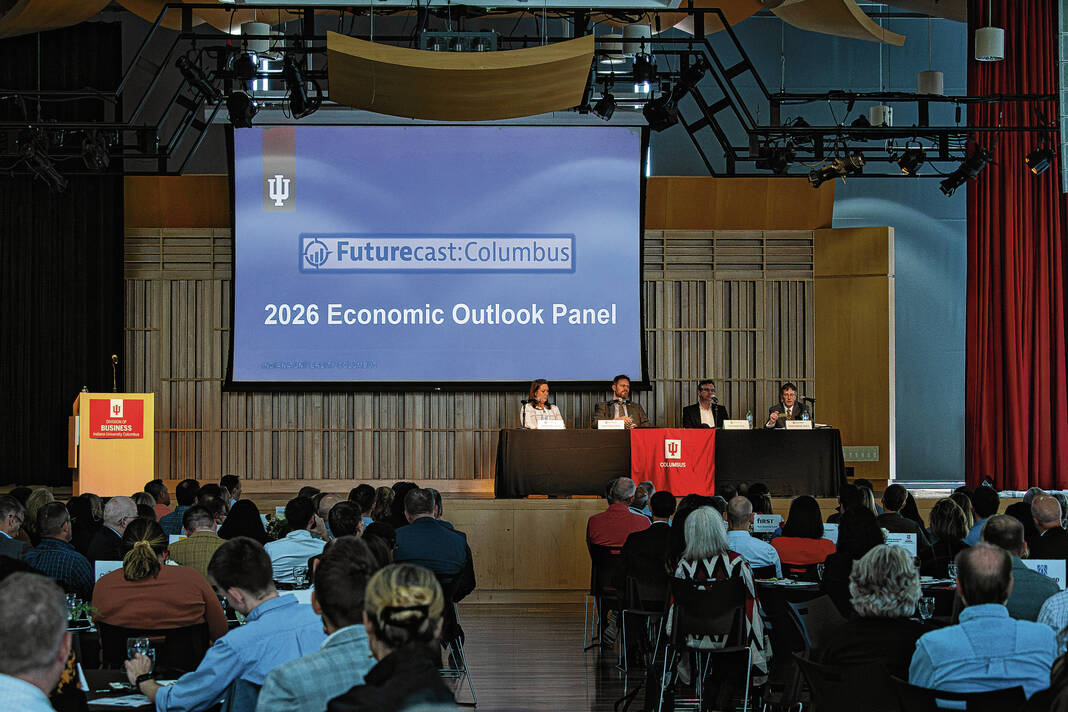
Mike Wolanin | The Republic Economic analysists Jennifer Rice, from left, Ryan Brewer, Phil Powell and Steven Mohler take part in a panel discussion during the IU Columbus 2026 Economic Outlook Panel at The Commons in Columbus, Ind., Wednesday, Nov. 5, 2025.
Financial and economic experts from Indiana University – Bloomington and IU Columbus did their best to look into a crystal ball to predict economic conditions locally, statewide, and for the United States in 2026 during a panel Wednesday.
Academics during the annual “Futurecast” Business Outlook Panel at The Commons said the economic picture of the country is a mix, with steady growth mostly fueled by large investment in pharmaceutical and AI sectors. However, the group said the continued uncertainty caused by the president’s tariff policy poses complications that are slowing business investment.
The event was hosted by the Division of Business at IU Columbus, the Columbus Area Chamber of Commerce, the Kelley School and the Indiana Business Research Center.
The presentation at The Commons was one several Futurecast panels taking place across the state. All proceeds from the local event will help fund scholarships for IU Columbus students.
U.S. outlook
Jennifer Lynn Rice, a senior lecturer at the Kelley School of Business, described the current economic picture of the United States as “full of mixed signals,” comprised of steady growth and an ease in interest rates. But she said the economy’s resilience is being tested due to better, but still elevated inflation, as well as continued federal monetary and trade policy, particularly regarding tariffs.
“2026 will be a year of cautious optimism in an uncertain world,” Rice said.
The forecast for the country in 2026 indicated a cooling of the economy but “not a collapse, not a crisis, just somewhat of a cooling,” Rice said.
National output is expected to grow at 1.8% in 2026, according to Rice. Real growth will be weaker than recent years due to the president’s tariff policies and slowing business investment. Making up for that, Rice said, is continued investment in AI technologies and corresponding energy investments.
On that note through a local prism, Cummins in the second quarter was able to weather some of the president’s tariff policies with earnings that topped Wall Street expectations. That was in part because of what the company described as strong demand for its power generation products, including power generators, from data centers that house IT infrastructure to train and deploy AI systems.
Rice said such an investment in AI is going to make-up for weaknesses in other sectors of the economy such as the housing market.
The unemployment rate in 2026 is predicted to rise to 4.8% in the United States as AI advancements will lead to increased productivity, but not an increase in labor, Rice said.
Rice called this a “healthy cooling” of the economy and that “it’s a sign of balance,” but that an underlying risk is a labor market softening that is greater than expected, which would in turn impact consumer spending.
Job growth one year ago was at 167,000 per month, which is now down to 75,000 a month, Rice said, adding that continued restrictive immigration policies could further impact the supply of both skilled and unskilled workers.
Inflation will remain elevated at 3% in 2026, Rice said, as tariff pricing pressures are expected to offest disflationary benefits of weakening demand.
She also noted that short-term interest rates are poised to decrease, but external inflationary pressures will make that a delicate balance.
All of this is against the backdrop of the start of oral arguments related to a Supreme Court case Wednesday that will have major implications for federal tariff policy going forward.
“One of the issues with the trade policy is firms are absorbing extra costs, which is starting to squeeze their margins,” Rice said. “In most cases, we haven’t seen a high or significant increase in price pressures due to the tariffs from all mini-sectors, but that may not last.”
State of Indiana
Indiana in the past year “has been a shining star in the Midwest,” said Phil Powell, executive director of the Indiana Business Research Center and clinical professor at the Kelley School of Business.
Real GDP grew 2.6% statewide between the second quarters of 2024 and 2025, while GDP growth for the nation was at 2.1%. Indiana’s border states didn’t grow more than 1.5% in GDP during that period, Powell said.
Part of the reason for that momentum, as Powell called it, is the state’s non-durables manufacturing sector. Powell mentioned food production, but said two-thirds of that is pharmaceuticals manufacturing prominently driven by Eli Lilly.
The state’s non-durable goods sector grew 12% in the last year, while it grew country-wide at just 1%.
“Life sciences have become more and more part of what we are as a state,” Powell said.
Indiana is the largest exporter of pharmaceutical products in the country at $24 billion. North Carolina is next at $12 billion, according to Powell.
But non-durables manufacturing is not the true core of manufacturing in Indiana, Powell pointed out. Legacy-wise, it’s durable goods manufacturing, which Indiana has been lagging behind on. Durable goods growth was at less than 1% in the past year, while it grew 2% across the country.
Part of the reason for that is because the state is largely lacking the skilled workforce well-equipped in technology fields that are capital intensive, although Powell noted he thought greater Bartholomew County was an exception to that.
While the state’s life sciences sector has been a bright spot, according to Powell, arts, entertainment and recreation in the state lags behind the rest of the county.
He also observed how the state’s farmers are being “hit hard” because of retaliatory tariffs brought about by federal trade policy. He said agriculture in Indiana is down 5%, while it went down 7% in the United States at-large in the past year.
Wage growth in Indiana has increased one-and-a-half times faster than the rest of the country in the past year, something Powell said hasn’t happened in a long time.
The average dollar-earned by Hoosier workers grew 5.2% in Indiana, while it grew 3.7% across the country from 2024 to 2025. But notably, Indiana’s workers still make just about 88% of the national average, according to Powell.
On the unemployment front, the state’s jobless rate is expected to rise from 3.6% to 4.4%, although like Rice, Powell described this as a “normalization” after a trend of improvement in recent years.
What the Hoosier state has going for it, Powell said, is its emphases on workforce apprenticeships for high school students that place young people in high productivity jobs without a bachelor’s degree, calling them “Swiss-style apprenticeships.”
Pharmaceutical manufacturing in Boone County through the LEAP Lebanon Innovation District and semiconductor development in West Lafayette will elevate the state’s global competitiveness as well, Powell said.
He said too that the state’s tax revenue was $270 million ahead of forecasts during the first quarter of the 2025-26 fiscal year, which Powell said could go towards new economic initiatives.
Local outlook
The question of the day regarding the state of the local economy going forward is whether it’s to be viewed “as half-full or half-empty,” Steven Mohler, assistant professor of management at IU Columbus told the crowd.
Mohler said that more than half of the area’s GDP during the past few decades has been generated by manufacturing, placing Columbus in the top five metropolitan statistical areas (MSAs) for the highest contribution of GDP from manufacturing, along with Kokomo, Elkhart and Goshen.
In the past 22 years, GDP in Columbus has increased 14 times and decreased eight times. Between 2013 and 2023, the GDP for Columbus declined at a compound annual growth rate of negative 0.2%, compared to increases in the state and national compound annual growth rate of 2% and 2.5% respectively.
Columbus should expect flat- to slightly-higher real GDP growth for 2026, although Mohler said that assumes continued interest rate reductions, increased revenues for Cummins, additional capital expenditures towards A.I. and continued consumer spending.
Columbus’ real GDP increased by 4.8% in 2021 and 3.7% in 2022, before declining 1.3% in 2023, the last year of current information.
“This comes to a 6.8% decrease in manufacturing-generated GDP, similar to decreases we saw in 2014 and the pandemic year of 2020,” Mohler said.
Columbus labor force has remained “relatively stable” between 2016 and 2025 at around 40,000, excluding the pandemic years.
The city’s unemployment rate was between 2% and 3% from 2015 to 2019, which continued to be true in 2022 and 2023, excluding the pandemic. But unemployment rates for 2024 and 2025 increased to 3.8% and 3.6%
The volatility of Columbus’ manufacturing economy is evident in Columbus’ average weekly earnings, Mohler said.
After increasing to a high of about $1,000 in 2022, based on average weekly labor hours of 36, a decline in weekly labor hours in 2023 and 2024 resulted in a 7.4% and 11.5% decline in average weekly earnings in the area.
Mohler also pointed out that a lack of available and affordable existing homes has been a drag on economic growth in the short-term, even though that’s slightly offset by the roughly 6,000 workers who commute to Columbus daily from surrounding counties.
The number of employed in the area is expected to grow between zero and 500 in 2026, Mohler said, with the support of the new Grillo’s Pickles facility and expansion at Toyota Material Handling.
Financial markets
Ryan Brewer, associate professor of finance at IU Columbus, said the financial markets forecast for 2026 is characterized by “cautious optimism.”
Expected interest rate cuts by the Federal Reserve at the end of the year means a favorable monetary backdrop for equities, bonds, and real estate. That is expected to result in broad equity market returns between 8% and 10%, Brewer said.
Depending on continued interest rate cuts, residential and commercial sectors are also expected to experience upward momentum in 2026.
“The federal funds rates is going to decline in 2026, approaching a normalization,” Brewer said. “We’re going to expect that we’re going to continue to see an upward trend in equity’s valuation, but there could be some significant draw downs and some volatility along the way.”
The S&P 500 is expected to grow revenues and earnings growth by 6% and 14% respectively in 2026, Brewer said
“Overall, there’s going to be a likely 10% call for upside in the S&P 500, with significant possibility for corrections of 10 to 20% over the time of 2026,” according to Brewer.
Despite a broad price-to-earnings ratio well over 30 in equity markets, the forecast suggests that A.I.’s continued trajectory justifies premium valuations.
Regarding the idea that continued A.I. investment is akin to the dot-com boom of the 1990s, Brewer estimated that the A.I. development process is in “about the third inning.”
Brewer said his strategy over the next 12 months is to “buy the dip.”