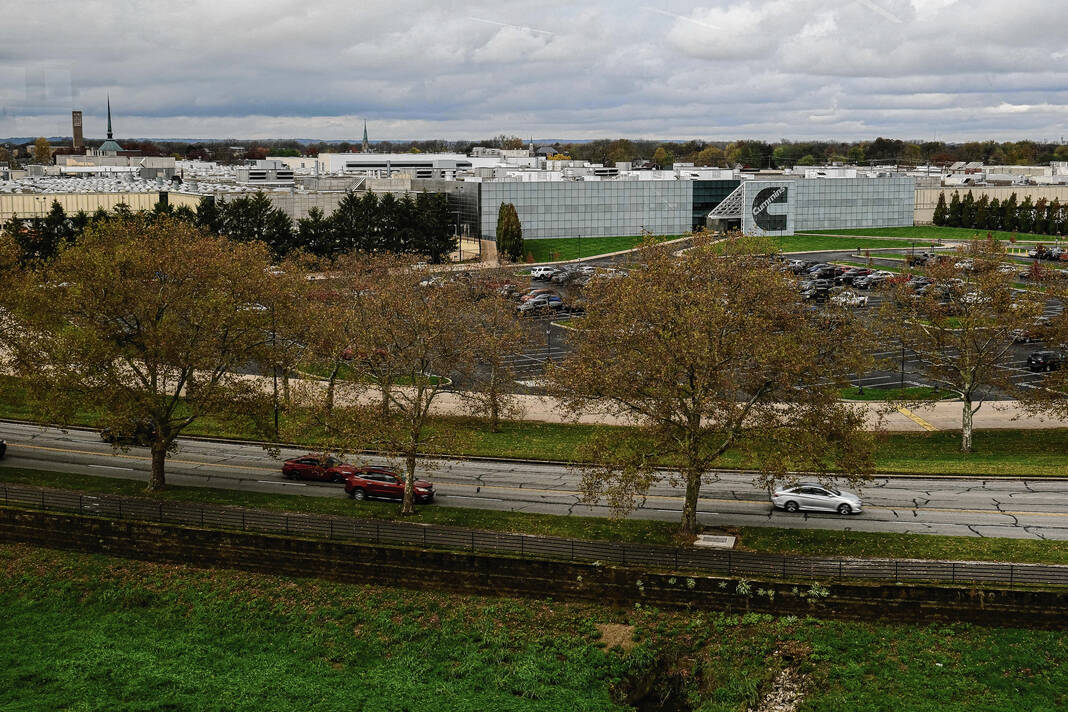
Mike Wolanin | The Republic A view of Cummins Engine Plant 1 from the fifth floor of the newly renovated Cummins Technical Center in Columbus, Ind., Wednesday, Nov. 6, 2024.
Experts say the uneven performance across Cummins Inc.’s business segments in North America reflects a widening divide in the broader U.S. economy, with some sectors surging while others have lost steam.
On one side, an investment frenzy in artificial intelligence — which is projected to channel hundreds of billions, if not more, into data centers — has fueled demand for electrical power, and, in turn, Cummins’ power generators. On the other side, the North American trucking industry has been pumping the brakes amid tariffs and uncertainty over emissions regulations, softening demand for engines and truck components.
On Thursday, the Columbus-based company reported that North American revenues in its power systems segment rose 20% from July to September compared with the same period last year “driven primarily by increased power generation demand, particularly for data center markets.”
In contrast, North American revenues in Cummins’ components segment fell 24% year over year, while North American revenues in the company’s engine segment declined 12%, largely “due to lower medium-duty and heavy-duty truck demand.” Similar trends have played out throughout the year.
One local analyst described the contrast is an “unprecedented period” in the company’s recent history. Cummins Vice President and Chief Financial Officer Mark Smith told financial analysts on Thursday that the situation “can be best described as a tale of two economies, certainly here in the U.S.”
“Definitely, two different economies,” said Steven Mohler, assistant professor of management at IU Columbus. “The AI boom is garnering significant capital dollars, but the transportation side of our economy doesn’t seem to be attracting as much capital expenditure.”
Cummins officials described the company’s third-quarter results as strong, citing the company’s diverse portfolio and its ability to “navigate ongoing uncertainty.”
Some local analysts described the phenomenon as a “paradigm shift” for a company best known for diesel engines, with growth in the power systems segment “offsetting the weakness in that core engine business.”
However, the current divide in the U.S. economy could have a “depressing effect on our economy” should it persist, experts said.
The business segments that have been seeing declines in revenue — engine and components — have facilities in Columbus, according to the company’s 2024 annual report. By contrast, the power systems segment has facilities in Friedley, Minnesota; Clovis, New Mexico; Kenosha, Wisconsin; as well as Seymour and Elkhart in Indiana.
“If you look at the last couple of years, even though the U.S. and state economies have been growing, the best I can tell, ours hasn’t,” Mohler said. “We’ve been relatively flat, maybe down a little bit. …If the power systems (facilities) are elsewhere (outside of Bartholomew County), and the two declining business pieces of Cummins are here, yeah, we’re struggling.”
‘Recessionary-level orders’
The North American trucking industry as a whole is seeing “recessionary-level orders,” while freight carriers are seeing “generationally bad levels” of profitability driven in large part by tariffs and regulatory uncertainty, experts said.
Slowdowns in the trucking industry can have major implications for Bartholomew County’s economy, which is heavily rooted in automotive manufacturing, including for heavy- and medium-duty trucks, analysts said.
A downturn in freight activity generally dampens demand for new trucks and fleet upgrades, potentially leading to reduced orders for engines and components produced by local manufacturers, experts said.
Cummins is a major supplier of engines and other components for heavy- and medium-duty trucks in North America.
On Thursday, Cummins officials said — outside of a broad economic recession or a hard emissions change — “this is the sharpest decline in truck orders that many of these people here a long time (at Cummins) have witnessed.”
Cummins said U.S. truck production “slowed sharply” in the third quarter, with shipments of heavy- and medium-duty truck engines down 27% compared to the second quarter, with company officials saying they expect to see further declines in engine shipments in the fourth quarter.
“To find a period of worst profitability — at least for the big, publicly traded truckload carriers that we track — we have to go back to 2009, 2010,” said Ken Vieth, partner and president of Columbus-based ACT Research. “I think it’s fair to say that carrier profitability remains at generationally bad levels.”
“We just continue to see a weakness in demand for medium-duty trucks, for heavy duty trucks and for semi-trailers,” Vieth added. “…Even in an economy that’s growing at 1.5% to 2%, we’re seeing this recessionary-level activity occurring in in freight markets, and that is now bleeding over into commercial vehicle demand.”
Class 8 truck net orders in September totaled 20,666 units, the weakest September performance since 2019, while medium-duty truck orders were down 19% year over year, according to ACT Research. Class 8 trucks are often referred to as heavy-duty trucks and include vehicles such as big rigs, dump trucks, cement trucks, among others.
However, companies in the trucking industry did not see full impact of tariffs during the third quarter, which ended Sept. 30.
On Nov. 1, a 25% tariff on the foreign content of imported medium- and heavy-duty vehicles into the United States took effect. About 1 in 3 North American Class 8 builds occur in Mexico, leaving fleets exposed to higher acquisition costs, according to ACT Research.
“By our estimates, the collection of all the tariffs that have occurred over the over the course of 2025 on a year-over-year basis … the price of a new Class 8 truck next year, we believe, is going to be around $10,000 higher than it was a year ago,” Vieth said. “The carriers aren’t making (a lot of) money, and because of tariffs, the cost of the truck is going up $10,000.”
Additionally, there is uncertainty around what the U.S. Environmental Protection Agency is going to handle emissions standards expected to take effect in 2027, which are expected to carry an estimated cost of about $25,000 per vehicle.
In March, the EPA said it was reconsidering the rule, but since then, “the EPA has gone dark,” Vieth said. “Nobody, I don’t believe, has any idea of what the administration is going to say,” he said.
Data center ‘gold rush’
At the same time, investments have surged in data centers, fueled by what the World Economic Forum earlier this year as a “gold rush.”
Data centers are facilities that house the servers responsible for storing, processing and transmitting vast amounts of data. They have become a focal point for tech giants like Amazon, Google, Microsoft, OpenAI and Meta to meet the enormous computational demands of AI systems.
“It’s kind of the quest for ‘ever more compute’,” said Scott Shackelford, a professor of business law and ethics at the IU Kelley School of Business. “…The concern (among tech companies) is that it’s a huge first-mover advantage. The first entity, or the first major tech company, to get to what some of the companies like Meta are billing as kind of superintelligence is going to able to unlock, or so the argument goes, just a world of economic potential.”
“Second, third, fourth place, maybe they still get there, but maybe they get there six months or a year later that could actually have the equivalent of trillions in economic impacts for these firms,” Shackelford added. “So that’s why you see the race, and that’s why you see the ripple down here and then to Columbus, Indiana.”
At the same time, lingering doubts about the economic promise of AI technology are starting to get the attention of financial institutions that raised warning flags in recent weeks about a potential AI investment bubble, The Associated Press reported.
Officials at the Bank of England last week the growing risk that tech stock prices pumped up by the AI boom could burst. “The risk of a sharp market correction has increased,” the U.K. central bank said.
The head of the International Monetary Fund raised a similar alarm, with IMF Managing Director Kristalina Georgieva saying financial conditions could “turn abruptly”
OpenAI, the maker of ChatGPT, doesn’t turn a profit but the privately held San Francisco firm is now the world’s most valuable startup, with a market valuation of $500 billion, according to wire reports.
At one point in 2022, the market valuation of AI chipmaker Nvidia was $310.28 billion. Last month, it reached $5.1 trillion, according to wire reports. That is more than the entire gross domestic product of Japan last year, according to data from the World Bank.
Additionally, research from the Massachusetts Institute of Technology published in July found that 95% of over 300 organizations consulted by researchers are getting zero returns from investments in generative AI despite pouring $30 billion to $40 billion into their efforts.
“I hear a lot of discussion by economists and people in the market, analysts that talk about the potential of a bubble, and I look back to … 1998, 1999, 2000 and the dot-com bubble,” Mohler said. “…Now, a lot of the analysts I hear talking comment that this is different. …(But) yes, there has to be a correction. This is moving and growing, and there will be a point where the market has determined that we’ve over produced, over committed. It can’t produce at the level that we anticipate. …How soon? I don’t know.”
“I don’t think anybody did a good job of projecting the dot-com bubble either,” Mohler added. “…A lot of economists might say, ‘Well, things aren’t parallel.’ Things don’t repeat, but they’re similar. We probably won’t see it repeat, but (rather) a similar reevaluation at some point.”
Shackelford, for his part, said “it’s really hard to say” whether there is an AI investment bubble.
“There are plenty of folks who think we’re in an AI bubble already, that we’re, you know, investing too much and putting too many eggs in one basket,” Shackelford said. “…When you look at the economic data for the year, there’s a case to be made that we would be close to, if not in, a recession but for this tremendous amount of investment going in to the AI field. It is propping up large segments of the U.S. economy at this point.”
In the meantime, only time will tell if the North American truck market rebounds before any potential market correction in AI.
For now, Cummins officials said they expect demand to remain high in the company’s power systems segment.
“We expect demand for power systems and distribution to remain strong through the fourth quarter and going into 2026,” Smith said on Thursday. “At the risk of sounding cautiously optimistic, I hope that demand in North America on-highway markets is close to bottoming in the fourth quarter in what has been a protracted and difficult slowdown.”
“We do anticipate a further 15% decline in our engine shipments to on-highway markets in the fourth quarter compared to the third quarter.” Smith added.