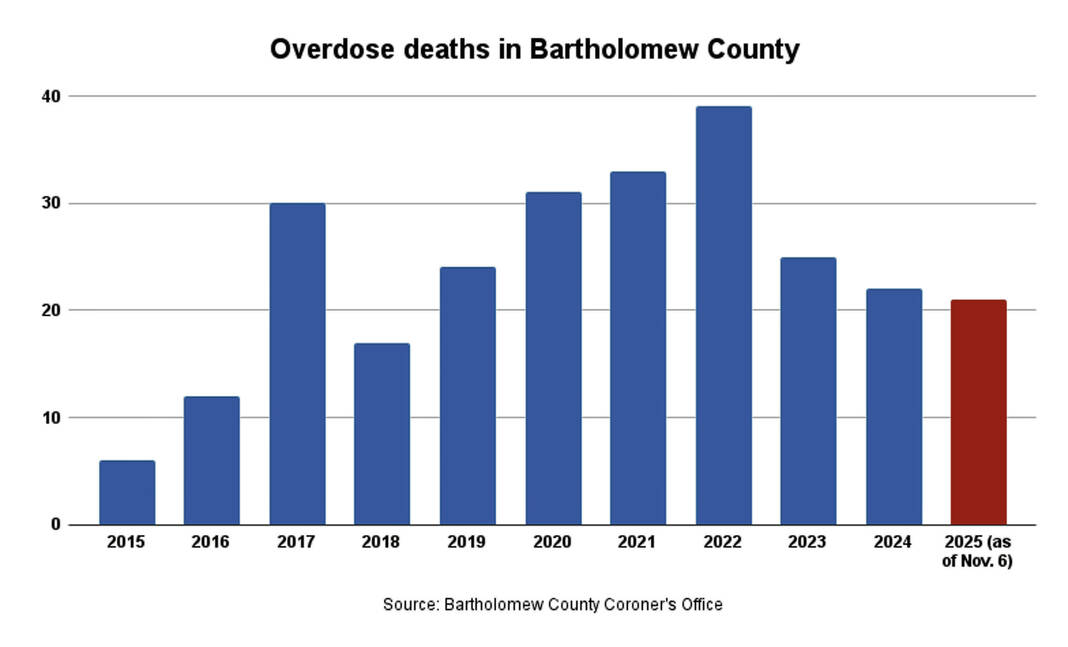
Chart showing overdose deaths in Bartholomew County over the past 10 years. Chart by Andy East | The Republic
Overdose deaths in Bartholomew County are on pace to increase the year as the county heads into the final stretch of 2025.
As of Thursday, there had been 21 overdose deaths in the county, according to the Bartholomew County Coroner’s Office. By comparison, there had been 19 overdose deaths at the some point in 2024.
That puts the county on pace for roughly 25 overdose deaths this year, which would be an increase from 22 deaths last year, but down from 39 in 2022, the highest annual total on record. There were 260 overdose deaths in Bartholomew County from Jan. 1, 2015, to this past Thursday.
The Bartholomew County Coroner’s Office said fentanyl and methamphetamine are the two most common substances that have appeared on toxicology tests so far this year, though officials have said in the past that most overdose deaths involve multiple substances.
Fentanyl is a synthetic opioid that is more potent than heroin but is cheaper to produce and distribute. Officials have said fentanyl is increasingly being cut with other drugs, including counterfeit pills.
“The goal is zero overdose deaths, and we are still far from that,” said Dr Kevin Terrell, medical director of Columbus Regional Health’s Treatment and Support Center, or TASC. “The good news, I suppose, is that we are still well below our community’s high of 39 overdose deaths from just a few years ago.”
At the same time, local drug treatment facilities, including TASC, have continued to see increases in the number of people seeking help for substance abuse issues. TASC, 2630 22nd St., has been consistently seeing more than 400 active patients, Terrell said.
Terrell said the most common substances that appear on patients’ urine screenings are fentanyl and methamphetamine, though TASC has started to see an increase in intentional cocaine use.
“The main difference is that we are seeing more intentional cocaine use than we did in prior years,” Terrell said. “Until about six months ago, patients were surprised to learn that cocaine was in the fentanyl or methamphetamine they were using. Today, some people are intentionally using cocaine and having difficulty stopping. The number of positive tests for cocaine isn’t big, but it’s a change from prior years.”
For its part, the local Joint Narcotics Enforcement Team, or JNET, has seen an increase in the number of times that cocaine has been seized during investigations this year, said Columbus Police Department spokesman Lt. Skylar Berry. So far this year, JNET has seized 377 grams of cocaine.
Formed in 2015, JNET is made up of undercover officers from CPD and Bartholomew County Sheriff’s Office and a Bartholomew County Deputy Prosecutor. Berry emphasized JNET’s “commitment to stopping drug dealers.”
“Through our combined efforts with the Bartholomew County Sheriff’s Office and Bartholomew County Prosecutor’s Office working with local, state and federal law enforcement, we will continue to target those bringing these dangerous drugs into our community,” Berry said.
The updated figures from the coroner’s office come a few months after the federal government reported that there were 30,000 fewer U.S. drug overdose deaths in 2024 than the year before — the largest one-year decline ever recorded, The Associated Press reported.
An estimated 80,000 people died from overdoses last year, according to provisional Centers for Disease Control and Prevention data released Wednesday, according to wire reports. That’s down 27% from the 110,000 in 2023.
The CDC has been collecting comparable data for 45 years. The previous largest one-year drop was 4% in 2018, according to the agency’s National Center for Health Statistics.
All but two states saw declines last year, with Nevada and South Dakota experiencing small increases, according to wire reports. Some of the biggest drops were in Ohio, West Virginia and other states that have been hard-hit in the nation’s decades-long overdose epidemic, according to wire reports.
There were 1,695 overdose deaths in Indiana during the 12-month period that ended in December 2024, down from 2,193 during the same period in 2023 — a 23% decline — according to the provisional CDC data.
Bartholomew County saw declines in overdose deaths the previous two years after surging to records highs in 2020, 2021 and 2022, according to county records. Overdose deaths in the county declined 36% in 2023 and 12% in 2024.
Experts say more research needs to be done to understand what drove the reduction, but they mention several possible factors, including, among other things, increased availability of the overdose-reversing drug naloxone, expanded addiction treatment, shifts in how people use drugs, the impact of opioid lawsuit settlement money, according to wire reports.
Terrell, for his part, said he encourages everyone to carry naloxone and has two main concerns about drug abuse in Bartholomew County — animal tranquilizers such as xylazine and medetomidine and the increasing use of synthetic cannabinoids typically referred to as “spice.”
“I have two real concerns about drug abuse in our community,” Terrell said. “The first is the introduction of animal tranquilizers in our community (including xylazine and medetomidine). …Their effects are similar to sedating drugs, such as Valium. The real problem is that they are often added to the fentanyl supply and increase the risk of overdose deaths.”
“My second concern is the increased use of synthetic cannabinoids, which are typically referred to as spice,” Terrell added. “…People tend to use spice under the impression that it is as harmless as marijuana. The reality is that spice can cause serious problems, including heart problems, psychosis, kidney failure and death. People who use spice regularly can develop a withdrawal syndrome that causes problems similar to alcohol withdrawal. Spice withdrawal can cause seizures and death.”