Phillips
Bartholomew Consolidated School Corp. board members heard information about a drop in enrollment in the district this fall, which administrators attributed to factors including a smaller class of kindergarteners and an increased number of transfers to other online programs in the state.
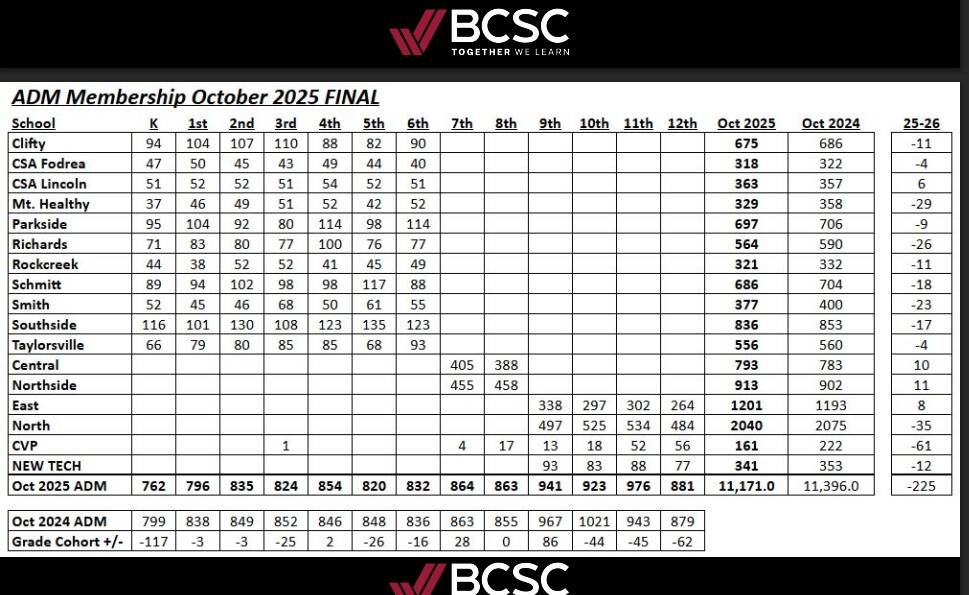
Brett Boezeman, assistant superintendent for finance and operations, gave the annual fall report of BCSC’s average daily membership (ADM) numbers, which is down 225 students compared to last fall.
The ADM decrease from 11,396 in Oct. 2024 to 11,171 this October is the largest dip the district has seen since a drop of 148 students in 2009-10 when International Charter School of Columbus opened, only to later close in 2013-14.
Average daily membership is used by the Indiana Department of Education to allocate state funding to go towards school district’s education funds, which are used to pay for items such as teacher salaries and classroom materials.
The decline in ADM means the district is down about $1.8 million in state-supported tuition towards the education fund, Superintendent Chad Phillips said.
The district is basing future ADM projections upon a demographic study it commissioned in 2016 and updated in 2021.
The school corporation has received preliminary information regarding another update to the study from consultant Susan Brudvig. Brudvig was asked to do the 2021 update as well.
Across BCSC’s 11 elementary schools ADM is down 145 students from last year, while ADM in the district’s two middle schools is up 21 students.
The ADM counts for BCSC’s high schools as of this fall are 1,201, 2,040 and 341 at East, North and CSA New Tech respectively. East’s count is up eight students while North is down 35 students. The count at New Tech is down 12 students.
Part of the drop had been anticipated because the current kindergarten class of 762 students is much less than the outgoing 2024 senior cohort of 879 students. Increasingly smaller kindergarten cohorts is a trend seen across the state in similarly-sized districts, according to Boezeman.
But BCSC officials say that another reason is an increased number of junior students graduating early because of the help of the team cohort model, which has the aim of making sure each student gets consistent, personalized guidance for all four years of their high school experience.
Cohort teams — made up of an assistant principal, guidance counselor, academic coach and administrative assistant — meet weekly to monitor academic progress, attendance and engagement. The teams proactively identify students who may be off-track and put together supports to help them course correct.
This year’s senior cohort lost 62 students between this year and the group’s junior year. That number was a bit of a surprise, BCSC officials said, but found after digging deeper that it’s in part due to 40 students who graduated at the end of their junior year.
There were 29 students from East who graduated early and 11 at North, according to the data. At least a portion of those had intentions to perhaps even drop out of school to begin working, and their team cohort advisers put them in a position where they could get all their credits done early to do so, BCSC officials said.
There has also been a rather significant number of students who have transferred out of Columbus Virtual Pathways (CVP), which BCSC officials said is due the district’s increased accountability of students in the program compared to other online options.
Enrollment in CVP decreased 61 students between this year and last to 161 students, continuing a trend of declining enrollment since an apex of 458 students in September of 2021 in the aftermath of the pandemic.
Part of the reason for that is a change driven by the cohort teams about a year-and-a-half ago where the district started to clamp down on expectations, ensuring that students in CVP really learn best online rather than in person and otherwise increasing accountability.
When team cohort leaders would say that a given student would learn best in-person rather than in CVP, often times families would just withdraw the student from BCSC and enroll them in another online program instead of returning in-person, according to BCSC officials.
A sampling of data from a transfer report provided by the state showed that there were 163 students in 2025 within the boundaries of BCSC that transferred to one of 12 districts that have some type of online program. Transfers to those 12 districts is up 117 students from 2021, according to data presented to school board members.
For example, the data showed that 45 former BCSC students attended Clarksville Community School Corp. this year. Boezeman pointed out it’s unlikely that all 45 students are driving an hour to attend in-person classes in Clarksville, so administrators are assuming a substantial number of those are likely enrolled in Clarksville’s online program.
Along those lines, 57 former BCSC students this year students transferred to Union School Corp., based in Modoc with a population less than 200. The district oversees Indiana Digital Learning School, a virtual school that has grown more than 7,500 students and been under a microscope by the state, which cited poor test scores.
Boezeman used an example of one BCSC student, who attended North through the first semester of their sophomore year and earned 15 of the 40 credits needed to graduate before transferring to another online academy during the second semester of their sophomore year.
When the student returned to North as a junior, they hadn’t earned any additional credits in the time since they left, prompting their cohort team to make additional efforts to catch them up. That’s just one anecdote out of other similar stories that team cohort leaders have told administrators about.
“This is an issue that, number one, is obviously not good for kids,” Phillips said. “It’s not good for our district if we lose our students and have to catch them up when they come back, and it’s not good for the community.”
Phillips said enforcing increased standards in other online programs is something administrators have reached out to state legislators about.
Board member Jason Major, District 1, who has repeatedly said he doesn’t think the district should be building a 12th elementary school in Maple Grove, cited the drop in enrollment as evidence that it’s not needed.
“My concern is: will that ever come back up? Because I go back to my continued disagreement with the need for another elementary school. I know there’s other reasons other than enrollment, but enrollment is what pays the bills.”