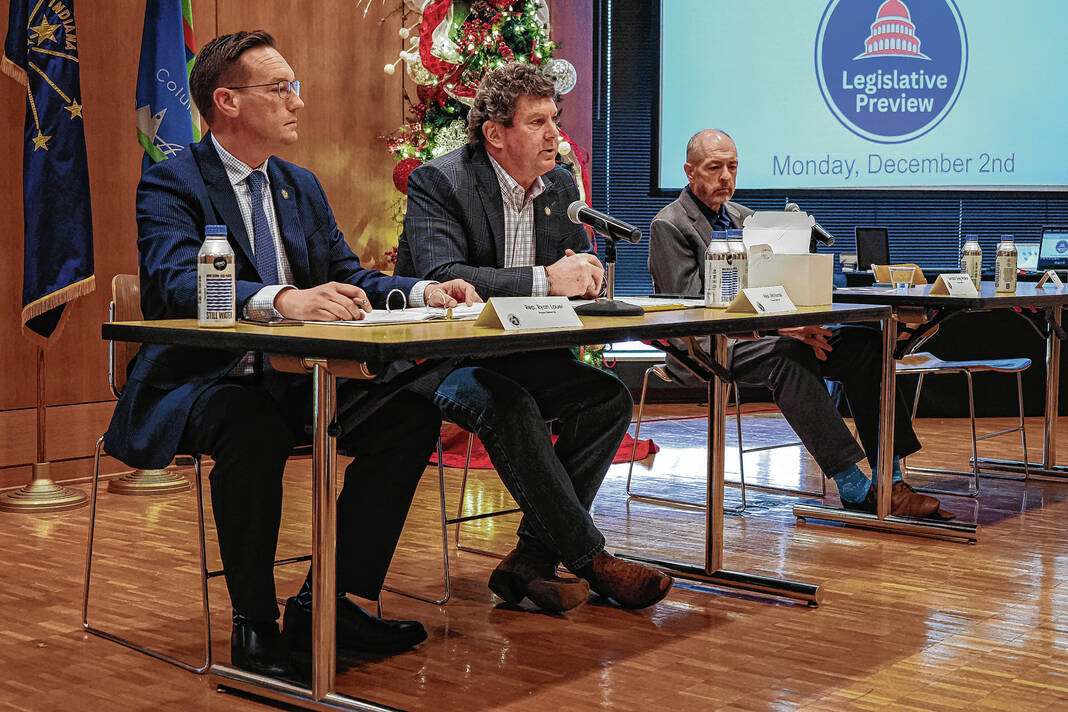
Mike Wolanin | The Republic State Representatives Ryan Lauer, from left, Jim Lucas and State Sen. Greg Walker take part in a legislative preview session at Columbus City Hall in Columbus, Ind., Monday, Dec. 2, 2024.
President Donald Trump’s push to redraw Indiana’s congressional maps ahead of next year’s midterm elections has continued to leave Republican lawmakers divided and uncertain about what to expect as they return to the statehouse next week to take up redistricting.
The House is scheduled to convene for a special session on Monday to consider redrawing Indiana’s congressional map — a process that is normally done once a decade after the census, not mid-decade at the request of a president seeking a partisan advantage for his party in a midterm election.
After Indiana Republican senators initially rejected Trump’s redistricting push, the Senate is now expected to convene starting Dec. 8 to “make a final decision on any redistricting proposal sent from the House.” Republicans hold supermajorities in both chambers.
The push by the White House seeks to press Indiana Republicans to redraw the state’s U.S. House districts in ways that — at least in theory — could flip Democratic-held seats and help preserve the GOP’s narrow national majority in Congress. Republicans currently hold seven of Indiana’s nine seats.
The outcome of the upcoming special session could affect which congressional district Bartholomew County residents will be in for next year’s election. Experts have said attempts to redraw either or both of the state’s Democratic-held congressional districts could set off a chain reaction that would reshape the boundaries of Indiana’s 6th and 9th Congressional Districts — both of which include parts of Bartholomew County.
But even just days before the House is set to convene, state lawmakers representing parts of Bartholomew County said they expect to discuss redistricting but are unsure about what exactly may be proposed or what the prospects a proposal would have of making it to the finish line.
“You know as much as I know. We’ve been called in Monday. We’ll just go from there,” said Rep. Jim Lucas, R-Seymour, who was initially opposed to early redistricting but now supports it, evolving from a “‘hard no’ to a ‘hell yes.’”
“I know you’re never supposed to assume anything, but I would assume that the people pushing for this have maps in mind,” Lucas added.
Sen. Greg Walker, R-Columbus, who has been a vocal opponent of early redistricting and has characterized the effort as “cheating” and a “ridiculous idea” that would backfire against Republicans, said he has not been presented with any proposed maps.
“No one has seen a bill yet. No one has seen a map yet,” Walker told The Republic. “There may be some attempts at mapmaking, but there is nothing, to my knowledge, that has been drafted and gone through the drafting process that is part of our normal business. So, if there are maps that exist and if people have put their eyeballs on them, they’ve not looked anything that has been drafted through Legislative Services, as far as I am aware.”
“I’m just watching like you are, trying to figure out what’s going on,” Walker added.
Rep. Ryan Lauer, R-Columbus, who initially said early redistricting would be “ill-advised” but later evolved to be “open” to the idea, said he is unsure whether any proposed maps could garner enough support to make it to the Gov. Mike Braun’s desk.
“It’s unclear at this moment, to me anyway, if the redistricting will go the full (legislative) process or not, but I think it’s important to have the debate,” Lauer told The Republic. “…When the initial bill is put out, then we’ll have a more concrete example of what we’ll be debating.”
Divided GOP
Initially, Lucas, Lauer and Walker each opposed the White House’s push to redraw Indiana’s congressional map ahead of next year’s election, collectively dismissing early redistricting as “ill-advised,” a “ridiculous idea” and “highly unusual and politically optically horrible.”
But after meetings with Vice President JD Vance and an August visit to the White House to meet with Trump administration officials, the three lawmakers have become divided on the issue.
Walker, who did not travel to the White House in August, remains the only one of the three who has not shifted his stance, telling The Republic this week that early redistricting amounts to election “cheating.”
On Wednesday, Walker said he had turned down an invitation to visit Trump in the Oval Office last week and accused the White House of violating the Hatch Act, which restricts certain political activities by federal employees.
Walker said he was contacted by a White House official on Nov. 17 and was invited to visit the Oval Office on Nov. 19 — the same day that he ended up being the victim of a swatting incident.
“How does (Trump) have the time to mess with a nobody like me with all of the important matters that are to take his attention as the leader of the executive branch in this nation?” Walker said. “There is no way that he should have time to have a conversation with me about Indiana mapmaking when that’s not his business for starters. But secondly, doesn’t he have anything better to do? I can make a big list of things that are more important for him to focus on.”
“I’ll guarantee you this — my opinion will not change,” Walker added. “And having been swatted didn’t convince me that the … right thing to do is to redistrict midterm. So what tactics are you going to use? There’s no leverage to change my mind. I know right from wrong. I was taught as a child the difference between right and wrong, and this is just wrong on so many levels.”
Shifting stances
Lucas and Lauer, however, accepted the invitation to the White House in August and have since softened their stances on early redistricting.
Before the White House meeting, Lucas said redrawing the state’s congressional map would be “highly unusual” and “politically optically horrible.” He also told The Republic at the time that he would be “a vocal no” against early redistricting should the topic come up at the White House.
“I don’t believe Republicans should stoop to the level of Democrats on this issue,” Lucas said initially. “…If there are seats that need targeted, we should do it the old-fashioned way and campaign harder in those districts.”
After the White House visit, Lucas said he had become “open-minded” about early redistricting, citing concerns about the paralyzing effect a Democratic House majority would have on Donald Trump’s agenda.
Since then, Lucas has gone from what he has described as a “‘hard no’ to a ‘hell yes’” on early redistricting. On Wednesday, Lucas told The Republic he supports early redistricting “even more so” than he did previously.
“We’ve seen the Democrats the first four years (during the first Trump administration) when they had (a majority) in the House, they manufactured things to go after him and justify their false impeachments. …Anything we can do to maintain a Republican majority in the House, within the law, I think we have an obligation to do, because today’s Democrat Party is not the same as 15, 20 years ago.”
“(The Democrats) will fabricate anything possible to undermine al of the great things that President Trump wants to do for our country,” Lucas added.
Before the White House visit, Lauer told The Republic that early redistricting would be “ill-advised. “I’m not for changing the maps,” he said in mid-August. “…From constituents reaching out to me, I think the consensus is that we should continue with the tradition of redistricting every 10 years unless there are extraordinary circumstances. But I don’t see this as an extraordinary circumstance.”
After the White House visit, Lauer said lawmakers had “an eye-opening conversation” about redistricting with Trump administration officials, who he said “made a strong case from a national perspective.” Last month, Lauer said he was “open” to the idea of early redistricting.
On Friday, Lauer told The Republic that he remains open to the idea but believes it is possible for lawmakers to draw a new congressional map that is “as fair or fairer” than the current map.
“I would not be surprised that a more competitive map can be drawn that is as fair or fairer (than the current map) but gives much more competition between three or more districts,” Lauer said. “From that perspective, we could have a more fair and more competitive map, but this is what the debate is going to be about (next week). …I think there are arguments on both sides.”
Walker, for his part, said the House will likely need to suspend rules to expedite the passage of a proposed map and would need to pass one within the next week for it to be ready for the Senate when it convenes on Dec. 8.
Additionally, Walker, who is not seeking reelection, said he still believes that redrawing the state’s congressional map will backfire against Republicans.
“Once you dilute the Republican strongholds — if you want to call them that, or the areas where there’s a significant population advantage — those advantages are going to be diluted or disappear,” Walker said. “…But when I said it would backfire, my thought was very much in terms of the election process. Hoosiers don’t like cheating. I feel like this is cheating, and they will react strongly at the polls, and they’ll punish all incumbents because most people won’t take the time to dissect, ‘Well, who was it that supported this redistricting mid-cycle and who didn’t support it mid-cycle?’”
“I would say that if this whole (redistricting) effort is successful, then the (Republican) Party may get the humility that it deserves,” Walker said.