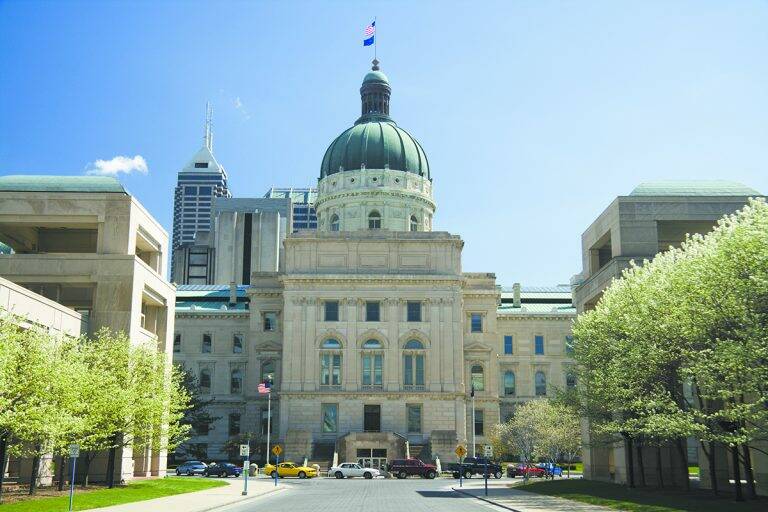
The Indiana Statehouse. IBJ photo
By Marek Mazurek
Indianapolis Business Journal
For The Republic
INDIANAPOLIS — While a contentious redistricting measure makes its way through the Indiana House, lawmakers are beginning to consider a number of other policy matters as the 2026 session gets underway.
There are already bills filed on topics ranging from teaching cursive handwriting in schools to data centers to new casinos. Some of those bills were heard in committees this week, but the main focus of House leadership has been on redrawing Indiana’s congressional maps.
The House and Senate deadlines for filing bills are Jan. 7 and Jan. 9, respectively, so there’s still plenty of time for legislators to submit language to be considered in the 2026 session.
Here are a few noteworthy bills to keep an eye on as the session progresses.
Allen County casino
The 2025 session got the ball rolling on a casino being added or relocating to Allen County. Now, armed with a study on potential casino sites, lawmakers are revisiting the conversation.
House Bill 1038—filed by Rep. Craig Snow, R-Winona Lake—would set the framework for bringing a casino to northeast Indiana. The bills requires the casino operator to pay the state a $50 million up-front licensing fee and invest at least $500 million into the casino development.
Any new casino would need the blessing of the Allen County Council, as well as approval from the city council where the development would be built. However, as currently written, the bill would not require a county-wide referendum as has been the custom for most past measures that shifted casino licenses.
In a statement, Snow said he hopes his bill is the starting point for continued debates over gambling licenses in the state.
“I authored this bill to get the conversation started,” Snow’s statement reads. “The hope is to have meaningful discussions to get the ball rolling and strategically analyze the data to see what the best option for Indiana and Allen County would be. I look forward to continuing these conversations this legislative session.”
A similar bill was filed Wednesday in the Senate by Sen. Justin Busch, R-Fort Wayne, though that bill specifies the casino license would be granted to Full House Resorts, which currently operates a casino in Rising Sun.
The study on potential sites was compiled by Philadelphia-based Spectrum Gaming Group. The analysis found a casino in downtown Indianapolis would generate the most revenue for the operator and taxes for the state at a projected $170 million in gambling tax revenue each year and more than $490 million in estimated gross annual revenue.
A casino in Allen County could yield $61 million in taxes per year, and $204 million in gross annual revenue, the study found. The study noted the Allen County location would siphon off very little revenues from other existing Indiana casinos, while the Indianapolis location would draw more heavily from casinos in Shelbyville and Anderson.
Data center permits
Data centers, and their significant use of resources, have become a hot-button issue in the past few months as a small, but growing number of counties are passing bans against them.
One Democrat is seeking to alleviate concerns over water usage with a bill that would require data center operators to get water consumption permits.
According to language filed by Rep. Alex Burton, D-Evansville, any data center facility capable of consuming 10 million gallons of water a day would need a permit from the Department of Natural Resources.
Burton said his legislation is a win for both developers and local communities, as he thinks more counties would be comfortable with data centers if they knew there were “fair and reasonable standards” in place for water usage.
“Establishing safeguards like I’m proposing could ease some concerns around data centers,” Burton told IBJ.
The bill says the DNR may not approve a permit if the data center would “impair” watershed health. The bill would apply to both existing and new data center projects. A Legislative Services analysis says there are 70 facilities in Indiana that might fall under the bill’s provisions.
Lieutenant governor selection
Another bill to watch is one which would change the way Indiana chooses its lieutenant governor candidates.
Rep. Danny Lopez, R-Carmel, is carrying House Bill 1022 which upends the practice of party insiders choosing lieutenant governor nominees at state party conventions. Typically, the Republican and Democratic nominees for governor pick their running mate and state delegates go along with the candidate’s wishes.
That precedent was broken by Indiana GOP delegates last year when they chose Hamilton County pastor Micah Beckwith over Mike Braun’s preferred choice; Rep. Julie McGuire.
The proposed language would require the Democratic and Republican gubernatorial nominees to pick a lieutenant governor candidate and file jointly by July 15 in an election year.
Lopez’s bill has already garnered Beckwith’s attention. In a social media post this week, he labeled it “the Micah Beckwith bill” and said it’s “not surprising from the Republican who refuses to stand with President Trump and will try to take down those who do.”
Lopez did not respond to a request for comment about the bill.
Carbon sequestration
A bill filed by Sen. Rick Niemeyer, R-Lowell, would require carbon sequestration projects that transport carbon dioxide outside the county where the chemical compound originated to receive local approval.
The bill does not appear to affect a pilot project led by Wabash Valley Resources to make anhydrous ammonia fertilizer at a former coal plant in Vigo County. Wabash Valley Resources plans to pipe and inject 1.67 million tons of carbon dioxide annually a mile underground in nearby Vermillion County. That pilot project is covered under a separate section of code from Senate Bill 7.
Oil company British Petroleum also had plans to store carbon from its Whiting refinery in other counties in northern Indiana, though that plan was put on hold earlier this year.