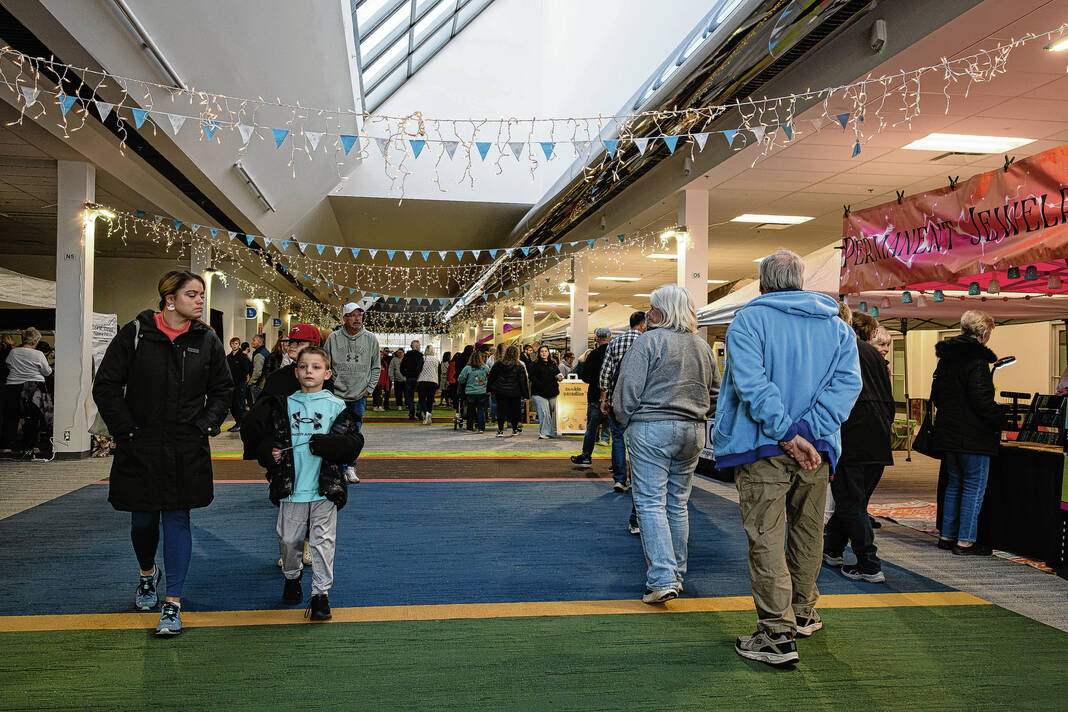
Mike Wolanin | The Republic People walk past vendor booths at the Seasonal Entertainment Arts and Recreation Space (SEARS) Winter Market in the former Sears building in Columbus, Ind., Saturday, Dec. 20, 2025.
With the holidays in full swing, a couple of local groups in partnership with the city worked to provide the community with an item that was on their wish list.
The former Sears Building saw its most activity in quite a while this past Saturday for the first iteration of the S.E.A.R.S. Indoor Winter Market, a free pop-up event featuring local vendors, kids activities and live music that’s going to be tested out over four more dates through February.
The repurposing of the “Seasonal Entertainment Arts and Recreation space,” at 318 Jackson St. is evidence of the Columbus Downtown 2030 plan in action, and turned out to be a hit its first time around.
During the input process as part of the city’s newest strategic plan, one common piece of feedback from community members was how much they appreciated the Columbus Farmer’s Market, and how there was an appetite for more of something similar.
Urban planning and design firm Sasaki, who partnered with subconsultants SB Friedman and Storyboard in the plan’s inception, put together more than 50 recommendations for the future of downtown, based on community feedback, divided over the immediate to long-term.
Since the recommendations were officially released in September, three different implementation teams Mayor Mary Ferdon put together have begun looking for ways to realize some of the ideas in the plan.
One such recommendation in the 2030 plan was some type of market hall to operate as a year-round Columbus Farmer’s Market location. This drove momentum for the pop-up, which was a collaboration between the city’s department of community development, Office of Downtown Development (ODD) and Columbus Area Arts Council.
“This all came together in like eight weeks,” said Jacob Sipe, the city’s director of community development. “We wanted to do something immediate that can engage everybody.”
As he spoke a day before the market opened, Sipe was rearranging some cones for what would turn out to be a popular big wheel track.
“I saw the space and knew that we wanted it to be multi-generational,” said Sipe, who joined the city over the summer after previously serving as executive director for the Indiana Housing and Community Development Authority (IHCDA). “I had no experience working on big wheel tracks with the state.”
And with four dates to come on Jan. 3, Jan. 17, Jan. 31 and Feb. 14 from 11 a.m. to 5 p.m., there’s always room for improvement.
“We would have liked to have a couple ping-pong tables,” Sipe posited, taking estimation of the kids play area.
“During those sessions with Storyboard— a lot of voices said: ‘Love the farmer’s market,’” said Ike DeClue, executive director of ODD. “’We wish there was something comparable to that in the winter.’”
The market encompasses a “main street” area with more than 20 vendors, a play area for children overseen by kidscommons, as well as a space for a beer garden, picnic tables and a performance stage programmed by Columbus Area Arts Council. Food trucks sitting outside on Jackson Street served as dining options.
Daniel Martinez, director of Indiana University’s J. Irwin Miller Architecture Program designed the layout for the market, DeClue said. A $15,000 grant community development provided to ODD got the pop-up off the ground.
The Office of Downtown Development organized two different outdoor night markets in November and December for First Thursdays, and it was evident there was continued vendor interest in similar opportunties.
Josie Royer, who does marketing and events for ODD, said they were able to build a healthy vendor list, and when calls went out for the winter market, vendors were eager to get a spot.
“We’ve gotten an overwhelming amount of vendor applications for this one— we have 60 applicants,” Royer said. “I think it’s rare that Columbus has one big event where there’s opportunities for a lot of vendors to come together and have such good exposure. I think a lot of people miss the farmer’s market once it ends in September. So I think having something that’s similar— that’s indoors and seasonal— is really intriguing for people.”
There’s free admission to the market, but people are asked to provide feedback by writing on a large white board situated near the kids play area.
“The great thing is, every two weeks if something doesn’t work, we’re willing to scrap it and add something better,” DeClue said. “And then each two weeks, if people really like something, we’ll keep that.”
“And then hopefully by the last one in mid-February, we have a really good idea of what worked and what didn’t, so that if there was a more permanent location (for the winter market), we know what people really want,” DeClue went on.
The city purchased the building from Cummins for $4.2 million in 2024, with the idea being that it will be sold back to a private developer sooner-rather-than-later, with its new use informed by the 2030 plan.
“It may or may not be here,” Sipe said, noting that the 2030 plan actually shows a market hall closer to the end of Fourth Street.
“The idea is this is going to allow us to say to developers, number one, we want a market hall,” Sipe said. “And then number two, this is what the community has said that they value in it. And then how do we incorporate that into a larger development?”
Sipe said that ideally, a future market hall would be part of a residential multi-family property.
“It really is about allowing us to have an informed conversation with developers,” Sipe said. “Hopefully when you come back every Saturday, it’s going to look a little different.”
More information can be found at: searsmarket.com.