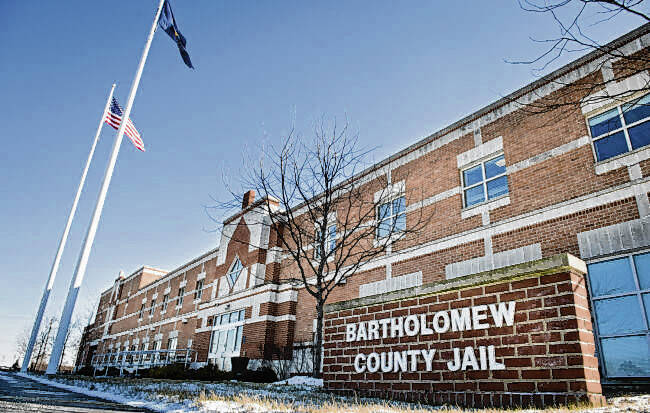
Mike Wolanin | The Republic The exterior of the Bartholomew County Jail in Columbus, Ind., pictured Friday, Dec. 15, 2017.
County officials on Monday renewed an agreement that will provide around-the-clock medical services to inmates housed at the Bartholomew County Jail.
The Bartholomew County commissioners finalized a one-year agreement with Carmel-based Quality Correctional Care (QCC) for $1,036,334.86 to provide medical care to inmates.
The county has been using QCC since June 2024, switching to the provider after using Advanced Correctional Healthcare (ACH) of Franklin, Tennessee for the previous 17 years.
The change was chiefly made because QCC is able to provide 24/7 healthcare, which ultimately cuts down on potentially expensive emergency room visits if a nurse isn’t present when an incident involving an inmate happens.
“That was one of our big expenses, was when we didn’t have access to a physician and/or nurses, the easy out was send them to the emergency room,” said Commissioner Larry Kleinhenz, R-District 1. “It’s costly.”
The county will pay QCC in 12 monthly installments of $86,361.24 through the end of 2026, said Chief Deputy John Martoccia.
ACH supervised licensed practical nurses who provided 104 nursing hours during established hours on weekdays. In contrast, QCC doubled the amount of time by providing 208 nursing hours on a 24/7 basis.
QCC, widely-used by county jails in the state, also provides a full-time registered nurse to oversee the LPNs, as well as a part-time electronic medical records keeper. The county previously employed two full-time nurses at the jail, which were replaced through the agreement with QCC.
The population at the jail in 2024 was hovering close to 300 inmates, up significantly from population ranges between 160 to 200 that were typical 20 years before.
The inmate population at the county jail is now at about 195 inmates, Martoccia said, in part due to legislative changes that decreased the number of lower-level felony offenders the jail was housing.
Legislation reforming Indiana’s criminal code was passed in 2013, which among various changes, removed the previous four-level felony penalty classification and replaced it with the current six-level felony penalty classification.
It also made it so that people convicted of Level 6 felonies, the lowest felony classification, would not be eligible for state prison and would do their time instead at county jails. But that resulted in county jails experiencing overcrowding before later legislation gave judges discretion to send Level 6 offenders to state prisons, especially if a local county jail was full.
“A lot of it has to do with the F6s go back to prison now,” Martoccia said of the inmate population decrease.
Enlisting the medical services provider is also a matter of protecting the county from liability.
When the original agreement was signed, the commissioners made reference to a $7.25 million settlement the Jackson County government paid to resolve federal civil rights lawsuits filed by the surviving relative of an inmate. Joshua McLemore, 29, died in 2021 after spending 20 days in solitary confinement in the Jackson County Jail.