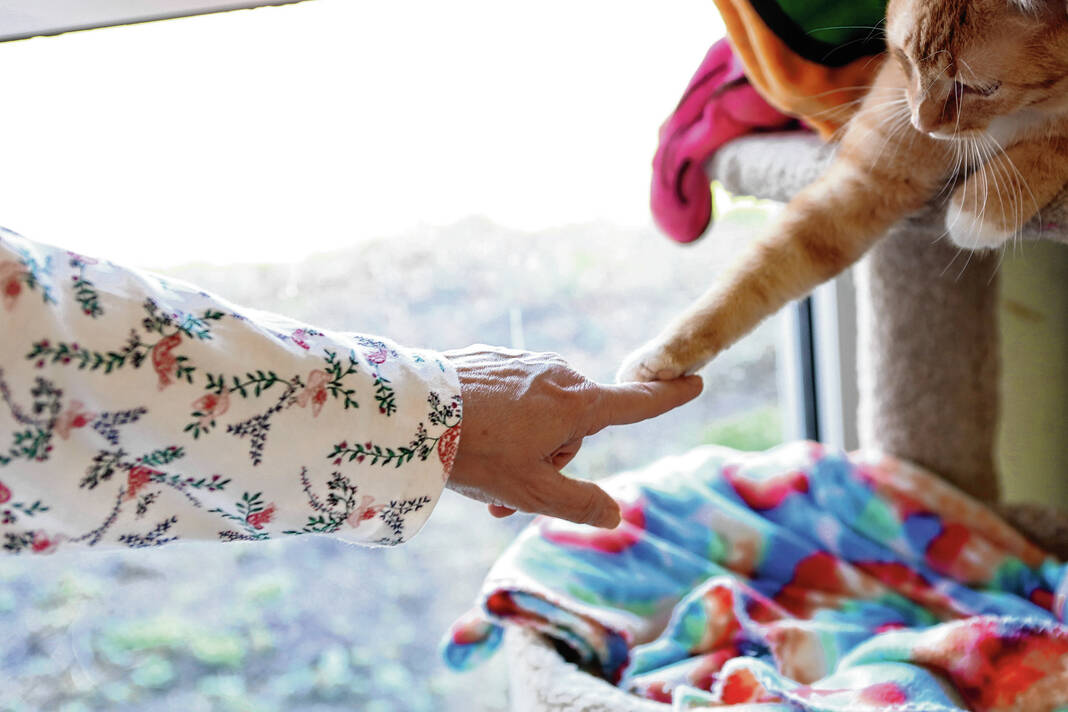
Carla Clark | For The Republic The hand of Kathy Bealmear, Bartholomew County Humane Society volunteer, is touched by the paw of Tigger as she works on socializing the cats, Wednesday, May 13, 2024.
A new agreement finalized this week sets the terms for how much county government will pay the Bartholomew County Humane Society (BCHS) for animal control services over the next five years.
The agreement between the Bartholomew County commissioners and the Humane Society was described as “monumental” by BCHS Board President Elizabeth James, who said it will enable both groups to more effectively impact the causes of shelter overpopulation.
“For the first time, the Humane Society and the county are pivoting towards incentivizing all parties to decrease pet population,” James said. “… We’re trying to implement a model to where we bring in fewer animals that incurs fewer costs for the county. But it also allows us to be funded in a way that we can support an in-house clinic, which is very expensive.”
That in-house clinic is BISSELL Pet Foundation’s (BPF) Fix the Future program, which accepted BCHS as a host organization last year. The program pays contracted veterinarians to perform high-volume spay and neutering services.
“Our hope is that we can set a regional standard, if not a state-wide standard, on how we can get ahead of this problem,” James said.
The county has invested more resources into its animal control operation of late, adding a second full-time animal control officer for the first time in 2026, supporting BCHS’ new low-cost spay and neuter program financially, equipping each animal control van with chip readers and increasing training of animal control officers. Through the new agreement, the county is also more fairly compensating BCHS for their services.
BCHS agrees to take in all animals brought in by county animal control officers as a result of ordinance violations or any lost, stray, homeless or injured animals, according to the agreement. The Humane Society also agrees to provide housing, shelter, food, water and veterinary care to the animals as well, and work to place them for adoption with suitable owners.
The new agreement states that the county will provide BCHS a flat-fee of $100,000 each year through 2030 to cover the cost of care for the first 125 animals brought to BCHS by county animal control. The county will pay BCHS an additional $950 for each animal turned over to BCHS if they aren’t claimed within the first 48 hours.
The $950 number may seem like a lot on face value, but animals turned over to BCHS typically spend between 40 and 43 days in the shelter, according to BCHS Executive Director Shawn Bilton. Expenses related to pet food, veterinary care and compensating staffing can stack up.
“Going into this model of incentivizing decrease in pet population is huge,” James said. “Going from, ‘Hey, this is the check we’re going to cut you each month,’ to now it’s going to be per animal— we’re all on the same page, us and the county, on let’s get these numbers down.”
“The hope is at the end of five years, the cost to us is much less because we can now be aggressive with spay and neuter and lower intake, which will lower county costs,” James continued.
This year is the 60th year the county has had its relationship with BCHS. The agreement for animal control services between the two parties essentially hadn’t been updated since the relationship started.
Previous agreements were on an annual basis, but both parties wanted to focus more on the long-term this time around, said Commissioner Tony London, R-District 3.
“The Humane Society was really instrumental in helping do that and I have such great respect for them because their only goal in life is to provide better lives for these animals,” London said. “In many ways, it’s a thankless job. We certainly don’t want to add to their challenges, but we also have to be able to talk to the taxpayers and say: how are we spending? Are we spending this money in a good way? And right now, this is the proper way.”
When London first took office in 2021, the county had paid BCHS roughly $90,000 each year for animal control services. This year, with support of the county council, that figure could get as high as $250,000.
“The situation with the Humane Society is that — just like every shelter everywhere — they’re just so full and they require so many more helpers,” London said. “The costs of doing this has just skyrocketed.”
“And to be fair to the Humane Society, the amount of money we were paying them did not correlate with the number of animals we were bringing them,” London added.
The cause of overpopulation in shelters across the country is multi-faceted, James said, sometimes stemming from underlying human factors like addiction and domestic violence, which can fuel more animals being turned over to animal shelters. People getting animals during COVID and realizing pet ownership may not be for them is also a contributor. General increases in costs associated with caring for animals in a shelter filled to the brim compounds that.
According to county animal control’s recently released annual report for 2025, there were 407 animal pick-ups and drop offs to BCHS last year, an average of 34 animals per month, made up of 236 dogs and 171 cats. That’s up over 30% from 2024’s total of 313 animal pick-ups, an average of 26 animals per month. There were 360 animal pick-ups in 2023, or an average of 30 per month, according to county documents.
In order to make a tangible impact on the issue of overcrowding, James said BCHS aims to eventually fix roughly 3,000 animals a year.
BCHS held 12 Fix the Future clinics in 2025 after launching half-way through the year, spaying or neutering 467 animals, about 40 animals per clinic.
Another clinic is coming up on Jan. 24, although Bilton said BCHS is focusing on shelter animals first as a means of ensuring they can build the capacity to transition to non-shelter animals in the future.
BCHS, in collaboration with county animal control, is also working to identify hot spots in the county where there are higher numbers of animals turned over to BCHS. Columbus Township is one.
But attacking a complex problem like shelter overcrowding is still a balancing act. BCHS hopes to tackle the issue and inform the public about responsible pet ownership, while also not overwhelming the resources at their disposal.
“What we don’t want to become is just the local alternative to your vet’s office. That’s not our goal. From our end, we’re trying to imagine something this is community driven to where we are soliciting animals from those hot spots before we actually open fully to the public.”