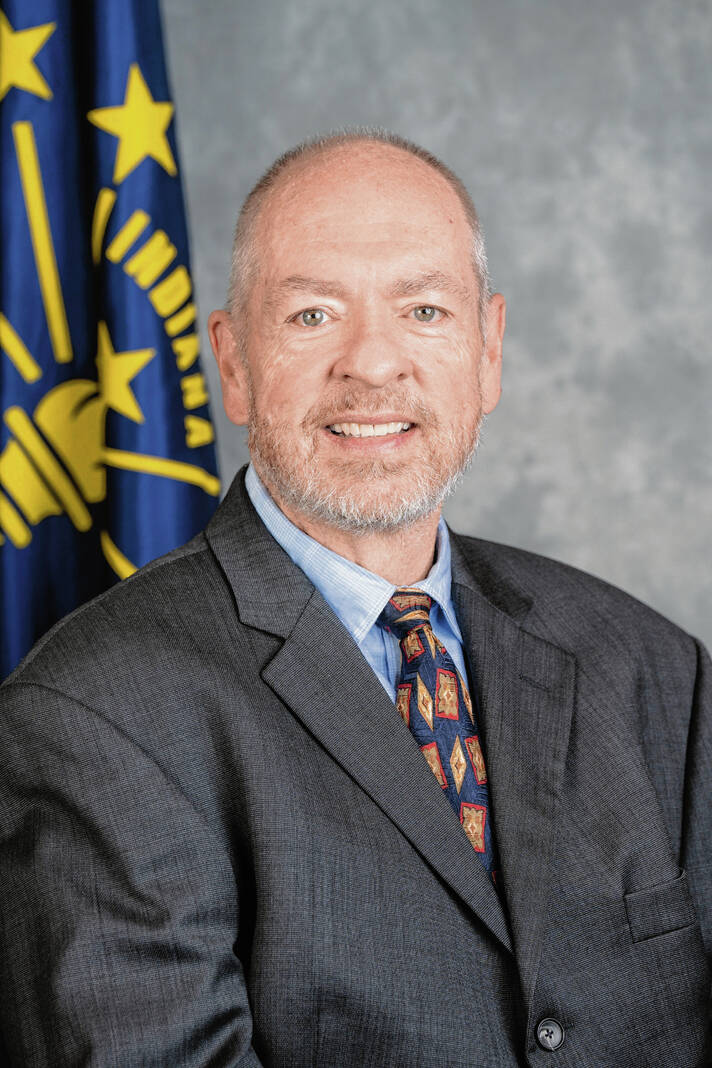
Sen. Greg Walker, R-Columbus
An Indiana state senator representing Columbus who planned to retire at the end of his term has now decided to run for re-election to defend what he has described as the state’s right to govern itself without outside interference from Washington.
Nearly five months after Sen. Greg Walker, R-Columbus, said he planned to retire at the end of his term representing District 41, he said last year’s battle over early redistricting has “re-energized” and motivated him to seek a sixth term.
Walker was a vocal critic of President Donald Trump’s demands to redraw Indiana’s congressional map ahead of this year’s midterm elections. The Senate ultimately voted 31-19 — including a majority of Republicans — last month to reject Trump’s demands to redraw the state’s congressional map.
District 41 includes all of Bartholomew County and most of Johnson County.
“I wasn’t anticipating this fall’s and December’s conflict, and it has re-energized me to the point where I want to continue to focus on Indiana rather than let Washington politics creep in and destroy the institutions that we have here that are trying to serve Hoosiers,” Walker told The Republic. “We’ve got a rift right now over where our priorities are, and there are lots of things that need to be addressed in Indiana. …I don’t see that being a priority of others. I feel like someone needs to be the voice that says, ‘We are a sovereign state. We run elections, and Washington, you work for us.’ They’ve got the script flipped. So, that’s what has motivated me to file.”
Walker’s opposition to early redistricting drew national attention, with the five-term state senator being quoted in The New York Times, Politico, CNN, Associated Press and several other major news outlets.
Trump and his allies had pressured Indiana lawmakers to redraw the state’s congressional map to help preserve the GOP’s narrow national majority in Congress. The proposed map would have placed all of Bartholomew County within Indiana’s Sixth Congressional District, eliminating the current split between the Sixth and Ninth districts in the county.
Redistricting is a process that is normally done once a decade after the census, not mid-decade at the request of a president seeking a partisan advantage for his party in a midterm election. The president’s party generally loses congressional seats in midterm elections.
Last year, Walker declined two invitations to visit the White House, including an offer to visit the Oval Office, and accused the White House of violating federal law in its push to pressure Indiana Republicans to redraw the state’s congressional ahead of this year’s midterm elections.
Walker told The Republic that he declined the invitation and believes it violated the Hatch Act, which bars federal employees from engaging in partisan political activity while on duty, including using their authority to interfere with or influence an election, among other things.
Walker said he would have reported the alleged violation to federal authorities “if I thought that there was anyone of integrity in Washington that would follow through on my accusation and actually cause someone to lose their job over it.”
Since then, U.S. Sen. Alex Padilla, D-Calif., has urged the Office of Special Counsel to investigate whether Trump administration officials violated the Hatch Act by contacting Walker in a letter, which has been sent to Acting Special Counsel Jamieson Greer and White House Counsel David Warrington.
The Office of Special Counsel is a federal watchdog agency that works to protect government employees and whistleblowers from retaliation for reporting wrongdoing. It is responsible for enforcing the Hatch Act.
In December, Walker delivered a 20-minute address to his colleagues on the Senate Committee on Elections, warning that political intimidation must not be allowed to govern Indiana.
Walker’s remarks came after he and several state lawmakers were targeted in swatting incidents last month following the Senate’s announcement that it would reject Trump’s push for early redistricting.
Swatting involves making false reports of criminal incidents in an attempt attempting to create a dangerous SWAT response to the residence.
“I refuse to be intimidated,” Walker said during his address. “…I will not let Indiana or any state become subject to the threat of political violence in order to influence legislative product. I honestly don’t feel from fear for my safety. …I fear for this institution, I fear for the state of Indiana, and I fear for all states if we allow intimidation and threats to become the norm.”
“And you’re thinking, ‘Oh, it’s easy. You already said you’re not coming back. You can’t be primaried,’” Walker continued later during his address. “Well, some little seed in the back of my head says, ‘Go ahead and file.’ I think it’d be the dumbest thing I ever did in my life, but that’s what my wife thought when I ran 20 years ago.”
After the Senate voted against proposed congressional map, Gov. Mike Braun, a Republican, issued a statement that seemed to indicate that he was pledging to work with Trump against members of his own party in Indiana to oppose state senators who voted against early redistricting.
Trump, speaking from the Oval Office, lamented the rejection of Indiana’s proposed map and targeted Senate leadership, according to the Indiana Capital Chronicle.
“I don’t have any delusion that I’m the only one that can do this and stand for Indiana statehood, Indiana rights, from a voice of District 41,” Walker said. “But I think I’m uniquely situated as an incumbent that I can continue to see that as a priority need for our legislative process and our body. We should be one of the other checks and balances on federal power. …Congress has seceded their power to the executive branch, and that’s on them. That’s their fault. And I don’t want to see Indiana secede any more of its power to a federal system that is highly unpopular and currently highly ineffective.”
“We govern best when we have checks and balances on power,” Walker added. “It should not be concentrated in one branch or the other. It should be a balance of power. …I’m concerned about the institutions of democracy, not just the statehouse, but for all states. So, I’ve decided that if District 41 is willing to have me, I’m willing to continue to be that voice going forward in the statehouse.”
Walker enters what could be a very competitive race for the Republican nomination.
Indiana Rep. Michelle Davis, R-Whiteland, has filed to run for the GOP nomination. Davis has represented Indiana House District 58 since 2020.
It is currently unclear if more people will throw their hats into the ring.
After Walker initially said he did not plan to seek re-election, former U.S. Rep. Greg Pence, R-Ind., said he had conversations about the seat becoming vacant with leaders and others who may be interested in running in the GOP primary but had not made a decision about whether he would run.
Pence, who is the older brother of former Vice President Mike Pence, represented Indiana’s Sixth Congressional District for three terms from 2019 to 2025.
Former Indiana Rep. Milo Smith, R-Columbus, who represented Indiana House District 59 from 2006 to 2018, said in August that he planned to run for Walker’s seat.
Walker said he is not thinking about how good his chances are of winning the nomination.
“I don’t consider the odds because I’m just doing what I think is right,” Walker said. “It’s not about me winning or losing, because honestly, that’s up to everyone else. That’s not up to me. That’s up to the voters in District 41,” Walker said. “…My focus is on continuing to stand up against those who would strip Indiana of our liberties to govern as we choose.”