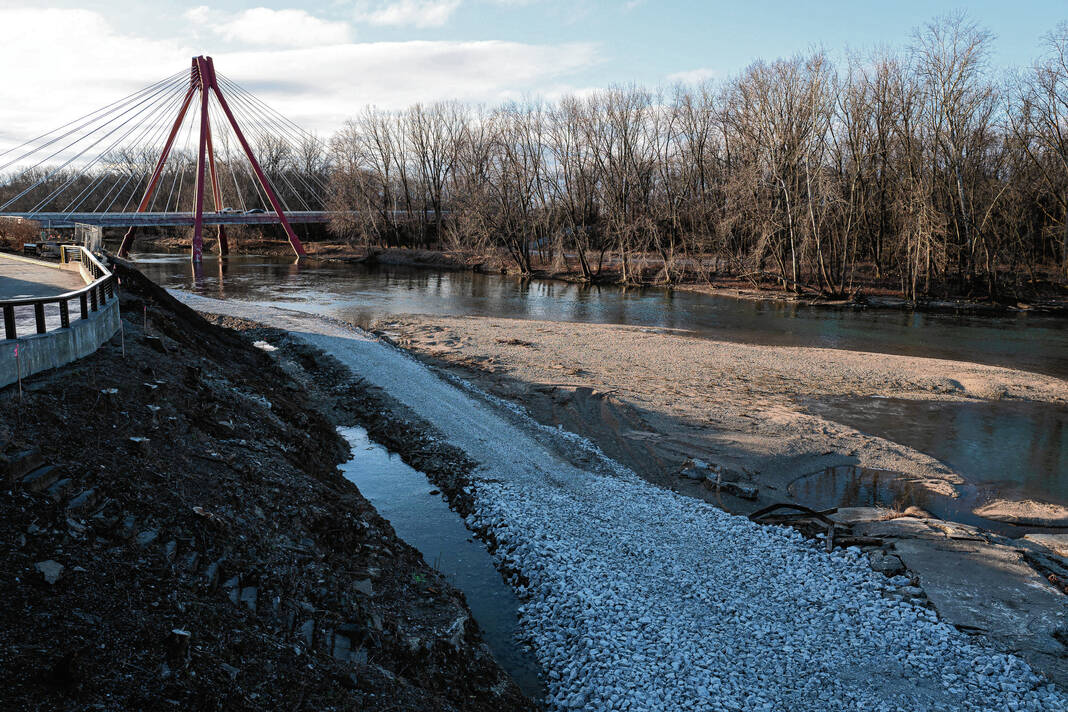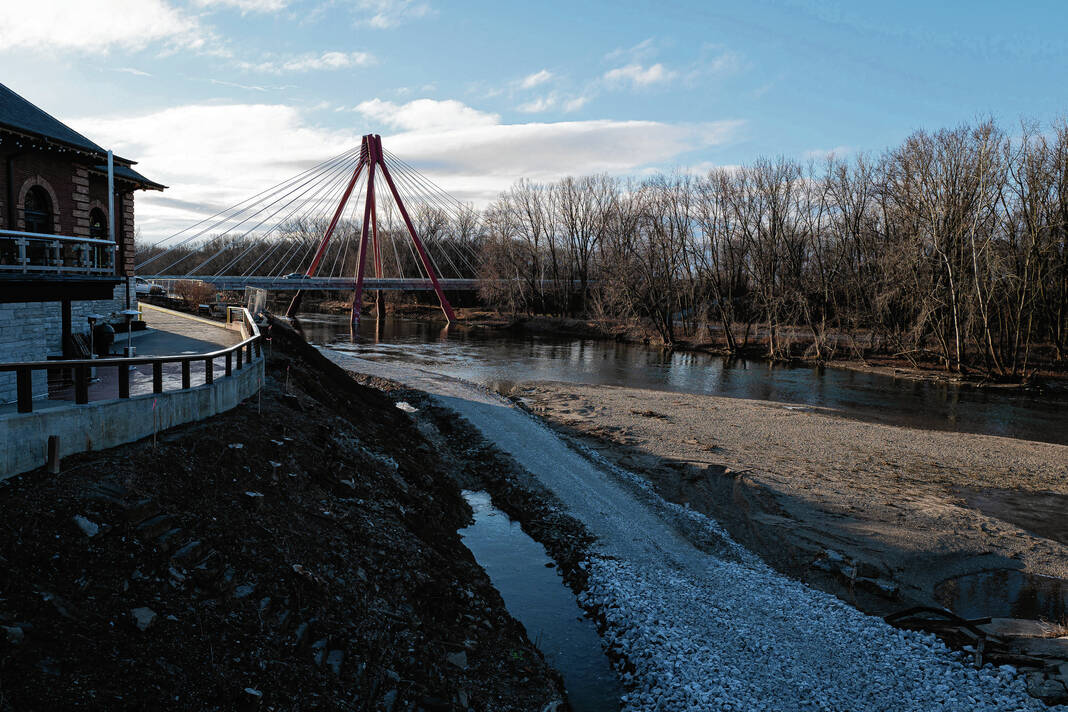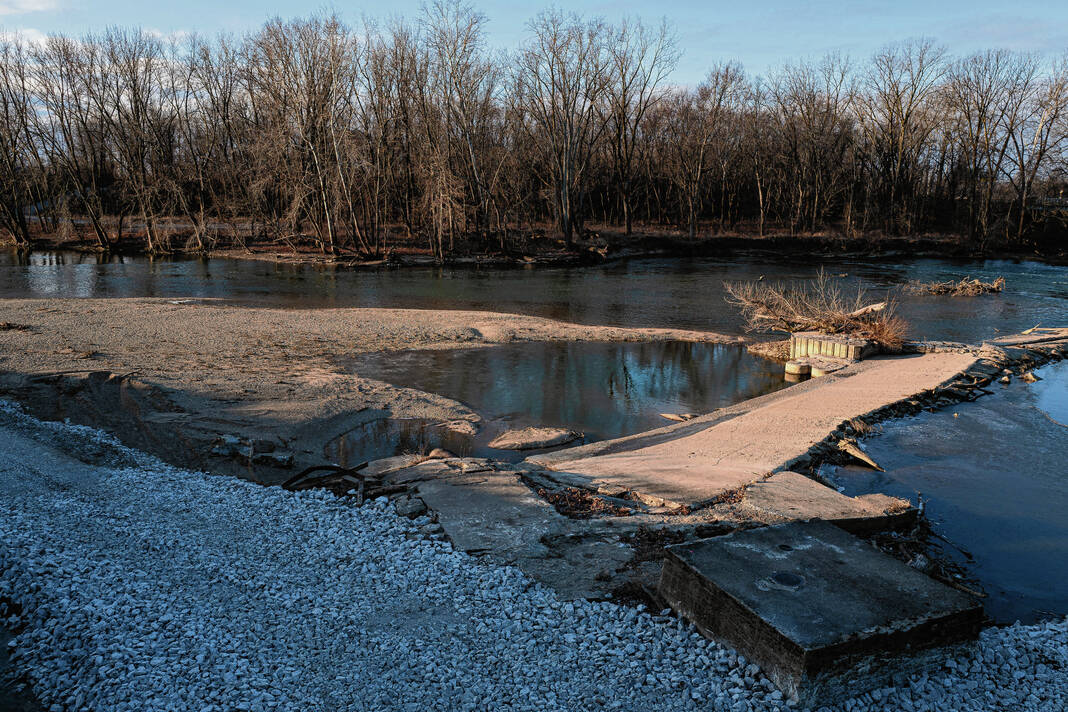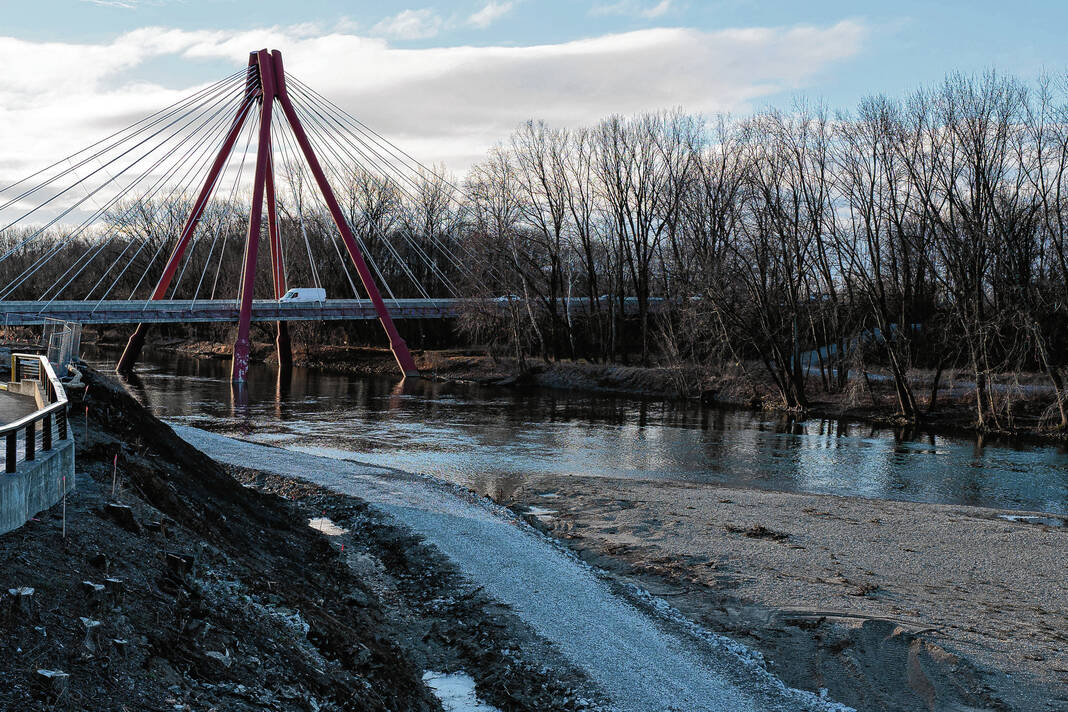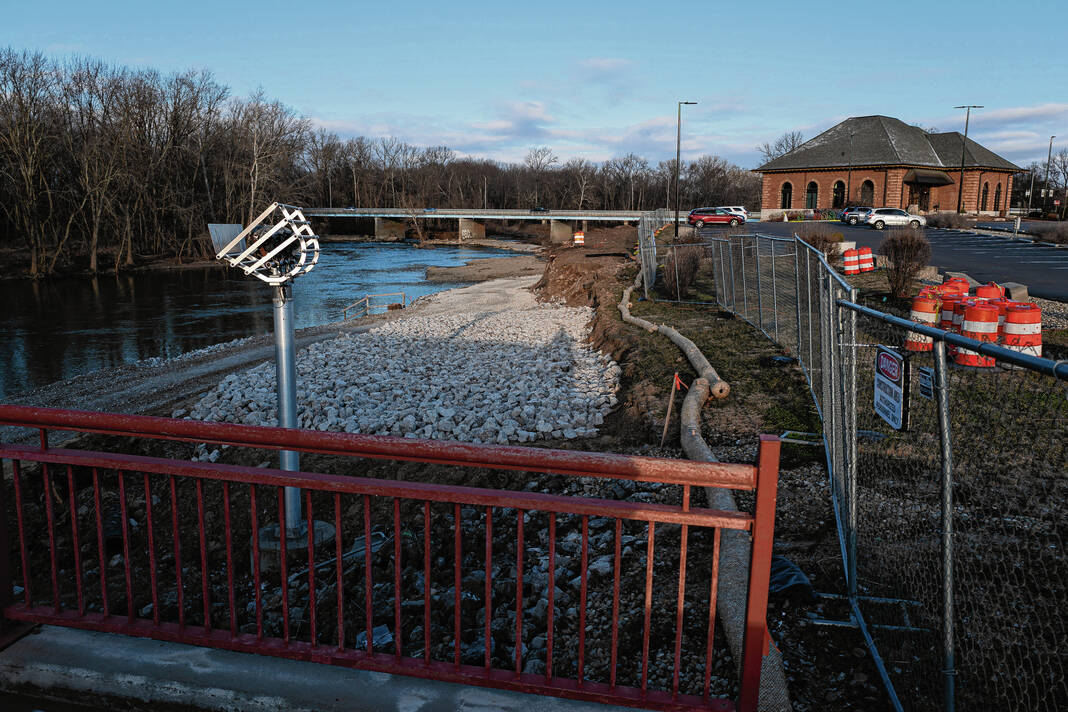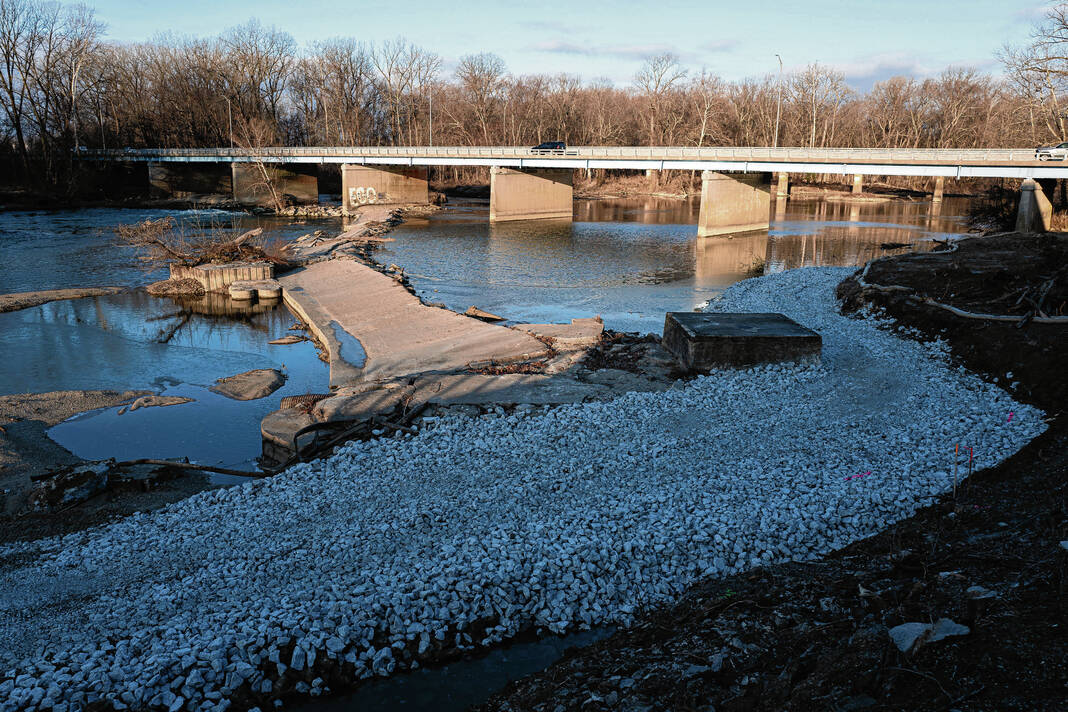
Mike Wolanin | The Republic A view of the riverfront near Upland Columbus Pump House in Columbus, Ind., Thursday, Jan. 15, 2026.
Construction on a plaza that is part of the city’s “Our River…Our Riverfront” project is about to get started, marking the latest progress in the remake of the riverfront along the East Fork White River.
Contractors on the project have made significant progress in creating a construction road along the river after they finished removing invasive trees in the area, Director of Redevelopment Heather Pope said. This work makes way for a plaza that will provide access to the river for both community members and first responders.
The invasive trees that were removed will be replaced with native plantings, informed by a comprehensive restoration plan, with specifications for trees, grass and ground cover, according to city officials.
Milestone Contractors was putting a crane in place for further construction on Friday morning amidst the cold, with plans to begin sheet piling work around the future plaza sometime soon, so community members may start hearing the clanging of tools in the area.
The project, which has been in the works since 2016, seeks to address safety concerns on the riverfront. In particular, it will involve the removal of the failing low-head dam in the East Fork White River, make way for a pedestrian connection to the People Trail and Mill Race Park, while also providing safe access to the river.
The “Our River…Our Riverfront” project has seen several iterations in its design, with the most recent involving the removal in-river recreation component that included a recreation channel, rock riffle ramp and fish habitat structures.
Mayor Mary Ferdon and redevelopment officials went down on site to check out the progress earlier in the week, and took part in meetings with Milestone and the person who will be tasked with removing the dam about the project, Jerry Sweeten of Ecosystems Connections Institute.
“It was very exciting to be able to see firsthand the direction that we’re going and how much has been achieved,” the mayor said. “It’s a really beautiful area and I know that once we get it complete, that people will really appreciate being able to get that close to the water and seeing it as they really haven’t seen before.”
Erosion in the area is visibly evident, the mayor said, and again seeing the failing state of the dangerous low-head dam up close reinforced the need for its removal.
“When I talk to people about the riverfront — regardless if you think it’s a good project — you need to understand the primary reason we’re doing all of this is safety,” Ferdon said.
Permitting, a change in project scope, and the rising cost of construction has delayed the endeavor, but the mayor said the goal is for the entire project to be finished by the end of 2027.
The project so far
Milestone was tasked with stabilizing and re-landscaping the east side of the bank, instituting the connection to the People Trail from Mill Race Park to Water Street and constructing the plaza. The contractor is also fixing a wash out on the west bank.
Milestone will be doing initial erosion control measures as well, placing erosion control mats that will stabilize the bank before native planting material is incorporated.
Construction on the plaza is expected to be done as early as April, although it’s very much weather dependent, according to city officials.
The plaza will be immediately north of an existing old bridge abutment near Upland Columbus Pumphouse, providing people a place to easily get near the river, and will be eligible to be used for events or just as a place to relax, city officials said.
Site clearing started south of the Robert N. Stewart Bridge, where river access is readily available and continued northeast under the Third Street Bridge, ultimately clearing the way for a connection to the People Trail in Mill Race Park.
Dam removal
Among the more crucial aspects of the project is the removal of the low-head dam, which will assist in keeping the west bank from further eroding and exposing the former city landfill, which is a delisted IDEM Superfund Site.
The dam removal will be done by Sweeten, who consultants on the project and city officials have previously referred to as something akin to the “Michael Jordan of removing dams” in Indiana. Sweeten also works as Professor Emeritus of Biology ad Environmental Studies at Manchester University.
Sweeten and his team have removed 23 dams in the state including Edinburgh’s Thompson Mill Dam in 2024, with the goal of working to remove as many dams as possible to reconnect the entire basin, ultimately improving the overall health of the system.
While Sweeten said that no two dams are the same, they all block fish passage, estimating that about 85% of fish species need to be able to swim upstream and downtream, which the dams encumber.
He also added that all the dams can become extremely dangerous once they begin failing and “take lives needlessly,” in a scenario where a person gets sucked in.
“Decade after decade of the power of a river working against these structures, it compromises the structural integrity of them,” Sweeten said. “The Columbus dam is a very good example— it served a purpose at one time, providing a pool for the city to draw water— but they don’t do that anymore so it’s not needed.”
Sweeten said while the dam in the East Fork White River is not very tall, it is longer than typical, about 500 feet. He added that he expects it to “come out fairly easy,” although he noted that “you never know what you’re going to find when you start cracking up an old dam— sometimes you get surprises.”
The removal of the dam will likely come in the September to October range, and will take about five days, Sweeten said.
He also emphasized what is likely to result once the dam is removed— an improved fishery and a more scenic area.
“It’s sort of an abstract thing for people because they’re used to seeing that dam and that pool and that’s what they think the river’s always been like,” Sweeten said. “And its hard to have that vision of how beautiful a stream can look once it’s set free.”
Grant funding from the Indiana Department of Natural Resources and U.S. Fish and Wildlife Service becomes available just as Sweeten will begin the process of removing the dam. Jason Larrison of consulting firm J.S. Held told the redevelopment commission in July that “the anticipation is that the majority of that (removal of the low-head dam) cost will be covered by state dollars.”
Milestone’s part of the project is being done for an amount not to exceed $11.8 million. Redevelopment said that over half of the work Milestone is doing is being paid for through state and federal grant dollars.
Overall, the project has access to about $18.9 million in approved funds, made up of $11.5 million in tax-increment-financing (TIF) funding, $5.6 million in Regional Economic Acceleration and Development Initiative (READI) funds and $1.8 million from various funding sources including a $1.72 million Next Level Trails Grant from the Indiana Department of Natural Resources, along with contributions from Duke Energy and the Columbus Park Foundation.
The portion Milestone is doing will use up READI and grant funding first, followed by just over $4 million in TIF funding.
The “Our River…Our Riverfront” project also plays into other ongoing city projects including the Second Street Thoroughfare Project and remake of the downtown entrance into the city, city officials said.