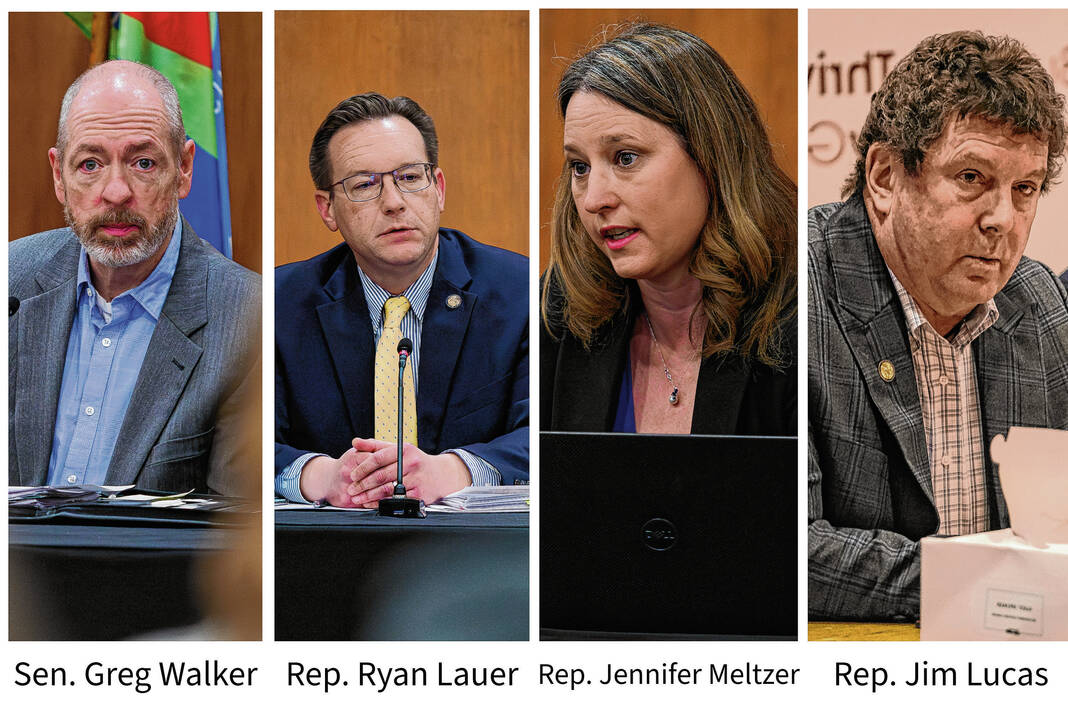
Collage by Mike Wolanin | The Republic Local legislators State Sen. Greg Walker, from left, State Rep. Ryan Lauer, State Rep. Jennifer Meltzer and State Rep. Jim Lucas.
Over half of the bills authored or co-authored by state lawmakers representing parts of Bartholomew County have stalled or died after a key mid-session deadline passed this week.
Monday was the last day for House and Senate bills to advance to the opposite chamber, though lawmakers can still insert language from the bills that missed the deadline into other measures that are still being considered.
A total of 21 of the 39 bills authored or co-authored by Rep. Ryan Lauer, R-Columbus; Rep. Jim Lucas, R-Seymour; Rep. Jennifer Meltzer, R-Shelbyville; and Sen. Greg Walker, R-Columbus, failed to advance to the opposite the chamber ahead of the deadline, according to state records.
A total of eight of the 12 bills authored or co-authored by Meltzer have advanced to the opposite chamber, as well as half of the 12 bills authored or co-authored by Walker and half of the eight bills authored or co-authored by Lauer.
None of the seven bills that Lucas authored or co-authored this session advanced to the opposite chamber.
Overall, a higher percentage of bills authored or co-authored by the four legislators have cleared either the House or Senate than average.
A total of 224 of the 680 non-vehicle bills filed this session advanced to the opposite chamber before the deadline, or 33%, according to the Indiana Capital Chronicle. By comparison, that figure was 46% among the four lawmakers representing parts of Bartholomew County.
Some notable bills that did not meet the deadline include a measure filed by Lucas that would have allowed the death penalty to be carried out by firing squad in Indiana.
The measure, HB 1119, was defeated in a 48-47 vote in the House on Jan. 28, according to state records. Lucas and Rep. Ryan Lauer, R-Columbus, voted in favor of the bill, while Rep. Jennifer Meltzer, R-Shelbyville, voted against it.
A similar bill filed in the Senate this session failed to clear committee.
A bill filed by Lucas that would have reclassified marijuana and THC as less dangerous drugs and another measure he authored that would have increased access to birth control among low-income Hoosiers failed to clear committees.
Additionally, a bill co-authored by Walker that would have stripped the Indiana governor of the power to appoint Indiana University’s Board of Trustees and would have instead authorized IU alumni to select the board failed to clear committee.
Currently, the governor appoints all nine trustees to three-year terms, as well as a student trustee who serves a one-year term, according to the university’s website.
The bill comes several months after Gov. Mike Braun removed three elected members of the IU Board of Trustees, roughly a month after indicating he wouldn’t, The Indiana Capital Chronicle reported. Braun instead tapped three new members — two notable conservatives — along with reappointing a sitting trustee.
A bill authored by Walker and Sen. Fady Qaddoura, D-Indianapolis, that would have barred the Indiana General Assembly from redrawing legislative or congressional district maps outside of the first regular session immediately following the U.S. Census failed to clear committee.
Additionally, a bill filed by Rep. Michelle Davis, R-Whiteland, would have required the Ten Commandments to be displayed in schools failed to clear committee. Davis is challenging Walker for the GOP nomination for Senate District 41 in this year’s primary.
Some notable bills that are still alive is a proposal co-authored by Walker that would make doxxing a crime in Indiana cleared the Senate in a 44-0 vote on Monday. Doxxing is when somebody collects and publishes private or identifying information about another person online — often their address — to harass, intimidate or threaten.
The bill, SB 140, would generally make doxxing a Class A misdemeanor. However, it would become a Level 6 felony if the targeted person or a person closely connected to them suffers serious bodily injury or a Level 5 felony if it results in catastrophic injury or death.
Walker was one of several Indiana lawmakers who were targeted in swatting incidents last month following the Senate’s announcement that it would reject Trump’s push for early redistricting.
Swatting involves making false reports of criminal incidents in an attempt attempting to create a dangerous SWAT response to the residence.
A bill authored by Meltzer would allow any city or town in Indiana to pass an ordinance that moves municipal elections to even-numbered years.
The bill, HB 1055, passed the House in a 59-35 vote on Jan. 22 and is pending before a Senate committee, according to state records.
The bill could have implications for Columbus. Municipal elections in Columbus are currently held on odd-numbered years. The most recent municipal election was in 2023.
Under current law, only towns and cities with populations under 3,500 can adopt ordinances to move municipal elections to even-numbered years, according to state records. Should this bill become state law, Columbus could consider moving its municipal elections to an even-numbered year.
Local election officials and experts have said in the past that voter turnout is often much lower for municipal elections than in presidential elections or midterm elections because there are no national or state races on the ballot.
Turnout in the 2023 general election in Columbus was 23%, while turnout in the 2024 presidential election was 66.5% and 42.6% in the 2022 midterms, according to the Bartholomew County Clerk’s Office.
Offices contested in municipal elections include Columbus mayor, Columbus City Council, Columbus city clerk, among others.
A bill authored by Lauer that seeks to improve the transparency and timeliness of the state’s child fatality reports due to abuse and neglect has cleared the House in a 92-0 vote.
The bill, HB 1264, would require the state to publish public reports on the deaths within 90 days and include some details about the fatalities to raise awareness. Currently, the state publicly reports these cases annually, usually about a year and half after the incident, Lauer said previously.