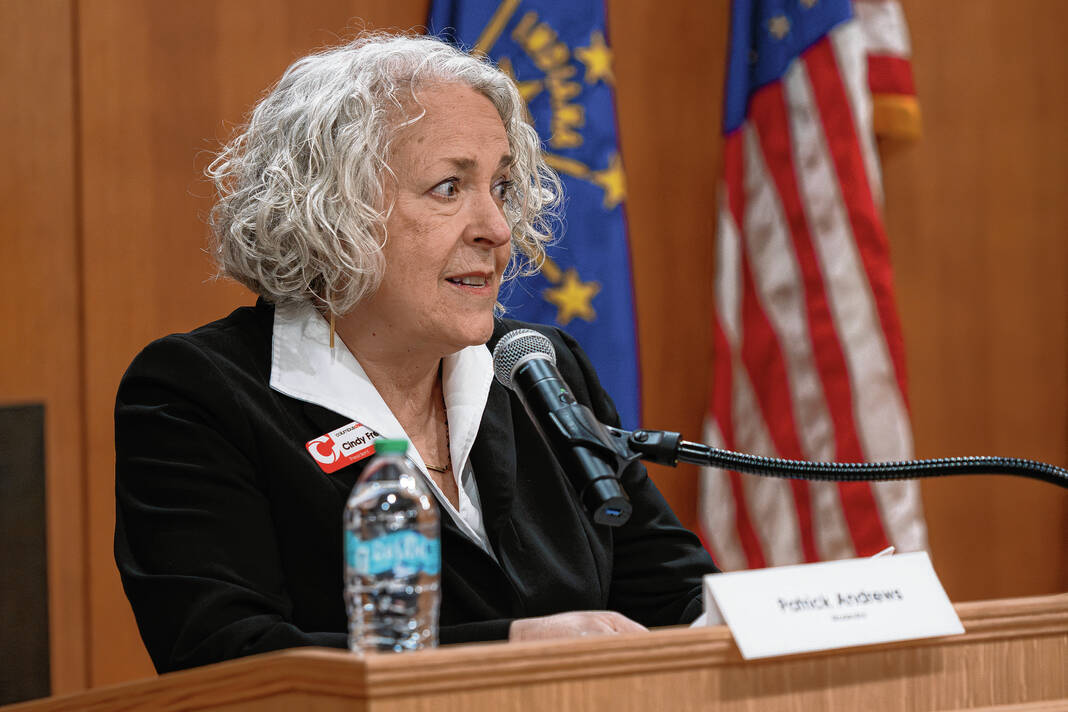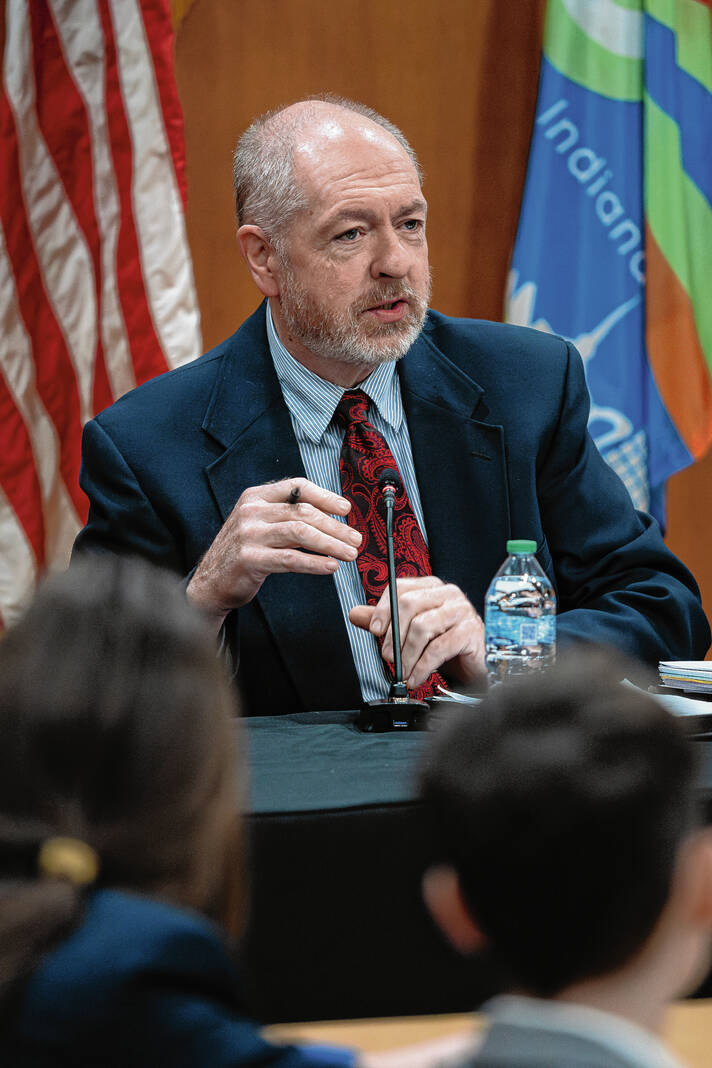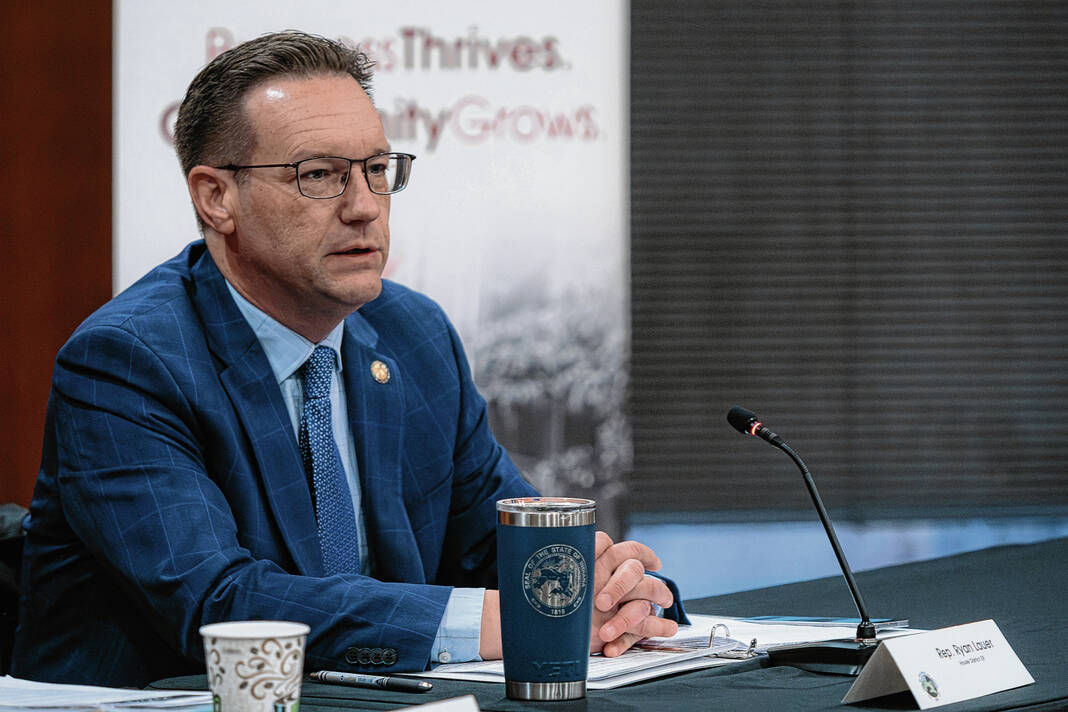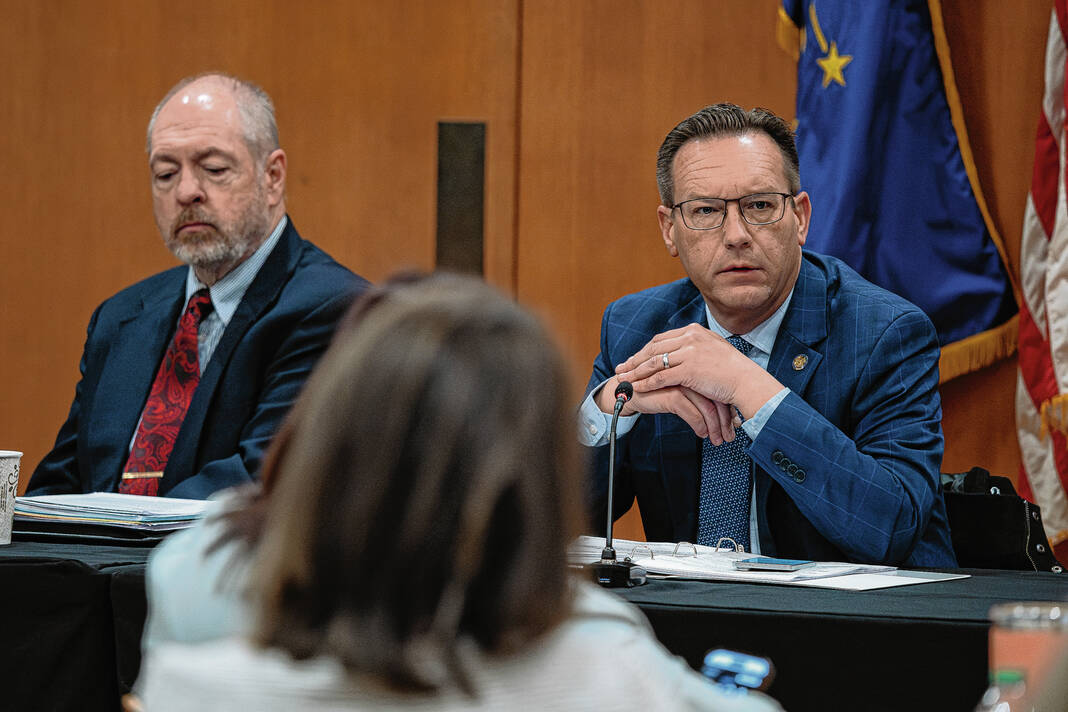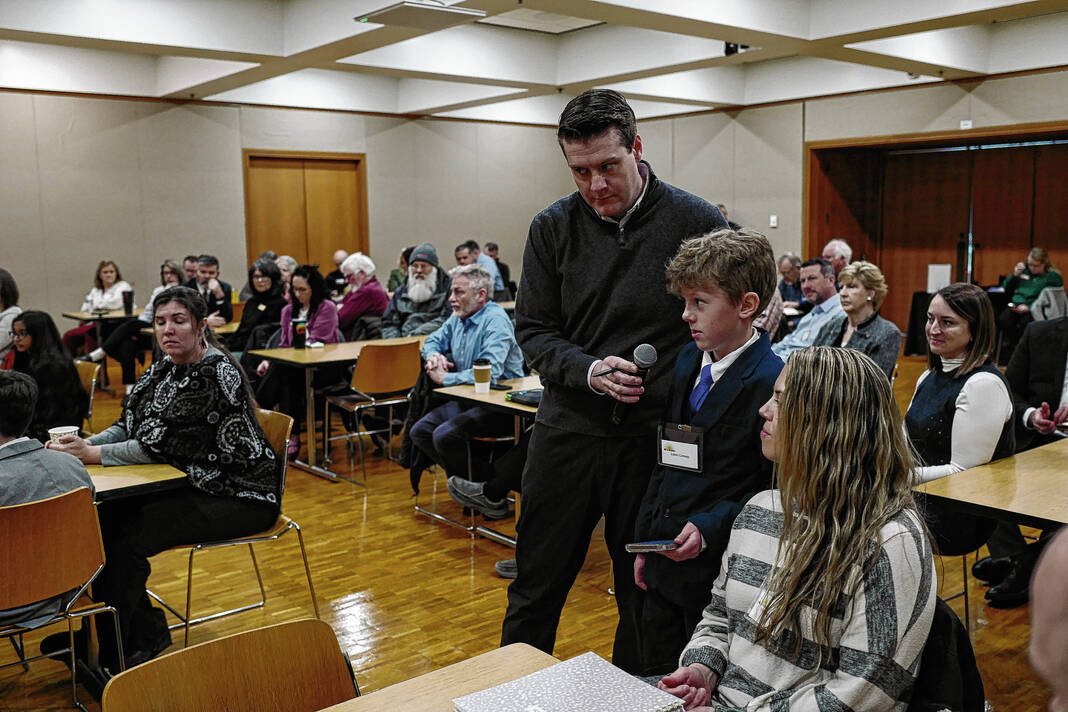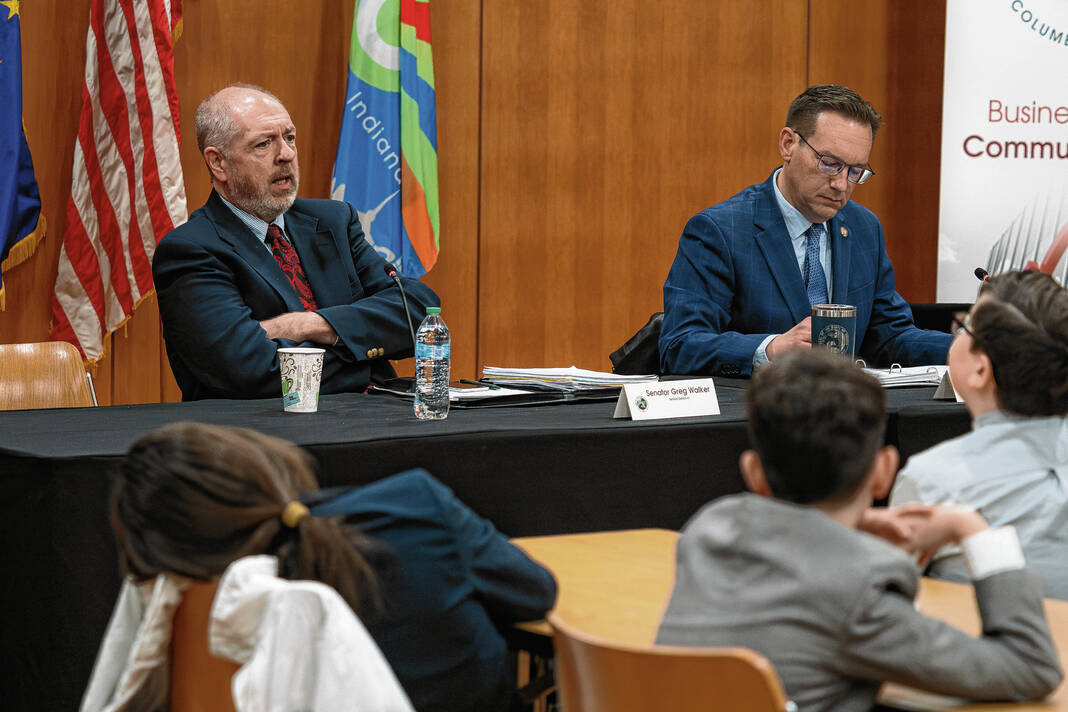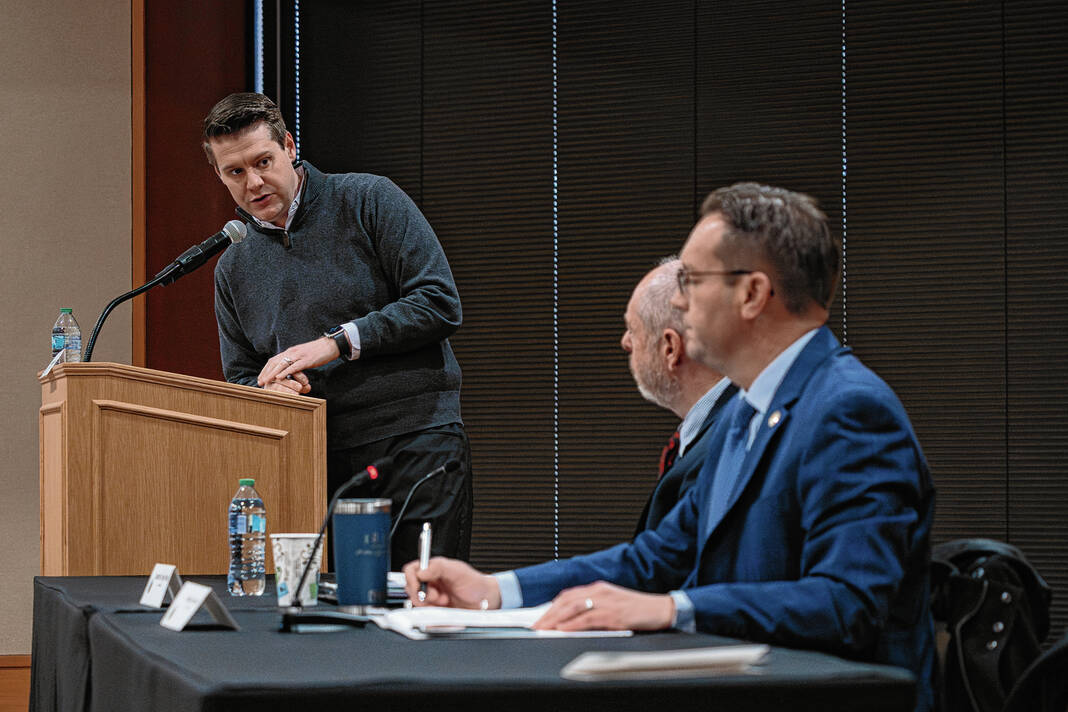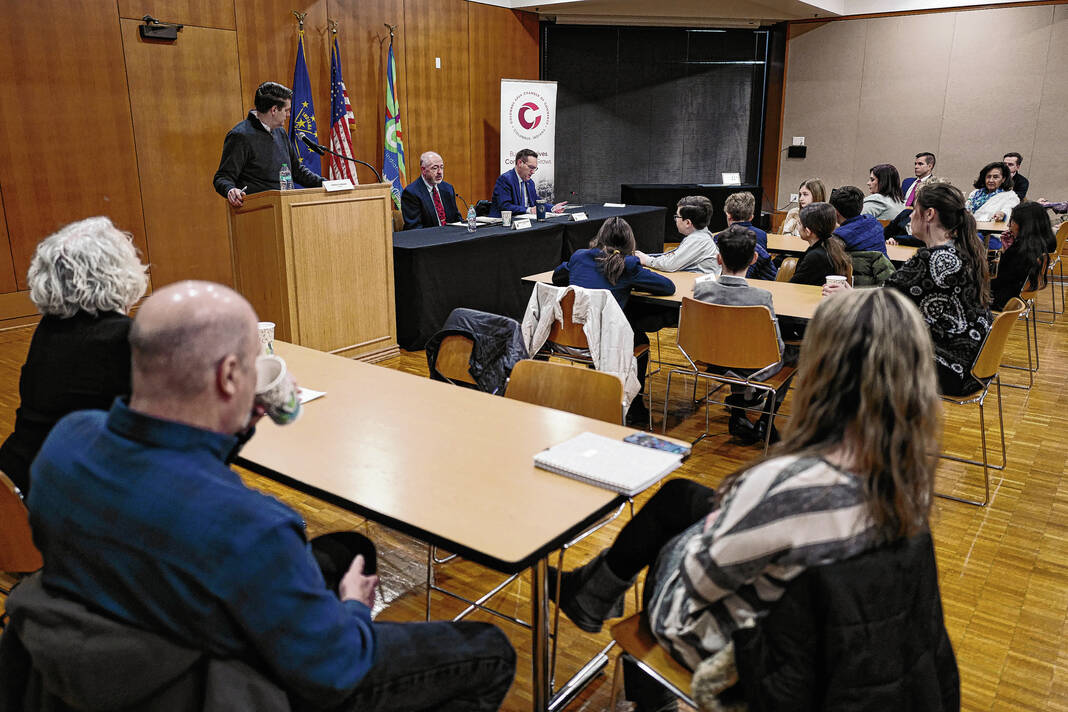
Mike Wolanin | The Republic Patrick Andrews, at podium, moderates the Columbus Area Chamber of Commerce’s Legislative Wrap-up session with State Sen. Greg Walker and State Rep. Ryan Lauer at Columbus City Hall in Columbus, Ind., Monday, Feb. 23, 2026.
Legislators representing parts of Columbus and Bartholomew County were back at Columbus City Hall on Monday to talk about bills relating to child care, immigration and social media, among several other topics, as the legislative session begins to wind down.
It was the second forum organized by the Columbus Area Chamber of Commerce this legislative session following a preview edition held in January. The short session is expected to come to a conclusion this week.
Rep. Ryan Lauer, R-Columbus and Sen. Greg Walker, R-Columbus attended in person. Rep. Jim Lucas, R-Seymour, and Rep. Jennifer Meltzer, R-Shelbyville, were not there after House Speaker Todd Huston, R-Fishers, called his members in for a caucus meeting that morning. The two were on their way to Indianapolis, chamber officials said.
The session was a bit of a whirlwind, the legislators said, after they were called into a special session by Gov. Mike Braun in December to take up the redistricting plan pushed by President Donald Trump to redraw congressional maps mid-decade in favor of Republicans.
Leadership in both houses chose to make that special session part of the regular session, so legislators were in a time crunch to get business done that they would typically have had at least an additional two weeks to work on.
Child care
A portion of the discussion during the moderated forum went towards discussing the crisis in child care in Indiana, which local officials have raised concerns as well.
The state in October announced cuts to child care and early learning initiatives, including significant reductions to Child Care Development Fund (CCDF) vouchers and the On My Way Pre-K program, which provide child-care assistance to low-income families.
Due to the new rates and declining enrollment because no new vouchers are being awarded, Children Inc. announced it would have to lay off 15 teachers and close six classrooms, Children Inc. Executive Director Jill Harden said in October. Additionally, local officials said another child care site that they declined to name would be closing altogether due to the cuts.
Walker and Lauer were asked questions about Senate Bill 4 and House Bill 1177.
Senate Bill 4, among a variety of provisions, could provide flexibility to tap into existing state dollars to support the CCDF voucher program.
“The bill makes those funds accessible by the budget body to help make seats available for children that otherwise there would be no other funding source,” according to Walker.
House Bill 1177 seeks to expand Indiana’s employer child care tax credit and encourage investment in child care facilities around the state.
“House Bill 1177 is going to allow some tax credits for larger employers. We really want to incentivize businesses and communities,” Lauer said. “… We’re looking at different ways to expand the number of seats and the number of facilities to do child care services. It’s become very expensive.”
Lauer specifically mentioned text in the bill that would allow local redevelopment commissions to put forward tax-increment-financing (TIF) dollars towards early education and child care.
The Columbus Redevelopment Commission for the past several years has annually granted BCSC $1 million to support workforce development.
Lauer said he recently had a roundtable with local early education and child care providers “and heard their concerns.”
“I have been an advocate for increasing that budget item in a non-budget year… so we’ll see how that shakes out,” Lauer said. “I think it’s going to happen…I’m very hopeful that we get some relief for child care needs and early education this session.”
Walker also mentioned the bill “tries to look at binding approval of library budgets as a means of fiscal control within a county.”
“Many have argued for years and years that we shouldn’t have an unelected board establishing property tax spending,” Walker said. “So when spending gets to a certain rate, or increases to a certain rate, there will be a binding review by the financial body, in the city or county.”
Immigration
State lawmakers representing parts of Bartholomew County have thus far all voted in favor of a bill, Senate Bill 76, that would allow the state attorney general’s office to seek sanctions against businesses found to have hired “unauthorized aliens.”
The bill would require city and county officials to comply with federal detainer requests for immigrants suspected of being in the country illegally.
ICE can place an immigration “hold” or “detainer” on inmates who are deemed removable from the country. This allows jails to hold inmates who would be otherwise eligible for release for an additional 48 hours to give federal immigration authorities time to come pick them up.
For its part, the Bartholomew County Sheriff’s Office has been cooperating with ICE for some time, notifying immigration officials whenever someone who wasn’t born in the U.S. is booked into the Bartholomew County Jail.
The bill would also empower the attorney general’s office to seek civil penalties of $10,000 per knowing and intentional violation by government bodies and public universities. Only county jails would get a warning — and 30 days to make fixes — before facing legal action.
Democrats blasted the bill as diverting local police officers away from focusing on community public safety needs to deal with the federal responsibility of immigration enforcement, according to the Indiana Capital Chronicle.
Lauer, Lucas and Meltzer all voted in favor of the bill, according to state records. Sen. Greg Walker, R-Columbus, also voted in favor of the bill, though the House has made changes to it after the ball passed the Senate originally, including requiring employers to use the federal E-Verify system to verify employment eligibility.
Walker said the bill “is a tough one for me because it does make reference to legal detainment actions and legal actions on the part of immigration enforcement,” but noted at the same time that “we are looking at a nation where there’s been some very questionable actions on the part of federal agents.”
Walker said the legislation represents a “little bit of political theater as well” considering much of what the bill describes is already being done by local law enforcement.
Walker indicated that supporting the bill would have “a deterrent effect” that would prevent federal agents from entering Indiana and causing the type of turmoil most prominently seen in Minneapolis.
“I don’t want to see illegal enforcement take the place of legal enforcement,” Walker said. “So you’ll have to read between the lines on some of my comments.”
Social media
Children’s access to social media was also brought up, centering around Senate Bill 199, which prohibits minors under the age of 17 from opening accounts of social media platforms like Instagram, Facebook and TikTok without parental permission.
Walker said regulating things like this are “worth exploring” but doing so is like “putting a noose around the wind” because it’s likely to just push children’s access from regulated platforms to unregulated platforms.
Lauer described the legislation as “an elegant balance between state regulation and local control,” also making reference to Hailey Buzbee, a 17-year-old Fishers girl who was killed this winter after being lured online by a predator. Buzbee’s parents are among those urging the tighter restrictions.
“It is important, I think, for parents to know that there children are on some of these sites that have chat and that sort of thing,” Lauer said.