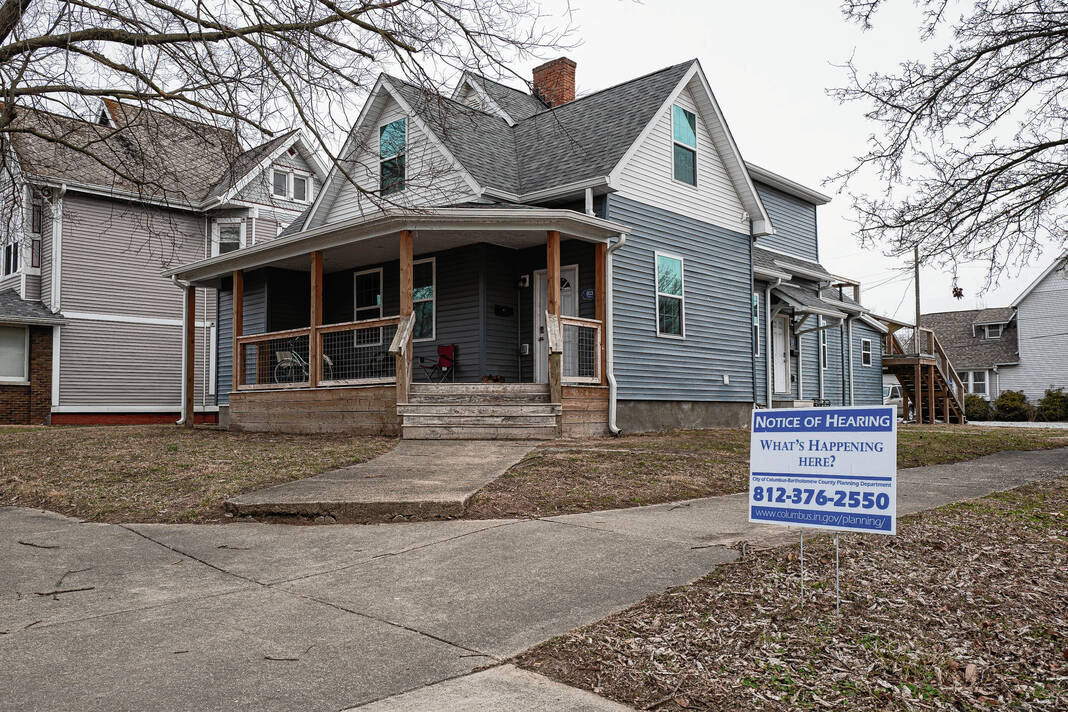
Mike Wolanin | The Republic An exterior of the proposed recovery house at 803 Pearl Street in Columbus, Ind., Tuesday, Feb. 24, 2026.
The Columbus Board of Zoning Appeals denied a proposal requesting a shared housing facility for up to 14 individuals at 803 Pearl St. following several neighbors voicing their concerns about the proposal.
Applicant Brandon Nielsen appeared before the board Tuesday to request conditional use for a Level One recovery residence in a Residential: Established zoning district. The proposal requested to turn a multi-family home into a recovery facility that provides stable, supportive housing for individuals in recovery from substance use disorders, according to the staff report from the City of Columbus-Bartholomew County Planning Department.
Nielsen serves as the executive director of Gemini Recovery Services, which provides treatment for those recovering from substance abuse. Though the proposed facility would operate unassociated with Gemini Recovery Services, he proposed to operate it as housing for those in recovery.
The proposed facility would be broken up into three units, with eight people each in both the first and third unit. The on-site property manager would then be alone in the second unit. The house was also previously divided into three apartments, according to the staff report.
Following the public hearing, board member Charles Doup voted to deny the proposal based on not all criteria being met. The staff report states that it did not meet the criteria of “granting the conditional use will not be contrary to the general purposes served by the Zoning Ordinance, and will not permanently injure other property or uses in the same zoning district and vicinity.”
One concern raised in the staff report is the parking situation. Nielsen said in the report that there is onsite parking for up to five vehicles and on-street parking available as well. He also anticipated that a majority of possible tenants would not have a driver’s license or vehicles and would utilize public transportation. Transport would also be provided by Gemini Recovery Center to get to and from treatment.
“Right now there’s eight people there and two of them have a car. That’s probably the most cars that’s ever been there, probably the most that will ever be there, but it’s one of those things you never know,” Nielsen said. “But the majority of these guys do not have a license and (have) not had one for a very long time and most definitely cannot afford a car.”
Community members agreed that parking would be an issue. Susan Kell said the area is very congested and Eighth Street is a bus route. Nathaniel Gootee, who wrote a letter voicing his concerns to the board prior to the meeting, said parking is restricted to one side of the street and residents can only park within the same city block of their residence.
“… if this is approved, we would have a demand of 64 parking spots and only 50 are available per 110 linear feet per each side of the block around it,” Gootee said.
Concerns were also raised about the density of the facility. The staff report states that the applicant requested conditional use approval to operate the property as a shared housing facility for up to 17 individuals, but Nielsen clarified during the meeting that 17 is a little lofty and 14 is the maximum amount they could fit in there comfortably.
He said the first unit could hold about six people and the third unit, which would take up the second floor, could fit seven people. About eight people and an on-site manager currently reside in the home and no treatment is provided on site.
“Their housing is contingent on them being engaged in treatment and doing the things that they need to do and that’s regular check-ins, all that stuff, weekly screenings, there’s a lot of accountability there,” Nielsen said.
Attorney Jeff Rocker spoke before the board saying he was representing several neighbors. While he commended Nielsen for what he’s wanting to do, he believed it would face a challenge in being contextually appropriate in the area. No matter if it’s 14 or 17 people, he said the more people they pack into that single family home, the more intense of an impact that will have on the neighborhood, the land and the community.
“… we all have a footprint that we leave in the world, and I think respectfully this footprint is a little too heavy for an RE zone and I think because of that, what we’re going to see is it’s going to have an impact on the residents both psychologically as well as on the value of their homes… just because of that intensity of the use,” Rocker said. “Just because people that live next door are not going to be able to park on their own street anymore.”
Other concerns raised by neighbors included the facility’s proximity to a preschool and Central Middle School, the area’s history regarding drug use, assurance on qualifications and the importance of who’s operating the facility to monitor it. However, a few community members did indicate when speaking to the board that they were supportive of these kind of facilities.
“I have over 50 years work experience in mental health, so I’m not unsympathetic with the need for sober living recovery homes,” Kell said. “I don’t believe that this is the proper location for a sober living house of the nature that’s being proposed.”
All board members but Grant Hale voted to deny the proposal. Doup said all the testimony he heard that evening confirmed the denial was correct, but he urged the community to address the mental health issue in the community.
“It is totally inadequate, I have had experience, first hand experience, trying to deal with that kind of situation and it is a disgrace what Columbus, Indiana does for the mentally impaired, let alone the drug impaired,” Doup said. “So I’m charging you all that have any power at all to get busy and get that fixed.”