Indiana Capital Chronicle
For The Republic
A typical Memorial Day weekend for Debbie Dunn is spent reveling in the recreation of the Northwest Territory Alliance’s encampment at Fort Sackville.
Dressed in 18th Century clothing, Dunn wanders around the encampment with her husband Nash, singing for visitors at the Spirit Vincennes Rendezvous.
“It’s truly like stepping back in time,” said Dunn, who started working the festival gates with her husband 11 years ago.
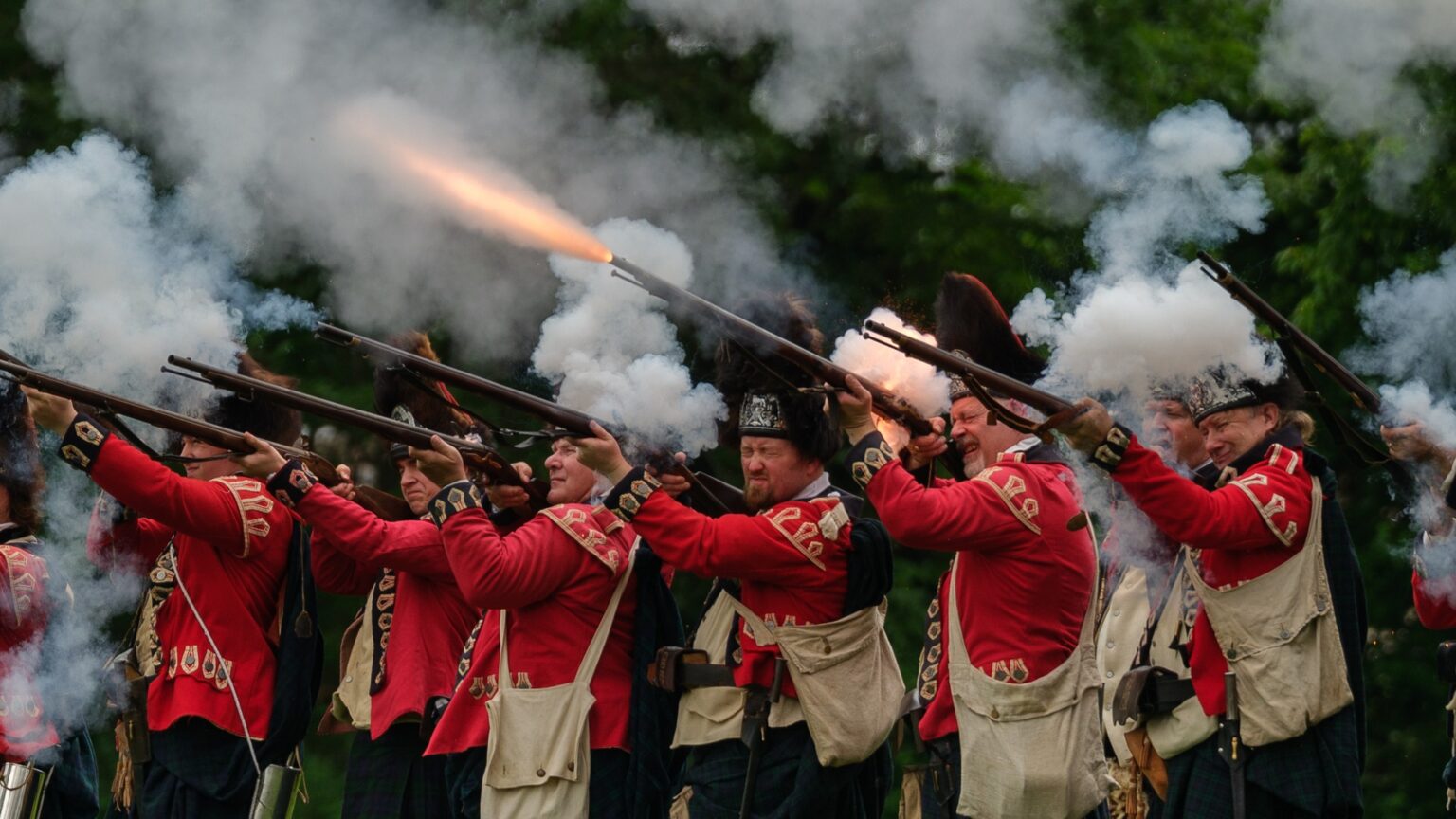
The clothing, food and scenery are authentic — the scent of turkey legs, leather and burning fires where militiamen prepare breakfast before heading to the battlefield, the sound of muskets, the sight of a rat catcher chasing pests like an 18th century CDC.
The annual reenactment of the Battle of Fort Sackville, a pivotal, two-day victory for the American Revolution in 1779 Vincennes, carries special significance this year as Hoosiers commemorate America’s semiquincentennial.
Hundreds of events will take place all year throughout the state in celebration of 250 years since the signing of the Declaration of Independence on July 4, 1776.
The Indiana semiquincentennial commission — a bipartisan panel of lawmakers, military leaders, veterans, civilians and the governor himself — has been planning events to commemorate the occasion for a year.
While Indianapolis will host a water lantern festival and a July 4th celebration at the Indiana War Memorial, Hoosiers are invited to partake in the festivities around the state and reflect on Indiana’s role in influencing the American experience from the founding to the present day.
For instance, Vincennes is hosting an outdoor screening of hit Broadway musical Hamilton during its Summer on Main festival June 26. Visitors are encouraged to dress in costume and sing along, with the help of captions on the 35-foot screen.
Witness the revolution in Vincennes
Col. George Rogers Clark led a small army of 170 men on a 200-mile journey through freezing swamp waters to capture the British outpost at Fort Sackville in a surprise attack on Feb. 23, 1779.
It’s one of the few Revolutionary War sites in the Hoosier state famous for the capture of British Lt. Gov. Henry Hamilton, notorious to colonists for his arming of Native American tribes to attack settlers.

“It’s an underdog story,” said Janice Barniak, executive director of the Knox County Tourism Bureau. “… They arrived completely undetected and it was almost immediate surrender.”
Vincennes recreates the battle scene at the Spirit of Rendezvous each Memorial Day weekend, making Indiana’s oldest city a popular destination for semiquincentennial festivities.
Visitors can witness living history on the battlefield, wander around the encampment, taste authentic 18th century food and learn about the victory at Fort Sackville. For more Vincennes events, check here.
Learn about the constitution in Corydon
Hoosiers can witness dramatic readings of the U.S. Constitution in Corydon, the state’s first capital.
The city will host two readings of the Declaration of Independence: The first on July 4, with a second reading planned July 8 as part of a nationwide celebration of the day Americans learned of the declaration’s existence.
Both readings are free to the public and will take place in Corydon’s historic Capitol Square.
“It may come as a surprise to most people why Corydon is one of the great places in Indiana to celebrate this,” said Kelly Hanna-Carroll, a site manager at the Corydon Capitol State Historic Site for the Indiana State Museum.
Indiana may not be one of the original 13 colonies, Carroll said, but Corydon claims close ties to Benjamin Harrison V, one of the declaration’s signers. Harrison’s son, William Henry Harrison, who briefly served as the 9th U.S. President before his death, owned the land upon which the Indiana Capitol Building and Corydon town square were built, she said.
Speaking of President Harrison…
Historical groups and sites are getting involved in the 250th celebration, including Indianapolis’ sole presidential site.
“One of the best things for anyone to do is to understand their own history,” said Charlie Hyde, president and CEO of the Benjamin Harrison Presidential Site.
“Thinking about those ways in which our country has found success, those challenges we faced over 250 years, the ways we came together and surmounted those challenges.”
Benjamin Harrison served as the 23rd President, and took office 100 years following the inauguration of George Washington.
Harrison’s tenure came at a fraught time 20 years after the Civil War. He took the centennial to assuage divisions through the simple gesture, becoming the first president to fly the American flag outside schools and public offices.
“We wanted to meet the promise that we had made that all people are created equal,” Hyde said, “so to be able to have that reminder through our shared national identity and flying the American flag” offered a chance at national unity.
The Harrison Home will be hosting monthly commemorative events.
Living history
Bruce Kolb acquired a taste for living history when he started acting in American Civil War battle reenactments in the 1980s.
The hobby became a popular pastime for Americans, including state Rep. Matt Lehman, after journalist Ken Burns released a civil war documentary in 1990.

Both Kolb and Lehman have served on the committee planning the semiquincentennial
A descendant of a Union soldier himself, Kolb realized the importance of remembering the toll the war took on the 210,000 Hoosier soldiers who joined the Union army — the second highest of any state.
Some 24,000 Hoosiers died and another 46,000 were wounded in battle.
Hoosiers can witness a reenactment of these battles on June 6 in Madison, complete with artillery demonstrations, a living encampment and historical dance workshop.
“I hope people get an understanding of how the union was preserved and upheld to ensure that our republic and our constitutional democracy would continue on,” said Kolb.
Find something local
America’s founding is unique as “one of the first times in history that a conquering army didn’t establish a king,” Lehman said.
The semiquincentennial is a “once-in-a-lifetime” event for Americans and Hoosiers to come together to celebrate the nation’s founding and independence, he said.
Lehman recalls the excitement he felt as a child for America’s bicentennial in 1976.
He hopes Hoosiers take the opportunity, as he once did, to pick up the books they haven’t read since grade school, attend a historical lecture or find events in their own communities to commemorate the occasion together.
“I’m hoping we can set aside political differences and say, ‘Our Founding Fathers, if they came back today, would say, we’re a little surprised you guys survived 250 years,’” Lehman said. “I don’t think they would have thought we would be here 250 years under the same constitution.”
— The Indiana Capital Chronicle covers state government and the state legislature. For more, visit indianacapitalchronicle.com.