Home Blog

Geno Auriemma taking an undefeated UConn team to Final Four for 9th time

Geno Auriemma is taking an undefeated UConn team into the women’s Final Four for the ninth time.

This group, while extremely talented like the rest, is a bit different than the previous ones for the coach.

Auriemma recalls those earlier teams with AP Player of the Year winners Sue Bird, Diana Taurasi, Tina Charles, Maya Moore and Breanna Stewart as having “that kind of swagger, trash-talking kind of mentality” when wondering why people were surprised that they hadn’t lost any games.

“We don’t walk around with that attitude,” Auriemma said. “That’s why I think, for me, I just keep my fingers crossed because it’s not the kind of team that I’ve had in the past that has gone this far undefeated. It’s not. They don’t have that kind of mentality off the court, on the court.”

The NCAA’s winningest men’s or women’s coach with 1,288 victories and 12 national championships instead calls them “just a bunch of really nice kids that play hard for each other.”

They are an unbeaten bunch with their own AP All-America teammates Azzi Fudd and Sarah Strong going for their second national title, along with Big East Conference top freshman Blanca Quiñonez. They have a 54-game winning streak that began with three-time All-America guard and WNBA top overall pick Paige Bueckers during the Huskies’ championship run last year, and could give Auriemma only his second 40-0 record in 41 seasons.

“What we’ve done the last (38) games was all in preparation for moments like this,” said Fudd, the fifth-year star guard seen all over TV commercials and social media during March Madness. ”So when it comes down to it, we have full confidence in ourselves, in each other. We know the coaches feel the same.”

UConn (38-0) is in its record 25th Final Four since the women’s NCAA Tournament debuted 44 years ago. Part of a quartet of all No. 1 seeds in Phoenix, and the same four teams as last year, its semifinal Friday will be against South Carolina (35-3) in a rematch of last year’s national championship game.

Staying unbeaten this season

These Huskies are winning by an NCAA-best average margin of 37.8 points a game, with a 72-69 win over Sweet 16 team Michigan in November their only game decided by fewer than 13 points. They have set NCAA single-season records with their 890 assists (23.4 per game) and 597 steals (15.7 per game), and also are tops nationally in scoring defense (50.1 ppg) and field goal shooting — both on offense (52%) and defense (33.4%).

Sophomore standout forward Strong averages 18.6 points, 7.6 rebounds and 3.9 assists. Fudd, the most outstanding player in last year’s Final Four after coming back from a torn ACL that limited her to two games during the 2023-24 season, is at a career-best 17.5 points per game.

Quiñonez, also selected as the Big East’s top sixth player, has at least 15 points in each NCAA Tournament game, the best four-game stretch of her young career while making 27 of 43 (62.7%) of her shots.

It has been a decade since Huskies finished undefeated

This is the 10th season since UConn’s sixth and last undefeated national title in 2016, a 38-0 team with a roster of eight future pros that included four-time champions Stewart and Moriah Jefferson in their senior seasons when Napheesa Collier and Katie Lou Samuelson were freshmen.

“That 2016 team was very, very mature,” Auriemma said. “This is a very young team doing it in a completely different way. … This isn’t that (2016) team, but they find their own way to get the same things done.”

That ended an unprecedented run of four championships in a row (2013-16), and a span of six titles in eight seasons for the Huskies, who then didn’t win another one until last year.

Their first (and only) losses in back-to-back Final Fours

After Gabby Williams, Collier and Samuelson returned from that 2016 title team, UConn got into the Final Four undefeated again in 2017 and 2018 before losing on last-second overtime shots in back-to-back national semifinal games.

The Huskies’ 111-game winning streak and championship run came to a stunning end in 2017 when Morgan William made a game-ending basket in Mississippi State’s 66-64 win. The coach then for the Bulldogs was Vic Schaefer, now in his sixth season at Texas and with the Longhorns in their second consecutive Final Four.

UConn was 36-0 again in 2018 before Arike Ogunbowale’s jumper with a second left gave Notre Dame a 91-89 semifinal win.

The other unblemished seasons

Six of Auriemma’s national championship teams finished undefeated. His very first title was a 35-0 team in 1994-95 with Rebecca Lobo and 6-foot-7 center Kara Wolters.

Bird was part of two titles, including the 39-0 championship team in 2002, when Taurasi was a sophomore for the first of three consecutive championships though the last two weren’t undefeated.

Four-time All-America forward Moore and Charles were part of back-to-back 39-0 teams that won the 2009 and 2010 national titles. UConn’s only 40-0 championship came in 2014, when Stewart was a sophomore and won the first of three consecutive AP Player of the Year Awards — more than any other player.

___

AP March Madness bracket: https://apnews.com/hub/ncaa-womens-bracket and coverage: https://apnews.com/hub/march-madness


Commission: Hundreds of college programs eliminated, but the majority serving students remain

By:

Indiana Capital Chronicle

For The Republic

The Indiana Commission on Higher Education voted Wednesday to consolidate, suspend, eliminate or monitor more than 1,000 low-enrolled degree programs at Hoosier public colleges and universities.

The commission spent the past nine months reviewing 3,400 academic programs to identify low-enrolled degrees to comply with House Enrolled Act 1001, which took effect last July as lawmakers seek to streamline higher education toward in-demand careers.

Six of Indiana’s public colleges and universities already voluntarily agreed to cut or restructure hundreds of academic degree programs last summer.

The commission will also begin a separate review of low-wage degrees following Wednesday’s meeting to comply with Senate Enrolled Act 199 that was approved by the General Assembly in February and takes effect July 1. The measure directs CHE staff to review programs whose graduates earn median wages below the average earnings of a high school graduate in Indiana — ranging roughly from $24,000 to $35,000 — and determine by Dec. 1 whether those programs should continue, be restructured or be consolidated.

What happens to the degrees

Only 210 low-enrolled degrees identified by all seven public universities and the commission were suspended or eliminated.

Expected action taken Wednesday affects:

  • 127 degrees at Ball State
  • 83 degrees at Indiana State
  • 605 degrees across Indiana University campuses
  • 47 degrees across Ivy Tech campuses
  • 274 degrees across Purdue campuses
  • 64 degrees at the University of Southern Indiana
  • 79 degrees at Vincennes

Another 374 degrees were merged or consolidated within similar degree programs. This includes 79 programs that exceeded the state’s threshold for low enrollment.

Colleges and universities identified 280 new degree programs — those that have only started enrolling students in recent years — that will be temporarily exempt from these standards while recruitment ramps up. The commission agreed to revisit those programs over the next seven to 12 years.

Similarly, schools identified 53 low-enrolled degrees that do not directly enroll students. These “stop-out” degrees are used by students who are unable to finish their original degree, but who wish to earn a similar credential in a lower tier like an associate’s or bachelor’s degree.

CHE staff recommended the board monitor 139 programs below the enrollment threshold identified by colleges and universities as critical to the workforce. The commission gave the non-specific example of a doctoral neuroscience program with only two students.

These programs will be placed on improvement plans to increase enrollment or completions, incorporate student-serving features and improve industry alignment, according to CHE officials.

How degrees are ID’d for review

The 2025 law uses a three-year rolling average to identify degrees producing few graduates.

A bachelor’s degree should produce at least 15 graduates in this time, while an associate’s degree should produce 10 graduates.

The state imposed lower graduate thresholds for master’s and doctoral programs at seven and three graduates within three years, respectively.

Students who enrolled in a degree slated for suspension or elimination will be given the option to finish their degree before the program is fully eliminated. This includes students who enrolled in such a program for the fall 2026 semester.

Schools will cease new admissions in affected programs; no enrollments will be allowed by fall 2027.

What’s next

Indiana’s public colleges and universities voluntarily made changes to low-enrolled degree programs last year in anticipation of HEA 1001, including the elimination of 71 degrees with few or no students enrolled.

An estimated 1,700 degree programs will remain unchanged. State officials emphasized that only 4% of 2024 graduates earned a degree in any of the 1,000 degrees subject to CHE action Wednesday.

Another 2,400 degree programs offered by Hoosier state colleges and universities — which produced roughly 96% public school graduates in 2024 — remain unaffected.

The commission did not review the additional 3,000 degree programs offered by private or for-profit colleges.

— The Indiana Capital Chronicle covers state government and the state legislature. For more, visit indianacapitalchronicle.com.

SpaceX files initial paperwork to sell shares to the public and likely make Musk a trillionaire

NEW YORK (AP) — Elon Musk’s space exploration company has filed preliminary paperwork to sell shares to the public, according to two sources familiar with the filing, a blockbuster offering that would likely rank as the biggest ever and could make its founder the world’s first trillionaire.

A SpaceX IPO promises to be one of the biggest Wall Street events of the year, with several investment banks lining up to help raise tens of billions to fund Musk’s ambitions to set up a base on the moon, put datacenters the size of several football fields in orbit and possibly one day send a man to Mars.

The sources spoke on condition of anonymity because they were not authorized to talk publicly about the confidential registration with the Securities and Exchange Commission.

SpaceX did not respond immediately to a request for comment.

Exactly how much SpaceX plans to raise has not been disclosed but the figure is reportedly as much as $75 billion. The offering, coming possibly in June, could value all the shares of SpaceX at $1.5 trillion, nearly double what the company was valued in December when some minority owners sold their stakes, according to research firm Pitchbook.

In addition to making reusable rockets to hurl astronauts and hardware into orbit, SpaceX owns Starlink, the world’s largest satellite communications company. The company also recently bought two other Musk businesses, social media platform X, formerly Twitter, and his artificial intelligence business, xAI.

Luigi Mangione’s federal trial delayed until October in killing of UnitedHealthcare CEO

NEW YORK (AP) — A judge on Wednesday granted Luigi Mangione only a slight delay of his federal trial in the killing of UnitedHealthcare CEO Brian Thompson, moving it from September to October instead of next year, as his lawyers had wanted.

U.S. District Judge Margaret Garnett tied her decision to the schedule of Mangione’s state murder trial, which is set to begin June 8 and take four to six weeks. She rejected a defense request to postpone the federal case until January or February 2027 so that it could then seek to delay the state case until September.

Mangione’s lawyers had argued that back-to-back trials on a compressed timeline would violate his constitutional rights. However, Garnett said their proposal to push the federal case into 2027 and slot the state case in its place doesn’t “solve any of these problems because it shifts the very same problems from the summer to the fall.”

Jury selection in the federal case will begin on Oct. 5 instead of Sept. 8, followed by opening statements and testimony on Oct. 26 instead of Oct. 13, Garnett said. The schedule could change again if the state trial is delayed, she said.

Mangione, 27, has pleaded not guilty. He faces the possibility of life in prison if he’s convicted in either case, which are set to be tried two blocks apart in lower Manhattan.

“There really is no way around taking into account the events in the state case,” Garnett said, telling lawyers at a hearing in Manhattan federal court. “Whether we like it or not, we’re at the mercy of the state case.”

However, Garnett said, “I am skeptical of moving the (federal) trial wholesale into 2027 when the state trial has not been adjourned. It is a little bit of a tail wagging the dog.”

Along with the new trial date, Garnett compressed preparations for jury selection in the federal case so that they don’t overlap with the state trial, giving Mangione more time to review questionnaires filled out by hundreds of potential jurors. The original schedule had been set when the death penalty was still on the table.

Federal prosecutors opposed a trial delay, arguing that witnesses are harder to locate and memories fade with the passage of time. At least one witness will be traveling from out of the country, Assistant U.S. Attorney Dominic Gentile said.

“The public has a right to a speedy trial as well, especially in a case as significant as this,” Gentile said, noting that Mangione’s lawyers have had more than a year to prepare and that both cases involve the same allegations and witnesses.

The state trial judge, Gregory Carro, previously raised the possibility of moving the state trial to September — but only if federal prosecutors appealed Garnett’s decision barring them from seeking the death penalty. They declined to do so.

Garnett’s ruling on Wednesday leaves Carro little room to delay the state trial, and pushing it until after the federal trial could raise double jeopardy concerns.

The state’s double jeopardy protections kick in if a jury has been sworn in in a prior prosecution, such as a federal case, or if that prosecution ends in a guilty plea. The cases involve different charges but the same alleged course of conduct.

At a hearing in February, Mangione spoke out against the prospect of two trials, telling the judge: “It’s the same trial twice. One plus one is two. Double jeopardy by any commonsense definition.”

Thompson, 50, was killed on Dec. 4, 2024, as he walked to a Manhattan hotel for UnitedHealth Group’s annual investor conference. Surveillance video showed a masked gunman shooting him from behind.

Police say the words “delay,” “deny” and “depose” were written on the ammunition, mimicking a phrase used by critics to describe how insurers avoid paying claims.

Mangione, an Ivy League graduate from a wealthy Maryland family, was arrested five days later at a McDonald’s in Altoona, Pennsylvania, about 230 miles (370 kilometers) west of Manhattan.

His lawyers have argued that authorities prejudiced him by turning his arrest into a “Marvel movie” spectacle with armed officers parading him up a pier after he was flown to New York and by publicly declaring their desire to seek the death penalty before he was indicted.

In January, Garnett dismissed a federal murder charge — murder through use of a firearm — that had enabled prosecutors to seek capital punishment, finding it legally flawed.

The judge, a former Manhattan federal prosecutor appointed to the bench by President Joe Biden, also threw out a gun charge but left in place stalking charges that carry a maximum punishment of life in prison.

FIFA appears to have technical difficulties with World Cup ticket sales

FIFA appeared to have technical difficulties when it resumed World Cup ticket sales Wednesday after the 48-team field was finalized.

Soccer’s governing body did not say which games and price categories were available.

Some people who clicked on what FIFA called its “last-minute sales phase” when sales opened at 11 a.m. EDT were directed into a queue for “PMA late qualifier supporters sales phase,” aimed for a segment of fans for the six nations who earned berths on Tuesday.

FIFA appeared to have lengthy waits to purchase tickets, with people who joined the queue at the start still waiting to get through the queue 90 minutes later.

FIFA did not have an explanation for why the link misdirection occurred but said around noon that the links were working properly.

FIFA also said that not all remaining tickets were being put on sale for the 104 games to be played in the U.S., Mexico and Canada from June 11 to July 19 and that additional tickets will be released on a rolling basis.

This was the fifth phase of ticket sales following a Visa presale draw from Sept. 10-19, an early ticket draw from Oct. 27-31, a random selection draw from Dec. 11 to Jan. 13 and an unscheduled 48-hour availability in late February.

FIFA said this phase, which will remain open through the tournament, marked the first time a specific seat location could be purchased rather than a request for a ticket in a category.

FIFA is using dynamic pricing for the tournament, which will be played in 11 U.S. cities plus three in Mexico and two in Canada.

For the month-long sales phase after the Dec. 5 draw, tickets were priced at $140 to $8,680. After complaints, FIFA said $60 tickets would be made available to each participating national federation for their most loyal supporters, an amount likely to be 400-700 per team for each match.

“The employment of dynamic ticket pricing for the 2026 FWC starkly contrasts with FIFA’s core mission to promote the accessible and inclusive promotion and development of soccer globally,” 69 Democratic members of Congress wrote in a March 10 letter to FIFA President Gianni Infantino. “Despite host cities’ cooperation in bringing the vision of the largest, most global World Cup in history to fruition, the consequences of dynamic pricing will make the 2026 FWC the most financially exclusionary and inaccessible to date.”

FIFA also has its own resale market, collecting 15% from both the buyer and seller.

Bosnia-Herzegovina, Congo, the Czech Republic, Iraq, Sweden and Turkey completed the World Cup field. Fans of teams eliminated Tuesday could attempt to resell tickets they already had purchased, nations that include Italy, Poland, Denmark, Jamaica and Bolivia.

Infantino claimed in January that the amount of ticket requests FIFA had received was the equivalent of “the request for 1,000 years of World Cups at once.”

“This is unique,” he said at the time. “It’s incredible.”

It was unclear if many of those requests were for seats in the lowest-price categories.

Fan groups have voiced concern over the soaring costs for resold tickets and one filed a formal complaint to the European Commission last month.

Infantino defended FIFA’s cut of resales, saying the governing body was engaged in a legal commercial activity under U.S. law. Some European countries have laws which can restrict resale by requiring tickets to be sold for face value or only by authorized partners of the event organizers.

___

AP soccer: https://apnews.com/hub/soccer

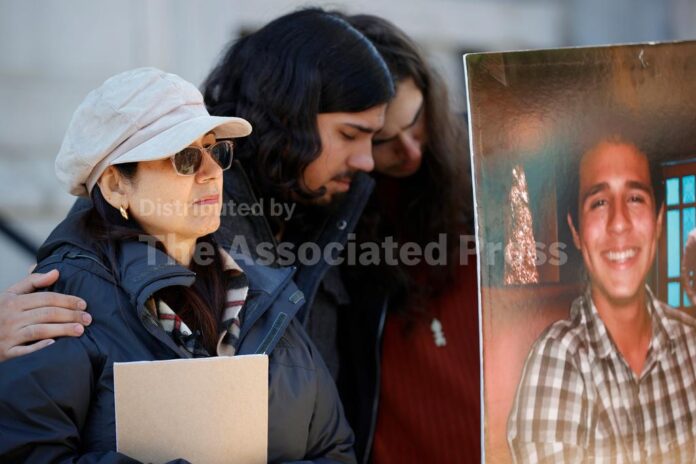
Judge tosses lawsuit filed by parents of ‘Cop City’ protester who was killed by troopers

ATLANTA (AP) — A federal judge has dismissed a civil rights lawsuit filed by the parents of an environmental activist who was shot dead by Georgia state troopers, saying their actions were “objectively reasonable” when they shot pepper balls into the activist’s tent and ultimately fired fatal gunshots after the 26-year-old shot one of the troopers.

The Jan. 18, 2023, shooting of Manuel Paez Terán, known as “Tortuguita,” was a galvanizing moment for the movement to halt the construction of what critics labeled “Cop City,” a sprawling police and firefighter training center that opened last year on the site of a forest and former prison farm just outside Atlanta.

Paez Terán’s family later sued three law enforcement officers who they say planned and carried out the raid against protesters who had spent months camping in the woods near the DeKalb County construction site. The lawsuit said troopers violated Paez Terán’s free speech rights and used excessive force against the activist, who then panicked and began firing shots. An autopsy commissioned by the family concluded that Paez Terán, who used they/them pronouns, was sitting cross-legged with their hands in the air when they were shot more than a dozen times.

In a ruling Monday, U.S. District Judge Steven Grimberg noted that, as the plaintiffs have acknowledged, Paez Terán fired at the troopers, wounding one of them, which the judge said makes the troopers’ lethal response reasonable. Grimberg also said that prior to the shooting, troopers were within their rights to fire pepper balls at Paez Terán after the activist, who was accused of criminal trespass, did not comply with orders to leave the tent.

“Because Paez Teran initiated gunfire with the (Georgia State Patrol) officers, Plaintiffs cannot maintain that Defendants’ actions were the proximate cause of the use of deadly force that ultimately ended the decedent’s life,” the judge wrote.

Grimberg also ruled that the officers had qualified immunity, special legal protection that prevents people from suing over claims that police or government workers violated their constitutional rights.

Paez Terán’s parents, Belkis Terán and Joel Paez, are “devastated” by the judge’s ruling, according to their attorneys, Jeff Filipovits and Wingo Smith.

“They feel they are being denied the accountability they deserve,” the attorneys said in a statement. “The records of their child’s death still have not been publicly released. They will be reviewing all their legal options.”

Body camera footage from four Atlanta officers involved does not show the shooting itself, the Georgia Bureau of Investigation has said. But the agency said footage shows the officers encountered Paez Terán in a tent in the woods and fired in self-defense after the activist shot at troopers and ignored verbal commands to leave the tent.

A prosecutor declined to charge the troopers who killed Paez Terán, saying their use of deadly force was “objectively reasonable.” Investigators have also said ballistics evidence shows the injured trooper was shot with a bullet from a gun Paez Terán legally purchased in 2020.

Activists formed the “Stop Cop City” movement to protest the construction of an 85-acre (34-hectare) Atlanta Public Safety Training Center, which they said would cause environmental damage by cutting down huge swathes of trees and exacerbate flooding fears in a poor, majority-Black neighborhood. They also opposed the use of tens of millions in public funding on what critics described as a training ground for “urban warfare.”

Protests against the facility at times veered into violence, with some masked activists torching police cars and construction equipment — actions that ultimately led to a sprawling racketeering indictment against 61 protesters in 2023. A Fulton County judge tossed the landmark case on procedural grounds last year, but Republican Attorney General Chris Carr is appealing the ruling.

Though the movement has receded since the filing of the racketeering charges and the opening of the training center, the name Tortuguita is still invoked at anti-police protests, and the activist’s image has become a common sight in murals and flyers across Atlanta.

FDA grants speedy approval to Eli Lilly’s weight-loss pill for obesity

Federal regulators on Wednesday approved Eli Lilly’s new weight-loss pill, a second daily oral medication to treat obesity and other weight-related conditions.

The Food and Drug Administration granted expedited approval to orforglipron, a GLP-1 drug that works like widely used injectable medications to mimic a natural hormone that controls appetite and feelings of fullness.

The drug, which will be branded as Foundayo, is expected to begin shipping Monday. The company said people with insurance may be able to get the drug starting at $25 per month with a Lilly discount card. Prices for people paying cash will range between $149 per month to $349 per month, depending on the dose.

The new pill joins drugmaker Novo Nordisk’s oral Wegovy pill, which has spurred more than 600,000 prescriptions in the United States since it was approved in December.

The FDA authorized Eli Lilly’s drug as part of a new program aimed at cutting drug approval times. The agency said it reviewed the company’s application in 50 days.

In a clinical trial of more than 3,000 adults with obesity, participants who received the highest dose of orforglipron, 36 milligrams, lost 11.2% of their body weight –- about 25 pounds on average –- over more than 16 months. That compared with a 2.1% weight loss, or less than 5 pounds, in patients who received a placebo, or dummy pill, according to the New England Journal of Medicine.

Both the Lilly and Novo Nordisk pills resulted in less weight loss than the average achieved with Lilly’s injectable Zepbound, which results in a 21% average weight loss, or Novo Nordisk’s injectable Wegovy, which averages about 15%.

Both once-daily pills promise convenience, but orforglipron is a small-molecule GLP-1 drug that can be taken without restrictions. The Wegovy pill, a peptide, must be taken with a sip of water in the morning on an empty stomach, with a 30-minute wait before eating or drinking.

Users of orforglipron also saw improvements in waist circumference, blood pressure, triglyceride levels and cholesterol levels, the study found.

Side effects, mostly gastrointestinal issues, led between 5% and 10% of participants in the orforglipron study to discontinue treatment, compared with nearly 3% in the placebo group.

About 1 in 8 people in the U.S. have used injectable GLP-1 drugs, according to a survey from KFF, a nonprofit health policy research group. But many more have trouble affording the costly shots.

The pill from Indianapolis-based Lilly will be included in a Trump administration deal to lower prices on GLP-1 drugs.

___

AP Health Writer Matthew Perrone contributed to this report.

___

The Associated Press Health and Science Department receives support from the Howard Hughes Medical Institute’s Department of Science Education and the Robert Wood Johnson Foundation. The AP is solely responsible for all content.

Quadruple amputee cornhole player acted in self-defense when shooting car passenger, lawyer says

LA PLATA, Md. (AP) — A quadruple amputee professional cornhole player acted in self-defense when he shot and killed a passenger in his car during a heated argument, his attorney said Wednesday.

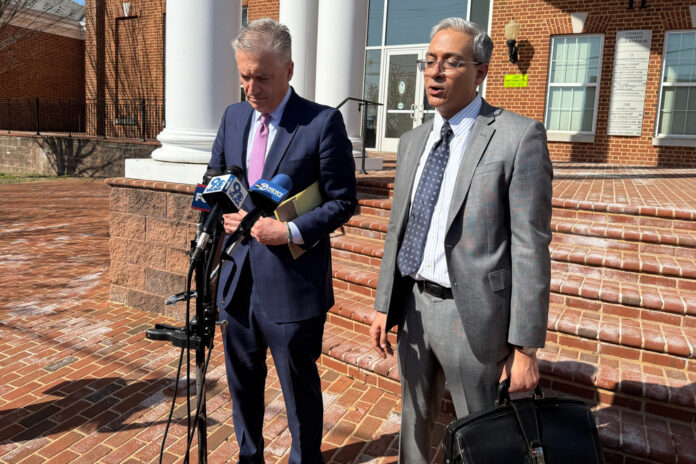
Dayton James Webber, 27, appeared in Charles County District Court via videoconference for the bail review Wednesday, where Judge Patrick Devine noted that he left Maryland after the March 22 shooting of 27-year-old Bradrick Michael Wells and ordered Webber to remain jailed without bail.

Webber, who was extradited from Virginia and is charged with first- and second-degree murder, hasn’t entered a plea yet and is due in court for a May 6 preliminary hearing. He also faces assault and firearm charges.

Defense attorney Andrew Jezic told the court that Webber acted in self-defense and that he anticipates “a lengthy trial” to prove it.

After the hearing, Jezic told reporters that his client was “terrified.”

“The truth here is that he would have been a murder victim if he had not acted immediately in defense of his life,” Jezic said.

Family members of Webber declined to comment after the hearing.

Webber, whose arms and legs were amputated when he was 10 months old to save his life after he contracted a serious blood infection, is accused of shooting Wells, of Waldorf, twice in the head during an argument, according to police charging documents.

Karen Piper Mitchell, a deputy state’s attorney, said witnesses in the car told authorities the argument was over a gun that a friend of Wells had stolen from Webber, and that Webber was upset Wells was still friends with the thief.

In arguing that Webber should remain in custody, Mitchell noted that he drove to Virginia after the shooting and owns firearms.

According to the charging documents, Webber pulled over after the shooting in La Plata, Maryland, and asked two backseat passengers to help pull the victim out, but they refused, got out of the car and flagged down police officers.

Webber fled with the victim still in the car, the Charles County sheriff’s office said. Two hours later, a resident in Charlotte Hall, about 10 miles (16-kilometer) away, found Wells’ body in a yard along a road and notified officers.

Detectives tracked down Webber’s car in Charlottesville, Virginia, and found Webber at a hospital where he was “seeking treatment for a medical issue,” the sheriff’s office said.

Webber was featured by ESPN in 2023 in a story of inspiration, noting he rode dirt bikes, wrestled and played football before becoming a professional cornhole player. The same year, he wrote an essay for the “Today” show about how he became a professional competitor. He said he learned to grab the bean bag by the corners and throw it using his amputated arms.

Max Thieriot is on fire. Meet the man behind TV hits ‘Fire Country’ and ‘Sheriff Country’

NEW YORK (AP) — Max Thieriot is carving out a role as the King of Friday TV.

He’s the star, co-creator and an executive producer of CBS and Paramount+’s “Fire Country” and a co-creator and executive producer of the spinoff freshman drama “Sheriff Country,” which both rule Friday nights as the No. 1 and No. 2 top-rated shows.

“It still feels a little surreal, for sure,” he says. “I didn’t feel like I was as smart as a lot of other writers, but the thing that I also realized early on is the biggest thing is you just need to connect with people. If you can move people, then you have them.”

“Fire Country” — the most watched freshman show of the 2022-23 season and now in its fourth season — and “Sheriff Country” are both set in the fictional California town of Edgewater, a rural community where everyone knows everyone else’s business.

Both marry things like office love triangles with plenty of heart-thumping action — knocking down canopy fires on “Fire Country” or solving a kidnapping tied to synthetic weed for the folks on “Sheriff Country,” led by actor Morena Baccarin.

“That’s what these shows are — they’re grounded human stories centered in this small, rural community where life is complex, things aren’t black and white, and I think that’s relatable to a lot of people,” says Thieriot.

On Friday, his two shows will have their first crossover event as Edgewater’s sheriffs and firefighters team up to search for nine missing teens amid escalating chaos, a two-hour block where actors from both shows mingle.

“I love the episodes and it really plays like one, big, two-part incident,” he says. “It feels very fluid but we get to dive a little bit into the fun, too, like there’s moments of levity and moments of heart and some great intrigue.”

Thieriot knows this place

Thieriot grew up in the Sonoma County town of Occidental, a former logging hub nestled among towering redwoods, and watched many of his friends join the ranks of Cal Fire, California’s Department of Forestry and Fire Protection.

Thieriot’s early acting gigs included “Bates Motel” and “SEAL Team” before he turned to writing. And when he did, he wrote what he knew.

“There’s a lot of things that people go through in their own personal life experiences or places they grew up that really could make for great television,” Thieriot says. “It almost takes somebody else looking at your crazy life to realize, ‘Wait a second, that sounds like a show.’”

Thieriot created the character of Bode Donovan, an inmate given the chance to join Cal Fire in exchange for a shortened prison sentence. Over the seasons, he’s faced drug dependency, a return to jail, family strains and heartbreak, in addition to harrowing wildfires.

Thieriot says he was deeply influenced by the show “Friday Night Lights,” which centered on a Texas town where the culture of high school football runs deep: “The thing that I loved about that show was you didn’t have to be a fan of football to like it. You saw how football was something in this community that brought everybody together, how life revolved around it.”

He hopes people tune into his show for the fires but stay for the characters. And with “Fire Country” a hit right out of the gate, Thieriot believed the town he created had more stories to tell. “We get to see one part of Edgewater in ‘Fire Country.’ Let’s bring the viewers the other part of Edgewater.”

Perhaps more than ruling Friday TV nights, Thieriot is proudest of creating jobs with his two shows: “One of the most gratifying things is knowing that between both shows there’s like 800 people that are getting paid every two weeks.”

Rural life

Running procedurals for two shows set in a working-class, rural community has its challenges. Unlike in a series set in an urban area, law enforcement and firefighters in Edgewater likely know the victims they race to help.

“There is something different about rolling up on a scene and it’s your friend or your neighbor,” says Joan Rater, who co-created both shows with Thieriot and her husband, Tony Phelan. “You know them as a whole person. And so you’re not going to come with certain assumptions you may come with if you didn’t know them.”

That means the writers need to play a long game — laying the groundwork for future drama by introducing and nurturing characters to weave in and out every week.

Phelan laughs that Thieriot is so plugged into his Northern California community that he always knows a buddy in firefighting or farming or law enforcement whom the writers can turn to for a storyline.

“Max is incredibly generous, but he also has a very clear idea of the story and the tone of the show and what feels true to him,” he says. “I think Max is really dialed into the audience of the show.”

Thieriot hopes the fictional community he’s created can help the real nation bridge some of its division. Neighbors in Edgewater might disagree but they’ve got each other’s backs and they need to stay civil because they’ll see them again real soon.

“I think it’s important to be reminded that we all live in the same country, we all bleed the same,” he says. “Obviously there’s differences between everybody, but that’s the great thing. It’s understanding those differences that makes us unique and special, not enemies.”

As for whether there’s another series in him, don’t bet against Thieriot. “My wheels are always turning,” he says, laughing. “I’m doing my best to add as much as I can to these two shows, but I’d be lying if I said if I wasn’t thinking about something else.”

Supreme Court hears arguments over Trump’s bid to limit birthright citizenship as he attends

Pro and anti-Trump demonstrators rally outside the U.S. Supreme Court, before justices hear oral arguments on whether President Donald Trump can deny citizenship to children born to parents who are in the United States illegally or temporarily, on Capitol Hill, in Washington, Wednesday, April 1, 2026. (AP Photo/J. Scott Applewhite)

WASHINGTON (AP) — The Supreme Court is taking up one of the term’s most consequential cases, President Donald Trump’s executive order on birthright citizenship declaring that children born to parents who are in the United States illegally or temporarily are not American citizens, and he was in the courtroom on Wednesday for some of the arguments.

The justices are hearing Trump’s appeal of a lower-court ruling from New Hampshire that struck down the citizenship restrictions, one of several courts that have blocked them. They have not taken effect anywhere in the country.

Trump is the first sitting president to attend oral arguments at the nation’s highest court. He spent just over an hour inside the courtroom, hearing arguments by the government’s lawyer, Solicitor General D. John Sauer. He left shortly after Sauer wrapped up and the plaintiff was invited to present her case.

The case frames another test of Trump’s assertions of executive power that defy long-standing precedent for a court that has largely ruled in the president’s favor — but with some notable exceptions that Trump has responded to with starkly personal criticisms of the justices. A definitive ruling is expected by early summer.

The birthright citizenship order, which Trump signed the first day of his second term, is part of his Republican administration’s broad immigration crackdown.

Birthright citizenship is the first Trump immigration-related policy to reach the court for a final ruling. The justices previously struck down global tariffs Trump had imposed under an emergency powers law that had never been used that way.

Trump reacted furiously to the late February tariffs decision, saying he was ashamed of the justices who ruled against him and calling them unpatriotic.

He issued a preemptive broadside against the court on Sunday on his Truth Social platform. “Birthright Citizenship is not about rich people from China, and the rest of the World, who want their children, and hundreds of thousands more, FOR PAY, to ridiculously become citizens of the United States of America. It is about the BABIES OF SLAVES!,” the president wrote. “Dumb Judges and Justices will not a great Country make!”

Trump’s order would upend the long-standing view that the Constitution’s 14th Amendment, ratified in 1868, and federal law since 1940 confer citizenship on everyone born on American soil, with narrow exceptions for the children of foreign diplomats and those born to a foreign occupying force.

The 14th Amendment was intended to ensure that Black people, including former slaves, had citizenship, though the Citizenship Clause is written more broadly. “All persons born or naturalized in the United States, and subject to the jurisdiction thereof, are citizens of the United States and of the State wherein they reside,” it reads.

In a series of decisions, lower courts have struck down the executive order as illegal, or likely so, under the Constitution and federal law. The decisions have invoked the high court’s 1898 ruling in Wong Kim Ark, which held that the U.S.-born child of Chinese nationals was a citizen.

The Trump administration argues that the common view of citizenship is wrong, asserting that children of noncitizens are not “subject to the jurisdiction” of the United States and therefore are not entitled to citizenship.

The court should use the case to set straight “long-enduring misconceptions about the Constitution’s meaning,” wrote Sauer, the solicitor general.

No court has accepted that argument, and lawyers for pregnant women whose children would be affected by the order said the Supreme Court should not be the first to do so.

“We have the president of the United States trying to radically reinterpret the definition of American citizenship,” said Cecillia Wang, the American Civil Liberties Union legal director who is facing off against Sauer at the Supreme Court.

More than one-quarter of a million babies born in the U.S. each year would be affected by the executive order, according to research by the Migration Policy Institute and Pennsylvania State University’s Population Research Institute.

While Trump has largely focused on illegal immigration in his rhetoric and actions, the birthright restrictions also would apply to people who are legally in the United States, including students and applicants for green cards, or permanent resident status.

___

Associated Press writer Darlene Superville contributed to this report.