Home Blog Page 1008

City police calls — Jan. 3

EDITOR’S NOTE: The following information is summarized from the records of city, county and state police, fire and hospital agencies.

Arrests

Tuesday

David L. Losure, 64, of 10105 Joann Drive, Columbus, probation violation, 3:27 p.m., by the probation department, held with no bond.

Tyler J. Cook, 33, of 3133 Miami Court, Columbus, probation violation, 6:16 p.m., by the probation department, held with no bond.

Omar S. Donald, 56, Seymour, driving while suspended with a prior conviction, 8:50 p.m., by the Bartholomew County Sheriff’s Office, held in lieu of $5,000 bond.

David M. Hert, 48, of 12005 W. County Road 525S, Columbus, theft, 9:06 p.m., by the Bartholomew County Sheriff’s Office, held in lieu of $7,500 bond.

Wednesday

Curtis R. Hoesman, 43, of 1075 Second St.-D, Columbus, possession of marijuana, dealing in cocaine or narcotic drug, possession of paraphernalia, possession of a syringe, maintaining a common nuisance, 1:07 a.m., by the Columbus Police Department, held with no bond.

Brittany R. Shelby, 36, of 2312 Maple St., Columbus, possession of cocaine or narcotic drug, possession of paraphernalia, possession of a syringe, visiting a common nuisance, 1:47 a.m., by the Columbus Police Department, held with no bond.

Tyler J. Vandiver, 39, of 2528 McKinley Ave., Columbus, dealing in cocaine or narcotic drug, possession of paraphernalia, possession of a syringe, maintaining a common nuisance, deception, 1:53 a.m., by the Columbus Police Department, held with no bond.

Brandon P. Clark, 41, of 1012 California St., Columbus, operating a vehicle while intoxicated-endangerment, operating a vehicle with a controlled substance in body, leaving the scene of a property-damage crash, 5:16 a.m., by the Indiana State Police, held in lieu of $10,000 bond.

Fire, medic runs

Wednesday

12:23 a.m. — Possible overdose in the 5000 block of East State Street.

7:59 a.m. — Person injured in a fall in the 3400 block of Earls Court.

9:25 a.m. — Carbon monoxide investigation in the 300 block of Cleveland Street.

12:25 p.m. — Gas odor at Sixth and Maple streets.

3:25 p.m. — Person injured in a fall in the 4100 block of Appleway Drive.

4:51 p.m. — Smoke investigation in the 1400 block of Jackson Street.

6:09 p.m. — Illegal burn in the 1200 block of Iowa Street.

7:16 p.m. — Person injured in the 4800 block of Pine Ridge Drive.

7:43 p.m. — Possible overdose in the 5000 block of East State Street.

8:48 p.m. — Person injured in the 8600 block of West County Road 700S.

Incidents

Wednesday

9:43 a.m. — Residential entry in the 4800 block of North County Road 700E.

11:54 a.m. — Property-damage accident at North Indianapolis Road and West Lowell Road.

12:39 p.m. — Personal-injury accident at North National Road and Hawcreek Boulevard.

1:02 p.m. — Personal-injury accident at Linden Park Place and West Jonathan Moore Pike.

1:18 p.m. — Property-damage accident in the 8100 block of East County Road 450N.

1:51 p.m. — Shoplifting in the 2300 block of 25th Street.

3:55 p.m. — property damage accident in the 2400 block of North National Road.

4:03 p.m. — Juvenile problem in the 9100 block of North State Road 9.

4:14 p.m. — Shoplifting in the 1800 block of North National Road.

10:55 p.m. — Leaving the scene of a property-damage accident in the 400 block of Washington Street.

11:09 p.m. — Loud music in the 200 block of North Marr Road.

11:20 p.m. — Trespassing in the 3300 block of Country Brook Street.

11:43 p.m. — Damage to property at the 78 mile marker of I-65.

Braun restarting workforce board months after similar board was eliminated

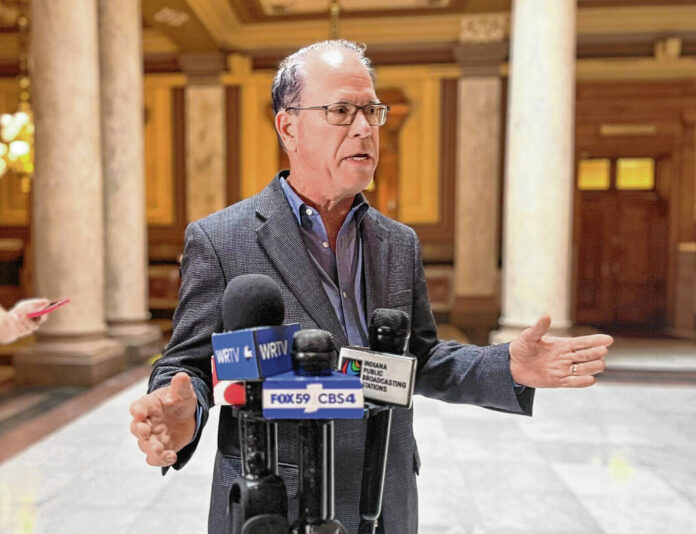
Niki Kelly/Indiana Capital Chronicle Gov. Mike Braun addresses reporters on Monday, Aug. 18, 2025, at the Indiana Statehouse.

INDIANAPOLIS — Indiana Gov. Mike Braun has re-established a board overseeing the state’s workforce training programs just months after a similar board was dissolved.

Braun signed an executive order saying the State Workforce Development Board was needed to comply with federal law on the implementation of state and federal workforce initiatives.

The governor’s office said the board would serve “as a central coordinating body to align employers, education and training providers, and state agencies around measurable workforce outcomes.”

Braun’s order released Monday comes after the 21-member Governor’s Workforce Cabinet was eliminated as of July 1. The Workforce Cabinet was enacted in 2018 at the request of then-Gov. Eric Holcomb.

The state budget bill approved by the General Assembly last year repealed the Workforce Cabinet from state law and transferred its activities to the state Department of Workforce Development.

Braun has not yet named members to the board or specified its makeup.

The order said Braun will be a board member and that the governor will appoint other members from those nominated by Indiana business organizations, trade associations and labor unions. Board members must include officials responsible for state workforce programs and from local government.

“We will use the Indiana Workforce Development Board to bring together an elite team of job creators and workforce development experts to help create new opportunities and bigger paychecks for Hoosier workers,” Braun said in a governor’s office statement.

The workforce board’s reinstatement follows a renewed push by some Republican lawmakers to reduce Indiana’s roster of more than 250 state boards and commissions. Legislation specifying which board might be eliminated had not been released as of Friday.

The Indiana Capital Chronicle covers state government and the state legislature. For more, visit indianacapitalchronicle.com.

Trial to begin for police officer charged in delayed response to Uvalde school shooting

Families who lost loved ones in the 2022 attack on an elementary school in Uvalde, Texas, have sought for nearly four years to hold accountable the police who waited more than an hour to confront the shooter while children and teachers lay dead or wounded in classrooms.

Now one of the first officers on the scene is about to stand trial on multiple charges of child abandonment and endangerment. Former Uvalde schools police officer Adrian Gonzales is accused of ignoring his training in a crisis with deadly consequences. His attorney insists he was focused on helping children escape from the building.

The trial that starts Monday offers potentially one of the last chances to see police answer for the long delay. The families have pinned their hopes on the jury after their gun-control efforts were rejected by lawmakers, and their lawsuits remain unresolved. A few parents ran for political office to seek change, with mixed results.

The proceedings will provide a rare example of an officer being criminally charged with not doing more to stop a crime and protect lives.

Jesse Rizo’s niece was one of 19 children and two teachers killed by the teenage gunman in one of the deadliest school shootings in U.S. history. Nine-year-old Jackie Cazares still had a pulse when rescuers finally reached her, Rizo said.

“It really bothers us a lot that maybe she could have lived,” he said.

Only two of the 376 officers from local, state and federal agencies on the scene have been charged — a fact that haunts Velma Lisa Duran, whose sister, Irma Garcia, was one of the teachers gunned down.

“What about the other 374?” Duran asked through tears. “They all waited and allowed children and teachers to die.”

The charges reflect the dead and wounded children, but not her sister’s death or that of the other teacher who was killed.

“Where is the justice in that?” Duran asked. “Did she not exist?”

Prosecutors will likely face a high bar to win a conviction. Juries are often reluctant to convict law enforcement officers for inaction, as seen after the Parkland, Florida, school massacre in 2018.

Sheriff’s deputy Scot Peterson was charged with failing to confront the shooter in that attack. It was the first such prosecution in the U.S. for an on-campus shooting, and Peterson was acquitted by a jury in 2023.

The attack, the delay and the indictments

Police and Texas Gov. Greg Abbott initially said swift law enforcement action killed Uvalde gunman Salvador Ramos and saved lives. But that version quickly unraveled as families described begging police to go into the building and 911 calls emerged from students pleading for help.

The reality was that 77 minutes passed from the time officers first arrived until a tactical team breached the classroom and killed Ramos.

Multiple reports from state and federal officials cataloged cascading problems in law enforcement training, communication, leadership and technology, and they questioned whether officers prioritized their own lives over those of the children and teachers.

Gonzales was charged two years later in an indictment that alleged he placed children in “imminent danger” of injury or death by failing to engage, distract or delay the gunman and by not following his active shooter training.

The indictment said he did not advance toward the gunfire despite hearing shots and being told where the shooter was.

The only other officer to be charged is former Uvalde schools Police Chief Pete Arredondo. His trial on similar charges has not yet been set.

Uvalde County District Attorney Christina Mitchell did not respond to requests from The Associated Press for comment on the indictments or whether a grand jury considered charging other officers.

According to a report by state lawmakers, Gonzales was among the first officers in the building. They heard gunfire and retreated without firing a shot after Ramos shot at them.

Gonzales told investigators he later helped break windows to remove students from other classrooms.

“He was focused on getting children out of that building,” said Gonzales’ attorney, Nico LaHood, a former district attorney and prosecutor in San Antonio. “He knows where his heart was and what he tried to do for those children.”

The trial was moved from Uvalde to Corpus Christi, 200 miles away, after defense attorneys and prosecutors agreed a change of venue would be the best way to find an impartial jury.

A divided community

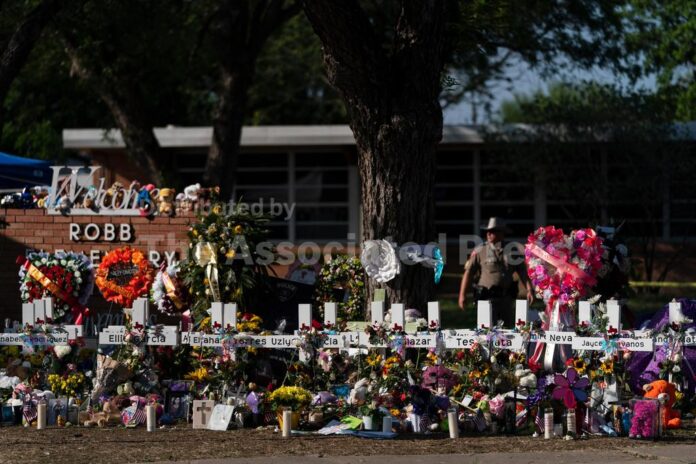
In Uvalde, a city of about 15,000 people, the Robb Elementary building is still standing, but it’s empty. A memorial of 21 white crosses and flowers sits in front of the school sign. Another memorial is displayed at a downtown water fountain plaza. Murals of the victims cover walls on buildings around town.

Craig Garnett, owner and publisher of the Uvalde Leader-News newspaper, said people who were not directly affected by the attack “have found it pretty easy to move forward.”

Garnett also believes getting the trial out of Uvalde was a good move for the city.

“The community was terribly divided in the aftermath,” he said. If the trial were held there, “you would have so many opportunities to inflame things.”

Some victims’ parents sought political office but with little success.

Javier Cazares, Jackie’s father, ran unsuccessfully in 2022 for the Uvalde County Commission as a write-in candidate on a platform that called for more rigorous police training. Kimberly Mata-Rubio, whose daughter Lexi was killed, made a bid for mayor in her memory in 2023 but lost.

Rizo, who won a seat on the school board in 2024, agreed that many Uvalde residents have moved on from May 24, 2022. He finds that maddening.

“I hear, ‘They tried the best they could’ and ‘Do you blame them? Would you have taken a bullet?’” Rizo said. “It angers me and frustrates me.”

Uvalde has a strong tradition of supporting law enforcement. Two of the people killed came from law enforcement families.

Mata-Rubio’s husband was a sheriff’s deputy who went to the school after the attack started. The other teacher killed, Eva Mireles, was married to one of the first officers to enter the building.

Families pursued multiple paths for justice

The families have sought justice through multiple legal paths. Federal and state lawsuits have been filed against law enforcement, a gun manufacturer, a video game company and the Meta social media company over the shooting. Those cases are still pending.

The families reached a $2 million settlement with the city that promised higher standards and better training for police.

Relatives also lobbied state and federal lawmakers for stricter gun control laws that never advanced. But earlier this year, Texas lawmakers passed the Uvalde Strong Act, which sets new requirements for active shooter training and shooting response plans for police and schools.

Duran wants accountability not just for her sister but also for a beloved brother-in-law who died two days after the shooting.

Irma’s husband, Joe, was watching a television report on the shooting when he heard that authorities missed their chance to end the attack quickly. He immediately fell to the floor with an apparent heart attack, Duran said.

The conviction of a single officer out of almost 400 would bring little in the way of justice, Duran said.

“The only justice is going to be when they take their final breath,” she said. “And then God will judge them.”


Letter: Thoughts on reclassifying marijuana

From: Cole Bennett

Columbus

President Trump delivered an early Christmas present to all you 420-friendly folks out there. Earlier this month, he signed an executive order reclassifying marijuana, which eases restrictions on research for medical use. The drug had previously been classified as what the feds call Schedule I, right up there with LSD and heroin. Now, weed is in the same category as Tylenol with codeine.

My historical hesitation with marijuana had to do with my upbringing. Coincidentally, I had just finished Rob DeSalle’s 2025 novel “Cannabis – A Natural History” earlier this month to grasp a better understanding of an issue I had only foundational knowledge.

It’s important to contrast Trump’s first term from the second. Trump One’s first two Attorneys Generals were strongly opposed to legalization (pg. 237). In Trump Two, the president appears to be shifting based on marijuana’s growing popularity, with over 60% of Americans believing pot should be legal in 2020 (pg. 258). As of 2025, 24 states have legalized recreational marijuana, and Indiana is not one of them. In August, Gov. Mike Braun signaled federal reclassification adds “a little more fuel to the fire” when it comes to legalization in the state. Locally, Republican State Rep. Jim Lucas filed a bill in January that would have legalized the use of medical marijuana, which failed to pass. Indiana AG Todd Rokita was not on board with the federal reclassification.

I understand now that my opposition to marijuana legalization had much to do with fear. And that’s not to say that there are no real dangers of using marijuana. DeSalle writes of a 2018 study out of Canada, which found an “increased risk of symptoms of schizophrenia or psychosis was linked to heavy use and even average use” (pg. 252). I have seen the horrors of severe mental illness such as schizophrenia in both my family and in my profession. If recreational use of marijuana is to become legalized in the Hoosier state, children need to be protected, and users need to know the risks. And no, I’m not advocating that all drugs become recreationally legal. The legal schedule of drugs should remain in place, but marijuana use is objectively not the same as LSD or heroin.

Ultimately, drug use is a choice. Drunk driving has taken countless lives; however, booze remains legal. Governments regulate its use, set consequences for driving under the influence, and tax it to fund rehabilitation programs. With marijuana’s popularity today, Hoosiers will get their hands on it one way or another, often by driving to another state. In Indiana, folks are at risk of buying weed off the street that may be laced with deadly drugs such as fentanyl – and that unfortunately includes our children.

The choice before legislators is between transparency and the black market. At the very least, reclassifying marijuana will give legislators more evidence of the risks and benefits so that policy is based on science and morals, not just emotion and fear.

Editorial: The bookstore comeback is good news for readers

As winter settles in and daylight fades early, Americans long have turned to books for comfort, curiosity and company. The good news this holiday season is that the bookstores which make that habit possible are rebounding, too.

In the late 1990s, many book lovers often looked with scorn upon the likes of Barnes & Noble and the now-defunct Borders, favoring the dusty shelves of their preferred independent book haunt.

Fast-forward to now and bookstores of any kind have been harder to come by in many communities. The old bookstore wars are over. In an age of Amazon dominance, readers have learned to root for anyone selling physical books, and that enthusiasm appears to be paying off.

Barnes & Noble is leading the charge, opening nearly 70 new stores this year with plans to add another 60 in the new year.

“2025 has been a fantastic year for us,” Barnes & Noble CEO James Daunt told CNBC on Dec. 15. To be sure, not all Barnes & Noble locations are built alike, with some maintaining a smaller footprint wedged into strip malls while others maintain the standalone, bulky presence many identify with the brand. Examples of both versions can be found peppered through Chicago and its suburbs.

Discussing what may be behind this positive news, Daunt said the naysayers might tell you books do really well during a recession. He had a more hopeful perspective, crediting strong releases from the publishing world and a growing thirst for book supply among the public. While COVID was awful in so many ways, it appears pandemic lockdowns had the effect of igniting a love of reading in lots more folks — making it possible for the bookstore ecosystem to grow.

“Once you get into the habit of reading books — and that clearly happened during the pandemic — you retain that habit,” Daunt said. He also noted that tariffs, which have hindered so many other industries, have had “virtually no impact” on books.

These good habits aren’t just bolstering big brands like Barnes & Noble, they’re leading to a resurgence of independent booksellers, too. The American Booksellers Association reported that more than 420 new bookstores opened this year, part of a rebirth of bookshops after the initial Amazon/big-box shock that caused so many to go under.

We found it interesting to follow the timeline of this evolution by tracking ABA’s membership, which peaked in 1995 with 5,500 members across 7,000 stores before dropping as of 2009 to 1,401 members across 1,641 locations. The group’s most recent numbers from 2022 — 2,178 members at 2,593 locations — reflect an ecosystem that is rebounding modestly postpandemic.

We couldn’t be happier. To read is to learn, to feel, to expand your horizons beyond the tiny corner of the world you occupy. To come to the realization that you are but one small part of a much bigger world without ever leaving your sofa.

And if more people are coming to this realization, all the better for us all.

Looking Back – Jan. 3

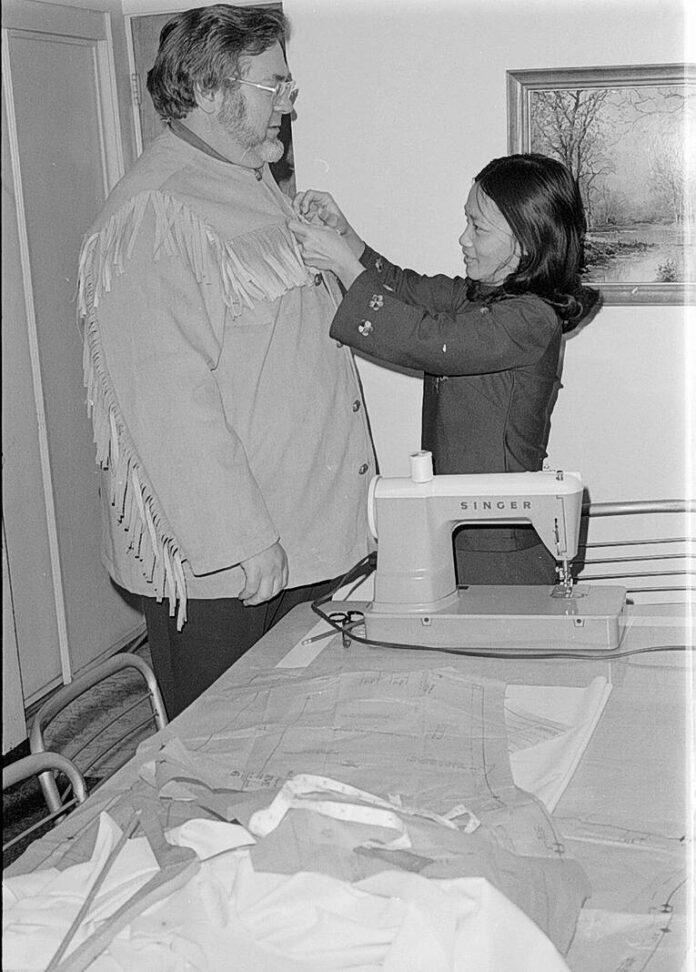
Rev. Jerry Stitt is fitted for a buckskin costume on Jan. 3, 1976, to be used during the debut of The Continental Singers, a bicentennial choir of area residents. Putting the final stitches in Stitt’s jacket is Mrs. Tam Ving, who helped with the production.

2016

Artwork by Hoosier artists Dalton Bolser, William Eyden, William Eyden Jr., Charles Buckler, Herbert Day, Roy Muncie and Albert Berne were put on display at A Perfect Day Café in downtown North Vernon for the month.

2001

Columbus Fire Department Battalion Chief Jack McKay announced his retirement after 41 years with the department. McKay was set to retire on March 1.

1976

Don Neafus was elected president and Lynn Clark vice president of the Firemen’s Local 2190 of the International Firefighters Association, representing members of the Columbus Fire Department.

Pets Page: Columbus Animal Care Services

Skye

Owen is a true athlete. He can jump really high to get his favorite feather toy. Owen enjoys cat and dog friends. He wants to be the leader of the pack except if you have a Churu treat. If you have the Churu treat, Owen will follow you anywhere.

Skye is very excited when people walk through the building just waiting to see if you will take him out for a walk. He loves going for walks where he feels less stressed and enjoys exploring. Skye has been on a Doggie Day Out where he just chilled and enjoyed every minute of it. If you like to go for walks, come take Skye with you.

If you would like any of these pets to join your family, please complete the adoption form. https://www.columbus.in.gov/animal-care-services/adoptable-pets/adoption-information-and-application/ then schedule an appointment at 812.376.2505 or email us at animalcareservices@columbus.in.gov.

Adoption Fees are $80 for cats and $100 for dogs or $20 special on all pets at the shelter over 90 days or over seven years, thanks to anonymous donor. Fees cover having them spayed or neutered, up to date on shots (age appropriate), and microchipped.

Pets Page: Bartholomew County Humane Society

Marlo

Marlo is a sweet dog who would do great with daily walks and attention from his humans. He can also be sort of silly and is a bigger pup that would thrive with plenty of playtime!

Clementine’s great looks turn heads but it’s her gentle, affectionate personality that truly steals hearts! She loves cuddles and warm laps and is perfect for anyone looking for a sweet, low-key companion.

To schedule an appointment to meet these or any of our animals, please contact the shelter via info@bartholomewhumane.org or call 812-372-6063. Appointment times are Monday, Wednesday, Thursday, and Friday noon to 5:30 p.m. or 10 a.m. to 12:30 p.m. Saturday.

Ryan Trares: Turning the page

Trares

This is one of the more underrated — and one of my personal favorite — times of year.

The hustle and bustle of Christmas has passed. All of the travel is done. Any lingering vacation days need to be used before the start of the new year.

It’s a lazy, lazy week that’s still filled with enough fun and celebration to feel special. And it’s always a time of transition, of fresh starts.

For starters, my birthday falls just four days after Christmas. On Dec. 29, I closed the book on my 46th year, with an eye towards the future.

Having a birthday smack dab in the middle of Christmas and New Year’s Eve has always been a challenge. This is a week when people collectively catch their breath, enjoy some downtime and gear up for the coming year. Kids are out of school, and many adults use up left-over vacation time to relax. No one really wants to do much of anything this week.

Still, I’ve always loved having a holiday birthday. My parents always made sure to make it a special day even in the midst of the holiday dead zone. Now that I’m older, my wife and Anthony take extra care to make my day special and unique. This year, that meant a meal at my favorite restaurant — the seared scallops are so good — then a fun time out with the family.

Sure, the day is a chance to have a little bit of fun (as if that’s necessary when it feels like the past month has been nothing but celebrations.) But coming so close to New Year’s Day and resolution season, it’s also a chance to set some goals, think about what I want to accomplish and push reset.

I’m not a huge resolution kind of guy, but I always like to set my sights on something to strive towards. This year, I’ve decided to focus on literature.

I’m bringing this one back from last year, as I didn’t even come close to reaching this bar: Finishing one book ever two weeks. I started out strong in January, as I had a whole stack of new novels and non-fiction to get into. But life got in the way as the weather got nicer, and I was lucky to get more than one a month.

I’m ready to give it another shot. My to-read list has been revitalized with some fascinating books I can’t wait to dig into. My dad contributed “Boys in the Boat” by Daniel James Brown, the story of the University of Washington rowing team and their quest to win gold at the 1936 Olympics in Germany. Combining sports, history and personal achievement, it seems like just the inspiration I need to start the year out right.

From my brother, who shares my pop culture sensibilities, I received “The Uncool: A Memoir,” written by director Cameron Crowe about his experiences as a young music reporter in the 1970s, interviewing such luminaries as Led Zeppelin, Bob Dylan and Fleetwood Mac.

Crowe’s film “Almost Famous,” which is loosely based on his experiences as a reporter, is a classic film, and one of his other’s, “Singles,” is an underrated gem that perfectly captures the early ’90s grunge scene in Seattle. I can’t wait to get into it.

And wrapping up my haul is “Hemingway’s Hurricane” by Phil Scott. The book tells the story of the 1935 Labor Day hurricane that ravaged the Florida Keys, a place where Ernest Hemingway made his home. The famed author was horrified to learn how government carelessness and callousness created a tragedy, and his vocal disgust lead to an investigation into the government response.

After visiting Key West this past year, touring Hemingway’s house and learning about such a unique place as the Keys, diving back into that magical place will be a cure to the winter blues.

Of course, there will be other goals for 2026 — trying new approaches and improving as a journalist and writer, taking on a new hobby, hoping to beat last year’s mileage record in my running this coming year.

But those can wait. Just a few more chapters first.

Ryan Trares is a senior reporter and columnist for the Daily Journal. Send comments to editorial@therepublic.com.

‘Roaring ‘20s’ rhyme a dire warning for investors

Mickey Kim

Mark Twain famously said, “history doesn’t repeat itself, but it often rhymes.” Andrew Ross Sorkin’s vivid new book, “1929: Inside the Greatest Crash in Wall Street History—and How It Shattered a Nation,” strikes an unnerving rhyme today. His tale of greed, corruption and incompetence makes the 2020s—our own gilded, speculative decade—feel suspiciously like the “Roaring ‘20s” of a century ago.

Today’s markets display the same heady mix of optimism, financial innovation and unchecked hubris. Easy credit, new ways to speculate dressed up as “democratization” and a familiar conviction that “this time is different” make the financial zeitgeist rhyme uncomfortably well with that era.

The cast of characters and technologies have changed, but the underlying human behavior and structural vulnerabilities are eerily similar.

The stock market crash of 1929 occurred from Thursday, Oct. 24, 1929 (“Black Thursday”) through Tuesday, Oct. 29, 1929 (“Black Tuesday”), when panic selling broke the market. Over those four trading days, the Dow Jones Industrial Average (DJIA) fell from 305.85 to 230.07, a 25% decline.​ From its peak of 381.17 on Sept. 3, 1929 to its eventual bottom of 41.22 on July 8, 1932, the DJIA lost roughly 89% of its value. Unemployment soared to roughly 25% (15 million Americans).

Our nation was shattered, both economically and psychologically.

Sorkin recounts the Crash and Great Depression like a true crime novel, tracing the characters and their motives that fueled disaster. In the late 1920s, Charles “Sunshine Charlie” Mitchell promoted National City Bank (which would become Citigroup) as the “Bank for All.” He extended loans to small depositors so they could speculate in the stock market, luring “throngs of inexperienced investors” with promises of effortless riches, all wrapped in the flag of “democratizing access.”

A New York Times story titled ‘The Magnet of Dancing Stock Prices,’ marveled, ‘The people who know the least about the stock market have made the most money out of it. Even Charles M. Schwab declared the old-timers are behind the times and a new speculative era has dawned.” The article wasn’t describing Roaring Kitty or the legion of social media “finfluencers” touting the meme stock (think GameStop) or crypto scheme du jour—because it was published on March 24, 1929.

Fast forwarding a century and the rhetoric about democratizing investing sounds strikingly similar. Robinhood CEO Vlad Tenev has been lionized as a “cult hero” to legions of traders flooding markets with risky bets. In my 2021 column, “’Commission-free’ trades a toxic combo for young investors,” Charlie Munger, Warren Buffett’s long-time partner, called such activity “speculative orgies,” likening it to casino gambling or racetrack betting.

Robinhood protested, arguing it was expanding access for those without generational wealth and dismissing critics like Munger as “elitist.”

Sorkin argues—and experience confirms—“the almost singular through line behind every major financial crisis is one thing: debt.” Debt is a powerfully optimistic force: if we envision the future as a land of ever‑expanding opportunity and affluence, why not marshal some of that wealth for use today? Debt draws the wealth of tomorrow into the present—exhilarating on the way up, devastating on the way down.

Reckless lending helped fuel the Great Depression, just as the subprime mortgage bust triggered the Great Recession of 2008. Today, cracks are appearing in the $1.5 trillion private- credit market, which aims to replace traditional banks as commercial lenders. Subprime auto dealer-lender Tricolor and auto-parts supplier First Brands collapsed after pledging the same collateral multiple times, saddling their lenders with billions in losses.

JP Morgan CEO Jamie Dimon compared the bankruptcies to spotting a cockroach: “when you see one cockroach, there are probably more.” Co-CEO Marc Lipschultz of private-credit giant Blue Owl fired back that if Dimon saw cockroaches, “there might be a lot more cockroaches at JPMorgan.” The exchange underscores how much uncertainty lurks in the rapidly growing, lightly-tested corner of the credit markets.

Policy mistakes also rhyme. After the 1929 Crash, President Herbert Hoover signed the Smoot-Hawley Tariff Act into law on June 17, 1930, sharply raising duties on thousands of imports. Smoot-Hawley didn’t cause the Great Depression, but it intensified the downturn by provoking foreign retaliation, collapsing trade and further damaging U.S. farmers, factories and banks.

Echoing that protectionist impulse, President Trump announced his own sweeping, “reciprocal” tariff policy on April 2, raising broad-based barriers in the name of fairness and leverage. The details differ, but the political logic—using tariffs as a blunt instrument to punish trading partners and “fix” perceived imbalances —would have been instantly recognizable in 1930.

This is not a prediction of a 1929-style market crash, but the parallels are too potent to ignore as Wall Street continues to churn out dubious products, the line between investing and gambling blurs and regulatory guardrails are being rapidly dismantled.

There is an old saying: those who fail to learn from history are doomed to repeat it. Investors who forget how quickly euphoria, leverage and policy mistakes can turn a boom into a bust may find the “rhyme” between the 1920s and the 2020s far more literal than they ever imagined.

Mickey Kim is the chief operating officer and chief compliance officer for Columbus-based investment adviser Kirr Marbach & Co. Kim also writes for the Indianapolis Business Journal. He can be reached at 812-376-9444 or mickey@kirrmar.com.