Home Blog Page 1091

Sports Planner for Wednesday and Thursday

COMING UP

Indiana Sentinels hockey

Friday vs. Blue Ridge, 7:30 p.m.

Saturday vs. Blue Ridge, 7:30 p.m.

Dec. 31 vs. Port Huron, 9:30 p.m.

IU Columbus men’s basketball

Tuesday at Lourdes, 5 p.m.

Jan. 3 vs. Saint Mary-of-the-Woods, 3 p.m.

Jan. 6 vs. Brescia, 6 p.m.

IU Columbus women’s basketball

Jan. 3 vs. Saint Mary-of-the-Woods, 1 p.m.

Jan. 6 at Brescia, 7 p.m.

Jan. 10 vs. Shawnee State, 1 p.m.

Indianapolis Colts

Sunday vs. Jaguars, 1 p.m. (FOX)

Jan. 3 or 4 at Texans, TBA (TBA)

Indiana University football

Jan. 1 vs. Alabama in CFP quarterfinals, 4 p.m. (ESPN)

Indiana Pacers

Friday vs. Celtics, 7 p.m.

Saturday at Heat, 8 p.m.

Monday at Rockets, 8 p.m.

Indiana University men’s basketball

Jan. 4 vs. Washington, 8 p.m. (BTN)

Jan. 7 at Maryland, 6:30 p.m. (BTN)

Jan. 10 vs. Nebraska, noon (BTN)

Purdue men’s basketball

Monday vs. Kent State, 7 p.m. (B1G+)

Jan. 3 at Wisconsin, 8 p.m. (FOX)

Jan. 7 vs. Washington, 8:30 p.m. (BTN)

Indiana University women’s basketball

Monday vs. Minnesota, 6 p.m. (B1G+)

Jan. 1 vs. Michigan State, noon (BTN)

Jan. 4 at Nebraska, 8 p.m. (B1G+)

SPORTS ON TV TODAY

College football

NCAA DIII Tournament: Johns Hopkins at UW-River Falls, 3 p.m. (ESPNU)

NCAA DIII Tournament: John Carroll at North Central, 6 p.m. (ESPNU)

Sheraton Hawaii Bowl: California vs. Hawaii, 6 p.m. (ESPN)

NFL

2025 Walter Payton NFL Man of the Year Special, 7 p.m. (ESPN)

SPORTS ON TV FOR THURSDAY

NBA

Cavs at Knicks, noon (ABC/ESPN)

Spurs at Thunder, 2:30 p.m. (ABC/ESPN)

Mavericks at Warriors, 5 p.m. (ABC/ESPN)

Rockets at Lakers, 8 p.m. (ABC/ESPN)

Timberwolves at Nuggets, 10:30 p.m. (ABC/ESPN)

NFL

Cowboys at Commanders, 1 p.m. (Netflix)

Lions at Vikings, 4:30 p.m. (Netflix)

Broncos at Chiefs, 8:15 p.m. (Prime Video)

Phyllis Maxine Blair

COLUMBUS

Phyllis Maxine Blair, 84, of Columbus, passed away at 3:48 p.m. on Friday, December 19, 2025, at Silver Oaks Health Campus in Columbus.

Born October 5, 1941, in North Vernon, she was the daughter of the late James and Anna (Mack) Fortner. She married Coy E. Blair on June 24, 1961, in North Vernon; he preceded her in death on December 7, 2019.

Phyllis attended North Vernon High School and was a graduate of I.U.P.U.I with a degree in Applied Science. She worked in the skilled trades program for Cummins Engine Company in Columbus from 1979 until her retirement in 2001 and had previously worked for the former Muscatatuck State Developmental Center in Butlerville for 11 years. She was a member of Ruth Circle of Church at East Columbus Christian Church. Phyllis enjoyed gardening, spending time with her family and was a huge Jeff Gordon Fan.

Survivors include her daughters, Tammy (Jim) Losey and Tina (Matt Jeffries) Ellis, both of North Vernon; sisters, Ellen Moore and Sandy (Mike Root) Summerfield, both of North Vernon; grandchildren, Joe (Jenn Romero) Hawkins and Shelly (Justin) Butler, both of Hayden, Katie (Josh Salinas) Hawkins of Columbus, David (Beau) Ellis and Kayla (Alex) Zimmerman, both of North Vernon, Toyce (Josh) Cord of Shelbyville and Nick Losey of Fox Island, Washington; fifteen great-grandchildren; and four great-great-grandchildren.

She was preceded in death by her parents; her husband; infant daughter; brothers, William and Charles Fortner; sisters, Virginia Booher, Edith Bishop, Geneva Monday, Lucille Redicker, Stella Krichner, and Sue Horton; and son-in-law, Bob Ellis.

A funeral service for Phyllis will be conducted at 1:00 p.m. on Tuesday, December 23, 2025, at the Dove-Sharp &Rudicel Funeral Home and Cremation Service in North Vernon with the Rev. Ron Bridgewater officiating. The visitation for family and friends will be on Tuesday from 10:00 a.m. until the time of the service. The burial will follow in the Vernon Cemetery.

Memorials may be made in honor of Phyllis through the funeral home to Our Hospice of South Central Indiana or Love Chapel of Columbus.

CPD investigating bomb threat, ‘hoax’ explosive device at Centerstone

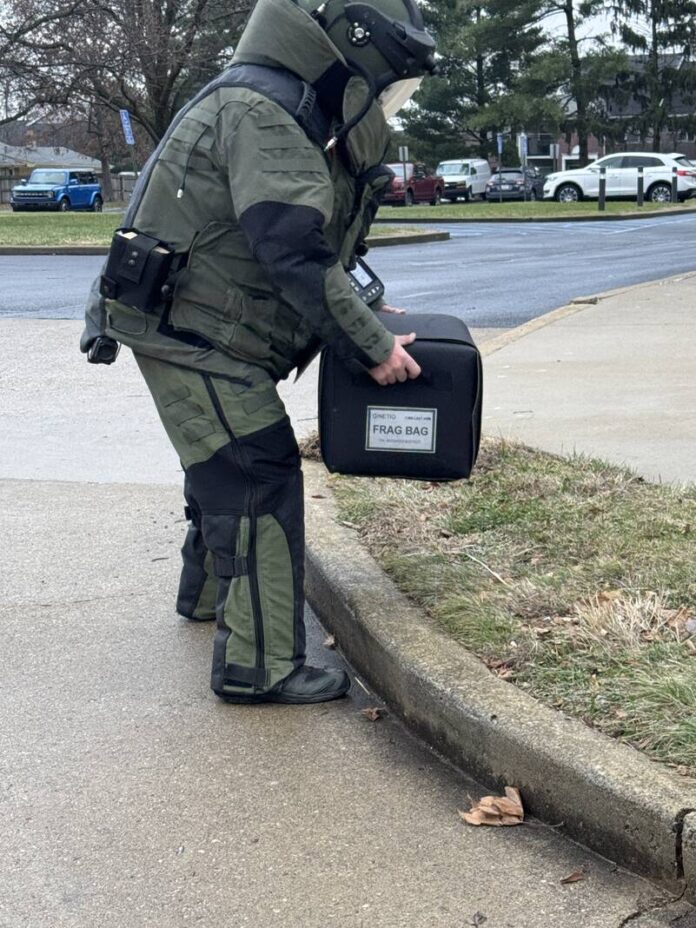
Photo provided by the Columbus Police Department

A member of the Columbus Police Department’s Hazardous Devices Unit removes a suspected explosive device from the Centerstone parking lot in Columbus, Ind., Tuesday, Dec. 23, 2025. The device was later determined to be a ‘hoax’ bomb.

Columbus police said they are investigating a reported bomb threat and hoax explosive device found in the parking lot of a local mental health provider, prompting an evacuation.

On Tuesday, Columbus Police Department officers were dispatched to Centerstone, 720 N. Marr Rd., after employees reported a suspicious item in the provider’s parking lot that they thought could be a bomb.

When officers arrived, they set up a perimeter around the item, which was located about 50 feet from the building and evacuated Centerstone, CPD said in a statement.

The CPD Hazardous Devices Unit determined it was likely not an explosive device, and the item was taken to a safe location to determine what it was, CPD said.

Upon examining the items, investigators believe someone used household items to make a “hoax device” that appeared to be an explosive from the outside but was not a real explosive device.

Over the course of the investigation, officers also learned that “an employee (at Centerstone) had received a message threatening to blow up the building” last week, CPD said.

Currently, the investigation remains ongoing to determine how the hoax device was placed in the parking lot and to look into the threat made last week, CPD said.

CRH and Franciscan Health announce hospital visitation restrictions for the holiday

An exterior view of Columbus Regional Hospital in Columbus, Ind., pictured, Tuesday, March 31, 2020. Mike Wolanin | The Republic

Columbus Regional Health announced Tuesday that it will implement hospital visitation restrictions starting next week, citing a rise in respiratory infections ahead of holiday gatherings.

CRH officials said the county hospital system has seen a recent increase in people with respiratory viruses coming through its emergency department and outpatient settings.

So far, the biggest jump in cases has been with flu, though officials have seen cases of COVID-19 and RSV. Hospitalizations at CRH have remained “pretty stable,” officials said.

“With people gathering for the holidays in the next couple days/weeks, and lower vaccination rates, this is a crucial time,” CRH spokeswoman Kelsey DeClue told The Republic on Tuesday. “We ask that everyone be extra diligent with symptom awareness, hand hygiene, masking if you’ve had symptoms or live around someone with symptoms, etc.”

Starting Monday, CRH will limit visitation at the hospital campus in Columbus to people ages 18 years and up, as well as no more than two visitors per patient at a time. Visitation hours will remain unchanged.

Visitors may rotate in most cases, although special exceptions may apply depending on patient circumstance or unit/department requirements, the hospital said.

The hospital said the following guidelines will also be implemented:

  • Visitors having symptoms suggestive of illness (including, but not limited to: cough, fever, shortness of breath, sore throat, runny or stuffy nose, body aches, diarrhea, tiredness, headache, or vomiting) will not be allowed to visit and will be respectfully asked to leave for the safety of our patients and staff.
  • Visitors may be asked to wear a mask in patient rooms when requested.
  • Birthing Center and Pediatrics/Women & Children’s
  • For the Birthing Center, patients must identify, upon arrival, two primary support persons to be present while in labor, and no more than four additional individuals who will be permitted visitation rights during their stay (this number does not include the “primary support persons”).
  • For the Level 2 Nursery, only the two individuals with an ID band matching the infant’s band will be allowed to visit. There will be no additional visitors allowed in the Level 2 Nursery.
  • Birthing Center & Pediatrics (Women & Children) visitation is allowed between the hours of 10 a.m. to 2 p.m. and 4 p.m. to 8 p.m. There will be no visitors allowed between 2 a.m./p.m. and 4 a.m./p.m. due to maternal rest time.
  • Visitation amendments may be made in extenuating circumstances at the discretion of unit leadership.

The announcement from CRH comes one day after Franciscan Health issued visitation restrictions at hospitals in central Indiana due to increased respiratory virus activity.

Franciscan Health hospitals in Indianapolis, Mooresville and Carmel implemented updated visitation restrictions this week in inpatient areas. The following policy went into effect on Monday:

  • Visitors must be at least 18 years old
  • Only two visitors per patient are allowed to visit at a time (excluding clergy who are part of the care team).
  • Those having symptoms suggestive of respiratory illness, including, but not limited to cough, fever, shortness of breath, sore throat, runny or stuffy nose, body aches, diarrhea, tiredness, headache and vomiting, will not be allowed to visit.
  • If visiting a patient who has respiratory symptoms, visitors are asked to keep a mask on and do not visit the cafeteria, coffee and gift shops or waiting rooms.
  • Visitors should continue to practice good hand hygiene.
  • Visitation hours are from 6 a.m. to 8 p.m.

The updated policies are being implemented with input from Franciscan Alliance leadership and in accordance with guidelines from the Marion County Public Health Department, the hospital system said.

Franciscan Health also urged everyone ages 6 months and older to get a flu shot, saying that vaccination is “the first and most important step for protecting against flu viruses.” RSV vaccines are also strongly encouraged, Franciscan said..

’60 Minutes’ segment on Trump immigration policy accidentally airs online

A news segment about the Trump administration’s immigration policy that was abruptly pulled from “ 60 Minutes ” was mistakenly aired on a TV app after the last minute decision not to air it touched off a public debate about journalistic independence.

The segment featured interviews with migrants who were sent to a notorious El Salvador prison called the Terrorism Confinement Center, or CECOT, under President Donald Trump’s aggressive crackdown on immigration.

The story was pulled from Global Television Network, one of Canada’s largest networks, but still ran on the network’s app. Global Television Network swiftly corrected the error, but copies of it continued to float around the internet and pop up before being taken down.

“Paramount’s content protection team is in the process of routine take down orders for the unaired and unauthorized segment,” a CBS spokesperson said Tuesday via email.

A representative of Global Television Network did not immediately respond to a request for comment.

In the story, two men who were deported reported torture, beatings and abuse. One Venezuelan said he was punished with sexual abuse and solitary confinement.

Another was a college student who said guards beat him and knocked out his tooth upon arrival.

“When you get there, you already know you’re in hell. You don’t need anyone to tell you,” he said.

The segment featured numerous experts who called into question the legal basis for deporting migrants so hastily amid pending judicial decisions. Reporters for the show also corroborated findings by Human Rights Watch suggesting that only eight of the deported men had been sentenced for violent or potentially violent crimes, using available ICE data.

The decision to pull a story critical of the Trump administration was met with widespread accusations that CBS leadership was shielding the president from unfavorable coverage.

The journalist who reported the story, Sharyn Alfonsi, said in an email sent to fellow “60 Minutes” correspondents that the story was factually correct and had been cleared by CBS lawyers and its standards division.

CBS News chief Bari Weiss said Monday that the story did not “advance the ball” and pointed out that the Trump administration had refused to comment for the story. Weiss said she wanted a greater effort made to get its point of view and said she looked forward to airing Alfonsi’s piece “when it’s ready.”

The dispute put one of journalism’s most respected brands — and a frequent target of Trump — back in the spotlight and amplified questions about whether Weiss’ appointment is a signal that CBS News is headed in a more Trump-friendly direction.

City finalizes contract for 10th Street shared use path project

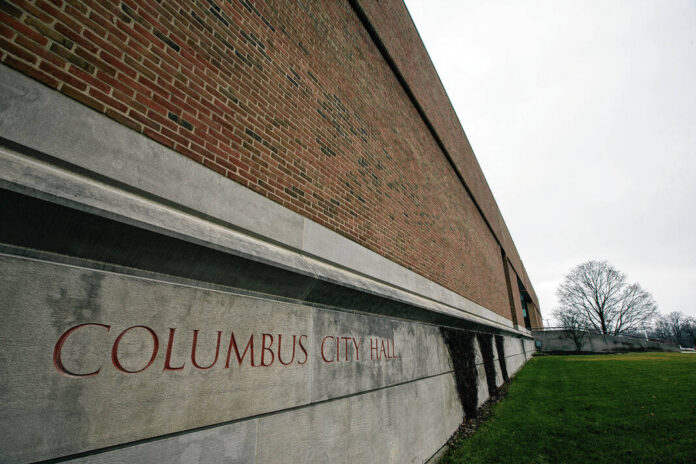
Republic file photo Columbus City Hall.

City officials on Tuesday finalized a contract with a construction firm that will build a new shared use path on 10th Street.

Columbus Board of Public Works and Safety members approved a contract between the city and Case Construction regarding the work for $215,410.500.

Case Construction will be tasked with building a shared use path along the north side of 10th Street from Marr Road to the existing shared use path along the Lowe’s frontage.

The new concrete path will be 8-foot wide with a grass buffer strip between the path and the roadway, according to city engineering.

The project is one of three using part of $1.5 million in leftover Federal Transit Administration (FTA) flex funds for bicycle and pedestrian projects the city council agreed to appropriate in November.

The $1.5 million in leftover FTA flex funds is money the Columbus Area Metropolitan Organization (CAMPO) had left over from previous years that was transferred from the Federal Highway Administration (FWHA) to be used for things including improvements to sidewalks and trails.

The funding requires just a 20% local match. Last year, the city used leftover FTA flex funds to buy buses and vans for the transit department.

The other two projects using the leftover FTA funds include one to build a sidewalk along the west side of Marr Road between 25th Street and the existing People Trail north of 32nd Street, and another to construct a shared use path along the north side of 27th Street between Washington Street and Home Avenue.

The board of works last week finalized contracts for the aforementioned two projects for $1.3 million and $543,905.20 respectively.

Construction on all three projects will start in the spring, City Engineer Andrew Beckort said previously.

Behind the walls of Indiana’s ICE detention facility

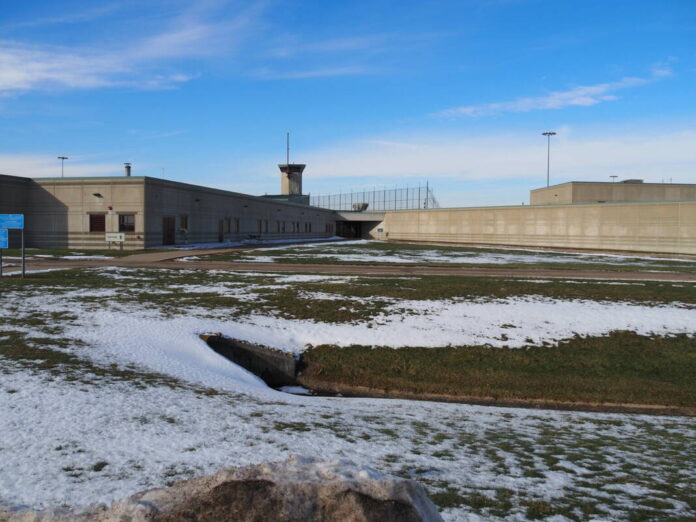
Miami Correctional Facility currently houses around 550 immigrant detainees. (Photo by Niki Kelly/Indiana Capital Chronicle)

By Niki Kelly | Indiana Capital Chronicle

Bundled in tan prison garb and coats emblazoned with “ICE,” dozens of immigrant detainees at Miami Correctional Facility played cards and checkers in a common room outside their cells.

In another building, dozens more — largely from Latin American nations — participated in online court hearings and met with attorneys.

The 550-plus men currently being held on the sprawling campus about 65 miles north of Indianapolis also have access to two chow halls, indoor recreation space and religious services.

“We are making sure we are giving detainees the resources they need,” said Indiana Department of Correction Commissioner Lloyd Arnold.

And he is “absolutely confident that it’s not going to cost state of Indiana’s taxpayers a dime.”

He and Warden Brian English last week gave the Capital Chronicle an hour tour — the first news media inside the facility. No photos were allowed behind the walls.

The state is now in its third month of a two-year contract with U.S. Immigration and Customs Enforcement.

Indiana officialsapproved $16 million for facility upgrades in September after the state signed an agreement allowing up to 1,000 immigrants to be held there. The state will receive a daily payment of $291 per detainee — almost four times the $75 daily per-person cost for inmates at the Miami Correctional Facility.

It is a high-medium security prison holding only men.

At that meeting, Democratic legislators expressed concerns about civil rights and access to legal services. Since then, faith groups and nonprofits have gathered for monthly prayer vigils outside the prison along U.S. 31 near Grissom Air Reserve Base.

“We pray for those being detained and also the immigrant community overall,” said Senior Pastor Matt Landry of the Castleton United Methodist Church. “We want to raise concerns for how detainees and families are treated in the system.”

The next event is set for Jan. 26.

Inside the facility

The state received an initial $6 million payment from the federal government but nothing since then. DOC billed for October, but the payment was delayed due to the federal shutdown. November billing goes out soon.

The immigration detainees are kept separate from about 1,800 state prisoners who are held in an identical set of buildings.

As of Wednesday, about 811 detainees have moved through the center with a current census of 558. But it is constantly changing as ICE brings in more menfrom around the nation and sends others back to their home countries.

Arnold said none of the men have pending criminal cases; otherwise, they would be in county jails awaiting trial. They are there for immigration violations, though he acknowledged some of them served “serious time” in other jurisdictions, at other points in their lives.

Miami is considered a long-term facility by ICE, holding the men for three days or more. The average stay was expected to be about three weeks but is running at about a month now.

English, the prison’s warden, said he declined detainees a few times as operations with ICE were ramping up in October. But now buses come from the Indianapolis International Airport daily. The facility receives about 20 detainees a day and releases about seven a day.

English expects to be fully operational by summer, which largely depends on staffing.

Among the upgrades was the creation of an intake center out of a storage area. Buses pull directly up to the back of the building and the men are processed. That includes health screenings.

While the detainees aren’t allowed access to educational services, there is an area for religious services, like a Catholic Mass in Spanish. Visitors are allowed up to one hour a week.

If detainees are in their cells, they have televisions and computer tablets. The tablets can be used to call family, communicate with attorneys, order from the commissary, listen to controlled music and watch select movies. Prisoners have the same tablets.

The detainee cells open out onto a large area with tables where the men can socialize and play games. They get up to five hours of recreation time per week.

The outdoor basketball court is currently covered in snow, but an indoor court and billiards tables are available.

The recreation building also contains a large, locked area for detainees’ personal property.

English said because the men are being removed from the country, they bring many more belongings than traditional inmates.

He also thinks the detainees have a different outlook than the prisoners set to serve decades behind bars who might feel hopeless about their futures.

Bad reputation

Miami’s prison operations have been criticized for excessive violence and drug trafficking in recent investigations by the Indianapolis Star.

But English could think of only two fights in the immigration detention space.

“Every now and then bunkees get mad at each other,” he said.

Jeff Migliozzi, communications director at Freedom for Immigrants in Washington, D.C., said its hotline has received nearly 70 calls from people inside the Miami Correctional Facility since Dec. 1.

“People detained here are raising urgent issues that are inherent to the immigration detention system, including severe medical neglect, poor food, and physical abuse by guards,” he said.

DOC said it’s equipped to handle such concerns and provided this response to the general allegations:

“Transition into any facility can be stressful for detainees, and we expect concerns will be raised as a natural part of that process,” Arnold said. “The department has established grievance and reporting processes to ensure those concerns can be communicated and reviewed in accordance with policy. We remain committed to maintaining safe, secure, and humane conditions for all individuals housed at the facility.”

Migliozzi wasn’t surprised by the long average stay, noting President Donald Trump’s administration “is shifting many of ICE’s policies in an effort to hold more people indefinitely.”

“It’s important to note that while conditions are worsening amid a record number of people in ICE custody, these systemic issues inside detention have long predated this administration,” he said. “Immigration detention undermines our shared values of justice, freedom, and human dignity, which is why we must end this cruel practice.”

Staffing issues continue

Landry, the pastor, said one thing the faith coalition always prays for — in addition to the detainees and family members caught in the immigration quagmire — is the overburdened staff at Miami.

One of the reasons the state had 1,000 open beds to offer up is that it couldn’t find enough prison guards and other staff members to operate the entire facility. The ICE contract boosts correctional officer pay from $24 to $28 an hour. DOC anticipated needing temporary staffing quarters on site, but it hasn’t been necessary yet. English said hiring has picked up — with 31 new officers currently approved and in the training process.

It takes about 150 staff members to run the detainee side every day.

The initial $16 million earmarked for upgrades, also went to more video equipment. The detainee side is averaging about 15 attorney appointments per day, and 30-plus court hearings.

English said most of the men have been in the country long enough to communicate in English but interpreters are available if needed.

“It has gone as well as we could expect,” he said.

US stocks rose again in 2025 after overcoming turbulence from tariffs and Trump’s fight with the Fed

NEW YORK (AP) — The year 2025 was scary good for investors.

It was scary because the U.S. stock market plunged to several historic drops on worries about everything from President Donald Trump’s tariffs to interest rates to a possible bubble in artificial-intelligence technology. In the end, though, it was a good year for anyone with the stomach to stick through the swings.

S&P 500 index funds, which sit at the heart of many savers’ 401(k) accounts, returned nearly 18% in 2025 and set a record high on Dec. 24. It was their third straight year of big returns.

Here’s a look at some of the surprises that shaped financial markets along the way:

Tariff tremors

Trump dropped the biggest surprise on “Liberation Day” in April, when he announced a sweeping set of tariffs that were more severe than investors expected.

It immediately triggered worries about a possible recession and spiking inflation. The S&P 500 plunged nearly 5% on April 3 for its worst day since the 2020 COVID crash. The very next day, it dropped 6% after China’s response raised fears of a tit-for-tat trade war.

The tariffs’ impact went beyond the stock market. The value of the U.S. dollar fell, and fear even shook the U.S. Treasury market, which is seen as perhaps the safest in existence.

Trump eventually put his tariffs on pause on April 9 after seeing the U.S. bond market get “queasy,” as he put it, which sent relief through Wall Street. Since then, Trump has negotiated agreements with countries to lower his proposed tariff rates on their imports, helping calm investors’ nerves.

Wall Street motored higher through a remarkably calm summer thanks to euphoria around artificial-intelligence technology and strong profit reports from companies. The market also got a boost from three cuts to interest rates by the Federal Reserve.

Trade worries can still cause havoc in markets, and Trump sent stocks spiraling as recently as October with threats of higher tariffs on China.

Trump and the Fed

Another surprise was how hard, and how personally, Trump lobbied to get the Federal Reserve to lower interest rates.

The Fed has traditionally operated separately from the rest of Washington, making its decisions on interest rates without having to bend to political whims. Such independence, the thinking goes, gives it freedom to make unpopular moves that are necessary for the economy’s long-term health.

Keeping interest rates high, for example, could slow the economy and frustrate politicians looking to please voters. But it could also be the medicine needed to get high inflation under control.

As inflation stubbornly remained above the Fed’s 2% target, the central bank kept rates steady through August. This drew Trump’s ire – even though it was his own trade policies that were driving fears about inflation higher.

Trump continuously picked on Fed Chair Jerome Powell, even giving him the nickname “Too Late.” Their tense relationship reached a head in July when Trump, in front of cameras, accused Powell of mismanaging the costs of a renovation of the Fed’s headquarters. Powell, in turn, shook his head.

Even though Wall Street loves lower rates, the personal attacks caused some queasiness in financial markets because of the possibility of a less independent Fed. Powell’s turn as Fed chair is set to expire in May, and the wide expectation is that Trump will choose a replacement more likely to cut rates.

Good but not first

“America first” didn’t extend to global markets. Even as U.S. stocks soared to another double-digit gain, many foreign markets fared even better.

The technology frenzy that helped fuel gains for the S&P 500 and the Nasdaq composite drove Korea’s KOSPI higher in 2025, enjoying its biggest gain in more than two decades. South Korea is a technology hub and companies including Samsung and SK Hynix surged amid the focus on artificial intelligence investments and advancements.

Japan’s Nikkei 225 had a double-digit gain for a third straight year. Besides the focus on AI and the technology sector, the gains were boosted in October and November following national elections and plans for a $135 billion stimulus package.

European markets also had a strong year. Germany’s DAX got a boost as the government announced plans to ramp up spending on infrastructure and defense, which could fuel economic growth in Europe’s largest economy.

The European Central Bank spent the first half of the year cutting interest rates, which helped give financial markets across Europe a boost. France’s CAC 40 was a laggard, but still gained more than 10%.

Crypto’s ups and downs

Even with a reputation for volatility, cryptocurrencies still managed to surprise market watchers.

Bitcoin dropped along with most other assets early in the year as Trump’s trade policies scared investors away from riskier investments.

The most widely used cryptocurrency roared back as the White House and Congress threw their support behind digital assets and the Trump family launched a number of crypto ventures. Retail investors joined in by pouring money into bitcoin ETFs, stock-like investments that allowed them to benefit from the run-up in price without having to actually store bitcoin in digital wallets. Some companies, notably Strategy Inc., made buying and holding crypto the crux of their business and their stocks jumped.

Bitcoin hit a high around $125,000 in early October. But, almost as quickly, digital assets tanked as investors worried the prices for shining stars such as tech stocks and crypto had jumped too high. As of Wednesday afternoon, bitcoin traded around $87,700, down roughly 30% from the peak and 6% below where it started the year.

What’s ahead?

Many professional investors think more gains could be ahead in 2026.

That’s because most expect the economy to plod ahead and avoid a recession. That should help U.S. companies grow their profits, which stock prices tend to track over the long term. For companies in the S&P 500, analysts are expecting earnings per share to rise 14.5% in 2026, according to FactSet. That would be an acceleration from the 12.1% growth estimated for 2025.

But some of last year’s concerns will linger. Chief among them is the worry that all the investment in artificial-intelligence technology may not produce enough profits and productivity to make it worth it. That could keep the pressure on AI stocks like Nvidia and Broadcom, which were responsible for so much of the market’s gains last year.

And it’s not just AI stocks that critics say are too pricey. Stocks across the market still look expensive after their prices climbed faster than profits.

That has strategists at Vanguard estimating U.S. stocks may return only about 3.5% to 5.5% in annualized returns over the next 10 years. Only twice in the last 10 years has the S&P 500 failed to meet that bar.

At Bank of America, strategist Savita Subramanian says the S& P 500 could rise by less than half as much as profits do in 2026. She said that could be a result of companies reducing stock buybacks, as well as global central banks implementing fewer rate cuts.

__

Reporter Damian Troise contributed.

Judge denies motion to dismiss Jennings County rape case

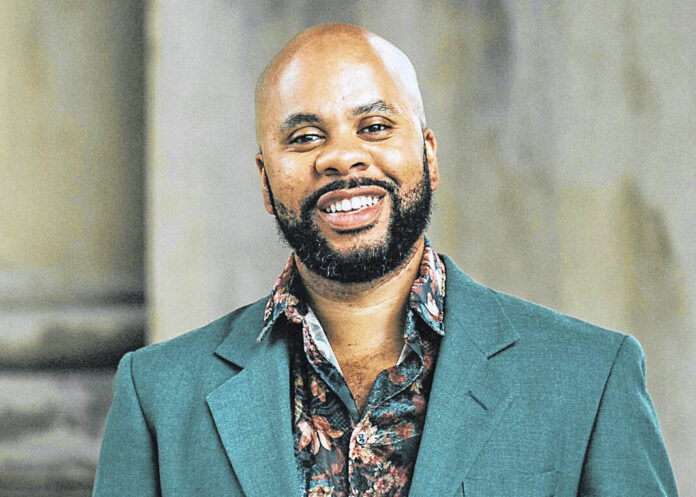
Doty

JENNINGS COUNTY — A Jennings County judge has denied a motion to dismiss 12 criminal charges against a teenager accused of raping a special needs student on a school bus, officials said.

On Monday, Jennings Circuit Court Judge Murielle Bright denied a motion to dismiss charges against Landon Doty, 15, North Vernon, following a hearing, according to Jennings County Prosecutor Brian Belding.

Doty was arrested in June and pleaded not guilty to 12 charges, including four felony counts of rape, two felony counts of child molesting, four felony counts of sexual battery, one count of criminal confinement and one misdemeanor count of public indecency.

The hearing comes after Doty’s attorney, Bradley Kage, asked the judge to dismiss the charges, citing what he describes in the motion as a lack of evidence.

In a motion to dismiss filed in October, Kage states that the bus driver and monitor on board the bus where the incident allegedly took place testified in depositions last month that “they did not see any sexual acts between the defendant and the alleged victim and that they saw nothing alarming.”

Additionally, Kage states in the motion that the videotapes taken from cameras on board the bus “do not show the defendant committing any of the charged acts,” the motion states.

“The state assumes that they show crimes were committed,” according to the motion. “… (T)he defendant respectfully requests that the court dismiss the information and the counts against him and for all other relief proper in the premises.”

Bright’s written order denying the motion was not yet available on Monday afternoon. However, Belding said the judge found that the video footage “is an issue of fact and is for the jury to determine.”

Bright had scheduled the hearing “to view the videos the state intends to introduce at trial” and consider the motion to dismiss, according to court records. Doty was required to attend the hearing.

In September, the judge granted a request by Kage to postpone Doty’s trial, which was scheduled for Oct. 20. Belding said he expects Bright to set a trial date but has not yet received an order setting the new trial date.

The motion to dismiss stands in contrast with claims about the video footage made by Jennings County officials and law enforcement.

In June, Doty was booked into the Jennings County Jail after a magistrate judge ordered the teenager to be tried as an adult, citing “heinous” conduct and a “repetitive pattern of delinquent acts” that was allegedly captured on the Jennings County School Corp. school bus’s camera “over a period of several weeks,” according to court records.

A probable cause affidavit alleges that the Jennings County Middle School principal showed North Vernon police video from the school bus’s camera that was taken after school the day before as the students were on their way home.

In June, Jennings Circuit Magistrate Judge Christopher Doran ordered Doty to be tried as an adult, stating in a court order that “the alleged delinquent’s conduct was captured on video cameras on the bus. …The alleged delinquent’s criminal conduct appears to be calculated, indicating that he knew what he was doing was wrong. It appears in the videos that he would stop his criminal conduct anytime he thought someone may observe him, then continue his criminal conduct when he felt safe to continue without detection.”

While the motion to dismiss claims that Jennings County prosecutors’ case “rests primarily with the videotapes,” it is currently unclear precisely what other evidence investigators have gathered.

A witness and exhibit list filed by Jennings County prosecutors in August includes, among other people, two physicians, one nurse and one forensic scientist. It also includes laboratory reports and the alleged victim’s medical records.

The probable cause affidavit filed in Jennings Circuit Court alleges that North Vernon police were dispatched to Jennings County Middle School, located at 820 W. Walnut St. in North Vernon, on April 17 regarding “an unknown issue at the school’s transportation building.”

When the officers arrived, the school’s principal allegedly showed them video from the school bus’s camera that was taken after school the day before as the students were on their way home, the probable cause affidavit states.

The probable cause affidavit describes the alleged sexual assault and includes investigators describing incidents of oral sex and rape.

At one point, the bus monitor allegedly walked over to Doty and asked what was going on. The bus monitor then allegedly told the bus driver to pull over and “stated that the bus video needs to be reviewed.” The students were then separated.

Doty was allegedly taken from class and his guardian, his maternal grandmother, was called to come to the school. She allegedly said her brother would come because she was in Indianapolis.

When her brother arrived, the principal allegedly advised that “an incident took place and is being handled by the police department.”

Doty was placed into handcuffs and escorted inside a patrol car. Once the officer got into the car, Doty allegedly said, “I’m basically screwed,” according to information in the probable cause affidavit.

The judge’s order states that the victim suffers from moderate to severe autism and is non-verbal. The order also states that Doty is allegedly of “normal intelligence” and is not a special needs student, raising questions about why he was allowed to ride the special needs school bus.

Asking Eric: Ex-military husband suddenly dressing like a cowboy

Dear Eric: My husband and I have been married for almost 32 years. He’s retired military and works as a civilian. All those years as military he wore the standard uniform, plus boots.

Well, some time back he visited Texas and bought some cowboy boots. Mind you, he had always been the non-clothes horse guy – simple jeans and shoes.

Well, now some kind of urban cowboy switch was turned on, and he has gone full-on cowboy! We are talking wearing boots with his work clothes, including collar tips and cowboy hat. I am perplexed. The cowboy aesthetic is not my thing and honestly looks out of place where we live (DMV) and his work.

It almost feels costume-y to me, and I don’t know what to do. It’s awkward to go anywhere in my casual clothes accompanied by my rootin’ tootin’ dressed husband.

How can I gently say anything? He would never comment on my clothes, and I want to respect his choices, but this feels so awkward. Should I be concerned about his mental judgment? He has now ordered three pairs of boots and wears them more frequently. Help!

– Rootin’ Tootin’ Trouble

Dear Rootin’ Tootin’: Let him get his yeehaw on in peace. I understand your confusion and agree that it’s a little eccentric, but we’re all allowed our harmless eccentricities. It sounds like he’s exploring a new form of self-expression. Maybe he got really into the television show “Yellowstone;” maybe he just likes the feel of cowboy boots. It’s all fine.

Try to lead with curiosity if you talk with him about it. Curiosity can be hard, I know, when the truth is we just don’t agree with another person’s choice. But see if you can leave your opinion aside and ask him what’s motivating this change in style. If he feels your genuine interest, he may share something that surprises you. Maybe there’s no big idea behind the change, but it’s always enlightening to hear about the things that excite others. At the very least, it’ll give you more insight into your spouse’s inner life.

Dear Eric: My daughter was 10 when my wife and I split. Soon after, she moved to Vermont with my daughter to live with her new boyfriend. When I phoned, she frequently would not let me talk with my daughter.

My ex used our daughter as a means to inflict pain on me. She bad-mouthed me to her and all our common friends to the point that I was told to leave the church we both had been attending.

My daughter has said she never heard my side of the divorce. She is now an adult, and my ex continues to try to monopolize time, even hiring her to work for her. What is painful is my daughter generally does not reach out to me. I have to initiate the connection. My daughter recently had a child. When I want to see her and my granddaughter, it is like making an appointment whereas my daughter frequently visits her mother.

She has expressed to me that her relationship with her mother is codependent, and she feels her mother is “playing mind games” with her, her own words, but nothing changes. The situation is very painful as I do not feel like I am important in her life, something my ex fostered. I want to talk with my daughter but am afraid it will create hard feelings. I even think it might be less painful to end the relationship with her. I know this sounds like I am playing the victim, but I honestly do not know what to say or do. I keep reaching out to my daughter, but it wounds me to hear how much time she spends with her mother.

– Neglected Father

Dear Father: As difficult as it may be, it will help you to start thinking about her relationship with you as completely separate from her relationship with her mother and your relationship with her mother. Right now, there’s a lot of comparison running through your head. This is understandable, but it’s only going to deepen your pain.

You and your daughter have been through a lot, it sounds like some of it wasn’t fair or wasn’t right, and so you need to start over. This is going to take time. But if you approach her with openness and clarity about your desire to connect on her terms, it is possible.

Don’t end the relationship. Instead, try saying something like, “I’d love to be in your life more. I know the divorce had an impact on you and we can talk about that if and when you need to. But I think that we can build something new that has meaning for both of us. Is that something you’d like?”

Send questions to R. Eric Thomas at eric@askingeric.com or P.O. Box 22474, Philadelphia, PA 19110. Follow him on Instagram and sign up for his weekly newsletter at rericthomas.com.