Home Blog Page 13000

AP Sportlight

May 14

1913 — Washington’s Walter Johnson gives up a run in the fourth inning against the St. Louis Browns to end his streak of 56 scoreless innings. The Senators win 10-5.

1919 — Four days after his Kentucky Derby victory, Sir Barton, ridden by Johnny Loftus, wins the Preakness Stakes by four lengths over Eternal.

1920 — Walter Johnson of the Washington Senators records his 300th victory with a 9-8 win over the Detroit Tigers.

1967 — Mickey Mantle hits his 500th home run, a shot off Stu Miller that lifts the New York Yankees to a 6-5 victory over the Baltimore Orioles.

1977 — The Montreal Canadiens edge the Boston Bruins 2-1 to win the Stanley Cup in four games.

1981 — The Boston Celtics win the NBA championship with a 102-91 victory over the Houston Rockets in Game 6.

1989 — James Worthy scores 12 of his 33 points in the fourth quarter, and the Lakers rally from a 29-point first-half deficit to beat Seattle 97-95 and sweep the Western Conference semifinals.

1995 — Kelly Robbins overcomes a three-shot deficit in the final seven holes to win the LPGA Championship by a stroke over defending champion Laura Davies.

1999 — Annika Sorenstam shoots an 11-under 61, the best score in LPGA history on a par-72 course, to take a two-shot lead over Michelle McGann after the opening round of the Sara Lee Classic.

2003 — Jean-Sebastien Giguere stops 35 shots for his third straight shutout, and Anaheim beats Minnesota 4-0 for a 3-0 lead in the Western Conference finals. He’s the first goalie in modern NHL history to record three consecutive shutouts in the next-to-last round of the playoffs.

2004 — Richard Jefferson scores 18 of his 31 points after regulation to lead New Jersey to a 127-120 triple-overtime victory over Detroit and a 3-2 lead in the Eastern Conference semifinals. The last playoff game to be decided in three overtimes was Phoenix’s 129-121 victory over Chicago in Game 3 of the 1993 NBA Finals.

2010 — The Philadelphia Flyers overcome a couple of 3-0 deficits to finish off the Boston Bruins. Simon Gagne scores on a power play with 7:08 left to cap a comeback from a three-goal deficit, and the Flyers win 4-3 for a berth in the Eastern Conference finals. The Bruins become the third team in NHL history to lose a series after winning the first three games.

2017 — Stephen Curry scores 40 points and hits a tying 3-pointer with 1:48 remaining, and the Golden State Warriors rally after Kawhi Leonard is lost to an ankle injury to beat the San Antonio Spurs 113-111 in Game 1 of the Western Conference finals. Draymond Green gives Golden State the lead for good on a three-point play after the Warriors trail by as many as 25 points in the first half.

2018 — The Supreme Court clears the way for states to legalize betting on sports, breaking a longtime ban and creating a potential financial boon for states and the gambling industry. Despite opposition from the major sports leagues and the Trump administration, the high court strikes down a federal law that barred betting on football, basketball, baseball and other sports in most states.

DC Police victim of massive data leak by ransomware gang

RICHMOND, Va. — The police department in the nation’s capital has suffered a massive leak of internal information after refusing to meet the blackmail demands of Russian-speaking ransomware syndicate. Experts say it’s the worst known ransomware attack ever to hit a U.S. police department.

The gang, known as the Babuk group, released thousands of the Metropolitan Police Department’s sensitive documents on the dark web Thursday. A review by The Associated Press found hundreds of police officer disciplinary files and intelligence reports that include feeds from other agencies, including the FBI and Secret Service.

Ransomware attacks have reached epidemic levels as foreign criminal gangs paralyze computer networks at state and local governments, police departments, hospitals and private companies. They demand large payments to decrypt stolen data or to prevent it from being leaked online.

A cyberattack last week shut down the Colonial Pipeline, the nation’s largest fuel pipeline, prompting gas-hoarding and panic-buying in parts of the Southeast.

Brett Callow, a threat analyst and ransomware expert at the security firm Emsisoft, said the police leak ranks as “possibly the most significant ransomware incident to date” because of the risks it presents for officers and civilians.

Some of the documents include security information from other law enforcement agencies related to President Joe Biden’s inauguration, including a reference to a “source embedded” with a militia group.

One documents details the steps the FBI has taken in its investigation of two pipe bombs left at the headquarters of the Democratic National Committee and the Republican National Committee before the insurrection at the U.S. Capitol on Jan. 6. That includes “big data pulls” of cell towers, and plans to “analyze purchases” of Nike shoes worn by a person of interest, the document said.

The police department did not immediately return a request for comment, but has previously said some officers’ personal information was stolen.

Some of that information was previously leaked, revealing personal information of some officers taken from background checks, including details of their past drug use, finances and — in at least one incident — of past sexual abuse.

The newly released files include details of disciplinary proceedings of hundreds of officers dating back to 2004. The files often contain sensitive and embarrassing private details.

“This is going to send a shock through the law enforcement community throughout the country,” said Ted Williams, a former officer at the department who is now an attorney. He’s representing a retired officer whose background file was included in an earlier leak.

Williams said said having background checks and disciplinary files made public makes it difficult for officers to do their jobs.

“The more the crooks know about a law enforcement officer the more the crooks try to use that for their advantage,” he said.

The Babuk group indicated this week that it wanted $4 million not to release the files, but was only offered $100,000.

The department has not said whether it made the offer. Any negotiations would reflect the complexity of the ransomware problem, with police finding themselves forced to consider making payments to criminal gangs. The FBI, which is assisting in this case, discourages ransomware payments.

The group revealed the attack last month, threatening then to leak the identities of confidential informants. The data release revealed Thursday is massive and it was not immediately clear if it included informants’ names.

AP source: T-wolves sale to Lore, A-Rod up for NBA approval

MINNEAPOLIS — Minnesota Timberwolves owner Glen Taylor has reached agreement on his $1.5 billion sale of the club to e-commerce mogul Marc Lore and former baseball star Alex Rodriguez, a person with knowledge of the negotiation told The Associated Press on Thursday.

The person spoke to the AP on condition of anonymity because league approval was still pending and neither side had publicly announced an agreement.

The deal, which Taylor previously said was contingent on Lore and Rodriguez keeping the team in Minnesota, was first reported by The Athletic. The two sides entered an exclusive negotiating window on April 10. Lore and Rodriguez are 50-50 partners. They tried to buy the New York Mets last year but were beaten out for the Major League Baseball club by hedge fund manager Steve Cohen.

Any sale of an NBA club must ultimately approved by the league’s Board of Governors, which could come later Thursday. The Timberwolves would then become the second NBA franchise sold this season. Gail Miller and her family struck an agreement in October to sell the Utah Jazz to Ryan Smith, a deal that was finalized after Board of Governors’ approval in December.

The 80-year-old Taylor, a lifelong Minnesotan who bought the Wolves in 1994 for $88 million to save them from moving to New Orleans, has said he will continue to run the club for two more seasons until a handover in 2023. The Minnesota Lynx WNBA team is included in the sale.

“They’ve asked that I would be there for any decisions that would need to be made. I would enjoy that. I love teaching people. These are a couple of very bright guys, and I think it could be helpful to the club and I think I could be helpful to them so that they feel confident once they take over 100%,” Taylor said an interview last month.

Lore became Walmart’s e-commerce chief in 2016, when the retail giant bought his Jet.com startup in an attempt to boost online business. Lore notified Walmart on Jan. 31 of his intent to leave the company. The 49-year-old Lore will continue to serve in a consulting role as a strategic adviser through September.

The 45-year-old Rodriguez hit 696 home runs over 22 major league seasons, with the New York Yankees, Seattle Mariners and Texas Rangers. His last season on the field was 2016, marking the end of marvelous career that was tainted by performance-enhancing drug use he later admitted to. Rodriguez was suspended for the entire 2014 season for violating MLB policy.


AP Basketball Writer Tim Reynolds contributed to this report.


More AP NBA coverage: https://apnews.com/hub/NBA and https://twitter.com/AP_Sports

Company: Ex-Trump lawyer raiding nonprofit for personal use

Former Trump attorney and self-proclaimed “Kraken releaser” Sidney Powell has told prospective donors that her group, Defending the Republic, is a legal defense fund to protect the integrity of U.S. elections.

But the company suing Powell over her baseless claims of a rigged presidential election says the true beneficiary of her social welfare organization is Powell herself.

Dominion Voting Systems claims Powell has raided Defending the Republic’s coffers to pay for personal legal expenses, citing her own remarks from a radio interview. The Denver-based voting technology vendor sued Powell and others who spread false claims that the company helped steal the 2020 election from Donald Trump.

“Now, Powell seeks to abuse the corporate forms she created for her law firm and fundraising website to hide funds that she raised through her defamatory campaign, shielding those funds from the very company that was harmed by the defamatory campaign,” Dominion lawyers wrote in a May 5 court filing.

The dispute shines a light on how Trump allies continue to support, spread and allegedly profit from lies about fraud in the 2020 election. Although the election is settled, and all major court challenges have been dismissed, Powell’s legal defense fund continues to raise money, with help from conspiracy-minded supporters like QAnon adherents.

Her group will receive a cut of proceeds from ticket sales for a Memorial Day weekend conference in Dallas called the “For God & Country Patriot Roundup,” the event’s website says. Some leading purveyors of far-right conspiracy theories are headliners, including Powell, pro-Trump attorney Lin Wood and former national security adviser Michael T. Flynn.

Event organizer John Sabal, known as “QAnon John” to followers of the QAnon conspiracy theory, declined to explain the decision to financially support Powell’s nonprofit, also known as DTR, but said the money isn’t for her personal benefit.

Powell didn’t respond to interview requests. One of her attorneys, Howard Kleinhendler, said a malpractice carrier covers Powel’s personal legal bills and her nonprofit has a proper corporate structure.

“She does not have unfettered control over its funds or how the funds are spent,” Kleinhendler wrote in an email.

Trump and his allies filed more than 50 lawsuits in multiple states over the election and lost at every turn. Powell and Rudy Giuliani were among the lawyers behind the cases claiming a conspiracy by Democrats, despite Republican state leaders, and Trump’s own attorney general and other administration officials, publicly stating there was no major election fraud. Powell appeared with Giuliani at a press conference and made multiple TV appearances.

But after Powell threatened to “blow up” Georgia with a “biblical” court filing, the Trump legal team distanced itself from her, saying she was not working on their behalf. She later made the comment on how she would release “the Kraken,” an apparent reference to the film “Clash of the Titans” in which Zeus gives the order to release the mythical sea monster.

Tickets for the Dallas conference cost $500 for general admission and $1,000 for VIP passes. The event’s website doesn’t name other beneficiaries or specify how much money goes to Powell’s nonprofit.

Logan Strain, who co-hosts a podcast about QAnon and other conspiracy theories, said Powell has appeared on QAnon promoters’ YouTube channels and is viewed as a “hero of the republic” among QAnon followers. QAnon adherents believe Trump has been secretly fighting a cabal of “deep state” enemies, prominent Democrats and Hollywood elites.

It wouldn’t surprise Strain if Powell is trying to harness the movement as a fundraising source.

“There is a great deal of money to be made in promoting and catering to QAnon,” he said.

Records link other leading conspiracy theorists from Trump’s orbit to Powell’s nonprofit. Defending the Republic’s chairman and CEO is former Overstock CEO Patrick Byrne, whose comments about the “deep state” led to his resignation from the company in 2019. Corporate filings in Florida and Texas have listed MyPillow founder and CEO Mike Lindell, Powell, Wood, Flynn and Flynn’s brother, Joseph, as the nonprofit’s directors.

To support its claim that Powell is using nonprofit money for her personal legal defense, Dominion cited her remarks during a Dec. 29 appearance on “The Rush Limbaugh Show.” Powell told the radio show’s guest host that listeners could go to her website to donate to the nonprofit “that is working to help defend all these cases and to defend me now that I’m under a massive attack from the attorney general of Michigan and the city of Detroit and everything else.”

Michigan’s governor, attorney general and secretary of state — all Democrats — have urged state bar officials in Texas and Michigan to permanently disbar Powell for ethical violations over election lawsuits.

Meanwhile, Eric Coomer, Dominion’s security director, has filed a separate defamation suit in Colorado against Powell, her law firm, Defending the Republic and others. Another voting technology firm, Smartmatic USA Corp., sued Powell in New York over her bogus election-fixing claims.

Dominion sued Powell in federal court on Jan. 8, seeking over $1.3 billion in damages against her, her law firm and her fundraising website. The company claimed Powell treated Defending the Republic “as her personal funds, redirecting them to the law firm she controls and dominates … and raiding them to pay for her personal legal defense.”

Defending the Republic describes itself as a 501(c)4 nonprofit, but it isn’t listed in an IRS database of tax-exempt organizations. It registered in February with Florida’s Division of Corporations as a nonprofit formed for “social welfare purposes.”

Radical rabbi’s followers rise in Israel amid new violence

JERUSALEM — In the 1980s, Rabbi Meir Kahane’s violent anti-Arab ideology was considered so repugnant that Israel banned him from parliament and the U.S. listed his party as a terrorist group.

Today, his disciples march through the streets by the hundreds, chanting “Death to Arabs” and assaulting any they come across. This week, they took part in a wave of communal violence in Jerusalem and mixed cities across Israel in which Arabs and Jews viciously attacked people and torched cars.

On Thursday evening, there was more ethnic strife. In Tel Aviv, two Jewish men attacked a journalist covering a gathering of ultranationalists. In the central Israeli city of Lod, a Jewish man was shot and seriously wounded by an Arab man. In Jaffa, an Israeli soldier was attacked by a group of Arabs and was hospitalized in serious condition

Israelis shocked by the violence have cast the right-wing extremism as a nasty aberration or a reaction to Palestinian violence. But to Arab citizens, who make up 20% of Israel’s population, the heirs of Kahane are a natural outgrowth of a discriminatory system — normalized by some mainstream leaders who largely share their views.

Admirers of Kahane were elected to parliament in March as allies of Prime Minister Benjamin Netanyahu’s Likud party, and one of the most prominent has become a fixture on Israeli TV.

Their resurgence has injected another element of volatility to the conflict. It’s also part of a broader shift to the right in Israel, where Kahane’s disciples are hardly alone in adopting a hard line toward the Palestinians and trafficking in anti-Arab rhetoric.

Right-wing parties that support Jewish settlements and oppose Palestinian independence won a large majority of seats in March, and Netanyahu and other right-wing leaders have often cast Israel’s Arab minority as a fifth column — unless they needed their votes.

During his lone term in parliament in the mid-1980s, before he was banned, Kahane was shunned by colleagues, including the Likud, and frequently gave speeches to an empty chamber. His racist agenda called for banning intermarriage between Arabs and Jews, stripping Arabs of their Israeli citizenship, and the mass expulsions of Palestinians. At one point, he was suspended for waving a noose at an Arab lawmaker.

Kahane was banned from running in 1988, and two years later, he was assassinated by an Egyptian-American in New York. But his hate-filled ideology has remained influential in Israel.

In 1994, Kahane follower Baruch Goldstein opened fire in a holy site in the occupied West Bank city of Hebron, killing 29 Muslim worshippers and wounding over 100. That led both Israel and the U.S. to label his Kach movement and an offshoot, Kahane Lives, as terrorist groups.

In March, another admirer of the late rabbi, who for years had hung a picture of Goldstein on his living room wall, was elected to Israel’s parliament.

Itamar Ben-Gvir joined the Knesset as part of Religious Zionism, a bloc of far-right parties that came together at Netanyahu’s prodding so none would fall below the electoral threshold.

Since then, Ben-Gvir has made frequent media appearances, displaying a cheerful demeanor and a knack for deflecting criticism as he banters with TV and radio hosts.

It’s working: Ifat, a research firm, says Ben-Gvir is the third most interviewed politician on Israeli TV and radio, behind Netanyahu and Naftali Bennett, another right-wing politician.

“He’s a good speaker and he knows how to play the game,” said Shuki Friedman, an expert on Israel’s far right at the Israel Democracy Institute. “On one hand, he is addressing his supporters. … On the other hand, he knows not to make mainstream Israelis too angry.”

He has staged provocative visits to Arab areas and been a near-constant presence on the sidelines of recent clashes, rallying ultranationalist supporters to confront Palestinians and assert “Jewish Power” — the name of his party.

Last week, he set up an outdoor parliamentary “office” in an Arab neighborhood of east Jerusalem where Jewish settlers are trying to expel Palestinians from their homes, setting off a melee. He later called for police to use live fire against Palestinian protesters at the Al-Aqsa Mosque compound, a site sacred to Jews and Muslims.

A long-range Hamas rocket, fired at Jerusalem on Monday, disrupted the Jerusalem Day parade, which celebrates Israel’s annexation of east Jerusalem.

The mob violence erupted the next day. A Telegram channel displaying the Kahanist emblem — a yellow fist inside a black Star of David — swelled from a few hundred members to more than 5,600.

It was used to organize a crowd in the Tel Aviv suburb of Bat Yam on Wednesday that pulled an Arab from his car and beat him severely. The attack horrified Israelis and was widely condemned, including by far-right politicians.

As a lawyer with a long history of defending Jewish extremists accused of attacking Arabs, Ben-Gvir has been careful not to run afoul of laws against incitement. He calls Kahane “righteous and holy,” but has tried to distance himself by saying he doesn’t agree with everything the rabbi said.

Ben-Gvir first became a national figure when he famously broke a hood ornament off then-Prime Minister Yitzhak Rabin’s car in 1995.

“We got to his car, and we’ll get to him too,” he said, just weeks before Rabin was assassinated by a Jewish extremist opposed to his peace efforts with the Palestinians.

Israel has shifted even more to the right since then, driven by the failure of peace efforts, repeated rounds of violence and demographic shifts. Ben-Gvir’s supporters are largely religious and ultra-Orthodox Jews, who tend to have large families.

Netanyahu hoped to tap into that by assembling a far-right bloc with Ben-Gvir and Bezalel Smotrich, another ultranationalist. Ironically, they foiled Netanyahu’s plan by blocking his outreach to a small Arab party needed to secure a parliamentary majority.

Dan Meridor, a former justice minister and Likud heavyweight who helped lead efforts to ban Kahane from parliament in 1988, believes Netanyahu made a grave error in rehabilitating his followers.

“You can just see the dramatic and very harmful change the Likud went through when they legitimized the Kahanists,” he said. “It changed very tragically to me.”

Palestinian citizens of Israel, on the other hand, view Ben-Gvir as the latest in a long line of Israeli politicians — including Netanyahu — who have treated them as second-class citizens, if not enemies of the state. It’s one of many grievances they point to in explaining the recent protests and clashes with police.

Diana Buttu, a lawyer and analyst who is a Palestinian citizen of Israel, says it’s easy for Israelis to dismiss the Kahanists as a fringe group.

“But if you step back and look at this country through the eyes of a Palestinian, you see that at every single political level, in every single political party, there’s been some form of anti-Palestinian racism.”

—-

Associated Press writer Ilan Ben Zion in Jerusalem contributed.

Biden meets with GOP senators as infrastructure talks deepen

WASHINGTON — President Joe Biden welcomed a group of Republican senators to the White House on Thursday to talk infrastructure as negotiations intensify over a potentially bipartisan proposal that could become one piece of the administration’s ambitious $4 trillion public investment plan.

Sen. Shelley Moore Capito of West Virginia, who is leading the group, said she expects to talk “very substantively” about the scope and cost of a potential plan, but would not disclose if she and the other senators are carrying a counter-offer to their initial $586 billion opening bid, which was panned by Democrats as insufficient.

As the senators gathered in the Oval Office, Biden called it a “good faith” effort to seek common ground.

Biden is intent on at least trying to strike a deal with Republicans rather than simply going it alone with a Democrats-only bill, which might in some ways be a more politically viable route in a Congress held by the president’s party with only the slimmest of majorities.

One strategy that appears to be coming into focus would be for Biden to negotiate a more limited, traditional infrastructure bill of roads, highways, bridges and broadband as a bipartisan effort. Then, Democrats could try to muscle through the remainder of Biden’s priorities on climate investments and the so-called human infrastructure of child care, education and hospitals on their own.

“I’m willing to negotiate,” Biden said Thursday at the White House before the afternoon meeting.

Those gathered include some of the top ranking Republicans — Sens. John Barrasso of Wyoming, Roy Blunt of Missouri, Mike Crapo of Idaho, Pat Toomey of Pennsylvania and Roger Wicker of Mississippi. Joining Biden were Vice President Kamala Harris, Transportation Secretary Pete Buttigieg and Commerce Secretary Gina Raimondo.

But the president has indicated that he’s not about to wait indefinitely for a compromise that may or may not come, and reiterated his view Thursday that “doing nothing is not an option.”

Thursday’s meeting followed a lengthy session at the White House with the congressional leadership the day before. Republican leader Mitch McConnell has said his side will accept spending as much as $800 billion, but the Republicans made it clear they would refuse to embrace Biden’s broad proposals or his idea of raising taxes on corporations and the wealthy to pay for the plans.

The White House outreach is part political strategy and part practical legislating. Striking a deal with Republicans would give all sides a political win — a rare bipartisan accomplishment — without fully forfeiting the president’s broader goals, which are largely shared by Democrats.

It also acknowledges the “red line” that McConnell has drawn against GOP votes for undoing the 2017 tax law by raising taxes on corporations or those earning more than $400,000.

“I want to get a bipartisan deal on as much as we can get a bipartisan deal on — and that means roads, bridges, broadband, all infrastructure,” Biden said Wednesday on MSNBC. “And then fight over what’s left and see if I can get it done without Republicans, if need be.”

Capito has taken the lead for Senate Republicans, keeping in close contact with both the president’s team and McConnell, she said, as she shuttles between the White House and Capitol Hill.

“We’re going to talk very substantively as to definitions of infrastructure and then, you know, I don’t know that we’ll get to negotiating the numbers, but I’m sure that’ll be part of the discussion,” she said before the meeting.

The West Virginia senator is no stranger to the legislative process, serving more than a decade in the House and now as the ranking Republican on the Senate Energy and Public Works Committee. She ushered a $35 billion bipartisan water resources bill to passage in the Senate and is hard at work with the panel’s Democratic chairman, Tom Carper of Delaware, a Biden ally, on a big surface transportation bill.

Biden personally reached out to Capito late last week after the water bill cleared the Senate.

“The president he expressed on the phone with me, and has with others, that you know he’s anxious to move forward,” she said.

“His desire is to define where we have common ground and I think we’ll probably spend the bulk of the time talking about that.”

Biden has insisted he doesn’t want working-class Americans to bear the “burden” of paying for all the new infrastructure investments alone, resisting GOP plans for taxes and user fees, like tolls, to fund the projects.

One potential new funding source could be the more than $1 trillion in unpaid taxes each year.

House Speaker Nancy Pelosi has mentioned tapping that potential funding source and she said Biden discussed it at their meeting Wednesday. Republicans have not resisted it.

“That’s a big chunk that would go a long way,” she said Thursday.

McConnell and House Republican leader Kevin McCarthy have insisted they want the infrastructure bills to go through the committee process, where lawmakers can hammer out the details and take ownership of the proposals, rather than have the package negotiated in their leadership suites.

CDC: Fully vaccinated people can largely ditch masks indoors

By ZEKE MILLER and MICHAEL BALSAMO
Associated Press

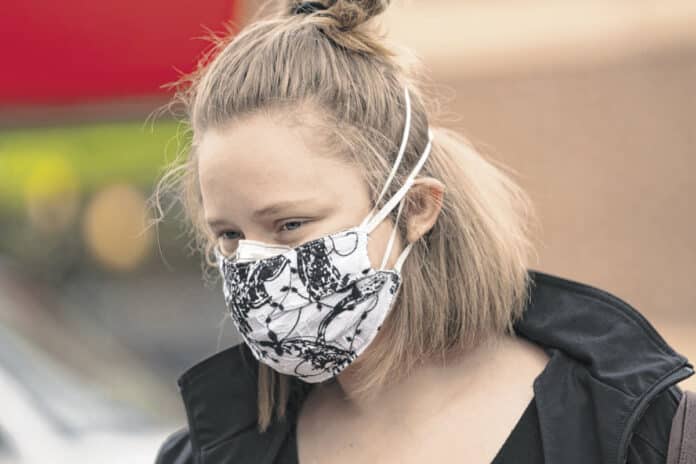
WASHINGTON (AP) — In a move to send the country back toward pre-pandemic life, the Centers for Disease Control and Prevention on Thursday eased indoor mask-wearing guidance for fully vaccinated people, allowing them to safely stop wearing masks inside in most places.

The new guidance still calls for wearing masks in crowded indoor settings like buses, planes, hospitals, prisons and homeless shelters, but will help clear the way for reopening workplaces, schools, and other venues — even removing the need for masks or social distancing for those who are fully vaccinated.

The CDC will also no longer recommend that fully vaccinated people wear masks outdoors in crowds. The announcement comes as the CDC and the Biden administration have faced pressure to ease restrictions on fully vaccinated people — people who are two weeks past their last required COVID-19 vaccine dose — in part to highlight the benefits of getting the shot.

Dr. Rochelle Walensky, the director of the CDC, announced the new guidance on Thursday afternoon at a White House briefing, saying the long-awaited change is thanks to millions of people getting vaccinated — and based on the latest science about how well those shots are working.

“Anyone who is fully vaccinated can participate in indoor and outdoor activities – large or small — without wearing a mask or physically distancing,” Walensky said. “If you are fully vaccinated, you can start doing the things that you had stopped doing because of the pandemic.”

The new guidance comes as the aggressive U.S. vaccination campaign begins to pay off. U.S. virus cases are at their lowest rate since September, deaths are at their lowest point since last April and the test positivity rate is at the lowest point since the pandemic began.

To date about 154 million Americans, more than 46% of the population, have received at least one dose of the COVID-19 vaccines and more than 117 million are fully vaccinated. The rate of new vaccinations has slowed in recent weeks, but with the authorization Wednesday of the Pfizer vaccine for children aged 12-15, a new burst of doses is expected in the coming days.

Just two weeks ago, the CDC recommended that fully vaccinated people continue to wear masks indoors in all settings and outdoors in large crowds.

During a virtual meeting Tuesday on vaccinations with a bipartisan group of governors, President Joe Biden appeared to acknowledge that his administration had to do more to model the benefits of vaccination.

“I would like to say that we have fully vaccinated people; we should start acting like it,” Utah Gov. Spencer Cox, a Republican, told Biden. “And that’s a big motivation get the unvaccinated to want to to get vaccinated.”

“Good point,” Biden responded. He added, “we’re going to be moving on that in the next little bit.”

The easing guidance could open the door to confusion, as there is no surefire way for businesses or others to distinguish between those fully vaccinated and those who are not.

Walensky said the evidence from the U.S. and Israel shows the vaccines are as strongly protective in real-world use as they were in earlier studies, and that so far they continue to work even though some worrying mutated versions of the virus are spreading.

The more people continue to get vaccinated, the faster infections will drop — and the harder it will be for the virus to mutate enough to escape vaccines, she stressed, urging everyone 12 and older who’s not yet vaccinated to sign up.

And while some people still get COVID-19 despite vaccination, Walensky said that’s rare and cited evidence that those infections tend to be milder, shorter and harder to spread to others. If someone who’s vaccinated does develop COVID-19 symptoms, they should immediately re-mask and get tested, she said.

There are some caveats. Walensky encouraged people who have weak immune systems, such as from organ transplants or cancer treatment, to talk with their doctors before shedding their masks. That’s because of continued uncertainty about whether the vaccines can rev up a weakened immune system as well as they do normal, healthy ones.

AP medical writer Lauran Neergaard contributed.

Colleges form alliance to support student-designed learning

At a convention on the future of learning in 2019, a handful of voices stood out to Philomena Mantella.

The newly appointed president of Grand Valley State University in Allendale, Michigan, had used the week of her inauguration to bring together philanthropists, educators and advocates to discuss innovation in higher education. But when the attendees gathered in small discussion groups, Mantella found some of the most insightful thinking came from the students.

“What really became clear is the students talking about their own personal experience and what they needed for success and what they were looking for in an institution was the most compelling element of the program,” Mantella said.

Those interactions inspired Mantella to create a formal pathway for students to help design the future of learning, focused on equity and inclusivity. The result is REP4, an alliance of six colleges and universities that will pilot student-designed programming addressing issues such as access and retention to higher education.

Students in an early pilot at Grand Valley State focused on developing ways to connect their classroom experience to their life after college — from personal finances to networking to finding a career.

The consortium will be announced at a virtual press conference at 4 p.m. EDT Thursday.

The participating schools are Grand Valley State, Amarillo College in Texas, Boise State University in Idaho, San Jose State University in California, Fort Valley State University in Georgia, and Shippensburg University in Pennsylvania. The name, REP4, stands for “rapid education prototyping,” and students will design programming to be tested and implemented at each school.

“Students need to feel ownership of their own learning, but often traditional practices and requirements stifle their participation,” San Jose State University President Mary A. Papazian said in a statement. “We believe REP4 will empower students to create a climate in which all students feel a sense of belonging.”

Ted Mitchell, president of the American Council on Education, praised the consortium for creating a systematic way to include student voices when addressing issues such as retention, access and diversity. He noted that each of the six schools serve a diverse range of students, many of whom are underrepresented in higher education.

“The students who are often least listened to are those who have less standing, less privilege in the system than others. This is an attempt to really create institutions by, for and with those students,” Mitchell said.

Last summer, Grand Valley State hosted a six-week Learner Engagement Challenge for 23 high school students from the Grand Rapids, Michigan, area to test out the model. Students learned the elements of design thinking and entrepreneurship before trying to come up with answers to this question: “How might we create equitable and inclusive future-focused learning experiences in high school or college?”

Two prototypes came out of that workshop and are now being piloted at Grand Valley State. The first is a life-readiness class that teaches skills around financial literacy, networking and academic structure — hurdles that often impact first-generation college students who do not have parental support to navigate the transition to college. The lessons will be incorporated into one of the university’s six-week summer programs for first-year students.

The second is a curriculum meant to connect what high school students learn in the classroom with possible career paths. Elements of that curriculum will be incorporated into a summer program the school hosts to prepare high school juniors and seniors for college.

Jordan Bernal, now a freshman at Grand Valley State, was one of the student designers who developed the life skills curriculum. Bernal said first-generation college students like himself often struggle to find and take advantage of resources and scholarships once they enroll. He said he hopes the skills program can help all students make a smoother transition to college.

“We didn’t have our parents or anybody else in our family that tell us about these things,” Bernal said. “Building this prototype really just came from our worries being high school seniors going into college, knowing that it’s a big step.”

Julian Sanders, a Grand Valley State senior who was a mentor in last summer’s challenge, said the solutions the students came up with would have filled a gap in his own college experience. While high school taught him how to succeed in a classroom, he said he struggled with other aspects of the college transition.

“It was really about understanding what students wanted out of their education,” he said. “How can we put together a curriculum that will prepare students for that?”

Each of the participating schools will run their own versions of the design-thinking workshop before sharing and implementing the ideas students develop.

High school students who complete the program are guaranteed admission into any of the six schools, Mantella said, where they may even participate in the curriculums they design.

“Let’s listen to the learners, their needs and their lived experience to determine how our systems need to adapt rather than how they need to fit into our system,” Mantella said.


Ma reported from Charlotte, North Carolina. She is a member of the AP’s Race and Ethnicity team. Follow her on Twitter: https://www.twitter.com/anniema15


The Associated Press’ reporting around issues of race and ethnicity is supported in part by the Howard Hughes Medical Institute’s Department of Science Education. The AP is solely responsible for all content.

Jimmy Harrell, Deepwater Horizon rig supervisor, dies at 65

MORTON, Miss. — Jimmy Harrell, a supervisor on the Deepwater Horizon oil rig that exploded in the Gulf of Mexico in 2010, has died at age 65.

Harrell, who worked for rig owner Transocean, died Monday, according to Wolf Funeral Home in Morton, Mississippi. He had battled cancer for a year.

Harrell was a key Transocean supervisor on the rig leased by BP. Investigations indicated Harrell had been unhappy with the oil giant’s plans for shutting down the rig. During a May 2010 government hearing he acknowledged disagreements but denied reports that there were headed debates.

At his insistence, a key pressure test that had not been originally scheduled was run. But investigations found that others with Transocean and BP misinterpreted the results. A federal judge eventually said that BP ultimately was responsible for the misinterpreted results, one of the factors resulting in a ruling that BP was grossly negligent and bore most of the responsibility for the disaster. The judge also ruled that Transocean and Halliburton, which was tasked with sealing the well, were partially to blame.

Eleven workers died in the explosion and 134 million gallons of oil spewed into the Gulf, fouling beaches from Louisiana to Florida, killing hundreds of thousands of marine animals and devastating the region’s tourist economy.

Harrell’s attorney, Pat Fanning, told WWL-TV that federal prosecutors tried to persuade Harrell to admit some criminal negligence and, as part of a plea deal, testify against two BP rig bosses. Harrell, who was portrayed by actor Kurt Russell in a 2016 movie about the disaster, refused.

“I said, ‘Jimmy, you’ll have to go into court and swear an oath and then testify that you were negligent. If you don’t, they’re going to charge you with 11 counts of manslaughter and gross negligence,’” Fanning told the TV station. “He prayed over the weekend and said, ‘I can’t do it. I can’t plead guilty and say I did something I didn’t do.’”

Harrell was never charged. Two BP supervisors aboard the rig were charged in connection with the test. One pleaded guilty to a misdemeanor pollution charge. The other was acquitted.

The horror of the explosion haunted Harrell for the rest of his life, according to the obituary provided by the funeral home.

“The explosion and loss of his employees and friends and the inferno that subsequently sunk the rig took a massive toll on his psyche,” it said. “He was never the same. When he wasn’t battling heavy bouts of PTSD, he found comfort in his favorite pastimes: hunting and fishing and simply being outdoors.”

It also said fiberglass was embedded in Harrell’s skin following the explosion, and that he suffered health problems for years after inhaling the smoke and gas from the blast.

Funeral services were held Wednesday in Morton.

DeSantis: Florida will fill void if small cruise lines leave

TALLAHASSEE, Fla. — Calling Norwegian Cruise Line Holdings “not one of the bigger ones,” Florida Gov. Ron DeSantis said Thursday that if smaller cruise lines want to leave the state because of bans on vaccine requirements, their void will be filled.

Miami-based Norwegian is the third-largest cruise line in the world and has three ports of departure in Florida — Miami, Port Canaveral and Tampa. It also makes stops in Key West. But it hasn’t operated in the U.S. since the federal government shut down all cruises last year because of the coronavirus pandemic.

The federal government is getting ready to let cruises sail again, but only if nearly all passengers and crew are vaccinated against the virus. DeSantis, however, signed a bill banning business from requiring proof of vaccination, prompting Norwegian to say it might move Florida departures to other states or Caribbean ports.

“The major cruise lines, Norwegian’s not one of the bigger ones, by the way … have been operating in other parts of the world where there’s no access to vaccine, much less the passengers required” to be vaccinated, DeSantis said during a news conference in Ormand Beach.

DeSantis later said that if one of the smaller cruise lines doesn’t want to operate in Florida, “that niche will get filled.”

“We are the number one destination for people who want to come and take cruises,” DeSantis said. “These cruise lines are ready to go — Royal Caribbean, Carnival — they want to go, they’re going to be able to do it. We’re ready.”

DeSantis is suing the Centers for Disease Control and Prevention over the no-sail order. The CDC is set to let cruises sail again if 98% of the crew and 95% of passengers are vaccinated and ships take other measures to limit the risk of transmitting the virus.

Norwegian didn’t immediately return a call and emails seeking comment.