Home Blog Page 14966

Garage Pub and Grill may be going to new owners

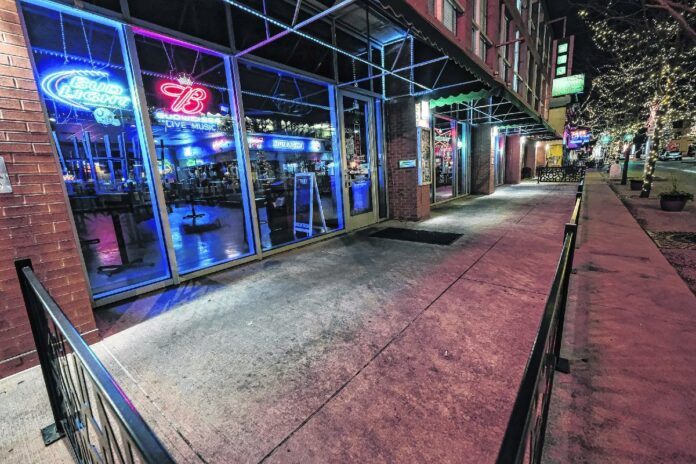
A view of empty outdoor dining area outside The Garage Pub and Grill in downtown Columbus, Ind., Monday, Dec. 7, 2020. The owners of The Garage Pub and Grill have announced that the restaurant will be closed until further notice. Mike Wolanin | The Republic Mike Wolanin | The Republic

COLUMBUS, Ind. — A downtown restaurant that has been temporarily closed for three months could reopen soon — under new management.

The Garage Pub and Grill is likely to be sold to new owners, said redevelopment director Heather Pope at a recent city meeting.

“We are in the process of talking with those folks and either negotiating a new contract or looking to have them accept the current contract for the Garage Pub and Grill,” she told the redevelopment commission on Tuesday. “But they have indicated to us that they’re anxious to get the Garage Pub and Grill back open again as soon as possible.”

Current owner Steve Leach declined to comment on the matter.

“The commission has committed to moving the reassessment as quickly as possible while still completing due diligence on the potential new owners and will likely hold a special meeting in the near future,” Pope said.

The Garage closed for the season in late November, citing safety concerns for both workers and customers amid the pandemic.

“It isn’t socially responsible to encourage crowds or have live entertainment, which is what we are known for, and continue to put our amazing staff at risk,” the restaurant said in a social media post.

It also stated in the comments that it was “closed until further notice” but hoped to reopen in the spring.

The Garage Pub and Grill is one of six restaurants who are city tenants and have received rent relief from the city. The others are Orange Leaf, Subway, Luciana’s, Bucceto’s, and Lucabe Coffee. In late November, the Columbus Redevelopment Commission voted to provide 100% rent abatement for all six restaurants from Jan. 1 to June 30 of 2021.

For the complete story, see Sunday’s Republic.

Health officials modify bar, restaurant limits

Niedbalski Submitted photo

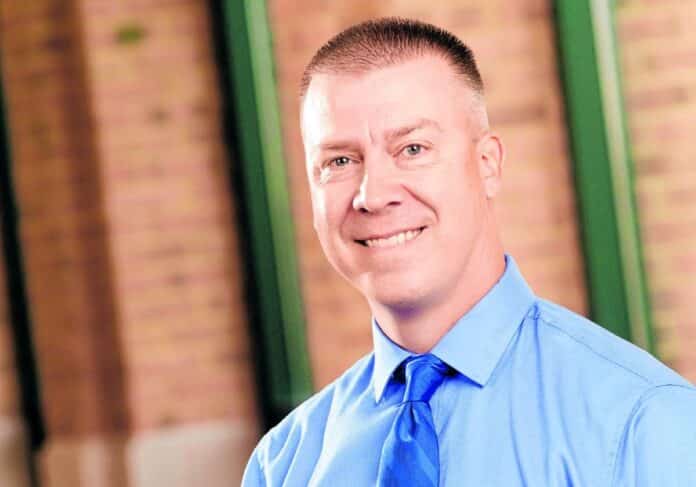
Events will be able to host up to 100 people with a safety plan, and restaurants will move from capacity limits to social distancing compliance, per a recent order from the Bartholomew County Health Officer Brian Niedbalski and the COVID-19 Community Task Force.

The order, released Friday, contains “an outline of updated restriction and capacity limits as well as safety guidelines at the state and local level.”

“Social gatherings, public meetings and all other events” will be limited to 100 people while following social distancing as part of the “overall safety plan” for events. The county will not be accepting or approving submitted plans for larger events at this time, according to Niedbalski’s order.

Starting at noon today, bars and restaurants will move from capacity limits to physical distancing compliance, according to Niedbalski. Social distancing must be followed at all times. Individuals from non-household parties must be spaced 6feet apart in seating arrangements, and masks should be worn when not actively eating or drinking.

The county also continues to strongly encourage frequent hand washing and proper sanitation.

Movie theaters, bowling alleys and similar indoor entertainment venues will continue operating at 50% capacity with social distancing.

Large retail stores, including groceries and hardware stores, will also continue at 50% capacity with social distancing.

Likewise, gyms, fitness centers and “personal services” will remain at 50% capacity with the following requirements:

Daily employee screening

Facial coverings

Spacing equipment for social distancing

Additionally, equipment must be cleaned after each use. Group fitness classes are permitted, with social distancing.

While Bartholomew County is now a “yellow status” county on the state’s map, Niedbalski cautioned residents to remain careful.

“Despite recent improvements and stabilization of COVID-19 cases in our area, viral spread remains at a high per capita rate in our county; therefore it is important the community continue to be diligent in preventing the spread by continuing to follow all the safety measures and guidelines of masking, physical distancing and hand hygiene,” he said in a statement.

[sc:pullout-title pullout-title=”Where to learn more” ][sc:pullout-text-begin]

The new health department order may be viewed at covid19communitytaskforce.org/news/.

For more on state restrictions, visit in.gov/gov.

[sc:pullout-text-end]

Health officials modify bar, restaurant limits

Niedbalski Submitted photo

Events will be able to host up to 100 people with a safety plan, and restaurants will move from capacity limits to social distancing compliance, per a recent order from the Bartholomew County Health Officer Brian Niedbalski and the COVID-19 Community Task Force.

The order, released Friday, contains “an outline of updated restriction and capacity limits as well as safety guidelines at the state and local level.”

“Social gatherings, public meetings and all other events” will be limited to 100 people while following social distancing as part of the “overall safety plan” for events. The county will not be accepting or approving submitted plans for larger events at this time, according to Niedbalski’s order.

Starting at noon today, bars and restaurants will move from capacity limits to physical distancing compliance, according to Niedbalski. Social distancing must be followed at all times. Individuals from non-household parties must be spaced 6feet apart in seating arrangements, and masks should be worn when not actively eating or drinking.

The county also continues to strongly encourage frequent hand washing and proper sanitation.

Movie theaters, bowling alleys and similar indoor entertainment venues will continue operating at 50% capacity with social distancing.

Large retail stores, including groceries and hardware stores, will also continue at 50% capacity with social distancing.

Likewise, gyms, fitness centers and “personal services” will remain at 50% capacity with the following requirements:

Daily employee screening

Facial coverings

Spacing equipment for social distancing

Additionally, equipment must be cleaned after each use. Group fitness classes are permitted, with social distancing.

While Bartholomew County is now a “yellow status” county on the state’s map, Niedbalski cautioned residents to remain careful.

“Despite recent improvements and stabilization of COVID-19 cases in our area, viral spread remains at a high per capita rate in our county; therefore it is important the community continue to be diligent in preventing the spread by continuing to follow all the safety measures and guidelines of masking, physical distancing and hand hygiene,” he said in a statement.

[sc:pullout-title pullout-title=”Where to learn more” ][sc:pullout-text-begin]

The new health department order may be viewed at covid19communitytaskforce.org/news/.

For more on state restrictions, visit in.gov/gov.

[sc:pullout-text-end]

‘Absolutely swamped’: County Coroner’s Office reports increase in cases in 2020

20210227cr coroners cases.jpg Andy East | The Republic

Last year was a busy one for the Bartholomew County Coroner’s Office.

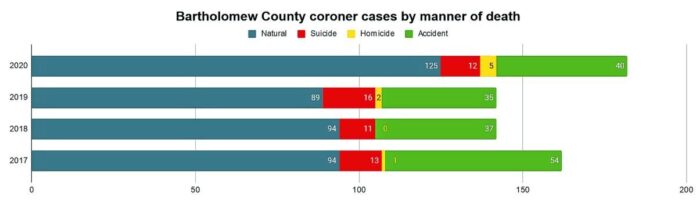
The number of fatal drug overdoses, homicides and deaths from accidents and natural causes that the Bartholomew County Coroner’s Office investigated last year reached levels not seen since at least 2018 even though none of those deaths were directly caused by COVID-19, according to the coroner’s office annual report.

Overall, the coroner’s office investigated 182 deaths in 2020 — or about one case, on average, every other day.

By comparison, the number of deaths investigated by the coroner’s office hovered around 140 during each of the previous three years.

[sc:text-divider text-divider-title=”Story continues below gallery” ]

The coroner’s office also ordered 43 autopsies last year, up from 34 the previous year.

Bartholomew County Coroner Clayton Nolting said while it was difficult to attribute the increase in numbers to the pandemic, one thing was clear — “it was a rough year for everybody.”

“I don’t want to say (it was) an odd year, but I don’t know how else to put it,” he said. “Because, obviously, you can see we were absolutely swamped at the coroner’s office just by the sheer volume of numbers and reports.”

The Bartholomew County Coroner’s Office does not investigate every death in the county, Nolting explained. Coroners have jurisdiction over all homicides, suicides and accidents and investigate natural deaths that are sudden, unexpected, unwitnessed or suspicious, or if the person who died didn’t have a physician.

Most deaths in Bartholomew County are certified by an attending physician, Nolting said.

The coroner’s office generally does not investigate COVID-19 deaths because people who die from the coronavirus are typically under the care of a doctor.

Deaths increasing

The increase in coroner cases in Bartholomew County last year mirrors similar trends seen across much of the United States, where deaths in general appeared to be rising — even deaths not directly or indirectly linked to COVID-19 infections.

U.S. deaths due to cardiovascular issues, diabetes and dementia have all significantly increased since February 2020, compared to averages seen from 2015 to 2019, according to preliminary estimates from the Centers for Disease Control and Prevention.

Deaths due to Alzheimer disease and dementia since February 2020 were nearly 45,000 higher than the five-year average, followed by deaths caused by high blood pressure, which were 28,673 above average, and diabetes, which were 18,053 above average, federal records show.

Drug overdoses deaths in the U.S. also accelerated during the pandemic, with over 81,000 deaths from May 2019 to May 2020 — the highest number of overdose deaths ever recorded in a 12-month period, according to the most recent figures from CDC.

Before COVID-19, local officials had been hopeful that they were turning the tide in Bartholomew County.

But the spread of the virus caused many in-person recovery meetings in the community to be postponed or canceled during parts of last year, and some local homeless shelters and treatment facilities were temporarily closed or had restricted access, which may have made it harder for people to continue with their treatment and recovery.

That was then compounded by financial stress, social isolation and a spike in unemployment that had been seen since the Great Depression, which local officials said set the stage for a surge in relapses.

Overall, there were 31 drug overdose deaths in Bartholomew County in 2020, up from 24 in 2019 and the highest since at least 2015, according to the coroner’s office report.

Most of the drug overdoses deaths involved multiple drugs, though fentanyl or fentanyl analogues turned up in about 55% of overdose cases, according to the coroner’s office report.

Fentanyl is a synthetic opioid that is 50 to 100 times more potent than morphine and is often illegally produced and sold on the streets for its heroin-like effect, according to the Centers for Disease Control and Prevention. Fentanyl analogues are drugs designed to imitate the effects of fentanyl.

Other drugs involved in overdose deaths last year included methamphetamine, which was found in 15 of the 31 overdose cases, and benzodiazepines, a class of drugs that includes Xanax, were found in 10 cases.

“It’s not the good kind of record, but it was a record,” Nolting said, referring to the number of fatal drug overdoses last year.

A total of 120 people died from drug overdoses in Bartholomew County from 2015 to 2020, though the pace of overdose deaths has slowed so far this year compared to 2020.

From Jan. 1 to Feb. 25, there had been one confirmed and one suspected fatal drug overdose, compared to 10 at the same point last year.

The coroner’s office also reported 125 natural deaths in 2020, up from 89 the year before, and 40 deaths from accidents, an increase of five from 2019.

There also were five homicides in Bartholomew County in 2020, compared to a combined three from 2017 to 2019 — an increase that Nolting characterized as “absolutely unfathomable.”

No child deaths

There was some good news, however.

The coroner’s office did not investigate any child deaths, including infants, last year, down from six in 2019 and five in 2018 and 2017.

While most infant deaths do not fall under the jurisdiction of the coroner’s office, Nolting and his team investigated five infant deaths in 2019 and one in 2018.

“The only thing that I can say we can celebrate at the coroner’s office is that we had zero child deaths in 2020,” Nolting said.

Suicides also decreased last year, according to the coroner’s office report.

“Last year, we did see a significant decrease in suicides, which I think a lot of people thought that our suicide numbers were going to go up due to the pandemic,” Nolting said. “Fortunately, they went down. There were 16 in 2019 and only 12 in 2020. Obviously, that’s 12 too many, but the numbers were going down.”

However, suicides in Bartholomew County are up so far this year.

There were four suicides in the county from Jan. 1 to Feb. 25, up from one suicide during the same stretch in 2020, Nolting said.

The coroner’s office released the 2020 report in hopes that “fewer families will come to experience the same grief by our sharing statistical data to assist those who work to reduce preventable deaths.”

‘Absolutely swamped’: County Coroner’s Office reports increase in cases in 2020

20210227cr coroners cases.jpg Andy East | The Republic

Last year was a busy one for the Bartholomew County Coroner’s Office.

The number of fatal drug overdoses, homicides and deaths from accidents and natural causes that the Bartholomew County Coroner’s Office investigated last year reached levels not seen since at least 2018 even though none of those deaths were directly caused by COVID-19, according to the coroner’s office annual report.

Overall, the coroner’s office investigated 182 deaths in 2020 — or about one case, on average, every other day.

By comparison, the number of deaths investigated by the coroner’s office hovered around 140 during each of the previous three years.

[sc:text-divider text-divider-title=”Story continues below gallery” ]

The coroner’s office also ordered 43 autopsies last year, up from 34 the previous year.

Bartholomew County Coroner Clayton Nolting said while it was difficult to attribute the increase in numbers to the pandemic, one thing was clear — “it was a rough year for everybody.”

“I don’t want to say (it was) an odd year, but I don’t know how else to put it,” he said. “Because, obviously, you can see we were absolutely swamped at the coroner’s office just by the sheer volume of numbers and reports.”

The Bartholomew County Coroner’s Office does not investigate every death in the county, Nolting explained. Coroners have jurisdiction over all homicides, suicides and accidents and investigate natural deaths that are sudden, unexpected, unwitnessed or suspicious, or if the person who died didn’t have a physician.

Most deaths in Bartholomew County are certified by an attending physician, Nolting said.

The coroner’s office generally does not investigate COVID-19 deaths because people who die from the coronavirus are typically under the care of a doctor.

Deaths increasing

The increase in coroner cases in Bartholomew County last year mirrors similar trends seen across much of the United States, where deaths in general appeared to be rising — even deaths not directly or indirectly linked to COVID-19 infections.

U.S. deaths due to cardiovascular issues, diabetes and dementia have all significantly increased since February 2020, compared to averages seen from 2015 to 2019, according to preliminary estimates from the Centers for Disease Control and Prevention.

Deaths due to Alzheimer disease and dementia since February 2020 were nearly 45,000 higher than the five-year average, followed by deaths caused by high blood pressure, which were 28,673 above average, and diabetes, which were 18,053 above average, federal records show.

Drug overdoses deaths in the U.S. also accelerated during the pandemic, with over 81,000 deaths from May 2019 to May 2020 — the highest number of overdose deaths ever recorded in a 12-month period, according to the most recent figures from CDC.

Before COVID-19, local officials had been hopeful that they were turning the tide in Bartholomew County.

But the spread of the virus caused many in-person recovery meetings in the community to be postponed or canceled during parts of last year, and some local homeless shelters and treatment facilities were temporarily closed or had restricted access, which may have made it harder for people to continue with their treatment and recovery.

That was then compounded by financial stress, social isolation and a spike in unemployment that had been seen since the Great Depression, which local officials said set the stage for a surge in relapses.

Overall, there were 31 drug overdose deaths in Bartholomew County in 2020, up from 24 in 2019 and the highest since at least 2015, according to the coroner’s office report.

Most of the drug overdoses deaths involved multiple drugs, though fentanyl or fentanyl analogues turned up in about 55% of overdose cases, according to the coroner’s office report.

Fentanyl is a synthetic opioid that is 50 to 100 times more potent than morphine and is often illegally produced and sold on the streets for its heroin-like effect, according to the Centers for Disease Control and Prevention. Fentanyl analogues are drugs designed to imitate the effects of fentanyl.

Other drugs involved in overdose deaths last year included methamphetamine, which was found in 15 of the 31 overdose cases, and benzodiazepines, a class of drugs that includes Xanax, were found in 10 cases.

“It’s not the good kind of record, but it was a record,” Nolting said, referring to the number of fatal drug overdoses last year.

A total of 120 people died from drug overdoses in Bartholomew County from 2015 to 2020, though the pace of overdose deaths has slowed so far this year compared to 2020.

From Jan. 1 to Feb. 25, there had been one confirmed and one suspected fatal drug overdose, compared to 10 at the same point last year.

The coroner’s office also reported 125 natural deaths in 2020, up from 89 the year before, and 40 deaths from accidents, an increase of five from 2019.

There also were five homicides in Bartholomew County in 2020, compared to a combined three from 2017 to 2019 — an increase that Nolting characterized as “absolutely unfathomable.”

No child deaths

There was some good news, however.

The coroner’s office did not investigate any child deaths, including infants, last year, down from six in 2019 and five in 2018 and 2017.

While most infant deaths do not fall under the jurisdiction of the coroner’s office, Nolting and his team investigated five infant deaths in 2019 and one in 2018.

“The only thing that I can say we can celebrate at the coroner’s office is that we had zero child deaths in 2020,” Nolting said.

Suicides also decreased last year, according to the coroner’s office report.

“Last year, we did see a significant decrease in suicides, which I think a lot of people thought that our suicide numbers were going to go up due to the pandemic,” Nolting said. “Fortunately, they went down. There were 16 in 2019 and only 12 in 2020. Obviously, that’s 12 too many, but the numbers were going down.”

However, suicides in Bartholomew County are up so far this year.

There were four suicides in the county from Jan. 1 to Feb. 25, up from one suicide during the same stretch in 2020, Nolting said.

The coroner’s office released the 2020 report in hopes that “fewer families will come to experience the same grief by our sharing statistical data to assist those who work to reduce preventable deaths.”
Pence votes against extending legal protections to LGBTQ people

Pence Submitted photo

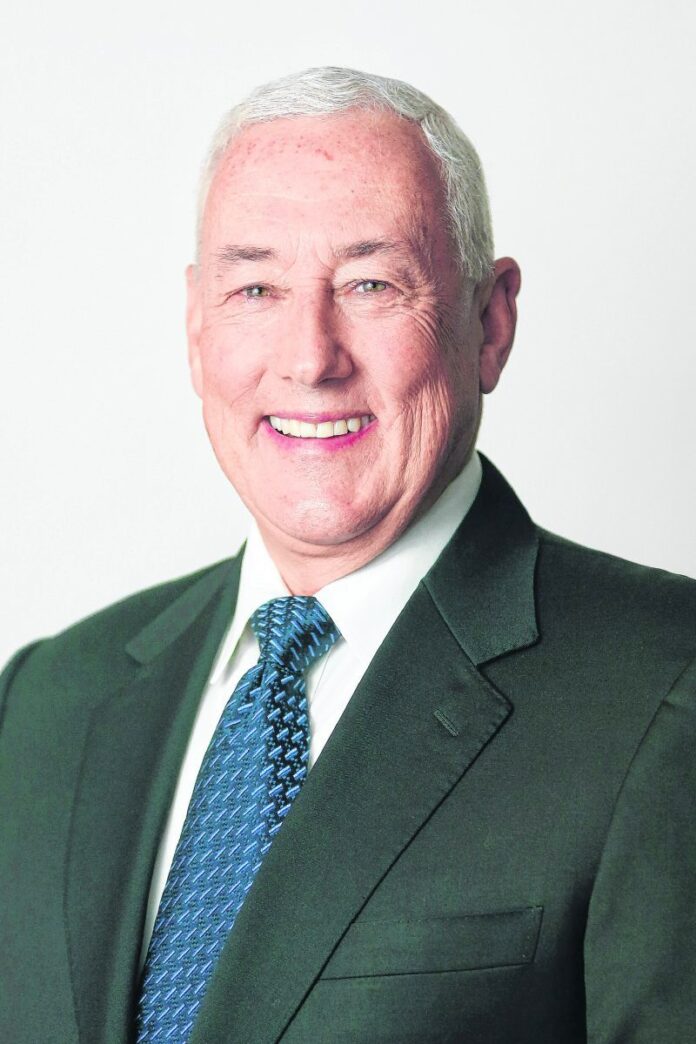
Rep. Greg Pence, R-Indiana, voted against expanding legal safeguards for LGBTQ people, including protections in the nation’s labor and civil rights laws.

In a 224-206 vote on Thursday, the Democratic-led House passed a bill that would amend existing civil rights law to explicitly include sexual orientation and gender identification as protected characteristics, The Associated Press reported. The protections would extend to employment, housing, loan applications, education, public accommodations and other areas.

Three Republicans joining Democrats in voting for the bill, called the Equality Act.

Supporters say the law before the House on Thursday is long overdue and would ensure that every person is treated equally under the law, according to wire reports.

Republicans broadly opposed the legislation. They echoed concerns from religious groups and social conservatives who worry the bill would force people to take actions that contradict their religious beliefs, according to the AP.

The House passed the Equality Act in the last Congress with unanimous Democratic support and the backing of eight Republicans, but Donald Trump’s White House opposed the measure and it was not considered in the Senate, where 60 votes will be needed to overcome procedural hurdles, according to wire reports. Democrats are trying to revive it now that they have control of Congress and the White House, but passage still appears unlikely in the evenly divided Senate.

Pence also voted against the bill during the previous Congress, federal records show.

The Supreme Court provided the LGBTQ community with a resounding victory last year in a 6-3 ruling that said the Civil Rights Act of 1964 applied to LGBTQ workers when it comes to barring discrimination on the basis of sex, according to the AP. Civil rights groups have encouraged Congress to follow up that decision and ensure that anti-bias protections addressing such areas as housing, public accommodations and public services are applied in all 50 states.

The city of Columbus added human rights protections for lesbian, gay, bisexual and transgender residents as part of its human rights ordinances in 2015.

Pence votes against extending legal protections to LGBTQ people

Pence Submitted photo

Rep. Greg Pence, R-Indiana, voted against expanding legal safeguards for LGBTQ people, including protections in the nation’s labor and civil rights laws.

In a 224-206 vote on Thursday, the Democratic-led House passed a bill that would amend existing civil rights law to explicitly include sexual orientation and gender identification as protected characteristics, The Associated Press reported. The protections would extend to employment, housing, loan applications, education, public accommodations and other areas.

Three Republicans joining Democrats in voting for the bill, called the Equality Act.

Supporters say the law before the House on Thursday is long overdue and would ensure that every person is treated equally under the law, according to wire reports.

Republicans broadly opposed the legislation. They echoed concerns from religious groups and social conservatives who worry the bill would force people to take actions that contradict their religious beliefs, according to the AP.

The House passed the Equality Act in the last Congress with unanimous Democratic support and the backing of eight Republicans, but Donald Trump’s White House opposed the measure and it was not considered in the Senate, where 60 votes will be needed to overcome procedural hurdles, according to wire reports. Democrats are trying to revive it now that they have control of Congress and the White House, but passage still appears unlikely in the evenly divided Senate.

Pence also voted against the bill during the previous Congress, federal records show.

The Supreme Court provided the LGBTQ community with a resounding victory last year in a 6-3 ruling that said the Civil Rights Act of 1964 applied to LGBTQ workers when it comes to barring discrimination on the basis of sex, according to the AP. Civil rights groups have encouraged Congress to follow up that decision and ensure that anti-bias protections addressing such areas as housing, public accommodations and public services are applied in all 50 states.

The city of Columbus added human rights protections for lesbian, gay, bisexual and transgender residents as part of its human rights ordinances in 2015.

Letter: School voucher programs benefit the wealthy

Laptop

From: Kathleen Leason

Columbus

Rep. Ryan Lauer, our state representative, co-sponsored and supported House Bill 1005 that expands private school tuition assistance.

The bill increases income eligibility to a family of four earning $145,000 annually in 2022. It’s worth noting that contributions to a tax-preferred account can also be used for a child’s private school education up to $10,000 per year, further benefiting high-income households.

One argument Rep. Lauer gives to justify his support of this bill is that it will expand school choice for more families.

I have to ask…how probable is this statement?

A quick survey of the private schools in Bartholomew County indicates there are roughly 1,500 elementary school students attending private schools. Most of these schools give enrollment priority to households who already have family members enrolled.

So, who will benefit from an expansion of the state subsidy? Will these schools undertake building projects to expand facilities to accommodate all students who wish to enroll? Probably not. It seems that this is purely a deeper subsidy to the families who already have students attending the school.

HB 1005 passed in the House last week and will move to the Senate for consideration next. Let’s hope our state senators will see this bill for what it truly is: a welfare program for the wealthy.

It’s interesting that Rep. Lauer began his political career as a Libertarian. Primary ideas in the Libertarian platforms are less government and minimal taxes. My, how he has drifted.

High school sports results

Boys basketball

Madison 65, Jennings County 43

Jennings County;5;8;19;11;—;43

Madison;19;20;16;10;—;65

Jennings County (12-10, 4-3): Austin martin 1 0-0 2, Trey Wilson 1 0-0 2, Darius Thomas 1 0-0 3, Cole Sigler 0 0-0 0, Lane Zohrlaut 0 0-0 0, Carson McNulty 3 0-0 9, Owen Law 3 0-0 8, Keegan Manowitz 2 0-0 6, Justin Ramey 2 0-0 5, Jacob Vogel 4 0-0 8. Totals: 17 0-0 43.

Madison (15-8, 4-3): Kaden Oliver 5 1-2 12, Jack Miller 1 1-3 3, Luke Miller 7 0-1 16, Luke Ommen 8 2-2 18, Jackson Falconberry 2 0-0 4, Parker Jones 1 0-0 2, Luke Schafer 2 0-0 4. Totals: 29 4-9 65.

3-point goals: Jennings County 9 (McNulty 3, Law 2, Manowitz 2, Thomas, Ramey); Madison 3 (Miller 2, Oliver).

Evansville Day 66, Brown County 44

Evansville Day;19;18;19;10;—;66

Brown County;17;13;5;9;—;44

Evansville Day (10-5): Brant 1 6-7 8, Rugami 3 1-4 8, Kunst 0 0-0 0, Myers 12 12-12 36, Kane 4 0-0 11, Rimawi 1 1-2 3, Bivins 0 0-0 0, Phillips 0 0-0 0, Atia 0 0-0 0, Foster 0 0-0 0, Craft 0 0-2 0, Boyce 0 0-0 0. Totals: 21 20-27 66.

Brown County (1-14): Travis Ely 7 2-2 20, Ricky Stanley 0 1-2 1, Malachi Nickels 0 0-0 0, Seth Oliphant 0 0-0 0, Eli Sichting 0 0-0 0, Josh Miller 1 0-2 2, Kody Walsh 1 0-0 2, Dalton Hedrick 2 0-0 4, Ethan Spiece 1 0-0 2, Carter Kelly 4 2-3 11, Isaac Roberts 1 0-2 2. Totals: 17 5-11 44.

3-point goals: Evansville Day 4 (Kane 3, Rugami); Brown County 5 (Ely 4, Kelly).

Gymnastics

 Columbus East Sectional

Team scores: Columbus North 107.875, Bloomington North 105.9, Martinsville 104.45, Franklin Central 103.65, Roncalli 102.1, Bloomington South 101.55, Columbus East 101.425, Owen Valley 98.675, Edgewood 98.2, Seymour 97.825, Indianapolis Scecina 76.175, Indianapolis Lutheran 34.375.

All-around: 1. Austyn Dykes (FC) 38.5; 2. Emily Moore (CN) 38.15; 4. Madi Edwards (CN) 35.1.

Vault: 1. Dykes (FC) 9.6; 2. Moore (CN) 9.45.

Bars: 1. Dykes (FC) 9.675; 2. Moore (CN) 9.5.

Beam: 1. Dykes (FC) 9.65; 2. Moore (CN) 9.5; 4. Lindsey Mullis (CN) 8.95; 5. (tie) Taylen Lane (CE) 8.8.

Floor: 1. Moore (CN) 9.7; 3. Edwards (CN) 9.475; 5. (tie) Elise LaSell (CE) 9.3.

Schaffer still held in Marion County Jail

Jon Schaffer turned himself in to the FBI in Indianapolis after being identified as an individual who participated in the insurrection at the U.S. Capitol on Jan. 6. His hat shows the Oath Keepers logo with Lifetime Member underneath the logo. Photo provided by the FBI Submitted photo

More than a month after being arrested for his alleged involvement in the Jan. 6 insurrection at the U.S. Capitol, Jon Ryan Schaffer is still awaiting extradition to Washington D.C. at the Marion County Jail.

Schaffer, 52, of Edinburgh, turned himself in to police on Jan. 17 after a statement of fact was filed in federal court by an FBI agent. The statement claims that video and photo evidence shows Schaffer as part of the mob that infiltrated the Capitol building on Jan. 6, and that he used a form of bear spray on Capitol Police.

After Schaffer waived his preliminary hearing, as well as his rights to an identity hearing and production of a warrant, on Jan. 22, U.S. Magistrate for the Southern District of Indiana judge Mark Dinsmore signed an order for Schaffer to appear in D.C.’s district court.

The document stated that a U.S. marshal will transport the defendant to the charging district, and that the attorney and the clerk of the court will schedule further proceedings once Schaffer has arrived. The D.C. attorney’s office will have all jurisdiction over Schaffer’s case.

Schaffer has no bond set, or trial date scheduled, at this time.

Indianapolis law enforcement confirmed Schaffer was still being held by the U.S. Marshal Service at the Marion County Jail on Thursday.

Schaffer has six different federal charges filed against him, including engaging in an act of physical violence in a Capitol building.

Photos from Jan. 6 show Schaffer wearing a blue hooded sweatshirt under a tactical vest with a baseball cap that reads “Oath Keepers Lifetime Member.” New video footage from the insurrection, shown on CNN on Feb. 15, appeared to show Schaffer charging through the building’s entrance towards Capitol officers with other rioters.

The FBI has described the Oath Keepers as an organization “that characterizes itself as a militia of former law enforcement and military personnel and has often, as a group, urged President (Donald) Trump to declare Martial Law in order to prevent the Congress from certifying the Electoral College Results.”

The Indiana chapter of the Oath Keepers has put out a statement that Schaffer is not a member of their organization.

Schaffer isn’t the only individual from the riot being held in his home state awaiting trial, as more than 200 federal cases have stemmed from the attack at the Capitol.

The U.S. attorney’s office in D.C. has assigned a special task force of prosecutors to examine whether to bring sedition charges against some of the rioters, as prosecutors and federal agents across the country develop more cases against extremists who plotted to attack the Capitol, according to the The Associated Press.

Thus far, “the FBI has linked at least 40 defendants to extremist groups or movements, including at least 16 members or associates of the neo-fascist Proud Boys and at least five connected to the anti-government Oath Keepers,” according to the The Associated Press

President Joe Biden has also ordered law enforcement and intelligence officials to investigate domestic terrorism.

Schaffer, who has ties to Columbus, is of moderate fame for his heavy metal band “Iced Earth” and side projects “Demons and Wizards” and “Sons of Liberty.”

Hansi Kürsch, who started Demons and Wizards with Schaffer 20 years ago, announced on Feb. 1 that the duo is no more. Last week, Iced Earth bassist Luke Appleton and singer Stu Block both announced their departures from the band.