Home Blog Page 15766

Democratic leader says prankster family members are ‘gonna get it’

Margie Boilanger poses next to a car bearing the campaign slogan and other statements for President Donald J. Trump's 2020 re-election campaign was placed in her front yard as a prank by her grandchildren in Hope, Ind., Thursday, Sept. 24, 2020. Mike Wolanin | The Republic

HOPE — A practical joke didn’t result in many laughs west of Schaefer Lake Thursday morning.

That’s where Margie Boulanger found an unusual discovery in her front yard off County Road 825E — an older, tan-colored Dodge Intrepid covered with banners and spray-paint promoting President Donald Trump’s re-election campaign.

Boulanger, who works for the Bartholomew County Democratic Party, says she was especially troubled by the discovery after recently learning about local residents who were vandalized after posting “Joe Biden for President” yard signs.

“I know this was supposed to be a joke,” Boulanger said. “But this was not appreciated in our front yard.”

[sc:text-divider text-divider-title=”Story continues below gallery” ]Click here to purchase photos from this gallery

The investigation had barely gotten underway before the mystery was solved. A relative revealed to a law enforcement agent that a younger family member did it as a practical joke.

Upon being told only it was a relative, Boulanger said she knows exactly who was responsible.

“And boy, they are gonna get it,” she said.

City to have ribbon cutting ceremony for new railroad overpass

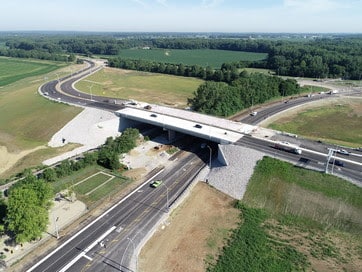
Final configuration for traffic for the Columbus railroad overpass will be opened on Saturday. Drone photo provided by Milestone

COLUMBUS, Ind. — Columbus will have a ribbon cutting ceremony for the new railroad overpass on the city’s west side at 4 p.m. Wednesday.

City engineer Dave Hayward said the ceremony will be held in the parking lot of Columbus Veterinary Services at 240 Jonesville Road, Columbus.

The $35 million overpass project is “basically complete,” Hayward said, with contractors finishing a few minor details, including some landscaping.

Hayward said previously that the city would go out for landscaping bids in January and that the work could be finished early spring or summer or possibly late next year.

Milestone Contractors was the Indiana Department of Transportation contractor on the project, which began with a groundbreaking ceremony last November.

The overpass project that is being jointly funded by the Indiana Department of Transportation, city of Columbus, Bartholomew County, Cummins Inc. and the Louisville & Indiana and CSX railroads.

For more on this story, see Friday’s Republic.

BCSC receives digital learning grant

Bartholomew Consolidated School Corp. has received almost $100,000 from the Indiana Department of Education to train teachers to better deliver virtual learning.

The Digital Learning Capacity Building Grant is awarded to schools and districts that “develop comprehensive plans to bring blended and digital learning training to their teachers, the department said.

BCSC’s grant proposal was written by BCSC coordinator of instructional technology Brenny Kummer. Kummer said that the grant project will allow BCSC to create a program called Growing Educators through Micro-Credentialing (GEM).

According to IDOE, micro-credentialing is a “non-traditional, competency-based approach to professional development that gives participants the tools necessary to gain targeted skills and demonstrate their learning by successfully implementing their newly developed skills.”

Kummer said, “Ideally, this grant will not only help our teachers become more proficient with technology tools for improved blended and digital learning, but will help our staff grow their skills for becoming better teachers in any learning environment.”

She said that BCSC staff will be able to work on self-paced modules through itslearning on their own. However, they will also be able to reach out for support and guidance by talking to the GEM development representatives in their building or attending a GEM workshop session offered once monthly after school.

Kummer said this grant will also have a positive impact on BCSC students.

“BCSC students deserve to have the most accessible, innovative learning experiences possible; by providing innovative, inclusive, accessible learning experiences for our staff, we can help model this practice and ensure that they take the same mindset and tools to their roles with students,” she said.

School board candidates participate in forum

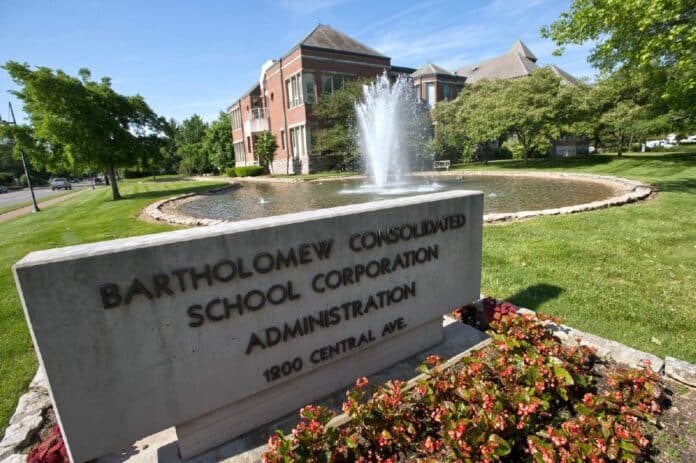
The Bartholomew Consolidated School Corp. administration building located on Central Avenue in Columbus is pictured on May 24, 2016. The Republic file photo The Republic file photo

Candidates seeking a seat on the Bartholomew Consolidated School Corp. board answered a wide range of questions about their views including how board members should engage with staff and community members, during a virtual public forum sponsored by local teachers.

Monday night’s forum was hosted by the Columbus Educators Association with logistical support from the Indiana State Teachers Association. Registration to view the event live was limited to the first 1,000 attendees, but the CEA plans to upload a recording of the event on its social media accounts.

There are candidates for three BCSC school board seats on the fall election ballot, including:

District 3 — James Persinger (incumbent), Todd Grimes, Mike Jamerson

[sc:text-divider text-divider-title=”Story continues below gallery” ]

District 5 — Jennifer Corsi (incumbent Pat Bryant is running for re-election but did not participate in the forum due to a family emergency.)

District 7 — Nicole Wheeldon, Lacretia Ulery (School board president and District 7 incumbent Jeff Caldwell is not running for re-election and did not participate in the forum.)

During the forum, candidates answered 10 questions gathered from submissions by teachers belonging to the CEA, in addition to making opening and closing remarks.

One of the questions addressed a controversial BCSC policy which has been interpreted by school corporation teachers to mean that all communication between school employees and school board members must go through the superintendent. According to the question asked of candidates, the policy goes as far as outlining how students, school staff and school board member may speak to each other if they happen to bump into each other in public.

Candidates were asked if BCSC school employees should be allowed to communicate with school board members, and whether, as a school board member, would they support revising or eliminating the policy.

Grimes said that the board needs to examine the policy, discuss it and revise it “to meet current needs.” He also said that there need to be “open, honest communication lines.”

Jamerson said that in his experience working on local, regional and national boards, there are always policies for how employees can voice their concerns, and these policies always go through the “chief administrator” (in this case, the superintendent).

“There are some issues that I would consider redoing, but I think it’s always important to welcome discussions about pedagogy, technology, new models of instruction,” he said. “However, those discussions can’t be about personnel issues or workplace issues, because those need to follow established policies and procedures to ensure that individuals are treated fairly and that the issues are resolved.”

Persinger said that he and Bryant are working on changing the policy and that he hopes to do so before the end of 2020. Persinger said that he has submitted a proposal to eliminate sections of the policy and is working on rewriting another section of it.

Corsi expressed a desire to revise the policy but also noted that staff’s requests to board members should be “reasonable.”

“Use that time to speak to the board members wisely,” she said. “What are the things that are going to be key to then increase the satisfaction that you have as a teacher and increase your effectiveness as a teacher?”

Wheeldon said that enacting disciplinary measures as result of a mere conversation seemed “harsh.”

“I think a revision of it makes total sense,” she said. “… However, I do think that with a voice comes an obligation to be part of the solution.”

She also said that there needs to be a structure and process in place for communication.

Ulery said that she believes in the chain of command and that, typically, individual school principals have the knowledge to address most issues that come from their staff. In the event they are not able to do so, the conversation then moves up the chain of command.

“As a board member, I understand the need for me to be a part of the policy-making, as the board has no authority for administrative actions,” she said. “… But if this policy needs to be reviewed and language be refreshed, then that should happen. I would hope that there could be more open communication agreed to in the future.”

Candidates were also asked about topics in the national and local community conversation about racism and racial justice, and what BCSC should do to address the needs of students of color and to combat racism.

“We need to have the hard discussions that make people uncomfortable,” Grimes said, who recently attended a conference organized by the Anti-Defamation League.

Jamerson said that addressing implicit bias is important, as is using the Universal Design for Learning to examine “areas of cultural responsiveness” and improve the school corporation. “It’s unfortunate that Mr. Bryant couldn’t join us tonight, as the only person of color who’s on the board today,” he added. “And I think it’s important to listen and speak with them, as opposed to just trying to decide what we need to do for them.”

Persinger said everyone has implicit bias and that bias needs to be recognized. He also said that it’s important to talk with people from other ethnic or racial groups and to help kids become involved with other cultures at a young age.

“The most important thing is to admit that there is a problem, especially, you know, as we see nationally, racism is unfortunately alive and well in this country,” he said.

Corsi emphasized the importance of addressing one’s own implicit bias.

“You can’t just gloss over and say, ‘We should all just get along,’” she said. “You have to dive deep into who you are as a human and how you can help others.”

Wheeldon said that it’s important to educate students on racism. “I also think that creating experiences for kids to really understand how these things play out in real life, what is their role as a growing member of society, is really important,” she added.

Ulery said that a first step should be implicit bias training for every staff member. She also said that the school corp. should examine the diversity of its staff.

“I would ask the question, ‘Does our staff reflect our community?’” she said.

Another question addressed the beginning of this school year in the midst of the COVID-19 pandemic. Candidates were asked about parents’ concerns about a lack of equity among the choices offered to BCSC families for in-person or virtual learning.

“I have a real respect for the school board and the administration in the central office that spend inordinate amounts of time planning and making sure that we have the best interests of kids in mind,” Grimes said of the opening of the school year.

There have been difficulties for teachers tasked with in-person and BRIDGE instruction, Jamerson said.

Stating his opinion that in-person learning was “a mistake,” Persinger said the school year should have begun with online learning before moving into offering the three different learning options for students.

“I think that would’ve given our teachers more adequate time to prepare for the school year,” he said. “I think that it was rushed. I think that’s why we had so many issues at the beginning and still continue to do.” He added that there should’ve been more “transparency and communication” between the administration, staff and community.

Corsi said that in her discussions with teachers, most said they didn’t feel as though they had enough time to prepare.

“I would’ve liked to have more time for the teachers to prepare for this, because that’s a big transition, when you’re teaching in-person and online,” she said. Like Persinger, she also expressed a need for transparency from the administration.

Wheeldon said that the litmus test of reopening is to ask how students are feeling about it. In her case, her daughter was “thrilled” to go back to school.

However, Wheeldon also noted that BCSC should continue to improve the reopening plan, ask important questions, receive feedback and listen to (and meet) teachers’ needs.

Ulery said that some students are struggling with virtual learning and that the school corp. needs to make “readjustments as needed” rather than go with a uniform approach across the board.

“We may want to consider more training for students and parents … or possibly a list of helpful resources like study groups or tutors that they may reach out to themselves,” she said. “But we should continue to look for those that struggle and are falling through the cracks.”

[sc:pullout-title pullout-title=”How to watch” ][sc:pullout-text-begin]

The Columbus Educators Association will upload a recording of the public forum to YouTube and then share it on their Facebook and Twitter accounts.

[sc:pullout-text-end]

Traffic stops down for 2020, due to pandemic

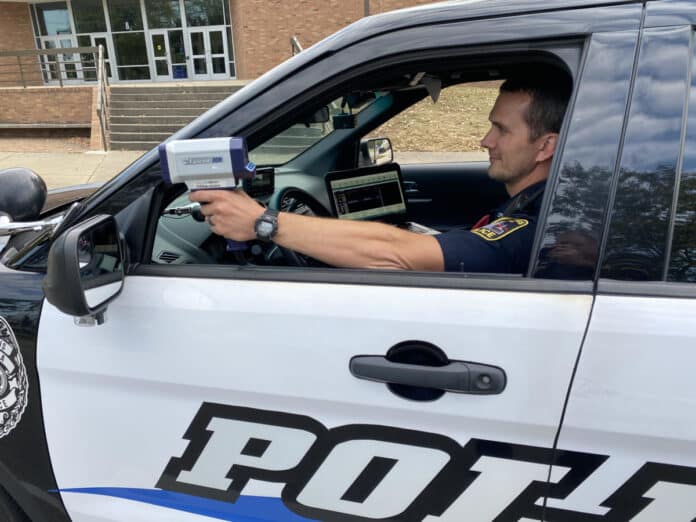
Columbus Police Officer Michael Pigman running radar on Home Avenue near Columbus North High School today. Photo provided

COLUMBUS, Ind. — Local law enforcement officers have performed fewer traffic stops this year compared to last year due in large part to the pandemic, which resulted in fewer cars on the road earlier this year.

As of Sept. 15, Bartholomew County Sheriff’s deputies had done 3,850 traffic stops, compared to 6,614 as of Sept. 15, 2019 and 9,385 during all of 2019.

The Columbus Police Department had done 2,539 traffic stops as of Sept. 14, compared to 3,583 last year and 3,264 in 2018.

Overall, the two law enforcement agencies performed a combined 6,389 traffic stops during roughly the first 9.5 months this year, just under half the combined 12,968 traffic stops done last year.

“Our traffic stops as a whole are down, but I will directly relate that to COVID,” said Capt. Dave Steinkoenig, road division commander at the Bartholomew County Sheriff’s Department. “When COVID first came out, there was a time that based on all the things we were hearing from the (Centers for Disease Control and Prevention) and other places like that, contact or interaction was for emergency situations only. …A lot of our guys were reactive during that time instead of proactive. So they were out in the county responding to calls, looking for suspicious vehicles, stuff of that nature, but they weren’t really stopping a whole lot of cars and doing that self-initiated contact with the motoring public.”

For more on this story, see Friday’s Republic.

Holcomb moves state to Stage 5 in pandemic

INDIANAPOLIS — Indiana Gov. Eric Holcomb announced Wednesday that Indiana will move to the final phase of his five-stage plan to reopen the state, citing improving COVID-19 case numbers in recent weeks.

The move, which Holcomb said will take effect Saturday, lifts capacity restrictions at restaurants, bars, retail stores, gyms, fitness centers and salons as long as social distancing and other guidelines are followed.

Stage 5 also allows social gatherings of over 250 people if social distancing guidelines are followed, though state officials said people seeking to hold events with more than 500 people should still consult their local health department.

Holcomb also extended the statewide mask mandate through Oct. 17. The mandate, which Holcomb instituted by executive order in July, applies to anyone 8 years or older in indoor public spaces, commercial entities and on public transportation, as well as when outdoors and without the ability to maintain 6 feet of physical distance with others.

Holcomb had initially planned to move into Stage 5 on July 4, but repeatedly held off, instead creating “Stage 4.5” as the number of hospitalizations and the percentage of tests coming back positive increased during much of the summer.

“The numbers continue to track in the right direction,” Holcomb said in a press briefing on Wednesday. “…We like the path that we’re on, the direction that we’re moving, but we really just have to underscore how important it is for our citizens and our businesses to continue to make those adjustments and operate in a very safe manner.”

The announcement came as state health officials reported an additional 728 new positive cases of COVID-19 and 10 deaths in Indiana.

A total of 815 people were hospitalized across the state with confirmed or suspected COVID-19 infections on Tuesday, up from 759 on Monday, according to the Indiana State Department of Health.

However, the seven-day average of the percentage of tests coming back positive for the coronavirus that causes COVID-19 was 3.9% as of Wednesday, down from 6.5% in late July, according to state figures.

Holcomb said Wednesday that he and other state officials “believe that it is safe to eat out at restaurants.”

The governor said he got a haircut in Columbus a few days ago while wearing a mask.

Locally, Dr. Brian Niedbalski, Bartholomew County health officer, said the governor’s decision to move to Stage 5 will likely be discussed on Friday during the COVID-19 Community Task Force’s meeting.

The task force, which was formed in February, includes representatives from Columbus Regional Health, the Columbus mayor’s office, Bartholomew County Health Department, Bartholomew County Emergency Management, Bartholomew Consolidated School Corp. and Cummins, Inc.

[sc:pullout-title pullout-title=”Learn more about Stage 5″ ][sc:pullout-text-begin]

Visit backontrack.in.gov/files/BackOnTrack-IN_WhatsOpen-Closed-stage5.pdf for more information about Stage 5 of Holcomb’s Back on Track Indiana plan.

[sc:pullout-text-end]

Columbus Magazine (Sept/Oct 2020)

092420_COLUMBUSMAGAZINE[embeddoc url=”http://www.therepublic.com/wp-content/files/sites/6/2020/09/092420_COLUMBUSMAGAZINE.pdf” download=”all”]

Warrant issued for defendant who skipped sentencing hearing

Riddle

By Leeann Doerflein | Daily Journal

For The Republic

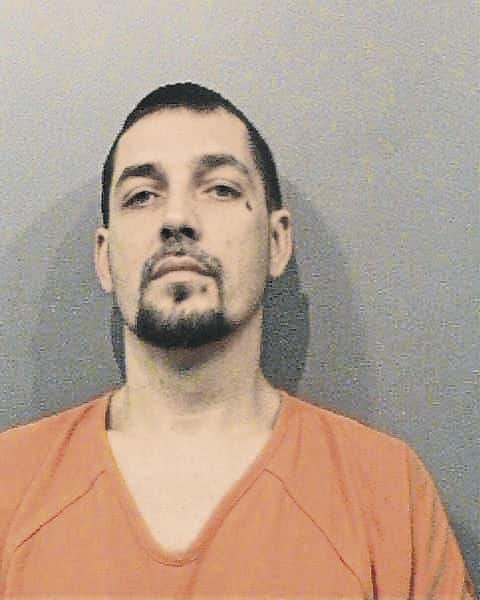
EDINBURGH — An Edinburgh man who is facing nearly 47 years in prison is wanted after he skipped his sentencing hearing for two meth dealing cases.

Michael Paul Riddle, 36, was set to be sentenced Monday in Johnson County Circuit Court, but is now on the run. The Johnson County Sheriff’s Office and Central Indiana Crimestoppers are seeking the public’s help in locating him.

For a case filed Jan. 29, Riddle was sentenced to up to 22 years for conspiracy to possess with intent to deliver methamphetamine, a Level 2 felony, all executed, with credit for 243 days served, according to court documents.

For a separate case filed April 30, Riddle was sentenced to up to 17.5 years for possession with intent to deliver methamphetamine, also a Level 2 felony; up to 6 years for possession of a handgun with an altered serial number, a Level 5 felony; and up to one year for possession of a handgun without a license, a misdemeanor, court documents show.

Circuit Court Judge Andrew Roesener ordered that the time for each charge and both cases be served consecutively, or one after another, according to court documents. Roesener also ordered that Riddle’s altered Taurus Millennium G2 9mm handgun be forfeited to the sheriff’s office for destruction, documents said.

Riddle was released on $66,000 bond Sept. 18, and was told to report back to the jail Monday to appear via video for his sentencing hearing, according to online court records.

A warrant for failure to appear was issued Tuesday.

For more on this story, see Friday’s Republic.

Jets fall just short against Indianapolis Lutheran

Hauser's Marnie Schwartzkopf, Kenze Bostic and Sophia Musillami attempt to block Indianapolis Lutheran at Hauser, Wednesday, Sept. 23, 2020. Paige Grider for The Republic Paige Grider | For The Republic

HOPE — The first two sets Wednesday night, Hauser went toe-to-toe with powerful Indianapolis Lutheran and pulled out a pair of close sets.

The next two sets, the Jets began experiencing the fatigue of playing their seventh match in five days.

Hauser recovered to push the Saints to the brink in the fifth and deciding set and had a match point, but Lutheran was able to score the final three points to finish off a 23-25, 24-26, 25-9, 25-12, 16-14 victory.

“We have to learn to be more mentally tough and learn how to finish,” Hauser coach Jeff Case said. “We didn’t win tonight, but hopefully, we’ll learn from it.”

[sc:text-divider text-divider-title=”Story continues below gallery” ]Click here to purchase photos from this gallery

The Jets (12-6) never trailed in a first set. In the second set, they led 13-7, only to see the Saints rally for a 17-15 lead. Hauser trailed 23-19 when it got a sideout and four consecutive points with Aunaka Wasil at the service line to take a 24-23 lead. After the Saints tied it, they had a service error and hitting error to allow the Jets to take a two-sets-to-none lead.

The third and fourth sets were all Lutheran. Hauser jumped out to a 3-0 lead in the fifth behind the serving of Adriana Musillami. After five lead changes in the final set, Hauser took its last lead at 14-13 before the Saints closed it out.

“We had opportunities,” Case said. “We missed a couple of serves there in that fifth set. But it was a team effort. We had mistakes all over the place. We just have to learn how to be more consistent. At times, we would play really well, and for whatever reason, we lose our consistency, and our ball control goes away and our hitting goes away.”

Lutheran’s Dara Milivojac, who came in leading the state with 408 kills, added 32 more kills on Wednesday.

Hannah Johnson recorded 12 kills, one block and three aces, and Wasil had 25 assists and 23 digs to lead the Jets. Kendal Bostic notched one kill, and Andie Clark tallied 23 digs.

Also for Hauser, Bostic pounded 11 kills, and Charlie Clark added nine kills. Kyra Meister posted 10 digs, and Wasil served two aces.

Now, Hauser will have to turn around and play its eighth match in six days tonight at Class A No. 1 Trinity Lutheran.

“That’s just what it is this year,” Case said. “Everybody is playing crazy schedules with games being canceled and moved around. I’d rather do this than not be able to play, but it could be some fatigue.”

State: 920 additional Hoosiers diagnosed with COVID-19

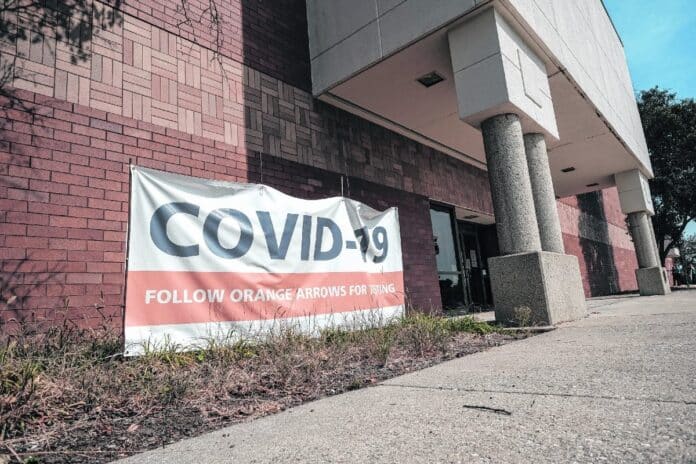
A sign marks the COVID-19 testing site at the old J.C. Penney store at FairOaks Mall in Columbus, Ind., Tuesday, Sept. 22, 2020. Mike Wolanin | The Republic

INDIANAPOLIS — The Indiana Department of Health today announced that 920 additional Hoosiers have been diagnosed with COVID-19 through testing at the state laboratory, the Centers for Disease Control and Prevention (CDC) and private laboratories. That brings to 114,236 the total number of Indiana residents known to have the novel coronavirus following corrections to the previous day’s dashboard.

A total of 3,322 Hoosiers are confirmed to have died from COVID-19, an increase of 17 from the previous day. Another 226 probable deaths have been reported based on clinical diagnoses in patients for whom no positive test is on record. Deaths are reported based on when data are received by the state and occurred over multiple days.

To date, 1,331,608 unique individuals have been tested in Indiana, up from 1,322,819 on Wednesday. A total of 1,937,499 tests, including repeat tests for unique individuals, have been reported to the state Department of Health since Feb. 26.

Bartholomew County reported 1,155 positive tests (up two) with 57 deaths (no change) on Thursday.

Surrounding counties reported:

  • Jackson County: 746 positive cases (up four) with nine deaths (no change).
  • Jennings County: 312 positive cases with 12 deaths (no change).
  • Decatur County: 458 positive cases (up one) with 39 deaths (no change).
  • Shelby County: 668 positive cases (up two) with 29 deaths (no change).
  • Johnson County: 2,291 positive cases (up 13 with 123 deaths (no change).
  • Brown County: 104 positive cases (up one) with three deaths (no change).

To find testing sites around the state, including a site at the FairOaks Mall in Columbus, visit www.coronavirus.in.gov and click on the COVID-19 testing information link.