Home Blog Page 16564

DNA match creates cousin confusion

Dear Amy: A relative contacted me on an ancestry site after learning that we were cousins.

We had no knowledge of each other and excitedly exchanged information about ourselves and our families. Eventually, though, she wanted specific names of male relatives who, presumably, might be her birth father.

She was not adopted and was raised by two parents (presumably, the father who raised her didn’t know he was not her biological father).

At that point I explained that I did not feel comfortable giving names and asked if she could speak with her mother about this, however uncomfortable that might be.

I truly felt I’d gone as far as I could, ethically speaking.

After declining to provide names of family members, I never heard from her again, which grieves me.

Now I’m left wondering: In this age of DNA discoveries, what are our obligations to family members, whether they be known or hidden? What is ethical here?

— Curious Cousin

Dear Curious: You could force this issue into the open by saying to your relatives: “I have been contacted by a previously unknown cousin through a DNA site. She is eager to reach out to other family members. If you are interested in communicating with her, let me know and I will give you her contact information.”

I’m not advocating for this approach, but it is an option that offers your relatives the same choice you have faced.

You could also reach out to your cousin again in order to stay in touch, without changing your own choice about disclosure.

Dear Amy: My co-workers all have children or grandchildren. My husband and I never had children (medical issues).

Most of my friends and co-workers were determined to get out of school, get married and have a baby! Me? I wanted to travel and do things I wanted to do before I got married. And I did!

Having a baby was never on my radar. Oh, I figured I would want a baby one day, but it wasn’t a priority.

I’m the type of person where I see dogs that are around me before I see the cute baby. And, please, don’t show me a video of your kid learning to run or dancing. No thanks!

My problem is that when my friends talk about babysitting their grandchildren (which I think they do too often — they can’t seem to say no to their kids!) my eyes tend to glaze over, and I zone out.

At work when co-workers start talking about their kids or grandkids, I have the same reaction. Usually I just go back to my office.

What is wrong with me? Why don’t I like kids?

— M

Dear M: I don’t know why you don’t like kids. I don’t assume that you actually dislike human children, but that you are bored by a topic that you don’t see as relatable.

Perhaps if you pretended that children were dogs, you could at least feign an interest in them. Maybe not.

There is a high likelihood that I wouldn’t be overly interested in your photos from your most recent travel adventure. But if you showed these photos to me, I would politely engage with you, because your travels and your pooches are important to you.

Friendship and collegiality confer a certain amount of benign politeness. You might not be overly interested in a friend or colleague’s golf game, her kids’ soccer score, or her grandbaby’s first steps, but a nod and a smile are all that is required; then you can go back to your office.

Dear Amy: Thank you, thank you for your response to “Tightrope Walker,” whose co-worker had survived a suicide attempt.

Yes, after a crisis, it is such a relief to interact with people in a “normal” capacity. Not directly addressing the crisis isn’t being in denial. It is demonstrating that you see the survivor as more than their illness.

— Been There

Dear Been There: Re-entry is so hard after a personal crisis. Thank you for your wisdom.

Letter: Some thoughts on Mitt Romney

From: James Brown

Morgantown

May I express a brief opinion of Mitt Romney? Hopefully, it won’t be like in church when someone asks to say a few words and they go on and on.

He ran for President and did not fight back against all the things the Democrats accused him of, and he lost. He made a bid to be Secretary of State under President Trump, and he lost. He ran for the U.S. Senate in Utah and would have lost except President Trump went to Utah and campaigned for him, so he won.

The Senate listened to the House’s impeachment of President Trump, and all the Republicans voted to acquit President Trump except one. It was Mitt Romney, and he lost again, 52-1. He blames his religious commitment that is better and stronger than the other senators. He also asked his wife, children, and grandchildren if they were OK with his decision.

Now to the real issue of his decision. How come he did not ask the people in Utah? Aren’t they the ones he is supposed to represent?

Letter: Open your hearts to thought that hope is real

Laptop

From: John Brooks

Columbus

As Benedictine Oblates, when we made our final Obligation in the Archabbey church, we made three promises before the Archabbot, all the Saints, all the assembled and God, stability of heart, fidelity to the spirit of the monastic life and obedience to the will of God. Each of us, while forming in our mother’s womb, receive from God, our creator, an ember from his heart that ignites a fire to light our way on our journey of life.

We begin our journey as our lungs fill with the precious air of life and we take our first breath and cry to the world announcing we have arrived as a child of God to do his work, welcomed into God’s family by our baptism, our hearts filled with God’s unconditional love, understanding, forgiveness and compassion.

We are called to transcend the world’s way and journey to reignite the fire in the hearts of those whose hearts have become cold, dark and distant. The light from the fire of our hearts, fed by acts of kindness, caring, understanding, forgiveness, compassion and love, guide those from the depths of despair not by pulling them up but by taking them by the hand and walking beside them towards the light of salvation, our stable hearts firmly settled on a foundation of sacrifice of self, service to others and putting others needs before our own should serve as a model for others. A beacon of light, hope and faith.

Being a beacon of light, hope and faith for me involves being an Oblate, a father, a grandfather, a friend, a coworker, a member of my local parish, a member of my local community and a volunteer. I volunteer at the local hospital, local food pantry and local homeless shelter. With a stable heart founded firmly on a foundation of love, kindness, caring, forgiveness, understanding and compassion, I engage those often overlooked, forgotten and shunned by society, a subset of human society desperately seeking acceptance, assistance and guidance in our complex dark cold self-centered world.

Becoming a stable force in a very unstable world involves more than just words. It involves being present in action and deed, standing side by side and engaging those in need with a caring kind forgiving servants heart day after day. Sometimes it is the smallest acts of kindness and caring that reap the greatest rewards — a smile of friendship, a warm handshake, a friendly face or a kind word. Showing others by our actions there is at least one person in their lives who cares about them and their journey of life. Planting the seeds of love, understanding, forgiveness and acceptance. Clearing away the weeds and noise of life to uncover the hope and faith that each of holds deep in our hearts. Opening our hearts to the possibility that the hope is real; the faith is genuine, and we are not alone on our journey — a journey out of the darkness and into the light of salvation.

Indiana’s restrictions on lobbying need an update

Anderson Herald-Bulletin

Indiana legislators aren’t supposed to be able to move straight out of lawmaking and into lobbying. The law spelling that out, though, needs another look.

The issue arises because of a case involving former state Sen. Allen Paul, a Republican from Richmond. Paul had been in the Senate for nearly three decades when he gave up his seat in 2014. The very next year, he was knocking down $900 a week working on behalf of the Indiana Department of Veterans Affairs.

The secretive deal blew up when The Indianapolis Star uncovered details early last year, but by that time, Paul had been paid more than $150,000 to promote the department’s agenda among his former colleagues.

The Indiana Lobby Registration Commission fined both the department and the temporary employment agency Paul had been working for. It also instructed Paul to register as a lobbyist, but he refused.

The commission turned the matter over to the Marion County prosecutor’s office, noting that failing to register as a lobbyist and violating the one-year cooling-off period were both Level 6 felonies, each carrying a sentence of up to 2½ years in prison and a fine of up to $10,000.

The prosecutor’s office, though, declined to take action, basically passing the ball back to the commission.

“The role of our agency is limited to prosecuting suspected criminal activity,” the prosecutor’s spokesman, Michael Leffler, told The Star in an email. “However, it is not our role to determine if other potential consequences or administrative sanctions are appropriate.”

And there we sit.

Paul actually voted on this measure as a sitting senator and then turned around and violated it after leaving office. The agency charged with enforcing this law says the prosecutor should take action. The prosecutor says no.

The commission says Paul was acting as a lobbyist. Paul says he was acting as a consultant.

Someone needs to figure this out, and it might well be Paul’s former colleagues in the Indiana General Assembly.

There was a reason lawmakers enacted this prohibition. It’s unseemly for our public officials to leave their elected positions and immediately begin cashing in on all the friendships they made at taxpayers’ expense. The one-year cooling-off period seems only reasonable.

If the law now in place isn’t adequate to send that message, lawmakers need to take steps to fix it. Taxpayers should demand that they do.

Musicians compete for scholarships

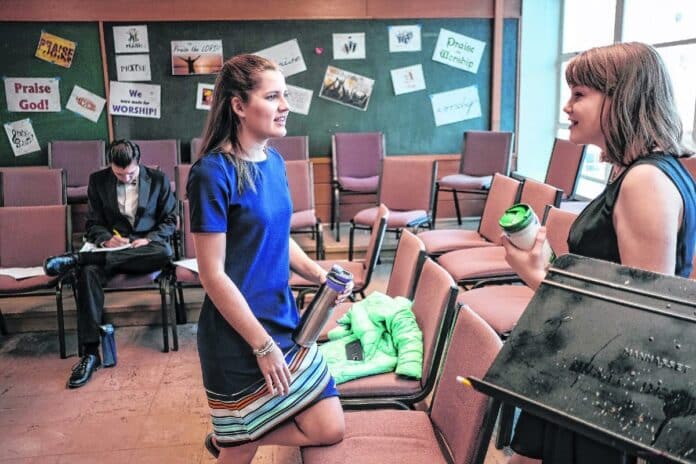
Columbus East student Reagan Lykins, left, talks with Columbus North student Zoe Dougherty before they sing in the Brown Music Competition at First Christian Church in Columbus, Ind., Saturday, Feb. 9, 2019. Mike Wolanin | The Republic

A total of 37 high school students will compete for $20,000 in scholarships at the 35th Annual Brown Music Competition Saturday at First Christian Church in downtown Columbus.

The competition begins at 8 a.m.

It is free and open to the public and attracts about 200 audience members each year.

The senior instrumental and senior vocal winner each are awarded a $3,500 college scholarship.

[sc:text-divider text-divider-title=”Story continues below gallery” ]

The event was the brainchild of the late Robert N. and the late Betty F. Brown, in honor of Robert’s mother, Anna Newell Brown, a talented vocalist. The Anna Newell Brown vocal awards began in 1985. Betty F. Brown was a talented player of piano, organ and recorder, and the instrumental awards, named in her honor, began in 1992.

Robert N. Brown was the longtime chairman of Home News Enterprises, former parent company of The Republic newspaper.

The Heritage Fund — The Community Foundation of Bartholomew County administers the program, considered among the best in the country for its polish, amount of scholarship money and accomplished judges, including those from Indiana University’s top-ranked Jacobs School of Music.

It also is heralded for the preparation and exposure given young students who later go on to professional music careers. That includes those who’ve performed on Broadway or in entertainment segments including opera, military bands, cruise ships, and television.

Local music and voice teachers say it is rare for high schoolers anywhere to have such arts opportunities in a smaller community.

Instrumental judges are: Dean Franke, violinist and retired assistant concertmaster of the Indianapolis Symphony Orchestra; Ray Kilburn, associate professor of music, piano, Ball State University; Kathryn Lukas, professor of music, flute, Indiana University Jacobs School of Music. Vocal judges are Mary Ann Hart, professor of voice, Indiana University Jacobs School of Music; Kerry Jennings, voice area coordinator/director of opera, associate professor of voice, DePauw University; Thomas Studebaker, artist faculty, Roosevelt University in Chicago.

Code enforcement issues $1,000 fine on Maple Street home

Columbus Code Enforcement is issuing a $1,000 fine to a Columbus homeowner after repeated attempts seeking to have garbage and rubbish removed from the property’s exterior.

City officials have alleged that the property, located at 720 Maple St., is a public nuisance, citing trash, garbage and rubbish along the outside area of the house and in the porch area.

Columbus police were dispatched to the house nearly 50 times from Feb. 10, 2018 to Jan. 23, 2020, regarding alleged incidences involving trespassing, unconscious people, fights, battery, theft and vandalism, according to public records.

The Columbus Board of Public Works approved the fine on Tuesday. The purpose of the fine would be to compel the homeowner to clean the property up, said Fred Barnett, Columbus’ code enforcement officer.

“I’ve tried to get them to comply and they just haven’t done it and I’ve given them chance after chance after chance,” Barnett said.

For more on this story, see Wednesday’s Republic.

Lucas creates stir with gun comments to student

Jim Lucas JordanRichartjrichart@tribtown.com

Rep. Jim Lucas, R-Seymour, caused a stir at Monday’s Third House session while answering a question posed by a 12-year-old student from ABC-Stewart School in Columbus.

Student president Jackson Brewer, a sixth-grader, asked the four legislators attending the Third House session at Donner Center, including Lucas, Rep. Ryan Lauer, R-Columbus, Sen. Greg Walker, R-Columbus and Sen. Eric Koch, R-Bedford, about their opinions on pending state legislation that would allow teachers to receive handgun training if they so desired and permit retired law enforcement officers to carry firearms on school property.

Lucas told the nearly 60 people in audience, including four ABC Stewart students, that he believes gun control laws won’t prevent school shootings, training teachers to use firearms can make schools safer and that a federal court has ruled “police do not have a duty to protect children while they are being slaughtered.”

After Lucas answered Brewer’s question, the student had a follow-up question: “Do you believe the more guns that are being carried, including in this room, would make my classmates and I safer?”

Lucas immediately said “absolutely” and then told the crowd “I’m carrying right now. Does that scare anybody?”

Around 20 people, or roughly a third of those in the room, raised their hands to signal that it scared them. Several other people said “yes” without raising their hands. There also were a few people who said “no.”

After the event, Lucas said he was carrying a .50-caliber 1911 handgun at the Third House session, adding that he carries a firearm everywhere he goes — including in the Indiana House of Representatives chamber and in the Statehouse. Donner Center, where Third House was held, is a Columbus city parks facility.

Lucas has repeatedly said Indiana should only have one gun law, Article 1 Section 32 of the Constitution which states “the people shall have a right to bear arms, for the defense of themselves and the state.”

“So you consider me a threat, but I’m not going to threaten anybody,” said Lucas said to the audience during the Third House session. “…I encourage everybody, one, take it serious, train and carry and be able to defend yourself because now it’s a morality issue. I’m perfectly capable of taking care of myself. I cannot fathom me expecting another person, a police officer, a total stranger, to risk their life to save mine when it’s perfectly within my ability to do so.”

He continued, “Police do not have a duty to protect you. You are on your own as ruled by the United States Supreme Court. Period,” he added.

Jerry Maulin, a team leader who teaches second through sixth grades at ABC Stewart and took the students to Third House, said he was “somewhat disappointed” that the other lawmakers didn’t comment on the student’s question about gun legislation.

The purpose of attending the event, Maulin said, was for the students to learn that there are multiple sides to issues, but they ended up only hearing one side of the gun debate.

“I’m not surprised by (Lucas’) comments,” Maulin said. “I understand that it is probably his main issue. …I was somewhat disappointed that the other members (of the General Assembly) didn’t have any comment on it. They kind of let him dominate (the conversation).”

Brewer, through Maulin, said he felt Lucas answered his question.

“He said he thought Rep. Lucas answered his question. He felt like Rep. Lucas really likes guns. He also said he felt many in the room were startled when Rep. Lucas revealed he was carrying a gun right there in our meeting,” Maulin said.

“It was kind of startling when Rep. Lucas shared that he was carrying a weapon,” Maulin said.

“‘Children being slaughtered,’ to say that to school kids, I don’t know,” Maulin said.

In a telephone interview after the event, Lucas said he hoped students who attended would “start to think for themselves.”

“I hope they would start to think for themselves and apply reason and logic,” Lucas said Monday afternoon. “That church shooting (in Texas) provides a perfect example. There are no guarantees in life. No matter what we do you can’t ever guarantee that nothing bad will ever happen.”

To back up his claim, Lucas, who allowed that he is not an attorney, repeatedly cited a 2005 U.S. Supreme Court case, Castle Rock v. Gonzales, as well as a recent lawsuit involving a 2018 school shooting in Parkland, Florida, in the U.S. District Court for the Southern District of Florida.

The U.S. Supreme Court case involved a dispute about police failing to respond to a violation of a court-issued protective order, The New York Times reported. While in violation of the order, a woman’s estranged husband murdered her three children, according to the American Civil Liberties Union.

In 2018, a federal judge in the U.S. District Court for the Southern District of Florida ruled in a similar fashion, finding that “neither the school nor sheriff’s deputies had a legal obligation to protect students” from a gunman who opened fire and killed 17 students at Marjory Stoneman Douglas High School in Parkland, Florida, in February 2018, according to a story in The Washington Post.

Columbus Police Department spokesman Lt. Matt Harris said while he is not familiar with the legal cases Lucas referenced, “a big part” of the police’s role is “to keep the community safe.”

“We’ve worked for a long time to make sure that not only adults are safe here in the community, but also youth, from the extra steps working with the school corporation to have resource officers in the schools to building relationships with the DARE Program and with students,” he said.

“Anytime there is an unsafe situation, we want young people feeling comfortable coming to a police officer and letting them know,” Harris said.

[sc:pullout-title pullout-title=”More coverage inside” ][sc:pullout-text-begin]

For more on Monday’s Third House session, see Page A4.

[sc:pullout-text-end]

City OKs rezoning request for large interstate sign

The city has approved rezoning more than 3 acres of land so a gas station convenient store can put up a sign designed to be seen by motorists along Interstate 65.

The Columbus City Council has unanimously approved rezoning 3.6 acres of land currently occupied by Get Go Café & Market at 3545 W. County Road 450S just west of Interstate 65 on the city’s south side.

With the approval, the land will be rezoned from “agricultural: preferred” and “commercial: community” to “commercial: regional,” which will allow the gas station convenient store to put up an interstate-oriented sign that could be as tall as 90 feet and occupy no more than 200 square feet in area, according to a staff report from the Columbus Plan Commission.

Besides allowing the company to construct the sign, the “commercial: regional” zoning classification would allow for some additional permitted uses on the property, such as whole sale facilities, farm equipment sales, among others, as well as conditional uses that include a truck stop or travel center, Jeff Bergman, city and county planning director, told the city council on Jan. 21 when initially presenting the proposed rezoning request.

Bergman, however, said Get Go Café & Market representatives had signaled to him that their main intent is to construct an interstate-oriented sign and would not be planning any changes to the property in the foreseeable future. Bergman added that the gas station across the street, Circle-K, currently has a similar sign on their property.

“To be eligible for one of the tall signs that are visible from the interstate, (the property) needs to be within 2,500 feet of the center point of an interstate interchange and zoned regional commercial, and we understand from the applicants that they’re not planning any use changes on the property. They’re main intent is to enable that taller interstate sign,” Bergman said.

The Columbus Plan Commission reviewed the application at its Jan. 8 meeting and issued a favorable recommendation to the council in a 10-1 vote, according to city records.

Bergman told the city council that the one vote against the rezoning request was “out of concern of the proliferation” of tall interstate oriented signs.

Patberg named finalist for Lieberman, Wooden awards

Ali Patberg Submitted photo

Indiana University guard Ali Patberg has been named one of 10 finalists for the 2020 Nancy Lieberman Award that was announced by the Naismith Memorial Basketball Hall of Fame and the Women’s Basketball Coaches Association on Monday. The award recognizes the top point guard in women’s NCAA Division I college basketball.

Patberg, a redshirt junior from Columbus North, is the first finalist for the award in the IU program’s history.

Patberg also is one of 20 players in the country named to the Wooden Award Late Season Top 20 Watch list. It is chosen by a poll of national college basketball experts based on their performances during the first half of the season.

This past week on the court, Patberg finished with 10 points, three rebounds and four assists in a 57-53 win over Nebraska on Sunday. She also had 16 points five rebounds and 11 assists in a 79-69 loss to Maryland on Thursday.

The Hoosiers, ranked No. 20 in the latest Associated Press Top 25 poll, are 19-6 overall and 9-4 in the Big Ten Conference.

Olympian gymnasts down Panthers

Taylen Lane

It wasn’t the most fine-tuned meet of the season for the Columbus East gymnasts, but it was just good enough to defeat visiting Bloomington South 103.45-99.9 in Monday’s dual meet.

“We weren’t as sharp tonight, and that’s where you have to be in the end,” East coach Nancy Kirshman said. “We don’t have a bunch that can do big things all the time, so even on the little things, you have to be sharp. That beam is still biting us, but we are working towards it, so hopefully, we are headed in the right direction. We just have to keep going and keep working. We’ll be there. We’ll be OK.”

The Olympians were led by Taylen Lane, who won the all-around competition with a score of 34.9. Elise LaSell was right behind with a 34.05, and Reagan Mount finished third with a 33.75.

Lane picked up a win on the vault with an 8.9. LaSell finished runner-up (8.65), and Mount was third (8.6).

Makyna Mullins scored the win on the bars for East with an 8.5. LaSell and Mount tied for second with 8.0s.

Lane claimed her second victory with her first-place finish on the beam with a 9.05. Mount and LaSell finished in a tie for third at 8.75.

On the floor, Lane finished in first place with a 9.2. LaSell placed third with an 8.65.

“We’ll go back to work, and that’s about all you can do is just work, work, work,” Kirshman said.

East will have more than a week to fine-tune itself for its last regular season meet of the year against Owen Valley on Feb. 19. The Olympians will host the sectional on Feb. 28.