Home Blog Page 195

Feds move to dismiss charges against Army veteran who burned American flag near White House

WASHINGTON (AP) — The Justice Department has moved to dismiss charges against an Army veteran who set fire to an American flag near the White House last year to protest President Donald Trump’s executive order on flag burning.

Jay Carey, 55, of Arden, North Carolina, who has said he served in the Army from 1989 to 2012 and was deployed to Iraq and Afghanistan, was arrested on Aug. 25 after he set fire to a flag in Lafayette Park, which the National Park Service oversees. Earlier that day, Trump signed an executive order requiring the Justice Department to investigate and prosecute people for burning the American flag.

Carey was charged with two misdemeanors that aren’t focused on the act of burning a flag: igniting a fire in an undesignated area and lighting a fire causing damage to property or park resources. He pleaded not guilty in September. Friday’s filing did not explain the decision to move to dismiss and the U.S Attorney’s office for the District of Columbia did not immediately respond on Saturday to an email seeking comment.

The Supreme Court has ruled that flag burning is a legitimate political expression protected by the Constitution. Trump’s order asserted that burning a flag can be prosecuted if it “is likely to incite imminent lawless action” or amounts to “fighting words.”

“I set out to demonstrate that the First Amendment is sacred and that no administration has the right to supersede our constitutional rights,” Carey said in a statement from the Partnership for Civil Justice Fund. “I was targeted for federal prosecution because of that. I am glad to stand with all those who are fighting for our fundamental rights and hope that this victory can help the next person who takes a stand.”

It shows people that “the Constitution still matters,” Carey said when reached by telephone on Saturday.

Mara Verheyden-Hilliard, one of Carey’s lawyers and fund co-founder, said the prosecution shouldn’t have been brought.

“The government’s attempt to criminally punish a protestor based on expressive conduct targeted for prosecution by presidential order posed a grave threat to First Amendment freedoms,” Verheyden-Hilliard said in a statement. “The government’s about-face is a critical vindication of those rights. This case also lays the groundwork for defending those across the country who are targeted for vindictive prosecution by the Trump Administration in an effort to silence and punish viewpoints it doesn’t like.”

Construction finishes on a major offshore wind farm, the first during Trump’s tenure

Construction is finished on a major Massachusetts offshore wind farm, the first project to reach this stage during President Donald Trump’s time in office.

Offshore construction was completed Friday night on Vineyard Wind with the installation of the final blades, Craig Gilvarg, a spokesperson for the project, said Saturday.

Trump, who often talks about his hatred of wind power, has said his goal is to not let any “windmills” be built. Vineyard Wind was one of five major East Coast offshore wind projects the Trump administration halted construction on days before Christmas, citing national security concerns. Developers and states sued, and federal judges allowed all five to resume construction, essentially concluding that the government did not show that the national security risk was so imminent that construction must halt.

Another one of the five, Revolution Wind, began sending power for the first time to New England’s electric grid on Friday and will scale up in the weeks ahead until it is fully operational.

While Revolution Wind just began delivering power, Vineyard Wind has been doing so for over a year as more turbines were finished. Vineyard Wind is a joint venture between Avangrid and Copenhagen Infrastructure Partners, located 15 miles (24 kilometers) south of Martha’s Vineyard and Nantucket, Massachusetts. It has 62 turbines that will generate a total of 800 megawatts. That is enough clean electricity to power about 400,000 homes.

Massachusetts Attorney General Andrea Joy Campbell has said the completion of this project is essential to ensuring the state can lower costs, meet rising energy demand, advance its climate goals and sustain thousands of good-paying jobs.

The Trump administration has been particularly critical of the Vineyard Wind project because of a blade failure. Fiberglass fragments of a blade broke apart and began washing onto Nantucket beaches in July 2024 during the peak of tourist season. Manufacturer GE Vernova agreed to pay $10.5 million in a settlement to compensate island businesses that suffered losses.

Vineyard Wind submitted state and federal project plans to build an offshore wind farm in 2017. Massachusetts had committed to offshore wind by requiring its utilities to solicit proposals for up to 1,600 megawatts of offshore wind power by 2027. In what might have been a fatal blow, federal regulators delayed Vineyard Wind by holding off on issuing a key environmental impact statement in 2019. Massachusetts Democratic Rep. William Keating said at the time the Trump administration was trying to stymie the renewable energy project just as it was coming to fruition.

The Biden administration signed off on it in 2021, as it sought to ramp up offshore wind as a climate change solution. Construction began onshore in Barnstable, Massachusetts.

The first U.S. offshore wind farm opened off Rhode Island’s Block Island in 2016, at the end of President Barack Obama’s tenure. But with just five turbines, it’s not a commercial-scale wind farm. The nation’s first commercial-scale offshore wind farm officially opened in March 2024, when President Joe Biden was in office. Danish wind energy developer Orsted and the utility Eversource built that 12-turbine wind farm, called South Fork Wind, 35 miles (56 kilometers) east of Montauk Point, New York.

Trump began reversing the country’s energy policies his first day in office with a spate of executive orders aimed at boosting oil, gas and coal. White House spokesperson Taylor Rogers said Friday night that Trump “reversed course on Joe Biden’s costly green energy agenda that gave preferential treatment to intermittent, unreliable energy sources and instead is aggressively unleashing reliable and affordable energy sources to lower energy bills, improve our grid stability and protect our national security.”

___

The Associated Press’ climate and environmental coverage receives financial support from multiple private foundations. AP is solely responsible for all content. Find AP’s standards for working with philanthropies, a list of supporters and funded coverage areas at AP.org.

Bartholomew County under enhanced risk for severe weather Sunday night

COLUMBUS, Ind. —  All of Bartholomew County is now under an Enhanced Risk (3/5) for severe weather Sunday evening/night.

Ahead of expected storms, gradient winds of 40-50 mph expected, gusts up to 55 mph possible. Light snow will mix in late Sunday night with Monday morning bringing much colder temperatures, minor snow accumulations with slick spots possible. Wind gusts of 30 to 40 mph are possible.

Potential Hazards:

  • Damaging Straight Line Winds – Widespread wind gusts in excess of 60 mph. Pockets of 70+ mph winds.
  • Large hail threat minimal.
  • Isolated Tornadoes Possible
  • Lightning
  • Localized Flooding

Timing:

  • 8 p.m. Sunday to 2 a.m. Monday – some uncertainty persists on exact timing


Preparedness Actions:

Stay weather aware and monitor changing conditions
Have multiple ways to receive warnings (NOAA Weather Radio, phone alerts, local media)
Review your severe weather safety plan and know where your safe place is
Avoid flooded roadways — Turn Around, Don’t Drown
Secure outdoor items ahead of storms and ensure emergency supplies are ready

Protest in central Cuba at local communist headquarters ends in 5 arrests

HAVANA (AP) — A group of residents of a city in central Cuba took to the streets early Saturday and partially destroyed the local headquarters of the ruling communist party. Authorities said that five people were arrested in a demonstration that was linked to the island’s energy supply issues and access to food.

The Cuban government said through official media that “vandalism acts” in Moron were directed at the building, while a smaller group also threw stones and set the reception furniture on fire. Videos published on social media showed that a drugstore and a store were also affected.

Cuba’s government said that its interior ministry has opened an investigation into the case. The country has suffered more blackouts and lack of fuel since other countries of the region stopped sending oil.

On Friday, Cuban President Miguel Díaz-Canel said that he was holding talks with the U.S. government, marking the first time the Caribbean country has confirmed widespread speculation about discussions with the Trump administration as it grapples with a severe energy crisis.

Díaz-Canel said that no petroleum shipments have arrived in Cuba in the past three months, and blamed a U.S. energy blockade for that. He said that the island is running on a mixture of natural gas, solar power and thermoelectric plants.

Cuban authorities also say the depletion of fuel oil and diesel forced two power plants to shut down and has limited the generation of power at solar parks. The most recent blackout was blamed on a broken boiler at a thermoelectric plant that forced the shutdown of Cuba’s power grid.

___

Follow AP’s coverage of Latin America and the Caribbean at https://apnews.com/hub/latin-america

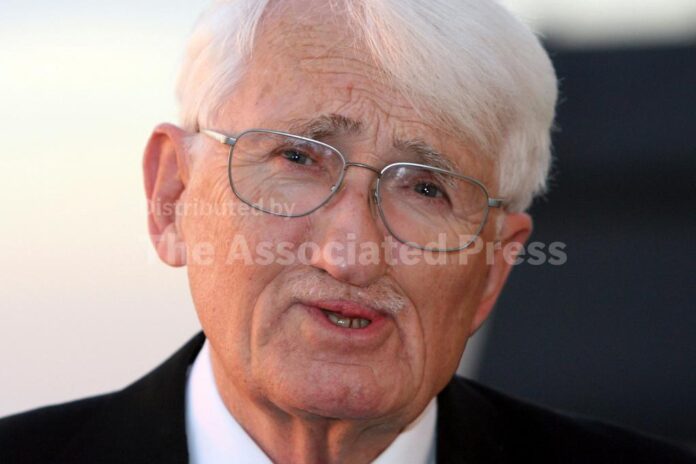
Jürgen Habermas, influential German philosopher, dies at 96

BERLIN (AP) — Jürgen Habermas, whose work on communication, rationality and sociology made him one of the world’s most influential philosophers and a key intellectual figure in his native Germany, has died. He was 96.

Habermas’ publisher, Suhrkamp, said he died on Saturday in Starnberg, near Munich.

Habermas frequently weighed in on political matters over several decades. His extensive writing crossed the boundaries of academic and philosophical disciplines, providing a vision of modern society and social interaction. His best-known works included the two-volume “Theory of Communicative Action.”

He was born with a cleft palate that required repeated operations as a child, an experience that helped inform his later thinking about language.

Habermas said he had experienced the importance of spoken language as “a layer of commonality without which we as individuals cannot exist” and recalled struggling to make himself understood. He also spoke of the “superiority of the written word” and said that “the written form conceals the flaws of the oral.”

Indigenous women tour Ecuador oil field as warning against Amazon drilling expansion

NUEVA LOJA, Ecuador (AP) — Standing beside a stream stained dark with oil in Ecuador’s northern Amazon, an Indigenous woman shook her head in disbelief as she stared at the oily sheen drifting across the water and broken pipes cutting through the forest. Nearby, gas flares burned above the treetops.

Julia Catalina Chumbi, a 76-year-old leader from the Shuar ethnic group in the southern Amazon province of Pastaza, had traveled hundreds of miles to see the damage for herself — the legacy of decades of oil and gas production in the northeastern province of Sucumbios.

“Everything is contaminated, even the air,” she said quietly.

Moments earlier, she had learned something that shocked her. In communities near the oil fields in Sucumbios, residents can no longer safely drink from local rivers and instead must buy water because of contamination and health fears.

“Seeing this makes me want to cry,” she said, adding that in her territory rivers are still drinkable.

Chumbi was among about 30 Indigenous women from across Ecuador’s Amazon who traveled to the region on what activists call a toxitour, visiting oil fields, pipelines and gas flaring sites to see firsthand the environmental and health impacts of extraction. Organizers said the trip aimed to connect women from areas facing proposed oil projects with communities that have lived alongside the industry for decades. Because many oil blocks overlap Indigenous territories, communities are often among the first to experience contamination of rivers, forests and food sources.

The women — representing seven Indigenous communities — gathered for several days in the city of Nueva Loja for workshops to share experiences and discuss the growing threat of oil expansion in their territories.

Nueva Loja is widely known as Lago Agrio, a name workers from U.S. oil company Texaco gave the settlement in the 1960s after the Texas oil town of Sour Lake. The city later became the center of Ecuador’s early Amazon oil boom.

A warning from the oil fields

The women traveled by bus, passing seemingly endless oil pipelines that snake along the roadside. Their destination was the Libertador oil field, operated by Ecuador’s state oil company Petroecuador. Once there, they made banners to carry during the walk, including one that read: “Amazon free from oil and mining.” The Associated Press was present as they quietly entered parts of the oil-producing area to witness the impacts firsthand. Polluted streams ran near pipelines and well sites, vegetation appeared contaminated and wildlife was notably absent.

Standing nearby in front of a roaring gas flare, Salome Aranda, 43, from the Kichwa community of Morete Cocha in Ecuador’s central Amazon province of Pastaza, wore elaborate face paint across her cheeks and forehead.

Aranda said the visit allowed her to see impacts she is rarely able to observe near oil operations in her own territory.

“In our area we are not allowed to enter,” she said.

Seeing the contamination up close confirmed concerns she already had about oil activity near her community.

“The animals are disappearing and the crops no longer grow the same,” she said.

After the tour, the women returned to Nueva Loja, where they spent hours in workshops and group discussions reflecting on what they had seen and sharing experiences from their own territories. By the end of the meetings, they had begun outlining strategies to s trengthen resistance to potential new oil concessions in their regions.

A looming expansion

“Women in the north have already lived through more than 50 years of oil exploitation,” Natalia Yepes, a legal adviser for Amazon Watch in Ecuador, told AP at the workshop. “The idea is that those experiences and lessons can be shared with women from the center and south who are now facing these new threats.”

Last year, Ecuador’s government unveiled a sweeping “hydrocarbon road map” proposing a major expansion of the country’s oil and gas sector, worth about $47 billion and new licensing rounds for exploration blocks in the Amazon and other regions. Many of them are located in the provinces of Pastaza and Napo, where Indigenous communities live.

Officials say the plan is designed to modernize the industry, attract foreign investment and boost oil production.

But environmental groups and Indigenous leaders say the projects could open large areas of rainforest to drilling, pipelines and gas flaring. They also warn that many communities have not given the free, prior and informed consent required under Ecuador’s constitution and international human rights agreements.

Ecuador’s Ministry of Energy and Mines did not respond to a request for comment.

The debate over fossil fuel expansion in the Amazon is also expected to feature at an international conference in Santa Marta, Colombia, in April. The meeting will bring together governments, Indigenous leaders and civil society groups to discuss pathways to transition away from oil, gas and coal following last year’s U.N. climate summit in Belem, Brazil.

Indigenous resistance

For some women on the tour, the visit reinforced battles they are already fighting at home.

Dayuma Nango, 39, vice president of the Association of Waorani Women of Ecuador, said the contamination she saw strengthened her determination to keep oil companies out of Waorani territory.

“Our forest is our mother,” said Nango, who has received death threats for her advocacy. “That’s why we protect it.”

The Waorani have already fought major oil developments in Ecuador’s Amazon. In 2019, Indigenous leaders won a landmark court ruling that blocked oil drilling in Block 22 in Pastaza after judges found the government had failed to properly consult communities as required under Ecuadorian law. In a separate decision in 2023, Ecuadorian voters approved a referendum to halt oil drilling in Block 43 inside Yasuní National Park, an area that overlaps with Waorani ancestral territory.

After seeing the pollution in Sucumbios, Nango said she fears her community could face similar consequences if new projects move forward.

“We don’t want to live the same story that our brothers and sisters are living here,” she said.

Toa Alvarado, 30, a Kichwa leader from the Pastaza province, said the visit also strengthened her determination to protect her territory. She recalled how her late father, a longtime community leader, once stood in the middle of a road holding a spear to stop a group of gold miners from entering their land.

“He told me our generation may be the last with the chance to protect our territories from contamination,” she said.

The following day, many of the women who joined the toxitour gathered in the Amazon city of Puyo for International Women’s Day demonstrations.

“Today is about reporting to the world about the violation of rights that us Indigenous women have to endure — specifically the rights of nature,” said Ruth Peñafiel, 59, from a Kichwa community in Ecuador’s northern Amazon.

“We want to live in a healthy environment and in harmony with the forest,” she said.

For Chumbi, the visit to Sucumbios reinforced the message she plans to bring home to her Shuar community, deep in the Amazon.

“What we are going to do is fight,” she said, referring to the possibility of oil drilling in her territory. “Even if it costs us our lives.” ___

The Associated Press’ climate and environmental coverage receives financial support from multiple private foundations. AP is solely responsible for all content. Find AP’s standards for working with philanthropies, a list of supporters and funded coverage areas at AP.org.

The biggest change to voting in Republican election bill could become a burden for many US voters

COLUMBUS, Ohio (AP) — Joshua Bogdan was born and raised in the United States. The only time the New Hampshire resident has left the country was for a day and a half in seventh grade, when he went to Canada to see Niagara Falls.

Even so, that did not mean proving his U.S. citizenship in last fall’s local elections was easy.

The 31-year-old arrived at his voting place in Portsmouth and handed the poll worker his driver’s license, just as he had done in other towns when arriving to vote. She said that would no longer do.

The poll worker said that under the state’s new proof-of-citizenship law, which took effect for the first time during town elections in 2025, Bogdan would need a passport or his birth certificate because he had moved and needed to reregister at his new address. A scramble ensued, turning the voting process that he had always found fun and invigorating into a nerve-wracking game of beat the clock.

“I didn’t know that anything had officially changed walking in there,” he said. “And then being told that I had to provide a passport that I’ve never had or a birth certificate that’s usually tucked away somewhere safe just to cast my vote — which I’ve done before — it was frustrating.”

A national push, despite noncitizen voting being rare

Bogdan’s experience in New Hampshire is a glimpse into the future for potentially millions of voters across the country. That is if Republican voting legislation being pushed aggressively by President Donald Trump passes Congress and a “show your papers” law is put in place in time for the November elections.

The Safeguard American Voter Eligibility, or SAVE America Act, cleared the U.S. House last month on a mostly party-line basis. Republicans say it would improve election integrity. Trump has called its safeguards common sense. The bill is scheduled to come up in the U.S. Senate next week for voting and debate.

Republican messaging has mostly highlighted a less divisive provision in the bill that would require voters to show a photo ID, but the mandate for people to provide documentary proof of citizenship to register to vote in federal elections is likely to have the most wide-ranging consequences. Noncitizens already are prohibited from voting in federal elections, and it is not allowed by any state. Cases where it occurs are rare.

Obtaining the necessary documents under the SAVE Act is not as easy as it might sound. A similar effort was tried in Kansas a decade ago and turned into a debacle that eventually was blocked by the courts after more than 30,000 eligible citizens were prevented from registering.

A long list of documents to use, but with caveats

Rebekah Caruthers, president and CEO at the Fair Elections Center, said the legislation’s strict documentation requirements could move the U.S. “in the opposite direction” of representative democracy.

“If this bill passes, it would deny millions of eligible Americans their fundamental freedom to vote,” she said in an email. “This includes millions of people who make up your communities, including married women, people of color and voters who live in rural areas.”

The list of qualifying documents in the SAVE Act for proving citizenship appears long, but many of them come with qualifiers.

Under the bill, a REAL ID -compliant driver’s license would have to indicate that “the applicant is a citizen,” but not all do. Only five states — Michigan, Minnesota, New York, Vermont and Washington — offer the type of enhanced REAL IDs that explicitly indicate U.S. citizenship.

Standard driver’s licenses, generally available to both citizens and noncitizens, often do not include a citizenship indicator. Some states, including Ohio, have recently added them.

The stipulations continue, buried in the fine print.

While military ID cards are listed as qualifying documents under the act, they will not suffice on their own. The bill says a military ID must be accompanied by a military “record of service” that indicates the person’s birthplace was in the U.S.

A DD214, the current standard-issue certificate of release or discharge for all military service branches, does not currently fulfill that requirement. According to the Pentagon, that document only lists where someone lived at points of entry and discharge and a person’s current home of record. It does not list where someone was born.

Obtaining a passport requires time and money

For most provisions, the SAVE Act contains no phase-in period that would give voters and local election offices time to adjust. If passed by Congress and signed by Trump, its documentary proof-of-citizenship mandate would apply immediately, meaning it would be in place for this year’s midterm elections.

That could lead to a rush to obtain documents by those who want to register or need to reregister. A 2025 University of Maryland study estimates that 21.3 million Americans who are eligible to vote do not have or have easy access to documents to prove their citizenship, including nearly 10% of Democrats, 7% of Republicans and 14% of people unaffiliated with either major party.

A passport would most effectively meet the requirement, but only about half of American adults have one, according to the State Department, and the SAVE Act requires the passport to be current. An expired one does not count.

Obtaining a passport in time for a looming voter registration deadline is another potential hurdle.

Workers who process passports had layoffs at the State Department reversed, but just last month the department forbid passport processing at certain public libraries that had long helped relieve pressure at the department. Government libraries, post offices, county clerks and others still provide the service.

It takes four weeks to six weeks to get a passport, according to the department’s website, excluding mailing time. A new passport costs $165 for adults while renewals cost $130, and the photo costs $10 or $20 more. The turnaround time can be sped up to two weeks or three weeks for an additional $60 — and for even faster processing, add $22 more. The fully expedited process for a new passport would cost at least $257.

Birth and marriage certificates

A birth certificate may be a quicker and cheaper choice for most people, but there are twists.

The SAVE Act requires a certified birth certificate issued by a state, local government or tribal government. What does not appear to qualify is the certificate signed by the doctor that many new parents are given in the hospital when their child is born. It provides information similar to a certified birth certificate, but would not meet the letter of the federal legislation.

Like passports, birth certificates can sometimes take weeks to obtain. Those who live near their birthplaces can visit the local vital statistics office, but staffing shortages and escalating demand for REAL IDs have caused significant backlogs in some states. In New York, the waiting period for certified copies is four months, the state said. Average processing times for online certificate requests vary widely by state, from as few as three days to 12 weeks or longer.

People whose birth certificates don’t match their current IDs — mostly women who changed their names when they married — would likely need additional documentation to register to vote under the bill. A 2023 Pew Research Center survey found about 80% of women in opposite-sex marriages in the U.S. take their husband’s last name.

A major change to the voting process, but with no extra money

Notably, the SAVE Act does not provide any money to help states and local governments implement the changes or promote them to voters.

For Bogdan, that was part of the problem when New Hampshire’s proof-of-citizenship law took effect. People who have voted elsewhere in the state are not required to show proof of citizenship in their new towns if poll workers confirm their registration history, but Bogdan said workers at his polling place did not seem to know that or try to look up the information.

He eventually was able to cast his ballot because, by luck, he had recently retrieved his birth certificate from his parents’ house more than an hour away so he could apply for a REAL ID. But he said government notices to voters would help prevent possible disenfranchisement.

“Young voters like myself don’t always carry around our birth certificate, Social Security card, all that important stuff, because it’s not used ever or very often,” he said. “And so all those young kids who are going to go out and try and vote will be held back from that.”

Police search for suspect in fatal shooting leads to delay in opening gates at Players Championship

PONTE VEDRA BEACH, Fla. (AP) — Authorities were searching for a man who shot and killed two people in a drug store parking lot near the TPC Sawgrass, leading The Players Championship to delay opening gates for the third round Saturday morning.

St. Johns County Sheriff Rob Hardwick said the suspect, whom he identified as Christian Barrios, shot two people multiple times about 10:30 p.m. Friday in the parking lot of Walgreens in a domestic violence situation. The store is located about a mile away from the course.

He said canine units pursued Barrios onto TPC Sawgrass property. Hardwick said Barrios, who turned 32 on Saturday, at one point picked up a PGA Tour radio and later dropped it. He then stole a black BMW, and Nassau County authorities in the far northeastern tip of Florida pursued the car and forced a crash into the woods.

The suspect fled on foot and was still at large.

The PGA cited “operational considerations” in deciding not to open the gates until 9 a.m. The first round bean at 8:15 a.m. and was not delayed. Hospitality areas were delayed opening until 11 a.m.

Hardwick said Barrios had a long criminal history and knew the victims, both of whom were shot multiple times and taken to the hospital where they died.

___

AP golf: https://apnews.com/hub/golf

Opposition leader Bobi Wine says he left Uganda after going into hiding after disputed election

KAMPALA, Uganda (AP) — Ugandan opposition leader Bobi Wine said on Saturday he fled the country to escape a military search for him in the aftermath of a disputed presidential election.

Wine, whose real name is Kyagulanyi Ssentamu, went into hiding shortly after the Jan. 15 presidential election. Ugandan President Yoweri Museveni won the election with 71.6% of the vote, according to official results that Wine rejects as fake.

Wine’s location has been unknown to the general public for weeks, with growing concern for his safety after the army chief, Gen. Muhoozi Kainerugaba, repeatedly posted threats against him on social platform X.

Kainerugaba, the president’s son and presumptive heir, has suggested Wine is wanted for unspecified crimes. Ugandan police say they are not looking for him.

In a video message posted on X on Saturday, an unshaven Wine said he managed to leave Uganda but did not reveal where he went.

“Fellow Ugandans and friends of Uganda all over the world, by the time you see this video I will have left the country for some critical engagements outside Uganda,” he said. “And at the right time I will come back and continue with the cause. I thank all of you fellow Ugandans who have concealed and protected me for all this time when the regime was looking for me.”

He said it was impossible for Ugandan security operatives to find him “because the people have protected me.”

Ugandan soldiers raided Wine’s house the day after the Jan. 15 vote, but the opposition leader had already gone into hiding, fearing for his life after campaigning for weeks in helmet and flak jacket at rallies where security forces were a constant presence.

The hunt for Wine is being led by Kainerugaba, who has called Wine a “baboon” and a “terrorist.” Kainerugaba has a yearslong habit of posting offensive tweets, which he often deletes later.

Wine, the most prominent of seven candidates who ran against Museveni, has a large following among young people in urban areas, many of them unemployed or angry with the government over official corruption and the lack of economic opportunities. Many want to see political change after four decades of the same leader.

In May, the 81-year-old Museveni will be sworn in for a seventh term that would bring him closer to five decades in power.

His supporters credit him for the relative peace and stability that has made Uganda home to hundreds of thousands fleeing violence elsewhere in this part of Africa. But opposition figures, including some who previously were his close allies, condemn what they see as a descent into authoritarianism.

Greek oil tanker damaged in suspected Black Sea drone attack as wars disrupt global shipping

ATHENS, Greece (AP) — A Greek-flagged oil tanker was damaged in a suspected drone attack in the Black Sea while approaching the Russian port of Novorossiysk, authorities said.

Greece’s shipping ministry said the attack occurred early Saturday, causing material damage, but the 24 crew members were unharmed and the vessel’s seaworthiness was not under threat.

The Maran Homer, chartered by U.S. oil giant Chevron, was traveling from Thessaloniki in northern Greece to the Black Sea port and was due to sail on to Istanbul. It was struck by a missile or drone before picking up Kazakh oil, according to Greek government officials and the vessel’s Greek operating company.

Greek Maritime Affairs Minister Vassilis Kikilias said Athens would lodge a “strong complaint” with the country deemed responsible, without giving further details. He later identified Ukraine as carrying out frequent attacks in the Black Sea.

“I consider the targeting of vessels flying the Greek flag — as well as those with Greek sailors and Greek shipping interests — to be unacceptable and extremely dangerous,” Kikilias told state-run ERT television.

He said he believed the attack could be related to a U.S. decision to temporarily ease some sanctions on Russian oil shipments because of volatility caused by the Iran war.

The war has also affected Greece’s massive shipping industry, with dozens of Greek-flagged or Greek-owned vessels currently stranded in the Persian Gulf.