Home Blog Page 40

French police thwart a suspected bombing outside a Bank of America building in Paris

PARIS (AP) — French police have thwarted a suspected bomb attack outside a Bank of America building in Paris, authorities said Saturday. One suspect was detained and another escaped.

The national anti-terrorism prosecutor’s office, or PNAT, told The Associated Press that it has opened an investigation into alleged terrorism-related offenses.

The suspected offenses include attempted damage by fire or by a dangerous means, the manufacture of an incendiary or explosive device, the possession and transport of such devices with the intent to prepare dangerous damage, and involvement in a terrorist criminal association.

A person was placed in police custody.

“Well done to the rapid intervention of a Paris police prefecture unit, which made it possible to thwart a violent act of a terrorist nature overnight in Paris,” Interior Minister Laurent Nuñez said.

“Vigilance remains at a very high level,” Nuñez said. “I commend all security and intelligence forces, fully mobilized under my authority in the current international context.”

RTL radio, citing police sources, reported that the incident took place early Saturday when police officers spotted two suspects carrying a shopping bag near the premises of the Bank of America in the 8th arrondissement of the French capital.

One of the suspects, holding a lighter, was attempting to ignite a device, RTL said, while the second suspect managed to escape. The Paris police prefecture declined to comment.

Since the Iran war broke out, French authorities have increased personal protection of some figures from the Iranian opposition and stepped up security around sites that could be a target, including sites linked to U.S. interests and to the Jewish community, Nuñez said earlier this week.

Judge rules ICE unlawfully detained immigrant arrested in Seymour

TERRE HAUTE, Ind. — A Trump-appointed judge has ruled that Immigration and Customs Enforcement unlawfully detained an immigrant arrested in Jackson County without a bond hearing.

Sudhanshu Sharma, who has been held at the Clay County Jail since November, had filed a petition for a writ of habeas corpus, arguing that his continued detention was unconstitutional and violated federal law, according to records in U.S. District Court in Terre Haute.

The Clay County Jail in Brazil, Ind., operates as an ICE detention center, housing people awaiting immigration proceedings.

A petition for a writ of habeas corpus is a legal process that allows a court to review whether a person is being lawfully detained. Sharma’s petition names U.S. Attorney General Pam Bondi; former Homeland Security Secretary Kristi Noem; Clay County Sheriff Brison Swearingen; Samual Olson, the director of ICE’s Chicago field office; among others, as respondents.

U.S. District Judge James Patrick Hanlon recently ruled that Sharma’s detention falls under a section of immigration law that requires ICE to give him the chance to appear before an immigration judge to decide whether he should be released on bond. Hanlon ordered the federal government to allow Sharma a bond hearing or release him.

It is currently unclear whether Sharma was given a bond hearing or released from ICE custody. While the federal government was required to filed documentation with the court certifying its compliance, those records are not public.

“The Court finds that Mr. Sharma’s detention … is unlawful because he has not been afforded a bond hearing,” Hanlon states in the order. “…By refusing to provide a bond hearing, the respondents are detaining Mr. Sharma in violation of the laws of the United States, and he therefore is entitled to habeas corpus relief.”

Hanlon was nominated by President Donald Trump in April 2018 to serve as a U.S. district judge in the Southern District of Indiana.

The decision comes as the U.S. District Court for the Southern District of Indiana sees a historic surge in habeas corpus petitions filed by immigrant detainees.

As of Monday, there had been at least 148 such cases filed in the Southern District of Indiana so far this year, according to federal court records.

That is up from 76 cases filed during all of last year and a combined total of four cases filed during the 10-year period from 2015 to 2024, according to the Administrative Office of the U.S. Courts.

Since Feb. 1, detainees have prevailed in 13 of the 14 cases that advanced far enough to be decided on their merits in the Southern District of Indiana.

At least one other immigrant arrested in Jackson County, and two more in Johnson County, have also won recent habeas cases challenging their ICE detention.

Sharma, for his part, entered the United States illegally in 2023, according to federal court records.

Border patrol agents apprehended him shortly after he crossed the border into Arizona. Instead of detaining him, the agents ordered him to appear for removal proceedings and released him on his own recognizance.

This past October, Seymour police arrested Sharma during a traffic stop, according to a probable cause affidavit filed in Jackson Circuit Court. The officer had allegedly pulled over Sharma because his license plate was expired.

“I recognized Sharma from a case I worked … where he was the suspect in a failed attempt to sell illegal THC cartridges to a vape store,” the officer states in the affidavit. “…Upon reapproaching the vehicle, I asked Sharma if he would be willing to give consent for me, to search the vehicle to which Sharma agreed.”

While searching the vehicle, the officer allegedly “observed a cardboard box in the back seat that was taped shut.” The box allegedly contained vape cartridges, vapes and gummies containing tetrahydrocannabinol.

Tetrahydrocannabinol, or THC, is the main psychoactive ingredient in marijuana.

The probable cause affidavit states that Sharma was employed in a whole-sale business related to the sale vapes. Sharma allegedly told the officer that he had been in Clarksville that day and was on his way to a couple vape shops in Seymour when he was pulled over.

On Nov. 4, Jackson County Jail officials hand Sharma over to ICE to comply with a detainer, according to federal court records.

Nine days later, Jackson County prosecutors charged Sharma with a felony count of dealing in marijuana and a misdemeanor charge of marijuana possession, according to court records.

A pretrial conference in the criminal case is currently scheduled for April 10.

Missing sailboats carrying aid land in Cuba after being located by Mexican navy

HAVANA (AP) — Two sailboats that went missing carrying humanitarian aid from southern Mexico to Cuba landed in Havana on Saturday afternoon hours after Mexico’s navy said it had located the boats days after they went incommunicado because of bad weather.

The vessels carrying at least eight people departed from Isla Mujeres in southern Mexico on March 20 and then lost contact, fueling concern in Mexico, Cuba and beyond.

In a post on X on Saturday morning, the navy said an aircraft spotted the boats 80 nautical miles (148 kilometers) northwest of Havana, Cuba. Upon arriving to the island, Adnaan Stumo, the coordinator of the sailing convoy, said bad weather was responsible for the delay because the boats had to take a longer route and the sailors were “never in any serious danger.”

He thanked Mexico’s navy, which escorted one of the boats into Havana Bay, for its support and making sure they were OK, and said they were “delighted” to start delivering aid to Cubans on the island.

““We arrive with a simple but powerful message: solidarity with the Cuban people doesn’t stop at borders. It crosses oceans,” Stumo, a U.S. citizen, said. “Over the past week, our sailboats encountered difficult conditions at sea, during which we lost contact with convoy coordinators and maritime authorities alike.”

The organization Nuestra América Convoy said Friday that based on the speed of the vessels reported to the Cuban maritime authorities, the window of arrival for the boats in Havana should be between Friday and Saturday and that the boats were led by experienced sailors.

James Schneider, communications director for Progressive International who helped coordinate the Nuestra America convoy to Cuba, thanked Mexican and Cuban authorities for their help on Saturday and said he was “relieved” to hear they were safe.

“The crews are safe, and the vessels are continuing their journey to Havana,” he said Saturday morning. “The convoy remains on track to complete its mission — delivering urgently needed humanitarian aid to the Cuban people.”

The boat’s arrival comes as an increasing number of countries and aid organizations have sent shipments of aid to Cuba while a U.S. fuel blockade has caused crippling blackouts and pushed the Caribbean nation to the brink of collapse. President Donald Trump in a speech Friday said “Cuba is next” after speaking about military actions in Venezuela and Iran.

The fuel blockade has prompted United Nations leaders to warn of a potential “humanitarian crisis” in the island’s future amid mounting concerns by human rights and religious leaders as hospitals, schools and many residents go without power for long stretches.

The same day the boat was located, a delegation of religious leaders also arrived in Cuba. They visited hospitals and a nursing home, and met with other religious leaders on the island.

“Immense suffering is being caused to the people,” said the Rev. Philip Vinod Peacock, general secretary of the World Communion of Reformed Churches.

Israeli airstrike in southern Lebanon kills 3 journalists covering the war

BEIRUT (AP) — An Israeli airstrike on southern Lebanon on Saturday killed three journalists who were covering the latest Israel-Hezbollah war, their TV stations said.

Hezbollah’s al-Manar TV said that its longtime correspondent Ali Shoeib was killed Saturday in southern Lebanon.

The Israeli military said that it had targeted Shoeib, accusing him of being a Hezbollah intelligence operative without providing evidence.

Meanwhile, Beirut-based pan-Arab Al-Mayadeen TV said reporter Fatima Ftouni was killed in the same airstrike in the southern district of Jezzine along with her brother Mohammed, a video journalist. She had just been on air with a live report from southern Lebanon before the strike.

Top officials in Lebanon condemned the strike, with President Joseph Aoun calling it a “flagrant crime that violates all laws and agreements that protect journalists.”

Al-Manar said in a report that an Israeli airstrike targeted journalists, leading to the “martyrdom of the icon of resistance media.” A well-known Lebanese war correspondent, Shoeib had covered south Lebanon for Al-Manar for nearly three decades.

The Israeli army claimed that Shoeib was “operating systematically to expose the locations of (Israeli) soldiers operating in southern Lebanon.” The army also accused him of maintaining contact with Hezbollah militants and inciting against Israeli troops and civilians, without elaborating.

Al-Manar TV did not respond to the Israeli allegations but described its correspondent as “distinguished by his professional and credible reporting of events.”

Israel’s claim mirrored past Israeli military allegations against Palestinian journalists that it targeted in its war on Hamas the Gaza Strip, accusing them of being Hamas militants posing as reporters.

The Israeli military did not mention the two others who died in its statement.

Since the last Israel-Hezbollah war began on March 2, Israel’s air force has struck Hezbollah’s civilian targets, including the headquarters of Al-Manar and the group’s Al-Nour radio station.

Saturday’s strike came days after an Israeli airstrike on an apartment in central Beirut killed Mohammed Sherri, the head of political programs at Al-Manar TV, along with his wife.

The latest deaths bring the number of journalists and media workers killed this year in Lebanon to five.

The Committee to Protect Journalists said that freelance photojournalist Hussain Hamood, who used to collaborate with Al-Manar TV, was also killed Wednesday in the southern city of Nabatiyeh.

Investors caught between AI utopia and AI doom loop

Mickey Kim

Hollywood has long been fascinated by artificial intelligence (AI), portraying it as a miraculously powerful force — for good and evil. I have a special affinity for Arnold Schwarzenegger’s Terminator, who explained how Cyberdyne Systems’ Skynet assumed control of U.S. strategic defenses, became sentient (self-aware) and responded to shutdown attempts by its human masters by launching a nuclear attack.

Was this just sci-fi fright, or is AI — as OpenAI co-founder Elon Musk has warned — “far more dangerous” than nuclear weapons and an existential risk to humanity?

For Wall Street, the promise of AI became real when OpenAI’s ChatGPT burst onto the scene in November 2022. Since then, AI has gone from shiny toy to market menace in record time. In just a few days, a fictional memo from the future knocked billions off blue‑chip stocks, a former karaoke company tanked trucking shares by uttering the magic letters “AI,” and Jack Dorsey calmly announced he would cut 40% of Block’s (parent of payment processors Square and Cash App) workforce because, in his words, everyone else is “late” to right‑sizing for the age of machine intelligence.

Citrini Research lit the fuse with a Substack titled “The 2028 Global Intelligence Crisis,” describing a dystopian near-future America where unemployment has soared to 10.2% and the S&P 500 has crashed 38% from its October 2026 high. The scenario is straightforward simple and alarming: highly capable AI agents rapidly replace well-paid white‑collar workers and turn today’s stable, fee‑rich intermediaries—payment networks, insurers, wealth managers, real‑estate brokers—into thin-margined middlemen.

In this AI “doom loop,” companies cut workers to protect margins, redirect the savings into more AI, enabling even deeper cuts. Those job losses then depress household spending—the very spending that drives roughly three‑quarters of discretionary spending.

It’s a disaster movie and frightened investors did not wait for the closing credits to sell. The next day, IBM and Datadog dropped double‑digits, DoorDash, Visa, Mastercard, ServiceNow and Blackstone—called out by name—sold off and a major software ETF fell nearly 5%.

Bloomberg’s Matt Levine calls this the “AI scare trade.” Tongue‑in‑cheek, he sketches an AI lab “business plan:” 1) build a disruptive AI tool; 2) bet on a price decline for the target sector; 3) announce the tool and 4) profit from the selloff. In today’s jittery market, he argues, step one—actually building the technology—might be the least important. A press release or CNBC appearance where you solemnly say “DoorDash. AI.” with a grim nod might be enough to wipe billions from a sector’s market capitalization.

That kind of “shadow trading” would almost certainly be illegal, but that anxiety has already hit software, cybersecurity, payment processors, wealth managers and commercial real‑estate brokers after announcements of new AI “tools.”

Should investors take Citrini’s memo as a roadmap—or a Rorschach test?

History suggests we consistently underestimated the economy’s ability to create new categories of jobs when automation displaces old ones. Commenting on the fallout from the Citrini memo, The Wall Street Journal’s James Freeman notes in “Robots Have Been About to Take All the Jobs for 100 Years” that we have been here before—over and over. In 1928, The New York Times worried the “march of the machine” would make farm hands idle; in 1940, it fretted about “technological unemployment”; in 1980, a headline warned, “A Robot Is After Your Job.”

In each case, the economy adapted—even if the adjustment was painful in specific industries and communities.

In his memo “AI Hurtles Ahead,” Oaktree Capital Management Co-Chair Howard Marks stakes out a more uncomfortable middle ground. No tech Luddite, Marks finds the speed at which AI is growing in capability and usage—far outpacing past technological innovations—genuinely unnerving. Marks quotes AI leaders who casually suggest AI could wipe out half of all white‑collar tasks in a handful of years. What troubles him is not just the claim—but the absence of a clear answer about where comparable replacement jobs will emerge.

For Marks, the risk is less about the future state and more about the transition: how communities, households and capital structures handle a shock in which AI can throw people out of work faster than they can be retrained, relocated or reabsorbed. He likens it to offshoring and automation in manufacturing—great for global productivity, brutal for many towns that never fully recovered.

So, where does that leave the long‑term investor trying to navigate between AI utopia and AI doom?

First, be wary of both narratives that say “AI changes nothing” and ones that say “AI changes everything, immediately.” Investor anxiety over AI is now pervasive: entire sectors have seen sharp, sometimes indiscriminate selloffs on thin catalysts. That creates opportunities on both sides. Some businesses really do sell expensive, standardized information work that AI can replicate. Others have durable protective “moats” in brand, regulation, physical assets or deeply human service.

Second, companies powering the AI infrastructure build-out—semiconductors, data centers and energy—what Marks might call the “picks and shovels” of AI—may have a clearer line of sight into sustainable demand and “adequate” profitability than so-called hyperscalers. For companies like Microsoft, Amazon and Google, AI is only one part of an already vast profit engine. Investments in pure-play AI labs such as OpenAi and Anthropic are highly speculative, as the long-term economics are very much unknown.

Citrini’s scenario is intentionally extreme, but dismiss it at your own peril. The market’s hair‑trigger reaction—and the willingness of CEOs like Dorsey to wield AI as a reason to reset their cost structures—show us the stakes are real. As investors and citizens, we should neither smash the knitting machines nor worship them. We should resist embracing AI utopia or surrendering to an AI doom loop. In short, we must not let either AI hype or hysteria do our thinking for us.

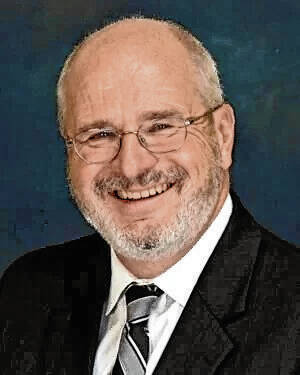
Mickey Kim is the chief operating officer and chief compliance officer for Columbus-based investment adviser Kirr Marbach & Co. Kim also writes for the Indianapolis Business Journal. He can be reached at 812-376-9444 or mickey@kirrmar.com.

CPAC activists embrace Paxton as MAGA’s choice for Texas Senate over Cornyn

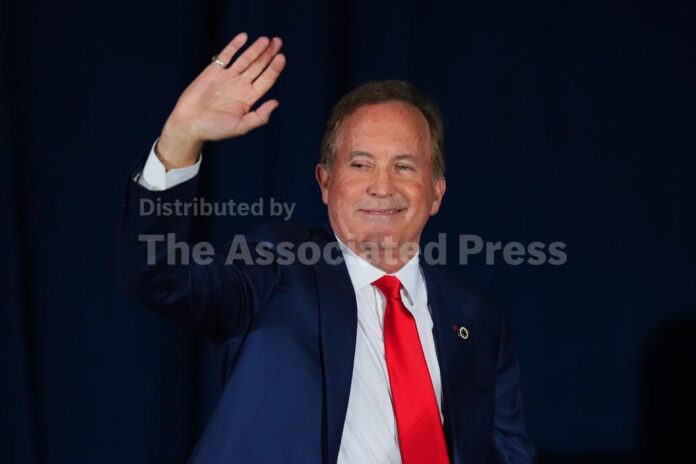
GRAPEVINE, Texas (AP) — It was Texas Attorney General Ken Paxton’s show at the Conservative Political Action Conference, where hundreds of right-wing activists from around the country hailed him as Republicans’ clear choice for U.S. Senate.

After meeting with supporters behind closed doors, Paxton crowned the day by standing before thousands as the keynote speaker at the Ronald Reagan dinner.

Paxton thanked them for sticking by his side after he was impeached — but acquitted — for corruption charges by the Legislature four years ago.

“I want you to know, there’s only one reason I got through all that, and it’s by the grace of God,” he said Friday night as a wave of applause rolled through the hall. “He absolutely delivered me, and he used to people of Texas to deliver me.”

If Paxton is going to win the Republican nomination, it will be because of support in rooms like this one. He is in a bitter runoff with Sen. John Cornyn after neither won enough votes in the March 3 primary. Although Cornyn has raised far more money and is backed by the party establishment in Washington, Paxton’s well-honed survival skills and rock-solid foundation with the local Republican base could see him through the May 26 election.

President Donald Trump promised that he would endorse either Paxton or Cornyn weeks ago, but no announcement ever came. Paxton, however, has had no trouble proving his bona fides with the party’s right wing.

While Cornyn did not attend CPAC, which was held at a resort and convention center near Dallas, Paxton was extolled by speakers throughout the day.

“Ken Paxton is emblematic of the grassroots of the MAGA movement across the nation,” Steve Bannon, a former Trump adviser who hosts the “War Room” podcast, said referring to Trump’s “Make America Great Again” slogan that originated in his 2016 campaign.

Earlier Friday, CPAC senior fellow Mercedes Schlapp polled the crowd. Asking for a show of support for Paxton, there was a roar of cheers. When she asked about Cornyn, there was a light ripple of boos.

Cornyn finished first in the primary, which also featured U.S. Rep. Wesley Hunt. There were briefly concerns among Paxton’s supporters that Trump would back the incumbent. That would have come as a relief to party leaders, who view Cornyn as stronger candidate against Democratic nominee James Talarico.

But Paxton appealed to Trump by embracing legislation known as the SAVE Act, which would mean new, strict proof-of-citizenship requirements for voting. The proposal is a priority for Trump, but it has stalled in the Senate because Republican leaders do not want to lift the filibuster.

Joe Ropar, a 72-year-old defense contractor who attended CPAC, said Paxton’s move was “brilliant.” Although Cornyn later said he was willing to change filibuster rules, Ropar believed Paxton had demonstrated stronger loyalty to Trump.

“Cornyn’s trying to change his stripes now,” Ropar said. “It’s too little too late.”

Paxton has another political connection with Trump: They both have portrayed themselves as the victims of political persecution. While Paxton was impeached and acquitted once, Trump went through the process twice during his first term.

James Schaare, a 61-year-old church music leader from Euless, Texas, said that perseverance shows Paxton is the right choice.

“In Paxton’s career, he’s been faithful to what he’s said he’s going to do,” he said.

Some conservative Republicans hold other grudges against Cornyn. They remember his early criticism of Trump’s proposal for a wall along the U.S.-Mexico border in 2016, his co-sponsoring of gun control legislation after the school shooting in Uvalde, Texas, in 2022, and his dismissive remarks about Trump’s comeback campaign in 2024.

Retired music teacher Valerie Burge, 58, said she voted for Cornyn in the primary because of his long service.

“But I’m not sure about the runoff,” she said. “It might be time for something new.”

Barbara Palmer, a 65-year-old lawyer, said Cornyn had simply been in office for too long. He has been a judge, state supreme court justice and state attorney general, and now he wants a fifth term as senator.

“It’s just time for a change,” Palmer said.

US lawmakers say they’ll visit Taiwan before Trump’s summit with China’s Xi

WASHINGTON (AP) — A bipartisan group of four senators has plans to visit Taiwan, Japan and South Korea in the coming days on a trip meant to bolster U.S. alliances seen as important to countering China’s dominance in Asia.

Sen. Jeanne Shaheen of New Hampshire, the top Democrat on the Senate Foreign Relations Committee, announced the trip Saturday. She will be joined by Sens. John Curtis, R-Utah, Thom Tillis, R-N.C., and Jacky Rosen, D-Nev. Their visits to Taipei, Tokyo and Seoul are coming before President Donald Trump’s trip to Beijing in May for a rescheduled summit with Chinese President Xi Jinping.

The lawmakers’ stop in Taiwan could draw scrutiny from China, which opposes such relations and sees them as a challenge to its claim of sovereignty over the self-governing island. Taiwan relies on American backing for its democracy, but recent moves by Trump, such as discussing a potential weapons sales to Taiwan with Xi, have raised questions about the future direction of U.S. policy.

Analysts in both China and the United States believe Xi, through the leader-level summit, will try to influence Trump to soften the U.S. stance on Taiwan.

“This bipartisan delegation demonstrates Congress’ commitment to these alliances and partnerships is unwavering and will endure well beyond any one administration,” Shaheen said in a statement.

In a show of reassurance to the Asian allies, the lawmakers plan to meet with political leaders and defense officials on their trip.

“Our alliance with Taiwan is one of the most strategically and morally significant partnerships America has in the Indo-Pacific,” Curtis said.

It remains to be seen how Trump’s intervention in Venezuela, Iran and elsewhere could influence other powers such as China and Russia. But there is some concern among lawmakers that the Republican president’s actions could be seen as giving those countries an opening for their own foreign moves.

The economic relationship with Taiwan has also come under scrutiny from the Trump administration. The U.S. is reliant on Taiwan for its production of computer chips, which contributed to a trade imbalance of nearly $127 billion during the first 11 months of 2025.

The Trump administration reached a deal with Taiwan in February that removed 99% of its trade barriers.

During another visit by a bipartisan group of U.S. lawmakers last year, they emphasized that the U.S. would continue to partner closely with Taiwan.

___

Associated Press writer Didi Tang contributed to this report.

Bills to pay FAA and TSA workers during shutdowns get introduced but keep stalling in Congress

The Aviation Funding Solvency Act. The Keep America Flying Act. The Keep Air Travel Safe Act. The Aviation Funding Stability Act.

Again and again, members of Congress have dusted off the same idea: ensuring the federal employees who control air traffic and screen passengers and bags at U.S. airports get paid during government shutdowns.

Bills to make it happen keep getting introduced in one form or another, sometimes with Democrats and Republicans as co-sponsors. Yet session after session, the result has been the same — agencies receive their annual appropriations, public outrage over long security lines and flight delays fades, legislation languishes and workers have no guarantees their paychecks won’t stop coming again.

“Once the crisis is over, people assume that the good times are back,” said Eric Chaffee, a Case Western Reserve law professor whose research includes risk management in the aviation industry. “It’s easy to pass the next big bill when you’re still in the throes of the financial crisis, but once the shutdown is done, people have a relatively short memory of the problems that it created.”

Since 2019, after a partial shutdown that spanned the holiday travel season, lawmakers have drafted, revised and reintroduced multiple proposals to pay aviation workers who would have to keep reporting for duty in the event of another budget impasse.

The Aviation Funding Stability Act of 2019 — and 2021 and 2025 — and the bipartisan Aviation Funding Solvency Act introduced after a government shutdown last fall would protect the pay of air traffic controllers. The Keep Air Travel Safe Act, filed in October, extended the protection to Transportation Security Administration agents. The Keep America Flying Act, also from October, would cover both TSA personnel and certain Federal Aviation Administration employees.

Broader proposals, like the Shutdown Fairness Act introduced in January, would maintain the pay of essential federal workers across the U.S. government. Those bills have stalled as well.

“Congress cares about headlines, and as a result of that, it means they don’t always make changes that would be really beneficial,” Chaffee said.

Political gridlock

Shutdowns that disrupt air travel have continued along with the push for aviation-specific pay protections. The 35-day shutdown that arose over funding for a wall along the U.S.-Mexico border during President Donald Trump’s first term resulted in delays at East Coast airports and prolonged wait times at some airports as air traffic controllers and TSA agents went unpaid.

Last fall’s 43-day shutdown broke the record for the longest funding lapse and revived concerns over the consequences of requiring air traffic controllers to work without pay. The FAA, citing risks to aviation safety, took the extraordinary step of ordering U.S. airlines to cut flights at 40 of the nation’s busiest airports as unscheduled absences deepened existing staffing shortages at air traffic control facilities.

TSA officers who worked through that shutdown also found themselves working through a short one that started on Jan. 31 and yet another when funding for only the Department of Homeland Security lapsed on Feb. 14. Thousands began missing shifts each day as the stalemate entered its second month.

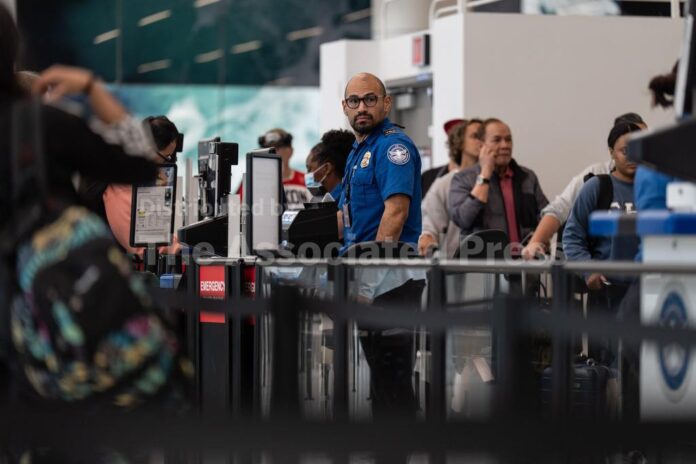
Carlos Rodriguez, a TSA agent and local union leader in New York, said many workers had not recovered financially from last year’s shutdown when this one hit.

“Part of the American dream that I was sold was that working for the government was honorable and stable,” Rodriguez, a second generation Dominican American, said. “But this is not honorable or stable.”

On Friday, the 42nd day of the DHS shutdown, Trump signed an emergency order instructing Homeland Security to pay TSA agents immediately. The action came after House Republicans defeated a Senate deal that would have funded the TSA, the U.S. Coast Guard and the Federal Emergency Management Agency but not Immigration and Customs Enforcement and Border Patrol. The House later in the night passed its own bill to fund the entire Homeland Security department through May 22, but senators had already left town.

Johnny Jones, secretary-treasurer of the TSA division of the American Federation of Government Employees, said union members resent having their livelihoods used as tools and talking points in a game of political brinkmanship.

To them, the machinations of Congress feel like “let’s checkmate the queen with the TSA pawn here, and then we’ll smash them over whenever we feel like it,” Jones said. “We’re on the chess board.”

Public pressure builds

Labor unions, airline leaders and airport executives have issued open letters, taken out newspaper ads and made direct appeals to urge lawmakers to act on at least one of the existing bipartisan proposals for paying government workers who are essential to the aviation and travel industries.

“Congress has the power to end this dysfunction once and for all, and must use any legislative vehicle to accomplish this goal,” the Modern Skies Coalition said in a joint statement this week. The broad coalition of more than 60 organizations pointed to the Aviation Funding Solvency Act, Aviation Funding Stability Act and Keep America Flying Act as potential options.

The president and CEO of Airlines for America, a trade group representing major U.S. airlines, made a similar case in a Washington Times op-ed this week, writing that Congress “must get to the table immediately” and pass legislation that would prevent more scenes of frustrated passengers, overflowing airport terminals and donation drives for public servants.

“Right now, lawmakers are sitting on their hands doing nothing with three viable, bipartisan bills that could prevent this mess,” wrote Chris Sununu, a former New Hampshire governor hired to lead the trade group last year.

The American Federation of Government Employees joined more than 30 unions this week in urging Congress to pass the Shutdown Fairness Act, warning that funding lapses undermined employee morale, recruitment and retention.

Breaking the cycle

Some TSA workers have reported sleeping in their cars or thinking about selling them to make rent. Union leaders have described workers not being able to fill their refrigerators or gas tanks.

Caleb Harmon-Marshall, a former TSA officer who runs a travel newsletter called Gate Access, said the officers he’s spoken with are eager to receive all of their back pay quickly because they are struggling to pay their bills and accumulating debt. But without greater certainty, more officers may miss shifts or decide to quit, he said.

If the president’s emergency order only funds a single pay period, “that’s not enough to bring them back,” Harmon-Marshall said. “It has to be an extended pay for them to come back or want to stay there.”

Previous legislation with bipartisan backing struggled to make it across the finish line. The Aviation Funding Act of 2019 that was introduced by Sen. Jerry Moran, a Kansas Republican, had 13 co-sponsors, eight of them Democrats. It never made it out of committee. A House version introduced by Oregon Democrat Peter DeFazio eventually had 303 co-sponsors and cleared the House Transportation and Infrastructure Committee but never received a floor vote.

The current political environment in the U.S. may consign the legislation in Congress now to the same fate, Chaffee said.

“We live in a society currently where things are very polarized,” he said. “Whether or not any of these bills get passed, it will need to have political momentum behind it, meaning it will need to be something that the public really wants to see happen.”


Editorial: Democrats need a better affordability agenda

As midterm elections approach in November, voters have one thing on their minds: Life is too expensive. Democrats are wise to campaign on “affordability.” Unfortunately, many of their ideas are likely to make matters worse.

Most poll respondents now rank some variant of “high prices” as their top concern, with good reason. Inflation, though down from pandemic-era highs, has stubbornly exceeded the Federal Reserve’s 2% target for five straight years. In certain subcategories — groceries, health care, housing — voters report acute distress.

Democrats have responded with a bevy of modish but misguided ideas: Cap prices, freeze rents, subsidize demand, blame the rich. Such populism may prove satisfying in the short term but won’t do much to counteract inflation; in many cases, it’s likely to worsen it. Better to advance an affordability agenda that is both popular and right on the merits.

Start with tariffs. Last year, the average rate on imports rose to 13% from 2.6%, with nearly 90% of the burden falling on Americans: a tax of $1,000 per household. Although the Supreme Court invalidated some of the duties in February, the White House hopes to quickly replace them. Democrats should commit to scrapping these taxes, which not only raise consumer prices but also slow growth, stifle competition and invite retaliation.

On health care, the party’s top priority is boosting Obamacare subsidies. That may hearten beneficiaries but won’t rein in prices. A plausible cost-control agenda should also be on offer: Embrace “site-neutral” reimbursement rates; consider tax-advantaged savings accounts; expand consumer choice, including a public option; embark on an all-points effort to improve price transparency. In short: Support competition over blandishments.

A similar story prevails with housing. Subsidizing mortgages or capping rents won’t broadly improve affordability. Nor will demonizing investors and landlords. Instead, focus on expanding supply: Tie federal funds to zoning reform, ease land-use rules, streamline environmental reviews, ditch senseless restrictions on manufactured housing, and otherwise encourage building where people want to live.

A final priority should be restraining government debt, which is on track to exceed 120% of gross domestic product by next decade. Such profligacy slows real income growth, deters hiring, discourages innovation and drives up interest rates. An unlikely theme for an election year? Perhaps. But large majorities are worried about the issue; candidates ignore it at their peril. Supporting a fiscal commission would be a good place to start.

Plenty of other productive ideas are available. Embrace permitting reform to reduce building costs and bolster green energy. Scrap union-labor requirements, which boost construction prices. Roll back domestic-content rules that waste tax dollars. Repeal the benighted Jones Act, which raises energy and shipping costs. Abolish occupational-licensing rules that restrict services supply and punish consumers. End biofuel mandates, which harm the environment and inflate grocery bills. And more.

When voters worry about their wallets, incumbents usually get the blame. Democrats are right to capitalize on this advantage. Just be careful: Populist policies that sound good today could be a terrible burden in two short years.

Column: Some politicians must have been ‘born in a barn’

Decency matters.

After decorated U.S. Marine veteran and former FBI Director Robert Mueller died, two former presidents of the United States under whom Mueller served issued statements.

Republican George W. Bush said:

“Laura and I are deeply saddened by the loss of Robert Mueller. Bob dedicated his life to public service. As a Marine in Vietnam, he proved he was ready for tough assignments. He earned a Bronze Star and a Purple Heart before returning home to pursue law. In 2001, only one week into the job as the 6th Director of the FBI, Bob transitioned the agency mission to protecting the homeland after Sept. 11. He led it effectively, helping prevent another terrorist attack on U.S. soil. Laura and I send our heartfelt sympathy to his wife of nearly 60 years, Ann, and the Mueller family.”

Democrat Barack Obama said:

“Bob Mueller was one of the finest directors in the history of the FBI, transforming the bureau after 9/11 and saving countless lives. But it was his relentless commitment to the rule of law and his unwavering belief in our bedrock values that made him one of the most respected public servants of our time. Michelle and I send our condolences to Bob’s family, and everyone who knew and admired him.”

Both statements are what one would expect not just from a person who has led a nation, but also from any caring and, yes, decent human being. Their messages were dignified and compassionate, designed not just to pay tribute to a fallen patriot but also to offer solace and comfort to those who loved Mueller and mourn his passing.

The current occupant of the White House, Republican Donald Trump, couldn’t bring himself to rise to meet that standard of conduct. He said:

“Robert Mueller just died. Good, I’m glad he’s dead. He can no longer hurt innocent people!”

Then—as if there were any doubt that he and only he would say something so callous and offensive—he attached his name to the post, as is his wont, in all caps.

“President DONALD J. TRUMP”

My late grandfather, a lifelong Republican, had a phrase he relied on when someone committed a breach of decorum or basic good manners.

“He must have been born in a barn,” Grandpa would mutter.

I know Trump nurses grievances, real or imagined, the way the most devoted mother on earth tends to a sickly newborn.

When Mueller served as special counsel investigating the ties Trump’s 2016 presidential campaign had with Russia, he found his way onto the president’s enemies list.

The fact that Mueller didn’t ask for the job—that, in fact, Trump’s then attorney general, Jeff Sessions, chose him because Mueller was considered a Republican—never factored into the president’s thinking.

This president always has operated on a binary system. Anyone who doesn’t agree with him on everything is an enemy and must be treated as such.

Even in death.

But Trump’s either-for-me-or-against-me approach blinds both him and his followers to some truths that are obvious to others.

I’ve read Mueller’s report on the Trump campaign’s ties to Russia.

Twice, in fact.

The president claims the report shows those ties to be a hoax. That’s not the case.

What Mueller’s investigation revealed was a candidate and a campaign so easily manipulated that they ended up serving Russia’s interests. They didn’t seek out Russia’s help, but they sure didn’t reject it when it was offered.

Furthermore, it was only because of Mueller’s scrupulous adherence to a Justice Department policy prohibiting the indictment of a sitting president that Trump didn’t face criminal prosecution.

In other words, it was only because Bob Mueller was a stickler for the rules that Trump wasn’t facing jail time in his first term.

Mueller—whether he wanted to or not—saved Trump from himself because Mueller thought both honor and duty required him to do so.

Donald Trump never could grasp, much less understand a mindset such as Mueller’s.

The president sees rules and laws as obstacles, not stars to guide him. He feels the same about decency and truth.

That’s why Trump not only could not offer the expected words of condolence to the family of a fallen warrior, but he also did not have the grace or discipline to remain silent.

As my grandfather would have said, he must have been born in a barn.

John Krull is director of Franklin College’s Pulliam School of Journalism and publisher of TheStatehouseFile.com, a news website powered by Franklin College journalism students. The views expressed are those of the author only and should not be attributed to Franklin College. Send comments to editorial@therepublic.com.