Home Blog Page 5

BCSC updates board on IREAD-3 projections

Hack

Bartholomew Consolidated School Corp. is continuing to make significant progress in fostering the skills of young readers, according to IREAD-3 projections provided to school board members on Monday night.

IREAD is an online test given to second- and third-graders across the state to determine their ability to understand letter sounds and assess their vocabulary and reading comprehension.

Just over 89% of BCSC third-graders passed the IREAD-3 assessment last year, up nearly 10 points from 2022-23, and projections show that figure is expecting to climb to 90% in 2026 at school year’s end.

The current crop of third-graders took the test as second-graders to give district officials and teachers the chance to find out ways to support those who are at risk of not passing, and that strategy has proved effective.

Students are able to take IREAD three different times before the year is out, and if they don’t pass, state law requires they be held back.

Students can also qualify for a good-cause exemption that would allow them to move on to fourth grade even if they don’t pass, including students who have been in the United States for fewer than two years or those who have an individualized education plan (IEP).

Students took the first administration of the test during the first two weeks of March. Director of Elementary Education Laura Hack, Elementary Curriculum Specialist Jeannie Long, and Taylorsville Elementary Principal Jennifer Dettmer talked about the results.

Of the current second-graders who took the test meant for third-graders, 54% were able to pass the test, Long said, up from 50% in 2025 and 44% from 2024.

“Over the past two years we’ve made intentional investments in structural consistency with teacher development grounded in the science of reading,” Long said. “These efforts have yielded measurable results.”

The science of reading is a way of teaching reading based on a large body of research on how kids actually learn to read.

Of the 819 second-graders testing, 441 passed. There are 90 students on track to pass the assessment next year as third-graders and 288 identified as at risk of not passing. There were 2% fewer students deemed at risk of not passing compared to 2025, according to BCSC.

Of the 810 current third-graders, 664 of those either passed the test in second grade or during the first administration of the test, or 82%. Of the remaining third-graders, 72 are on track to pass over the next to administrations and 74 were identified as at-risk of not passing.

“We still have intentional work to do with these students,” Hack said. “This comes in the form of small-group instruction and progress monitoring from now until the next two (test) administrations.”

The next two chances to take IREAD will be in May and June.

Some of strategies that district officials say have paid dividends include the small-group instruction and progress monitoring, but also mentoring of first year K-3 teachers by experienced colleagues; clear and consistent communication with student families about where their child is at; and strategic staffing of teachers in second- and third-grade that have experience with the science of reading.

Funk-rock band Here Comes the Mummies to perform at Brown County Music Center

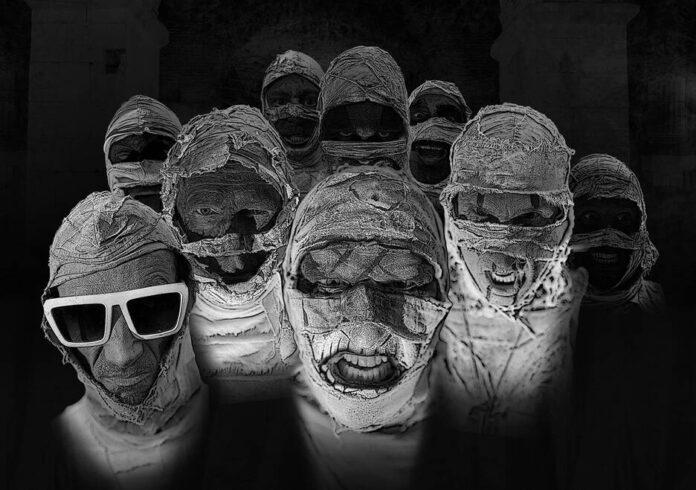
Photo provided Eight-piece funk rock band Here Comes the Mummies will be performing at the Brown County Music Center April 11.

They might be 5,000 years old, but these mummies really know how to rock out.

Here Comes the Mummies, an eight-piece funk rock band, are invading the Brown County Music Center this April with their “terrifying funk from beyond the grave” that’s sure to leave audiences smiling.

The show starts at 8 p.m. on April 11. Tickets are available at browncountymusiccenter.com.

Formed in 2000 in Nashville, Tennessee, Here Comes the Mummies consists of eight members, all of whom go under stage names and keep their real identities under wraps.

“We’re just mummies when we hit the stage,” Mummy Cass, the band’s lead vocalist and guitarist, said.

The band’s members have shifted some over the years, but their current line up includes Mummy Cass, vocalist and drummer Eddie Mummy, vocalist and bassist K.W. TuT, vocalist and keyboardist Spaz, bassist The Pole!, vocalist, saxophonist and tambourine player Dr. Yo and tenor saxophonist Highlander.

There’s also “HPOD,” or High Priest of Death, on trumpet and Midnight Mummy on bari and tenor sax, keys, percussion, talk box and vocals, according to the Brown County Music Center. Mummy Cass said this line up has been performing for five to six years, though they do have past members come back every once and a while.

“Everyone’s kind of got their parts and we try to play as a section, as a band, we like to try to get the groove on as much as we can but we always let everybody have as much time as they want to just kind of be free,” Mummy Cass said. “So there’s sections where we’ll let the trumpet player go, we’ll let the sax guy go, that kind of thing. And then just some dancing and stuff that we do but you got to remember: we’re 5,000 years old so we’ve got some creaky hips and some bad knees.”

If artists like Earth, Wind and Fire, Prince and P-Funk are your style, Mummy Cass said Here Comes the Mummies is trying to go for something like that. They like to use lots of innuendo and double entendres in their songs, and Mummy Cass likes to think of their shows as high energy performances.

“It’s an eight-piece band with a big horn section and it’s… funky and we want people shaking their booties, having a good time,” Mummy Cass said. “It’s all about smiling and forgetting what’s going on in the outside world.”

Here Comes the Mummies have brought their freaky funk with them to appearances on That’s My Jam with Jimmy Fallon, festivals like Summer Fest, Summer Camp and Musikfest, and have become regulars on the Bob & Tom Show. They’ll play anywhere, from across the Midwest to down south in Florida and New Orleans to even internationally in Canada and Australia.

They’ve also performed at the Brown County Music Center before, where Mummy Cass said they had a good crowd and a lot of high energy the last time they played at the venue. Fans of theirs can look forward to the same energy they’ve always delivered and some new tunes from their latest EP “Road Trip.”

“We’re going to play some new songs, we’re going to do some old favorites too, so hopefully it’s just going to bring a smile to your face,” Mummy Cass said.

Commissioners approve building change

The Bartholomew County commissioners approved suggested changes to the new government storage facility being built at the county fairgrounds.

Larry Mohr Construction Inc. is building the new facility and recommended some ways to give the facility a longer lifespan. The suggested changes add another $18,580 to the project, lifting the total cost up to $758,930, which still falls under the initial $1 million cost estimation.

“I totally support these. The building will last much longer with the foundation change, I’m glad to see it,” Commissioner Larry Kleinhenz said.

The storage facility is important for the county to keep government documents secured in a safe location. Currently documents are kept all over the county: the Bartholomew County Courthouse, Purdue Extension Building, Bartholomew County Health Department and the Bartholomew County Youth Services Center.

Indiana law requires that certain documents be stored for 50 years with some even in climate-controlled environments.

Bedford native Clayton Anderson to perform at Crump Theatre

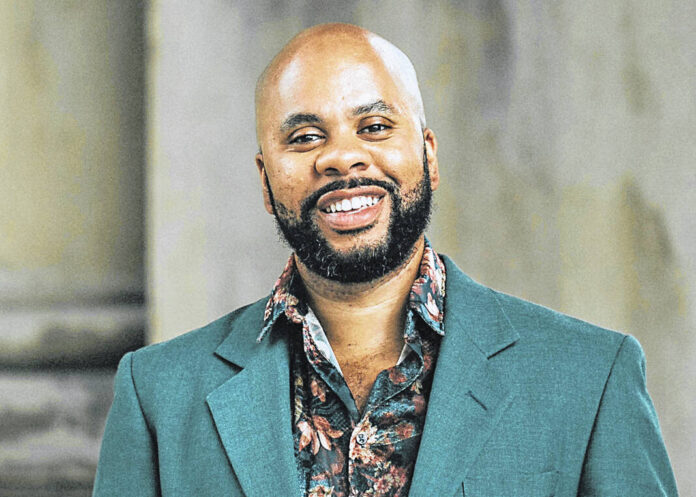
Photo courtesy of Hannah Fink Bedford native and touring country musician Clayton Anderson will be performing at the Crump Theatre on April 11.

Some may say all roads lead back home. For touring country musician Clayton Anderson, that’s especially true.

Though his musical career has taken him across the country and the world, for the time being, the Bedford native is back home in Indiana and will be making a stop at the Crump Theatre for a high energy concert.

The show starts at 7 p.m. April 11. Tickets cost $23.18 for general admission and $39.19 for early access general admission tickets. Early access ticket holders can enter the theater ahead of the crowd. The link to purchase tickets can be found at thecrump.org.

Growing up in Bedford and an alumnus of Bedford North Lawrence High School, music was always a part of Anderson’s household. He decided to pick up the guitar while attending Indiana University, where he said one thing led to another and the next thing he knew, he was playing shows, running around the country and making records in Nashville.

“Music’s really, it’s more than just music, it’s brought me everything that I have in my life,” Anderson said. “It’s brought me my wife, I met my wife through music, I met a lot of my best friends through music, I’ve met so many people through music and it all stems from there and I’m very appreciative for it.”

Throughout his musical career, Anderson has released a series of albums, a line up of singles and has performed alongside the Zac Brown Band at the Indy 500, according to his website. He has also opened for artists such as Eric Church, Blake Shelton and Thomas Rhett, and his 2023 track “Gotta Get Up” can be heard on ESPN as it was picked up by the network for their college baseball season.

Anderson also opened a country bar in Indianapolis last September. Though he technically resides in Nashville, he has spent a lot of time in Indiana lately because of the country bar keeping him busy, and he said it’s really nice to be back in the state again.

“I never wanted to leave to begin with,” Anderson said.

His musical style takes heavy influence from fellow Hoosier musician John Mellencamp, who he grew up listening to, but he also takes influence from ‘90s country artists he listened to growing up such as Johnny Cash and Willie Nelson. Anderson takes the “write what you know” approach to his music, and his experiences growing up in southern Indiana are where he takes inspiration.

“I’m a homer for Indiana, especially southern Indiana and I just think there’s a charm about it, there’s a goodness about it,” Anderson said. “I think people live the right way of taking care of one another the way we should and I’m very proud to be from here so all those things that I’ve witnessed growing up, obviously you got to write what you know and those are small town relationships and family ties and that type of thing.”

His upcoming show at the Crump Theatre will feature him performing alongside guitarist Aaryn Martin, drummer Niko Albanese and bassist Cole Mcglothlin. Audience members can look forward hearing songs Anderson wrote in addition to songs that have inspired him.

Anderson said he looks forward to entertaining the crowd at the Crump, a place he has driven past several times and always thought it would be cool to play at.

“Columbus is a great town, I have a lot of respect for Columbus, I think Columbus is one of the jewel towns in all the world,” Anderson said. “I appreciate its love for art and part of art is music and I think saving and keeping these… theaters alive is wonderful for the arts of music and entertainment, comedy, anything like that. So I’m very excited to be a part of that.”

Vance and Rubio’s differing postures on Iran war highlight their challenges ahead of 2028 election

WASHINGTON (AP) — As President Donald Trump assembled his Cabinet last week, he asked Secretary of State Marco Rubio and Vice President JD Vance to give an update on the Iran war.

Rubio, known for his hawkish views, gave an impassioned defense of the war, calling it “a favor” to the United States and the world.

Vance, who has long pushed for restraint in U.S. military intervention overseas, was more sedate. He said that the U.S. now has “options” it didn’t have a year ago and that it is important Iran does not get a nuclear weapon — before redirecting his remarks toward wishing the troops a happy Easter.

The exchange was a distillation of their diverging postures toward the war that their boss has launched in Iran. And it comes as some would-be Republican presidential candidates begin quietly courting officials in key states like New Hampshire in the early stages of the GOP’s next nomination fight.

With Vance and Rubio seen as the party’s strongest potential candidates in a 2028 primary, the two have to balance their roles in the Trump administration with their future political plans.

“It’s very obvious from the way that Rubio talks about Iran and the way that Vance talks about Iran that they are of different casts of mind,” said Curt Mills, the executive director of “The American Conservative” magazine and a vocal critic of the war. The Cabinet meeting episode was telling, he said, because it seemed as though Vance, discussing Easter, was “literally trying to talk about anything else other than the war.”

Vance’s office declined to comment. The State Department declined to comment but pointed to Rubio’s remarks last year during a Fox News Channel interview where he said he hopes Vance intends to run for president and wouldn’t rule out anything for himself.

It’s too soon to forecast how Republican voters might feel about the war next spring, when the 2028 contest is expected to begin in earnest, but the risks for both Vance and Rubio are acute. Rubio’s full-throated support for the war could come back to haunt him depending on how the conflict develops. Vance, meanwhile, would risk accusations of disloyalty if he were to stray too far from Trump, but struggles to square an appearance of support for the war with his past comments.

Vance’s restrained comments stand in contrast to Rubio’s full defense

Vance, who served in the Iraq war, has said that Iran cannot have a nuclear weapon, but he’s long been skeptical of foreign military interventions.

Trump seemed to allude that Vance may have held onto that position in private discussions about Iran, telling reporters that Vance was “philosophically a little bit different than me” at the outset of the conflict.

“I think he was maybe less enthusiastic about going, but he was quite enthusiastic,” Trump said.

Though Vance has been careful in how he speaks about the war, what he’s not saying has been conspicuous. On a March 13 trip to North Carolina, he was twice asked by reporters if he had concerns about the conflict. Each time, he said it was important that Trump could have conversations with advisers “without his team then running their mouths to the American media.”

A few days later at the White House, when Vance was again asked if he had concerns, he accused the reporter of “trying to drive a wedge between members of the administration, between me and the president.”

For Rubio, long before he became the country’s chief diplomat, he voiced support for muscular foreign policy and American intervention abroad.

Days into the war, he told reporters that it was “a wise decision” for Trump to launch the operation, that there “absolutely was an imminent threat” from Iran and that the operation “needed to happen.”

Fractures are emerging in the GOP

The apparent split between Rubio and Vance on the Iran war is emblematic of the divide starting to cleave within the Republican Party. A recent survey from The Associated Press-NORC Center for Public Affairs Research found some divisions within the GOP on Iran, with about half of Republicans saying the U.S. military action has been “about right.” Relatively few Republicans, about 2 in 10, say military action has not gone far enough, while about one-quarter say it’s gone too far.

While some conservatives have described the war as a betrayal, many other Republicans have cheered on the president’s actions.

Alice Swanson, a 62-year-old who attended Vance’s event in North Carolina, said she wants Vance and Rubio to run together in 2028 but favors the vice president.

“I think he fully believes and supports exactly what his convictions are,” Swanson said.

Swanson acknowledged, nonetheless, that Vance has been an outspoken opponent of interventionist policy but has been quieter on the subject since the war. “I can see both sides,” Swanson said after expressing full support for Trump’s decisions.

Tracy Brill, a 62-year-old from Rocky Mount, spoke highly of Rubio, but declared, “I love JD Vance.”

She made it clear she sides with the president, calling the course he’s taken “spot on.” But she defended the vice president if he seems at odds with his past statements, noting politicians do it frequently. “They’ve all changed their positions at one point or another,” she said.

However, Joe Ropar, attending the Conservative Political Action Conference last week, said Rubio’s unequivocal support for the Iran war helped crystallize his preference for the secretary of state for 2028.

“I’m not looking at JD Vance for president, and it’s for stuff like that,” said Ropar, a 72-year-old retired military contractor from McKinney, Texas. “I don’t 100% trust him.”

Benjamin Williams, of Austin, Texas, said at CPAC that both Trump and Vance are “tied to this war.” The 25-year-old marketing specialist for Young Americans for Liberty is looking elsewhere for a candidate.

The political risks might not be known until the field fills out

Whether the war becomes a political problem for Vance and Rubio depends on who ultimately enters the GOP’s next presidential primary.

While Vance and Rubio are currently considered the overwhelming front-runners, former New Hampshire Gov. Chris Sununu expects a half dozen high-profile Republicans to enter the contest.

Sununu and former RNC Committeewoman Juliana Bergeron told The Associated Press that multiple Republican presidential prospects have reached out to them in recent weeks to discuss the political landscape in the state that traditionally hosts the opening presidential primary; they declined to name them.

Republican strategist Jim Merrill, a top New Hampshire adviser for Rubio’s 2016 presidential bid, predicted that Iran would become a flashpoint in 2028 — just as the Iraq war was for Democrats in 2004 and 2008.

“If for some reason things don’t go as anticipated, there will be contrasts drawn,” he said.

Still, Sununu is doubtful that Iran would become a meaningful dividing line in a prospective Vance-Rubio matchup given their status as prominent members of the Trump administration. Both will likely take credit if the conflict ends well, and both would look bad if it does not, he predicted.

“They’re tied together with the success or failure of Iran. It doesn’t really separate one versus the other, at least I don’t think that’s how the electorate will see it,” Sununu said.

___

Peoples reported from New York. Associated Press writers Matthew Lee in Washington, Bill Barrow in Rocky Mount, N.C., and Thomas Beaumont in Grapevine, Texas, contributed to this report.


Column: Some statistics about Indiana’s ‘old’ houses

Morton Marcus

You can’t judge a house solely by its age. Unlike people, houses can be modernized, updated, and refurbished because they are less integrated than humans. Replacement furnaces are easier to install than human hearts and come with a longer warranty. Failed plumbing systems at home have complete, routine remedies while our personal systems often require extensive monitoring of their imperfect performance.

Data on the condition of houses is not as readily available as buyers would like. Most often we can discover the age of a structure, but we know little beyond that in most cases. It takes a professional inspector to tell us about the condition of the beams and the boards, the furnace and the fireplace, the garbage disposal and the garage doors.

As home buyers, however, we think of prospective properties in terms of their age. We base much on our prejudices of construction techniques and materials of today compared to yesterday.

“Oh, them old doors were real wood, not some cheap compost veneer.”

“Lordy, today’s kitchen will make your breakfast coffee, eggs, and toast before you can get down the stairs and to the table.”

Nationally, 48% of houses were built before 1980. That means nearly half went up more than 46 years ago, in a time before the cell phone or the WNBA.

Houses in Indiana rank 18th oldest among the states, with 52% built before 1980. That’s just ahead of Maine and right behind West Virginia. Illinois, Ohio, and Michigan are all even older than we are; only Kentucky, at 45% built before 1980, ranks younger among our neighbors

Now this can be a tribute to homebuilders and the suppliers of materials that go into homes. It also might be a compliment to home owners and renters who take care of property so that our residential infrastructure is well maintained.

But that is not what we see often as we drive our city streets and county roads. Maybe our eyes pick out the rundown porches, the unpainted boards, the broken windows of still occupied dwellings. And we label them as Old Houses because, in contrast, that really Old House across the way is so attractive with fresh paint, an intact roof, and flowers coming back for another burst of springtime. Certainly, that can’t be really old.

Within Indiana, 79.6% of occupied housing was built before 1980 in Benton County. Right behind are Wayne, Cass, Randolph, Fayette, and Henry counties, all with more than 75% of their housing structures built before 1980.

The newest housing is found (surprise!) in five counties adjacent to Indianapolis (Marion County). Only 18% of the occupied housing in Hamilton County was built before 1980. That is followed by Hendricks at 27%, then trailed by Johnson, Boone, and Hancock, each from 35% to 39%.

To me, age is not the crucial housing factor. It’s the volume of the neighbors’ music players and brightness of their exterior lights after sundown. A house is only as good as the people living in it allow it to be. Even the home inspector gathers no data on those factors.

Marcus is a research economist formerly with the Kelley School of Business at IU. Contact him at mortonjmarcus@gmail.com. Send comments to editorial@therepublic.com.

Letter: Learning the lessons of history

From: Danny K. Johnson

1SG U.S. Army (Ret.)

Columbus

There is a lesson from history that we ignore at our own risk, to continue on Mr. Don Strietelmeier’s thoughts.

In the years leading up to World War II, British Prime Minister Neville Chamberlain believed peace could be preserved through concession and negotiation with an aggressive regime. History has judged that approach harshly. Appeasement did not prevent conflict—it encouraged it.

Over the past 47 years, we have seen a similar pattern in how the world has dealt with Iran.

Since 1979, Iran has been linked to or accused of supporting terrorist activity across the globe—from attacks and assassinations in Europe to support of proxy forces in the Middle East. These are not isolated incidents, but part of a consistent pattern.

Yet the response from much of the international community has often been hesitation, negotiation without enforcement, or a quiet “not our war” attitude.

Iran rarely carries out attacks directly, instead relying on proxy groups to do its work. Examples include Hezbollah’s bombing of the U.S. Marine barracks in Beirut, which killed 241 American service members, and the Khobar Towers attack in Saudi Arabia. It is estimated that between 800 and 1,000 Americans have lost their lives due to Iran-backed actions, including many killed by Iranian-supplied IEDs during the Global War on Terror. Our NATO allies have also suffered, with civilians killed in attacks such as nightclub bombings in Berlin and assaults on newspapers in Paris. The list goes on.

World War I began with a single assassination, and World War II began with a single act of aggression, proving how quickly conflict can escalate when warning signs are ignored. History reminds us how small events can trigger massive consequences.

History shows that when nations treat growing threats as someone else’s problem, those threats rarely stay contained. They grow, spread, and eventually demand a far greater price.

Appeasement is not just about avoiding conflict—it can enable it. When there are no clear consequences, aggressive behavior continues.

This is not an argument against diplomacy, but against relying on it alone while ignoring repeated patterns.

As a retired member of the United States military, I believe strength, accountability, and unity among allies—not wishful thinking—are what prevent larger conflicts.

If we fail to recognize that, we risk repeating the mistakes of the past.

Editorial: The Pentagon needs to give better answers on its ‘Golden Dome’

Frustrated legislators tucked an unusual provision into the recently passed $839 billion defense appropriations bill, demanding answers from the Pentagon on its proposed “Golden Dome” missile defense project. Defense officials were given until early April to detail planned expenditures over the next two years and must report annually thereafter.

If White House officials want this program to succeed, they shouldn’t just accept the need for greater transparency; they should embrace it.

Currently, the administration risks becoming a victim of its own hype. Since announcing the program in May, the president has boasted that it will shield all of the U.S. from enemy missiles, for less than $200 billion, within three years. Pentagon officials insist the technology and the timeline are viable, but they have declared they can’t say more for fear of leaks. The lack of detail has angered lawmakers and strengthened critics, who warn that building a comprehensive space-based shield against incoming ballistic missiles would cost orders of magnitude more than the White House says, even if technological hurdles could be overcome.

The reality may well be more modest and less controversial. The U.S. confronts a range of new threats — not just the nuclear-armed intercontinental ballistic missiles familiar from the Cold War, but conventional long-range and cruise missiles, hypersonic glide vehicles, and all manner of attack drones. Ramping up production of existing missile defenses, layering them and integrating them with new battle-management systems to protect key areas could be worthwhile. So could investments in space-based sensors and research into new interceptors, which might yield useful insights even if they’re ultimately not deployed.

If that’s the plan, however, Congress deserves to know. Appropriators, who allocated nearly $25 billion to Golden Dome in last year’s reconciliation bill, have rightly complained that they can’t “effectively assess resources available” or “conduct oversight of planned programs and projects” without more information. To justify new funding, not to mention build support so the program isn’t scrapped by the next administration, the Pentagon needs to do more to convince members of both parties of its feasibility and worth.

Others are owed clarity as well. While the Pentagon recently laid out in broad terms how it hopes to spend the money from last year’s reconciliation bill, most details remain classified. American taxpayers deserve more information if they’re going to continue to provide billions to fund the program. Defense companies have been clamoring for more specifics and long-term contracts: They can’t be expected to invest huge sums in developing new products, or even scale up production of existing technologies such as air defense systems, without a better sense of the commercial potential.

Allies have advanced capabilities they could bring to bear if included in the discussions. And if the president is convinced the U.S. needs greater access to friendly territory such as Greenland to make the system work, he needs to explain why.

Concerns about revealing too much are understandable. But the U.S. has been more open about past defense initiatives — including former President Ronald Reagan’s aborted “Star Wars” program — without undermining operational security. Indeed, the U.S. could dangle the possibility of discussing Golden Dome in more detail with China and Russia as part of talks over their nuclear arsenals and investments in worrying new weapons.

Undue secrecy over the program risks raising both expectations and fears unnecessarily. The White House should welcome this opportunity to lower both.

Asking Eric: Estranged sister would be furious to find other family is still in contact

Dear Eric: I have two sisters. “Betty” and I had a serious falling out a few years ago. She won’t speak to me. She has cast herself as the victim in a situation where my other sister’s husband became abusive to me. My heart is broken. Betty and I were very close all our lives before that happened.

Betty has two sons. She is estranged from one. The other, “Allen,” has a child named “Rita.” I live in a state far away from Betty, Allen and Rita. I haven’t seen Rita since she was about two years old. She won’t remember me, but I have been sending her birthday cards every year.

Rita turns 10 years old in a few weeks and I’m wondering if I should stop sending her cards. She is getting old enough to wonder who this is. I don’t know if Allen knows about the rift between his mother and me or, if he does, if he has explained anything to Rita.

Do you think I should continue to send this child birthday cards? I don’t want to upset her, her father or her grandmother. I might never see any of them again because I would not be welcomed by my sister. I guess I really don’t mind backing out of their lives altogether to keep the peace, but I also don’t want to shine a light on the problem by stopping the cards if by chance Allen does not know about the situation. I’m confused about the right path to take. What are your thoughts, please?

– Invisible Aunt

Dear Aunt: I don’t think a conversation with Allen is out of bounds here. You and he and your sister are all adults and, as such, able to navigate having separate relationships. He may wish to set a boundary with you in order to keep the peace with his mother. But it’s better to find that out directly, rather than to assume.

Even though you don’t know Rita, you’ve extended your generosity and love to this family through these cards for nearly a decade. So, there is already a relationship. This isn’t to say that they owe you anything, nor you them. But some of the confusion you’re feeling may stem from the one-sidedness of the relationship. It’s fine to get an understanding of the other side.

You can practice discretion when talking about the fractured relationship with Allen’s mother, if you’d like. It’s probably best not to get too deep into the specifics, anyway, just because they’d distract from the true focus of your conversation. But this story is yours, too. You don’t have to hide it. If it would be meaningful to you to continue to reach out to Rita, tell Allen that and ask if it would be meaningful to him and his family, as well.

Dear Eric: I would love your input. My stepson has cut his dad out of his life because he will “only” inherit $1 million dollars when his dad passes. My stepson makes almost $500,000 a year. And he is upset that his dad will donate money to me and our local hospitals. What do you think?

– Curious Stepmother

Dear Stepmother: It’s likely that there is something else underneath this conflict between your husband and his son. Sure, it could just be about the money, especially if the son had assumed he’d be receiving far more than a million dollars. But for him to take such a drastic action suggests there are other sources of frustration in this relationship. They may be justified; they may not. There’s probably a bit of both/and in this situation.

Your husband could try to have a “lay it on the table” conversation with his son. It’s possible that there’s resentment about the money going to you or to the charities. Your stepson may feel that it’s his entitlement. And even though he makes a very good living, he may have counted his chickens before they hatched, as it were. Or he may have grander plans that match the lifestyle in which he was raised. Those are all feelings or intentions he has to reconcile on his own, however. Your husband can do whatever he wants with the money.

This shouldn’t be a reason to dissolve a relationship, though. When it comes to inheritance, money talks but it mumbles sometimes. So, your husband would do well to clarify what his intentions are and what he hopes to accomplish with the money. He doesn’t need to justify himself to his son, but for the sake of the relationship he might want to open himself up to a conversation. It’s ultimately not about the money. Your stepson can make it about the money, of course. But there’s an opportunity to be clear with each other before it’s too late.

Send questions to R. Eric Thomas at eric@askingeric.com or P.O. Box 22474, Philadelphia, PA 19110. Follow him on Instagram and sign up for his weekly newsletter at rericthomas.com.

Dancers Studio to present Snow White production as part of First Fridays for Families

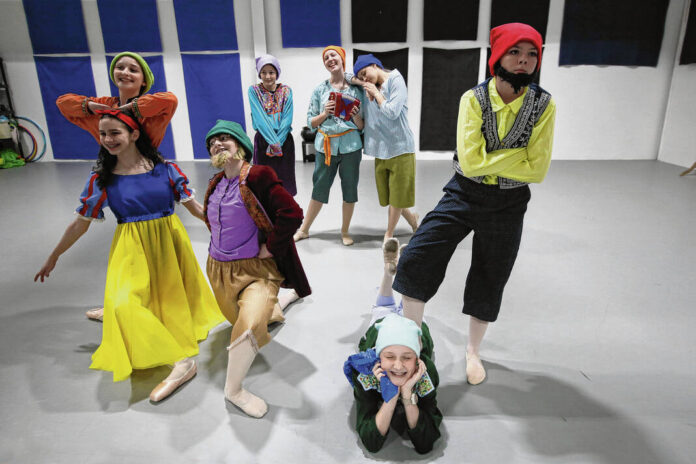
Carla Clark | For The Republic Snow White, played by Ryleigh Bardakjy, front left, Doc, played by Cora Tregoning, Sneezy, played by Pippa Haywood, Grumpy, played by Tora Vreeland, Dopey, played by Sawyer Peterson, Bashful, played by Clara DeVreese, Happy, played by Brynn Wendel, and Sleepy played by Camilla DeVreese at the end of a scene during a Dancers Studio rehearsal for their production of The Dwarves’ Tale of Snow White, at their studio, Columbus, Ind., Thursday, March 26, 2026.

Around the time Ryleigh Bardakjy first began dancing with Dancers Studio, Inc, she attended its production of Snow White as part of the First Fridays for Families series. Upon watching it, the then 6-year-old Bardakjy told her mother that she wanted to be in the production too some day.

Little did she know that at the age of 13, she would be up on that stage performing as Snow White herself, alongside her fellow dancers and friends, bringing the classic fairy tale to life through movement and music.

“I’m a little nervous. I was very surprised but I’m excited,” Bardakjy said. “I think it’s just going to be an exciting opportunity.”

“The Dwarves’ Tale of Snow White,” a part of the First Fridays for Families series, will be this Friday at The Commons from 5 to 7 p.m. Doors open at 5 p.m. and the show begins at 5:30 p.m. It is free.

Audience members will watch as dancers tell the story of Snow White through dance and mime, in addition to narration. In a story somewhat based on the Disney animated film, they’ll first meet the dwarves, who try to tell the narrator the story through dance, Snow White’s animal friends and of course the evil queen and her vulture servants.

“I think when (Dancers Studio, Inc. founder) Alma Wiley originally envisioned this show, she went into it going ‘Snow White does a lot in this show, but there’s so much more that you could explore with some of these other characters,’” interim artistic director Kaylin Hogan said. “And so… we come at it from the dwarves’ perspective, so the dwarves are one of the first people on the stage and then they have a pretty pivotal role, a whole bunch of scenes with some really comedic dancing for sure.”

Auditions for the production were held in January and rehearsals began later that month. Dancers range in age from 8 years old to 18, with five of the dancers being seniors this year. Having that wide range requires Hogan to think on her feet and to try and make sure she’s engaging all of them in a different way, while also teaching the older dancers to be patient with the younger ones.

“… actually, several of our seniors and juniors did play the role of some of the animals in Snow White seven years ago, the last time we did this production, and so it’s been a little bit fun to reminisce with them about how hard they were to work with at 9-, 10-years-old but how far they’ve come since then, which is really fun,” Hogan said.

Bardakjy said she wasn’t expecting to get the lead part and expected more of a role like a dwarf, but rehearsals and practicing her part have been fun, though trying to memorize it all has been tricky.

“It’s a lot of dancing and I’m on stage the whole time so it’s a little hard to keep everything in my mind and remember what’s where and when to do things,” Bardakjy said.

Practicing at home and talking with her friends, including Sydney Sampson, who also plays Snow White, and going over things in class have helped, Bardakjy said. This production is double casted, meaning that every major part has two dancers learning it and each will perform once for the public, once for a school show and once for another outreach program, Hogan said.

Bardakjy will be Snow White in the First Fridays for Families performance and a matinee at Columbus North High School on April 18 at 2 p.m. The other cast will then be featured later that evening for the 7 p.m. show. Both of these performances are open to the public and will have special offerings in celebration of Dancers Studio, Inc’s 35th year in business.

“We’re doing a silent auction before the show and then during each intermission, and there’s going to be themed photo booths set up and fun treats and things for kids and for adults and it’s going to be fun,” Hogan said. “Hopefully a chance to take pictures with some characters at some point.”

Those public performances on April 18 will also feature a second act with ballet variation solos and some modern and jazz pieces that dancers have been working on in class, Hogan said. The first act will then be what Dancers Studio, Inc performs at First Fridays for Families, complete with the narration.

Hogan described the First Fridays for Families production as perfect for kids as it’s only one act long, its pace is much faster than traditional ballet and it provides them with a full understanding of the pieces that go into traditional ballet without stopping for long periods of time. The narration also helps audience members match up the mime movements to the actual words from the story.

She said she loves reaching kids through First Fridays for Families and their school performances, and she believes the dancing students also enjoy performing for kids as they react in more fun, exciting and over-the-top ways.

“Adults have a lot more preconceived notions about how they should or shouldn’t act in an audience but kids don’t hesitate to boo for the queen or cheer or groan when the prince kisses Snow White or whatever,” Hogan said. “They’re going to react and sometimes you’ll hear them call something out from the audience and it makes your day, and it teaches the dancers not to break character.”