Home Blog Page 638

What Democrats are demanding in the fight over Immigration and Customs Enforcement funding

WASHINGTON (AP) — Despite rare negotiations between Democrats and President Donald Trump, a bipartisan agreement on new restrictions for federal immigration enforcement in the next two weeks will be exceedingly difficult — or even “an impossibility,” as Republican Senate Majority Leader John Thune said.

Congress is discussing potential new rules for Immigration and Customs Enforcement and U.S. Customs and Border Protection after officers shot and killed two Minneapolis protesters in January. The negotiations come amid some bipartisan sentiment that Congress should step in to de-escalate tensions over the enforcement operations that have rocked Minnesota and other states.

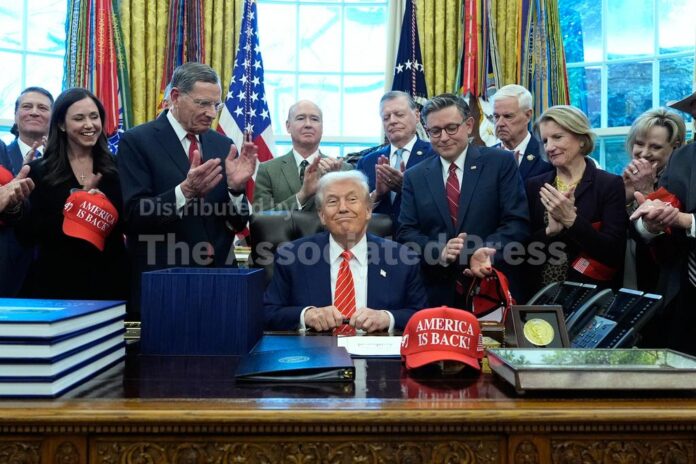
President Donald Trump last week agreed to a Democratic request that funding for the Department of Homeland Security be separated from a larger spending bill and extended at current levels for two weeks while the two parties discuss possible requirements for the federal agents. House Speaker Mike Johnson, R-La., said this weekend that he was at the White House when Trump spoke with Senate Democratic leader Chuck Schumer of New York and that they were “on the path to get agreement.”

But it’s unclear if the president or enough congressional Republicans will agree to any of the Democrats’ larger demands that the officers unmask and identify themselves, obtain judicial warrants in certain cases and work with local authorities, among other asks. Republicans have already pushed back.

And House GOP lawmakers are demanding that some of their own priorities be added to the Homeland Security spending bill, including legislation that would require proof of citizenship before Americans register to vote. South Carolina Sen. Lindsey Graham and other Republican senators are pushing for restrictions on sanctuary cities that they say don’t do enough to crack down on illegal immigration. There’s no clear definition of sanctuary jurisdictions, but the term is generally applied to state and local governments that limit cooperation with federal immigration authorities.

It’s also uncertain if Democrats who are furious over the Trump administration’s increasingly aggressive immigration enforcement operations would be willing to compromise.

“We don’t need promises. We need law,” Schumer said, adding that Democrats would present Republicans with a “serious, detailed proposal” soon.

A look at Democrats’ demands and what Republicans are saying about them:

Agreement on body cameras

Republicans say they are open to officer-worn body cameras, a change that was already in the underlying Homeland Security spending bill. Homeland Security Secretary Kristi Noem backed that up on Monday when she ordered body-worn cameras to be issued to every Homeland Security officer on the ground in Minneapolis, including those from ICE. She said the policy would expand nationwide as funding becomes available.

The bill already directed $20 million to outfit immigration enforcement agents with body-worn cameras.

Gil Kerlikowske, who served as commissioner of U.S. Customs and Border Protection from 2014 to 2017, said that most agents are “very supportive” of cameras because they could help exonerate officers. But he added that complex questions remain, including when footage should be released and when cameras must be activated.

“When do you turn it on? And if you got into a problem and didn’t have it on, are you going to be disciplined? It’s really pretty complex,” he said.

Schumer said Tuesday that the body cameras “need to stay on.”

Disagreement on masking

As videos and photos of aggressive immigration tactics and high-profile shootings circulate nationwide, agents covering their faces with masks has become a flashpoint. Democrats argue that removing the masks would increase accountability. Republicans warn it could expose agents to harassment and threats.

“State law enforcement, local folks don’t do it,” said Rep. Bennie Thompson, the top Democrat on the Committee for Homeland Security. “I mean, what’s so special about an ICE law enforcement agency that they have to wear a mask?”

But Republicans appear unlikely to agree.

“Unlike your local law enforcement in your hometown, ICE agents are being doxed and targeted. We have evidence of that,” Johnson said on Tuesday. He added that if you “unmask them and you put all their identifying information on their uniform, they will obviously be targeted.”

Immigration officers are already required to identify themselves “as soon as it is practical and safe to do so,” according to federal regulations. ICE officials insist those rules are being followed.

Critics, however, question how closely officers adhere to the regulations.

“We just see routinely that that’s not happening,” said Nithya Nathan Pineau, a policy attorney with the Immigrant Legal Resource Center.

Judicial vs. administrative warrants

Democrats have also demanded stricter use of judicial warrants and an end to roving patrols of agents who are targeting people in the streets and in their homes. Schumer said Tuesday that they want “arrest warrants and an end to racial profiling.”

Most immigration arrests are carried out under administrative warrants, internal documents issued by immigration authorities that authorize the arrest of a specific person but do not permit officers to forcibly enter private homes or other non-public spaces without consent. Traditionally, only warrants signed by judges carry that authority.

But an internal ICE memo obtained by The Associated Press last month authorizes ICE officers to use force to enter a residence based solely on a more narrow administrative warrant to arrest someone with a final order of removal, a move that advocates say collides with Fourth Amendment protections.

Democrats have not made clear how broadly they want judicial warrants used. House Democratic leader Hakeem Jeffries of New York said that Democrats want to see “an end to the targeting of sensitive locations like houses of worship, schools and hospitals.”

Johnson said Tuesday that Democrats are trying to “add an entirely new layer” by seeking warrants signed by a judge rather than the administrative warrants that are signed by the department. “We can’t do that,” he said.

The speaker has said that an end to roving patrols is a potential area of agreement, but he did not give details.

Code of conduct and more accountability

Democrats have also called for a uniform code of conduct for all ICE and federal agents similar to that for state and local law enforcement officers.

Federal officials blocked state investigators from accessing evidence after protester Renee Good was shot and killed by an ICE agent on Jan. 7. Gov. Tim Walz, a Democrat, demanded that the state be allowed to take part, saying that it would be “very difficult for Minnesotans” to accept that an investigation excluding the state could be fair.

Hoping for a miracle

Any deal Democrats strike on the Department of Homeland Security is unlikely to satisfy everyone in the party. Rep. Ayanna Pressley of Massachusetts said she would never support an agreement that didn’t require unmasking.

“I ran for Congress in 2018 on abolish ICE,” Pressley said. “My position has not changed.”

Thune, of South Dakota, has repeatedly said it’s an “impossibility” to negotiate and pass something so complicated in two weeks. He said any talks should be between Democrats and Trump.

“I don’t think it’s very realistic,” Thune said Tuesday about finding quick agreement. “But there’s always miracles, right?”

___

Associated Press writer Rebecca Santana contributed to this report.

Edmunds puts sedans Nissan Sentra and Toyota Corolla to the test

There is a lot of talk about affordability in 2026, and it can certainly apply to new vehicles. Many of the latest SUVs and electric vehicles are simply too expensive for people. Buying used is an option, but that means you’ll lose out on getting a full warranty and, of course, that new-car smell. Thankfully, a few automakers still offer inexpensive new sedans priced under $25,000.

Nissan has redesigned its 2026 Sentra, which is the smallest and least expensive sedan in the brand’s lineup. Nissan has given the car a new look and an interior makeover, featuring improved materials and a large digital display atop the dashboard. It’s a prime competitor to the venerable Toyota Corolla. The latest Corolla generation has been around for a while, but Toyota has spruced up the 2026 version with a few more standard features. Which of these small sedans is the better buy? Edmunds’ auto experts have tested both to find out.

Power and mpg

The Corolla and Sentra come with four-cylinder engines, but the Corolla’s makes more power. Rated at 169 horsepower, the Corolla hustled from zero to 60 mph in 8.8 seconds in Edmunds’ testing. That’s a bit leisurely but still nearly 1 second quicker than the 149-horsepower Sentra, which requires a heavy foot to keep up with highway traffic. The slower Sentra is also less efficient than its Toyota rival. It gets up to an EPA-estimated 33 mpg in combined city/highway driving. The Corolla gets up to 35 mpg combined and delivered even better results in Edmunds’ real-world driving.

The Corolla has other advantages, too. It’s also available as the Corolla Hybrid, which gets up to an EPA-estimated 50 mpg combined. All-wheel drive is also available. It’s only offered with the Corolla Hybrid, but it may appeal to you if you have to frequently drive in wintry conditions. The Sentra doesn’t offer a hybrid powertrain or all-wheel drive.

Winner: Corolla

Technology

For 2026, Nissan overhauled the Sentra’s interior, adding dual 12.3-inch displays for digital gauges and infotainment spanning half the dashboard. The wide-screen array comes standard on all but the base trim. By comparison, the Corolla feels years behind with its standard 8-inch display or optional 10.5-inch touchscreen. Both models come with wireless Apple CarPlay and Android Auto smartphone integration and optional wireless phone charging and upgraded audio systems.

These sedans are similar in the standard advanced driver assist features they offer. These include blind-spot warning and adaptive cruise control with lane centering that can apply light steering corrections to help you keep the car centered in its lane. However, the Sentra takes it further with available features that include enhanced functionality for adaptive cruise control in stop-and-go traffic, rear parking sensors and a high-definition surround-view camera system. It’s an impressive bundle of features for the money.

Winner: Sentra

Interior space and conveniences

Compact cars are tight and tidy by definition, but the Toyota and Nissan are roomier than they look. The Sentra has the edge with more elbow room and front legroom thanks to a slightly longer, wider body, but its sleek roof pinches rear headroom, which taller passengers will notice. Both models come with cloth upholstery to start and synthetic leather on higher trims, but the Sentra’s cabin looks and feels fresher from its recent redesign. The Nissan’s front seats are also among the best in any compact car for keeping you comfortable on long drives.

The Sentra’s 14.3-cubic-foot trunk is large enough for a couple of suitcases and carry-ons. The Corolla’s smaller 13.1 cubic-foot trunk might force you to abandon one of those bags, but you can always opt for the Corolla Hatchback, which beats both with nearly 18 cubic feet of cargo space.

Winner: Sentra

Price and value

The Nissan Sentra starts at $23,845, including the destination fee. The Corolla starts at $24,120 with destination; getting the Corolla Hatchback or Corolla Hybrid will cost approximately $1,500 to $1,900 more. Not only is the Sentra slightly more affordable, it also comes with the larger touchscreen, enhanced cruise control and more trunk space. Moving up to the Sentra SV trim — about $500 more than the base Corolla — adds a few more features, including the larger digital gauge cluster.

But when it comes to performance and efficiency, the Corolla is king. Its stronger engine makes a difference in traffic, and its superior fuel economy can help with saving on gas in the long term.

Winner: tie

Edmunds says

Edmunds officially scores the Sentra slightly higher than the Corolla. But your decision might come down to what you want most. If fuel economy and power are priorities, the Corolla is worth paying a little extra for. But the Sentra otherwise edges it out with superior roominess, utility and technology.

____________

This story was provided to The Associated Press by the automotive website Edmunds.

Dan Frio is a contributor at Edmunds.

IOC open to earlier dates for future Winter Olympics and Paralympics because of warmer temperatures

MILAN (AP) — Staging future Winter Games as early as January and the Paralympic Winter Games in February is a possibility because of the effects of warmer temperatures, the International Olympic Committee said Wednesday.

Every Winter Games medal was won in February since the 1964 Innsbruck Olympics opened Jan. 29, and moving to January would likely disrupt scheduling of storied World Cup races and events. It also would more directly clash with NFL and NBA schedules.

The IOC is now reviewing Olympic Games issues in the first year of Kirsty Coventry’s presidency and changing the winter edition dates is an option.

“Maybe we are also discussing to bring the Winter Olympics a little bit earlier,” the IOC member overseeing the sports program review, Karl Stoss, told reporters. “To do it in January because it has an implication for the Paralympics as well.”

The Milan Cortina Paralympic Winter Games will be held March 6-15.

The IOC has long acknowledged under Coventry’s predecessor Thomas Bach that changing climate is a challenge for finding future hosts and organizing competitions.

“(March) is very late because the sun is strong enough to melt the snow,” said Stoss, whose home country Austria is a traditional power in Alpine skiing and ski jumping.

“Maybe the Paralympics will be in February and the other edition will be in January. That would also be a part of our discussion,” he said on the sidelines of the IOC’s eve-of-Olympics meeting in Milan.

The 100-plus IOC members should meet again in June to make decisions about the Olympic reviews, in a program called “Fit For The Future,” and whether to add new sports and events to the 2030 French Alps Winter Games.

The French Alps edition is currently expected to run Feb. 1-17 and the 2034 Utah Winter Games from Feb. 10–26.

___

AP Olympics: https://apnews.com/hub/milan-cortina-2026-winter-olympics

Serbian government official faces forgery trial over withdrawn Kushner-linked project

BELGRADE, Serbia (AP) — A Serbian government minister and three others went on trial on Wednesday on charges of abuse of office and falsifying of documents to help pave the way for a real estate project that was to be financed by a company of Jared Kushner, U.S. President Donald Trump’s son-in-law.

Kushner has since withdrawn from the planned multi-million investment that envisaged building a high-rise hotel, a luxury apartment complex, office spaces and shops to replace a sprawling bombed-out military complex in central Belgrade.

The plan was backed by the government of Serbia’s autocratic President Aleksandar Vucic who had said it would help improve ties with the U.S. But the Serbian public and international heritage groups opposed the idea to turn a protected cultural heritage zone into a commercial compound.

Built by a prominent 20th century Yugoslav architect, Nikola Dobrović, the building was damaged in the 1999 U.S.-led NATO bombing of Serbia over Kosovo. The building is considered a masterpiece of modernist architecture, and heritage groups have called for it to be preserved and revitalized.

Many Serbs are still angry over the air war, launched to stop Belgrade’s crackdown against separatist ethnic Albanians in Kosovo.

Culture Minister Nikola Selakovic, who is a close ally of Vucic, and three other officials are accused of illegally lifting the protection status in 2024 for the site by forging documentation. If convicted they could face up to three years in prison. They pleaded not guilty as the trial opened.

Dozens of anti-government protesters chanting “thieves!” had gathered outside the organized crime court building as the defendants arrived.

The trial comes days after the Serbian parliament passed a set of legal changes seen as an attempt to curb the independence of Serbia’s judiciary, particularly of the organized crime prosecutors who have been handling high-profile cases.

The European Union’s Enlargement Commissioner Marta Kos urged Serbia to retract the amendments, describing them as “a serious step back on Serbia’s EU path.”

Prosecutors on Wednesday held a 10-minute silent protest outside their offices against the changes.

Vucic, who has faced more than a year of street protests over a Nov. 2024 train station disaster, has launched a crackdown on protesters and moved to strengthen control over the police and other state institutions to tighten his grip on power. Many in Serbia blamed the collapse of a concrete canopy at the train station in the northern city of Novi Sad on sloppy renovation work fueled by corruption. Sixteen people died in the crash, triggering massive demonstrations.

Almost daily youth-led protests have shaken Vucic’s tough rule in the Balkan country for the first time since his right-wing populist party came to power over a decade ago.

Vucic formally has promised to take Serbia into the EU but he has forged close ties with Russia and China while clamping down on democratic freedoms. He has labeled organized crime prosecutors as a “corrupt gang” and “criminals.”

Column: Congress must address America’s immigration dilemma

Hamilton

It’s obvious that America is deeply divided over immigration. President Donald Trump has been adding new restrictions and deporting immigrants that he describes as a threat. Trump’s critics see his actions as racist and a rejection of basic American principles.

The divide is on stark display in the daily news, where Trump demonizes immigrants and their supporters while protests spread against Immigration and Customs Enforcement. Minneapolis, where federal officers recently killed two U.S. citizens, one a mother of three and the other an intensive care nurse, has looked like a war zone.

It shouldn’t be this way. Trump may be fanning the flames, but Congress also bears responsibility. It’s no secret that America’s immigration system is broken. Our laws haven’t been updated in 40 years, despite massive changes in the economy and technology. Congress and its leaders, both Republicans and Democrats, keep kicking the can down the road. Their inaction plays into Trump’s hands.

The New York Times editorial board put it well in a recent analysis: “Instead of an immigration policy calibrated to the needs of the country, both Americans and immigrants are being let down by a set of outdated laws inconsistently enforced by underfunded agencies. Chaos has been a predictable result.”

America has fought over immigration from its beginning. In 1798, Congress passed the Alien and Sedition Laws, which targeted foreigners for spreading threatening ideas. The Know Nothing Party of the mid-1800s and the Ku Klux Klan of the 1920s grew powerful on anti-immigrant rhetoric. A surge in immigration at the turn of the 20th century produced a backlash that led to strict limits. One of my first votes in Congress was for legislation that overturned those restrictions.

Politicians who oppose immigration claim that immigrants bring crime, drive down wages and rely excessively on government aid. None of those claims are true. As the Times points out, immigrants are “America’s rocket fuel,” powering economic growth and cultural achievement. Our aging population and low birth rates mean we need immigration to keep the economy humming. Immigrants drive innovation and work hard-to-fill jobs in health care, technology, hospitality and agriculture.

Of course, this doesn’t mean immigration should be without restrictions. As the Times argues, we must secure our borders and make reasonable efforts to prevent people from working here illegally. At the same time, Congress should legislate an orderly expansion of legal immigration. Our current system, which favors family unification, should give way to an approach that encourages immigration where it’s most needed.

We also need humane policies for the estimated 11 million immigrants who are here illegally, many of whom were brought as children. Immigrants who have worked hard, stayed out of trouble and made productive lives should have a path to citizenship.

Mass deportation is cruel and unworkable. Government officials say they are targeting criminals, but news media have documented numerous deportations of people with no criminal record, and even of citizens. Aggressive tactics by ICE officers and Trump’s threats to deploy the military against protesters show a disturbing disdain for individual rights. In Minneapolis, a Star Tribune editorial states, “strangers with guns have metastasized in spaces where daily life should be routine and safe. It feels like a military occupation.”

This is another area where Congress should play a role. Congressional oversight of the executive branch is a key feature of our system of checks and balances. If federal agents are violating the rights of the people, Congress should hold the agencies accountable. As a Washington Post editorial notes, the administration has gutted the Homeland Security Department civil rights office that’s supposed to investigate abuses; consequently, the need for independent oversight “has become irrefutable.”

Meanwhile, the chaos and divisions show that the need to fix our outdated immigration system has become more urgent than ever. It’s past time for Congress to roll up its sleeves and get to work.

Lee Hamilton is a distinguished scholar at the IU Hamilton Lugar School of Global and International Studies and senior advisor for the Indiana University Center on Representative Government. He was a member of the U.S. House of Representatives for 34 years. Send comments to editorial@therepublic.com.

Column: Indiana could license younger drivers under little-noticed provision

I remember getting my driver’s license the day I turned 16 — and promptly locking my keys in the car. But it’s such a different time now.

Younger members of Generation Z are either entirely opting out of getting their license or delaying the process, according to a 2024 USA Today article. Since 2000, the number of 16-year-olds with driver’s licenses has decreased nearly 27% nationwide.

That’s why a small section in an Indiana Bureau of Motor Vehicles bill caught my attention recently.

House Bill 1200 walks back part of the Indiana graduated driver’s license system put in place in 1999. Right now, Hoosier teens must wait until they are 16 years and 90 days to get a license if they pass a driver’s education course. The bill would drop that to just 16 years old.

If you don’t take driver’s education, it would remain at 16 years and 270 days. And according to BMV data, about 75% of new licensees don’t take driver’s ed.

If teens are waiting longer to get their licenses, why are we moving up when they can get them?

Rep. Jim Pressel, R-Rolling Prairie, authored the legislation. and had this to say in committee on why he inserted the change:

“I’ve never really understood why it’s 16 years and 90 days… It’s been kind of all over the place. So, this just lowers it to 16 years of age.

“I have had nobody push back on this idea,” he said. “It just seems to be consistent.”

More than 30 states have 16 as the age for a license — not a learner’s permit — and a few are even at 15.

No one was there to testify for or against it because the bill itself is mostly agency inner-workings.

The state legislature took aim at the problem of teen driving fatalities in 1998 by passing Indiana’s graduated driver’s license law, which limits the freedom 16- and 17-year-old drivers have in the car. They pushed back when teens could get a permit, how long they had to hold it, required a practice log of hours and limited when a teen could drive and who could be in the car. They also delayed when a driver’s license could be obtained, which meant adding maturity to the process.

The law was strengthened again in 2009.

A large body of research has found that graduated licensing systems have substantially reduced the rates of crashes, injuries, and deaths of 16- and 17-year-old drivers, according to the AAA.

And yet, here we are in 2026, and teens are still dying.

Data from the National Highway Traffic Safety Administration shows that in 2023, there were 151 traffic fatalities involving traffic crashes with drivers aged 15 to 20. Of those, 65 were the teen drivers.

And Indiana ranks 7th highest in the country for teen involvement in fatal crashes.

So, it’s probably time to see if all those changes made a difference. But I’m not sure what the need is to revert — especially when fewer teens are driving now than ever before.

The change will likely be an administrative hassle for the BMV.

This type of provision should be debated in a standalone bill with all stakeholders weighing in, including traffic safety experts, parents, kids and the insurance and driver’s education industries.

Many of these people had no idea this change even existed, and in the second half of the session, I hope to see some more attention paid to rolling back a key part of Indiana’s graduated driver’s license system.

I know that my own teen driver needed that extra time, and pointing to a state law helps parents set limits.

Niki Kelly is editor-in-chief of indianacapitalchronicle.com, where this commentary first appeared. She has covered Indiana politics and the Indiana Statehouse since 1999 for publications including the Fort Wayne Journal Gazette. Send comments to editorial@therepublic.com.

The former Prince Andrew moves to King Charles III’s private estate amid Epstein document uproar

LONDON (AP) — The former Prince Andrew has moved out of his long-time home on crown-owned land near Windsor Castle earlier than expected after the latest release of documents from the U.S. investigation of Jeffrey Epstein revived questions about his friendship with the convicted sex offender.

The 65-year-old brother of King Charles III, now known as Andrew Mountbatten-Windsor, left the Royal Lodge in Windsor on Monday and is now living on the king’s Sandringham estate in eastern England, a person familiar with the matter said. British media reported that Mountbatten-Windsor will live temporarily at Wood Farm Cottage while his permanent home on the estate undergoes repairs.

Mountbatten-Windsor’s move to Sandringham was announced in October when Charles stripped him of his royal titles amid continuing revelations about his links to Epstein. But the former prince was expected to remain at Royal Lodge, where he has lived for more than 20 years, until the spring.

The expedited departure came as Thames Valley Police announced that they were investigating allegations that Epstein flew a second woman to Britain to have sex with Mountbatten-Windsor. A lawyer for the alleged victim told the BBC that the encounter took place in 2010 at Royal Lodge.

The allegations are separate from those made by Virginia Giuffre, who claimed she had been trafficked to Britain to have sex with Andrew in 2001, when she was just 17. Giuffre died by suicide last year.

Mountbatten-Windsor has repeatedly denied any wrongdoing in his relationship with Epstein. He hasn’t responded publicly to the new trafficking allegation.

Mountbatten-Windsor features a number of times in the 3 million pages of documents the U.S. Department of Justice released on Friday.

Correspondence between Epstein and someone believed to be Mountbatten-Windsor show Epstein offering to arrange a date between the man and a 26-year-old Russian woman. The man, who signs off simply as “A,” later suggests that he and Epstein have dinner in London, either at a restaurant or Buckingham Palace.

The former prince’s residence at Royal Lodge has long been a point of contention between the king and his brother.

After Charles became king in 2022, he tried to force his brother to move into a smaller house on the Windsor Castle estate. Mountbatten-Windsor refused, citing a lease on the property that ran through 2078.

But the pressure for him to leave became irresistible in October as lawmakers and the public raised questions about the favorable terms of Mountbatten-Windsor’s lease on the 30-room house and surrounding estate, which is managed by the Crown Estate.

The Crown Estate controls properties throughout the country that are technically owned by the monarchy but are managed for the benefit of British taxpayers.

By contrast, the Sandringham Estate in Norfolk is the personal property of the king.

UK will release files about Mandelson’s ambassador appointment as anger mounts over Epstein

LONDON (AP) — The U.K. government agreed Wednesday to release documents casting light on the decision to appoint Peter Mandelson as ambassador to the United States, despite his friendship with Jeffrey Epstein, as it tries to stem mounting anger over the revelations.

Prime Minister Keir Starmer faced the wrath of opposition lawmakers, and his own Labour Party backbenchers, after acknowledging that he had known at the time of the 2024 appointment about Mandelson’s friendship with the convicted sex offender.

Starmer said that he was unaware of the depth of the relationship, and that Mandelson had “lied repeatedly” about his ties to Epstein.

A trove of documents about Epstein released last week by the U.S. Justice Department has finished off Mandelson’s long political career — and left Starmer facing angry questions about his judgment in making him Britain’s envoy to the Trump administration, the country’s most important ambassadorial post.

Starmer’s judgment questioned

Starmer fired Mandelson, 72, in September after emails were published showing that he maintained a friendship with Epstein following the late financier’s 2008 conviction for sex offenses involving a minor. Epstein died by suicide in a jail cell in 2019, while awaiting trial on U.S. federal charges accusing him of sexually abusing dozens of girls.

At a question-and-answer session in the House of Commons dominated by the Epstein revelations, Starmer said that Mandelson had “lied repeatedly to my team when asked about his relationship with Epstein before and during his tenure as ambassador.”

“Mandelson betrayed our country, our Parliament and my party,” Starmer said. “I regret appointing him. If I knew then what I know now, he would never have been anywhere near government.”

The opposition Conservative Party said that explanation wasn’t good enough, and moved to force a vote in Parliament calling for the release of emails and other documentation related to Mandelson’s appointment.

Starmer said that he would ensure that “all of the material” is published, except for documents that compromise Britain’s national security, international relations or the police investigation into Mandelson’s activities.

Opposition lawmakers — and some from Starmer’s Labour Party — said that they worried the government would use national security as an excuse to keep embarrassing documents secret.

Conservative leader Kemi Badenoch said the government should publish all relevant files, “not just the ones the prime minister wants us to see.”

“The prime minister is talking about national security. The national security issue was appointing Mandelson in the first place,” she said.

The government gave in to lawmakers’ anger and agreed that the Intelligence and Security Committee — made up of parliamentarians from several parties — would decide what papers should be published, rather than a senior civil servant as Starmer had proposed.

Police investigation

Documents released last week by the U.S. government suggest Mandelson may have shared sensitive information with Epstein when he was a government minister around 15 years ago.

In 2009, he appears to have told Epstein that he would lobby other members of the government to reduce a tax on bankers’ bonuses, and passed on an internal government report discussing a potential sale of U.K. government assets. The following year, he appears to have tipped off Epstein about the imminent bailout of the euro currency.

The newly released files also suggest that in 2003-2004, Epstein sent three payments totaling $75,000 to accounts linked to Mandelson or his partner Reinaldo Avila da Silva, now his husband.

Since those disclosures, Mandelson has resigned from the House of Lords and faces a police investigation for alleged misconduct in public office, which carries a maximum sentence of life in prison. Opening an investigation doesn’t mean Mandelson will be arrested, charged or convicted.

London’s Metropolitan Police said that it had “immediately” reviewed documents sent to it by Starmer’s office and warned that the release of some of them could undermine its investigation.

“We therefore asked them not to release certain documents at this time,” Cmdr. Ella Marriott said.

Starmer said that the government was working on legislation to remove the noble title, Lord Mandelson, that the ex-ambassador still holds. He will also be removed from the Privy Council, a committee of senior officials that advises King Charles III, for bringing “the reputation of the Privy Council into disrepute,” Starmer said.

An email requesting comment on the documents was sent to Mandelson through the House of Lords.

The European Union is also investigating potential wrongdoing by Mandelson when he was the bloc’s trade commissioner between 2004 and 2008. The U.K. was an EU member until 2020.

“We will be assessing if, in light of these newly available documents, there might be a breaches of the respective rules with regard to Peter Mandelson,” European Commission spokesperson Balazs Ujvari said. “We have rules in place, emanating from the treaty and the code of conduct that commissioners, including former commissioners, have to follow.”

___

Sam McNeil contributed to this report from Brussels.

___

A previous version of this story was corrected to show that the EU is investigating Mandelson, not Epstein.

Russia and Ukraine envoys meet in Abu Dhabi for US-brokered talks

KYIV, Ukraine (AP) — Envoys from Russia and Ukraine met in Abu Dhabi on Wednesday for another round of U.S.-brokered talks on ending the almost four-year war, a Ukrainian negotiator said.

The delegations from Moscow and Kyiv were joined in the United Arab Emirates by U.S. officials, Rustem Umerov, Ukraine’s National Security and Defense Council chief, who was present at the meeting, said on social media.

Umerov said the planned two-day negotiations started with all three delegations present, after which negotiators were to break into groups according to topics and then meet as a full group again at the end.

The American team was due to include special envoy Steve Witkoff and President Donald Trump’s son-in-law, Jared Kushner, who also attended last month’s meeting, according to the White House.

The current talks also coincide with the expiry of the last remaining nuclear arms pact between Russia and the United States on Thursday. Trump and Putin could extend the terms of the treaty or renegotiate its conditions in an effort to prevent a new nuclear arms race.

Last month’s discussions in the Emirati capital, part of a U.S. push to end the fighting, yielded some progress but no breakthrough on key issues, officials said.

Russia targets Ukrainian energy infrastructure

The Abu Dhabi talks were held amid Ukrainian outrage over major Russian attacks on its energy system, which have occurred each winter since Russia launched its all-out invasion of its neighbor on Feb. 24 2022.

A huge Russian bombardment overnight from Monday to Tuesday included hundreds of drones and a record 32 ballistic missiles, wounding at least 10 people. This came despite Ukraine’s understanding that Russian President Vladimir Putin had told Trump he would temporarily halt strikes on Ukraine’s power grid.

Ukrainian civilians are struggling with one of the coldest winters in years, which saw temperatures around minus 20 degrees Celsius (minus 4 Fahrenheit).

Kremlin spokesman Dmitry Peskov wouldn’t offer any details on the Abu Dhabi talks and said that Moscow wasn’t planning any comment on their results.

He said that “the doors for a peaceful settlement are open,” but noted that Moscow will press its military action until Kyiv meets its demands.

Russia is hitting Ukraine’s energy facilities because its armed forces believe the targets are associated with Kyiv’s military effort, Peskov said.

There has been a lack of clarity about how long Putin promised to observe a pause on power grid attacks, and Moscow hasn’t stopped its aerial attacks on other targets in Ukraine despite a Kremlin official saying last week that Russia had agreed to halt strikes on Kyiv for a week until Feb. 1.

Ukrainian President Volodymyr Zelenskyy said late Tuesday barely four days had passed and a fresh wave of attacks targeted Ukraine’s power grid, accusing Putin of duplicity.

Trump claimed Tuesday that Putin “kept his word” on the temporary pause. Meanwhile, White House Press Secretary Karoline Leavitt said Trump was “unfortunately unsurprised” by Moscow’s resumption of attacks.

The Institute for the Study of War, a Washington think tank, said the developments were part of Moscow’s negotiating strategy.

“The Kremlin will likely attempt to portray its adherence to this short-term energy strikes moratorium as a significant concession to gain leverage in the upcoming peace talks, even though the Kremlin used these few days to stockpile missiles for a larger strike package,” it said late Tuesday.

Overnight attacks

Russia launched 105 drones against Ukraine overnight, and air defenses shot down 88 of them, the Ukrainian air force said Wednesday. Strikes by 17 drones were recorded at 14 locations, as well as falling debris at five sites, it said.

In the central Dnipropetrovsk region, a Russian strike on a residential area killed a 68-year-old woman and a 38-year-old man, regional military administration head Oleksandr Hancha said.

The southern city of Odesa also came under a large-scale attack, regional military administration head Oleh Kiper said. About 20 residential buildings were damaged, with four people rescued from under the rubble, he said.

___

Follow AP’s coverage of the war in Ukraine at https://apnews.com/hub/russia-ukraine

China’s Xi and Russia’s Putin reinforce ties in video call

BEIJING (AP) — Russian President Vladimir Putin hailed his country’s growing economic cooperation with China in a video call with Chinese leader Xi Jinping on Wednesday.

The virtual meeting came in the middle of a series of meetings between Xi and Western leaders who have sought to boost ties with China despite differences over Russia’s war in Ukraine. European leaders have pressed China for years to end its support for Russia. China has continued to trade with Russia, providing some relief from Western economic sanctions.

“I would like to once again assure you of firm support for our shared efforts to ensure the sovereignty and security of our countries, our socio-economic welfare and the right to choose our own development path,” Putin said in opening remarks that were broadcast by Russian state television.

Many of America’s closest partners are exploring opportunities with China following clashes with President Donald Trump over tariffs and his demands to take over Greenland from NATO ally Denmark. The Xi-Putin call followed visits by the British and Canadian prime ministers to Beijing last month. The German chancellor is also expected to visit later this month.

The Russian leader noted that “our partnership in the energy sphere is mutually beneficial and has a truly strategic character.”

He added that the two countries were “conducting an active dialogue in peaceful use of nuclear energy and developing high-tech projects, including in the industry sphere and space research.”

Xi said that he and Putin would discuss a new “grandiose plan for the development of bilateral ties” and “exchange views on major strategic issues,” according to a Russian translation of his opening remarks. He noted that the two countries need to “use a historic opportunity to continue deepening strategic cooperation.”

The call may have been in part to reassure Russia that China’s position on the Ukraine war hasn’t changed.

Russian Security Council Secretary Sergey Shoigu also visited Beijing last weekend, during which he met China’s top foreign policy official, Wang Yi. The two officials agreed their countries should maintain close ties in a turbulent world, state media reports said.

Putin, in his call with Xi, applauded China’s decision to allow visa-free entry for Russians, their partnership in energy including the peaceful use of nuclear power, and high-tech cooperation in space and industry.

He also noted that Wednesday marked the beginning of spring in the traditional Chinese calendar and said that “any season is springtime in Russia-China relations.”