Home Blog Page 1005

‘Knock Out The Need’ blood drive set for Wednesday, Thursday

INDIANAPOLIS – The American Red Cross Indiana Region and WTHR are partnering for the annual “Knock Out The Need” Blood Drive to help save lives during National Blood Donor Month in January. The community is invited to donate blood at upcoming blood drives at five locations across the area on Wednesday and Thursday.

“When you roll up a sleeve to donate, you can help change a life,” said Regional Donor Services Executive Julie Brady. “We’re grateful for WTHR’s support in highlighting the impact of blood donations to help us ‘knock out the need’ and ensure a stable blood supply.”

National Blood Donor Month is an important time to honor the contributions of blood donors and raise awareness about the need for blood donations. The winter months can be challenging to collect blood products, due to holiday travel, seasonal illness and the threat of severe winter weather which could lead to the cancellation of blood drives.

Knock Out The Need Blood Drive locations from 1 to 6 p.m. Wednesday and 10 a.m. to 3 p.m. Thursday:

  • American Red Cross Office, 1510 N. Meridian St., Indianapolis
  • Hancock County Fairgrounds – Sheep Barn, 620 Apple St., Greenfield
  • The Commons – Lower Miller-Tangeman Lobby, 300 Washington St., Columbus
  • Ivy Tech Community College – Lamkin Hall, 200 Daniels Way, Bloomington
  • Church at Main – Multipurpose Room, 1500 E Main St., Brownsburg (Jan. 8 – 11:00 a.m. – 4:00 p.m.)

To schedule an appointment, visit RedCrossBlood.org or call 1-800-RED CROSS (1-800-733-2767) and use sponsor code knockouttheneed.

Presenting donors will receive a Knock Out The Need Blood Drive T-shirt, while supplies last.

The Red Cross and the NFL are partnering for the seventh year and invite football fans and blood donors to join our lifesaving team and score big! All who come to give Jan. 1-25, 2026, will be automatically entered for a chance to win a trip for two to Super Bowl LX in California’s San Francisco Bay Area. Visit RedCrossBlood.org/SuperBowl for details.

How to donate blood: All blood types are needed to ensure a reliable supply for patients. A blood donor card or driver’s license or two other forms of identification are required at check-in. Individuals who are 17 years of age in most states (16 with parental consent where allowed by state law), weigh at least 110 pounds and are in generally good health may be eligible to donate blood. High school students and other donors 18 years of age and younger also have to meet certain height and weight requirements.

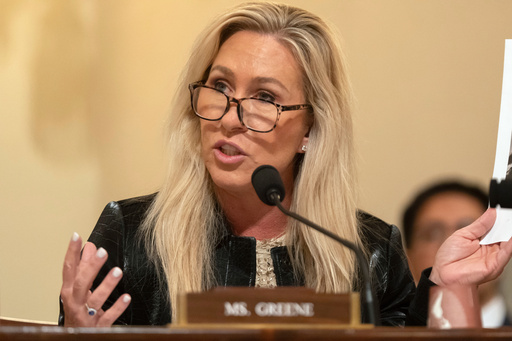
Marjorie Taylor Greene made waves. Her constituents don’t agree on whether it was worth it

DALTON, Ga. (AP) — President Donald Trump says Rep. Marjorie Taylor Greene is a traitor. But for Jackie Harling, who chairs the local Republican Party in Greene’s northwestern corner of Georgia, she’s still “mama bear.”

“Every thought that we had in our minds, she seemed to be very good at verbalizing,” Harling said.

Saying things that no one else would say may be Greene’s most durable legacy as she steps down on Monday, resigning halfway through her third term in Congress. First, it was her embrace of conspiracy theories and incendiary rhetoric, turning her into a national symbol of a political culture without guardrails. Then it was her willingness to criticize Trump, a schism that made her position in Washington untenable.

In interviews in Greene’s district, constituents described her over and over as a “fighter.” For Republicans like Harling, that was enough.

“We got a lot of satisfaction,” Harling said. “She was our voice.”

It was less satisfying for an independent like Heath Patterson, who struggled to think of ways that Greene’s fame and notoriety made a difference for her district during her time in the U.S. Capitol.

“I don’t know of anything that she did do here except, certainly, got her voice heard. But where did we, how did we benefit from that?” he said. “I don’t think we did.”

From MAGA warrior to exile

Greene began clashing with Trump last year, criticizing his focus on foreign policy and his reluctance to release documents involving the Jeffrey Epstein case. The president eventually had enough, saying he would support a primary challenge against her. Greene announced a week later that she would resign.

She has kept up the criticism since then, including over Trump’s decision to strike Venezuela this weekend.

“This is what many in MAGA thought they voted to end,” Greene wrote on social media on Saturday. “Boy were we wrong.”

The split was surprising because, until that point, Greene’s trajectory had mirrored Trump’s own rise to power. She didn’t become politically involved until his presidential campaign in 2016 and first ran for Congress in 2020. Greene considered trying to represent Georgia’s 6th congressional district, which includes the Atlanta suburbs, before relocating to the 14th, where the Republican incumbent was retiring.

She remained loyal to Trump after he lost to President Joe Biden, promoting his falsehoods about a stolen election. When Trump ran again in 2024, she toured the country with him and spoke at his rallies while wearing a red “Make America Great Again” hat.

Her Georgia district is one of the most Republican-leaning in the state, although it wasn’t always that way. The region once backed Democrats like Zell Miller, a governor and U.S. senator who spearheaded Georgia’s lottery program that still bankrolls college scholarships and early childhood education programs.

But residents have felt left behind by years of change, said Jan Pourquoi, a Belgian native who emigrated in 1987, became a U.S. citizen and later won local office in Whitfield County.

His county’s population has grown by roughly by 32% since 1990, which pales in comparison to statewide growth of 74%. As the U.S. becomes more urban, secular, and diverse, Pourquoi said residents believe they’re “culturally oppressed.”

“They see themselves as great Americans, proud Americans, Christian Americans, and that doesn’t fit the American model anymore as they see it,” said Pourquoi, who said he left the Republican Party because of Trump. Greene exemplified the political backlash, which he summarized as “stick it to them — any possible way you can.”

Georgia leaders, like those in many other states, have spent years drawing congressional districts to pack like-minded voters together. That means in red areas, whoever wins the Republican primary is virtually guaranteed to come out on top in the general election, incentivizing candidates like Greene with more hardline views.

The political landscape means former Republicans like Pourquoi or independents like Patterson say they have no shot at helping a centrist win.

“I’m kind of square in the middle,” said Patterson, adding that it sometimes feels like he’s “the only one around here who’s that way.”

Republicans plan their path forward

Whitfield County Republicans gathered at a local restaurant last month for their annual Christmas party, where seasonal decor and a visit from Santa Claus were intermingled with the red, white and blue regalia and a smattering of MAGA paraphernalia.

There was still deep affection for Greene and plenty of talk about the cultural issues she championed.

“I think it’s just the fact that she was unwavering in ‘America First,’” said Gavin Swafford, who worked on Greene’s initial campaign.

Swafford called her “an accountability representative” because of her clashes with Republican leaders.

Lisa Adams, a party volunteer, called Greene “our stand-up person.”

“Look at her stance on transgenderism. That’s a big one,” she said. “Abortion. That’s a big one.”

None of Greene’s inconsistencies — real or perceived — were a problem, they said.

For example, Greene has praised the Korean-owned solar panel factories in the district even after voting against Biden-era policies intended to boost production. She broke with Republicans, Trump included, and sided with Democrats who wanted to extend premium subsidies for Affordable Care Act health insurance customers.

None of the Republicans at the Christmas party expressed any interest in taking sides between Trump and Greene.

“I think it’s inevitable when you have two firebrands that are both stubborn,” Swafford said.

Asked whether the district missed having a more traditional lawmaker, the kind who might cut bipartisan deals and bring as much federal money as possible back home, Swafford was unconcerned.

“The biggest thing that Marjorie contributed wasn’t even in legislation,” he said.

Still, there was also a sense among some that Greene, for all her bare-knuckle politics, could have gone further.

Star Black, a Republican who is running to replace Greene, was already planning a primary challenge before she announced her resignation.

“You had a great representative who was a fighter. Well, you know what? I want to take it one step further,” Black said.

“Not only do you need a fighter,” Black said, “you need someone who is going to listen. You need someone who is going to represent you.”

How cocaine and corruption led to the indictment of Maduro

NEW YORK (AP) — A newly unsealed U.S. Justice Department indictment accuses captured Venezuelan President Nicolás Maduro of running a “corrupt, illegitimate government” fueled by an extensive drug-trafficking operation that flooded the U.S. with thousands of tons of cocaine.

The arrest of Maduro and his wife in a stunning military operation early Saturday in Venezuela sets the stage for a major test for U.S. prosecutors as they seek to secure a conviction in a Manhattan courtroom against the longtime leader of the oil-rich South American nation.

Attorney General Pam Bondi said in a post on X that Maduro and his wife “will soon face the full wrath of American justice on American soil in American courts.”

Here’s a look at the accusations against Maduro and the charges he faces.

Maduro faces drugs and weapons charges

Maduro is charged alongside his wife, his son and three others. Maduro is indicted on four counts: narco-terrorism conspiracy, cocaine importation conspiracy, possession of machine guns and destructive devices and conspiracy to possess machine guns and destructive devices.

Maduro is facing the same charges as in an earlier indictment brought against him in Manhattan federal court in 2020, during the first Trump presidency. The new indictment unsealed on Saturday, which adds charges against Maduro’s wife, was filed under seal in the Southern District of New York just before Christmas.

It was not immediately clear when Maduro and his wife, Cilia Flores, would make their first appearance at the courthouse in Manhattan. A video posted Saturday night on social media by a White House account showed Maduro, smiling, as he was escorted through a U.S. Drug Enforcement Administration office in New York by two federal agents grasping his arms. He was expected to be detained while awaiting trial at a federal jail in Brooklyn.

Maduro allowed ‘cocaine-fueled corruption to flourish,’ US says

The indictment accuses Maduro of partnering with “some of the most violent and prolific drug traffickers and narco-terrorists in the world” to allow for the shipment of thousands of tons of cocaine into the U.S. Authorities allege powerful and violent drug-trafficking organizations, such as the Sinaloa Cartel and Tren de Aragua gang, worked directly with the Venezuelan government and then sent profits to high-ranking officials who helped and protected them in exchange.

Maduro allowed “cocaine-fueled corruption to flourish for his own benefit, for the benefit of members of his ruling regime, and for the benefit of his family members,” the indictment alleges.

U.S. authorities allege that Maduro and his family “provided law enforcement cover and logistical support” to cartels moving drugs throughout the region, resulting in as much as 250 tons of cocaine trafficked through Venezuela annually by 2020, according to the indictment. Drugs were moved on go-fast vessels, fishing boats and container ships or on planes from clandestine airstrips, the indictment says.

“This cycle of narcotics-based corruption lines the pockets of Venezuelan officials and their families while also benefiting violent narco-terrorists who operate with impunity on Venezuelan soil and who help produce, protect, and transport tons of cocaine to the United States,” the indictment says.

Allegations of bribes and orders of kidnappings and murders

The U.S. accuses Maduro and his wife of ordering kidnappings, beatings and murders “against those who owed them drug money or otherwise undermined their drug trafficking operation.” That includes the killing of a local drug boss in Caracas, according to the indictment.

Maduro’s wife is also accused of accepting hundreds of thousands of dollars in bribes in 2007 to arrange a meeting between “a large-scale drug trafficker” and the director of Venezuela’s National Anti-Drug Office. In a corrupt deal, the drug trafficker then agreed to pay a monthly bribe to the director of the anti-drug office as well as about $100,000 for each cocaine-carrying flight “to ensure the flight’s safe passage.” Some of that money then went to Maduro’s wife, the indictment says.

Nephews of Maduro’s wife were heard during recorded meetings with confidential U.S. government sources in 2015 agreeing to send “multi-hundred-kilogram cocaine shipments” from Maduro’s “presidential hanger” at a Venezuelan airport. The nephews during the recorded meetings explained “that they were at ‘war’ with the United States,” the indictment alleges. They were both sentenced in 2017 to 18 years in prison for conspiring to send tons of cocaine into the U.S. before being released in 2022 as part of a prisoner swap in exchange for seven imprisoned Americans.

Operation to capture Maduro was a ‘law enforcement function,’ Rubio says

During a news conference, Secretary of State Marco Rubio and Dan Caine, the chairman of the Joint Chiefs of Staff, cast the military raid that captured Maduro and his wife as an action carried out on behalf of the Department of Justice. Caine said the operation was made “at the request of the Justice Department.”

Rubio, as he responded to a question about whether Congress had been notified, said the U.S. raid to get the couple was “basically a law enforcement function,” adding that it was an instance in which the “Department of War supported the Department of Justice.” He called Maduro “a fugitive of American justice with a $50 million reward” over his head.

___

Richer reported from Washington.

Asking Eric: Old resentment sour 50th high school reunion

Dear Eric: Why should I go to my 50th high school reunion? I received a phone call from a former classmate who wouldn’t give me the time of day when we were in school together. “You need to go!” No, thank you.

The cost is outrageous. Plus, most of the people I would like to see are either not going or are deceased.

During my high school years, I was not treated well by some of the students. I definitely did not like my high school years. If I wasn’t bullied, I definitely wouldn’t have been absent so many days. I would have had better grades and maybe a six-figure income.

So, once again, is there a reason to go?

– No Way to a Reunion

Dear Reunion: Nope!

There are some things that are unresolved from your time in high school years. But it’s unlikely that you’ll find the resolution you seek at a reunion because that’s not what reunions are for, generally. Moreover, you don’t want to go. In the grand scheme of things, not wanting to do something is a perfectly fine reason not to do it. Yes, your 50th high school reunion only happens once. But if it’s going to do you more harm than good, emotionally or economically, once is one time too many.

Dear Eric: I recently learned that I have a fatal disease, although there may be some treatments to lessen my symptoms for a while.

I don’t want to tell my family anything about my plight until January, so as not to spoil their holidays.

I want to tell my two adult children but allow them to decide when to tell their children (my grandchildren). Or is it better for me to tell them all together?

What is the best thing to do?

– Family News

Dear News: The simple (perhaps too simple) answer is to do whatever you need to feel cared for and supported. It’s very thoughtful of you to think of how this news will impact your loved ones, but you don’t have to carry this weight for a second longer than you want to. Your loved ones would surely do anything in their power to make this moment easier for you, so hold that idea in your mind as you decide when and how to deliver the news.

A less simple but more practical answer is that you should consider telling your children first. They’re going to have different questions than their children will and the conversation you have with them will work differently than a group conversation. You may find that you’ll need to manage the grandchildren’s feelings and responses more, as might your children. Whereas in a conversation with just the adults, you may find you all have capacity to feel however you feel and hold each other. This also allows your children time to process first, which then better prepares them to talk with their kids.

No matter what you decide, please remember that this diagnosis isn’t your plight alone. This is something that is happening to you, but it’s also happening to your family. In moments when it feels too complicated, scary, or overwhelming, know that you’re not alone and you don’t have to hold back what you’re feeling.

Dear Eric: How does a person respond when invited for dinner at someone’s home who has cats and dogs?

I am not a person who hates them. I get offended and heartbroken when they are mistreated. But I do take offense when people have them in the kitchen jumping and walking on tables where people are preparing and eating.

My closest friends do not have pets, but I have others who do, and I would love to share a meal with them but not at their home.

How should I respond to this? I don’t want to offend them or ruin a relationship. I just prefer not to have animal hair in my food.

– No Pets at the Party

Dear Party: You may be making too broad a generalization about pet owners. There are plenty of people who have pets that don’t get on the counter (I hope those St. Bernard owners are discouraging it, if for no other reasons than structural integrity). And there are others who keep their pet-friendly home so spotless you could eat off said counter and never find a hair. Every home is different.

If you’ve had personal experience with someone whose home didn’t make you comfortable, it’s fine to decline by telling them you’re not a pet person and you’d prefer that they come to you or that you eat out together. This allows you to bow out without obfuscating the truth. Frankly, you can decline joining someone for dinner for no reason at all.

Send questions to R. Eric Thomas at eric@askingeric.com or P.O. Box 22474, Philadelphia, PA 19110. Follow him on Instagram and sign up for his weekly newsletter at rericthomas.com.

City police calls – Jan. 4

EDITOR’S NOTE: The following information is summarized from the records of city, county and state police, fire and hospital agencies.

Arrests

Wednesday

Chance H. Anderson, 33, Washington (IN), resisting law enforcement, 11:33 p.m., by the Columbus Police Department, held with no bond.

Thursday

Riley S. Berger, 23, of 2540 Pearl St., Columbus, domestic battery, 12:48 a.m., by the Columbus Police Department, held with no bond.

Timotelin Velasco DeJesus, 32, of 6869 Bonesteel Drive, Columbus, operating a vehicle without every obtaining a license, Bartholomew County warrant, 2:10 a.m., by the Bartholomew County Sheriff’s Office, held with no bond.

Alonzo Perez Bartolo, 29, of 2102 Hawcreek Ave., Columbus, operating a vehicle while intoxicated, operating a vehicle with an ACE of .15 or more, operating a vehicle while intoxicated-endangerment, false reporting, obstruction of justice, false identity statement, operating a vehicle without ever obtaining a license, 2:20 a.m., by the Indiana State Police, held in lieu of $7,500 bond.

Abigail E. Wright, 50, Nashville, disorderly conduct, public intoxication, resisting law enforcement, 7:27 a.m., by the Columbus Police Department, held in lieu of $12,000 bond.

David G. Combs, 60, Hope, Bartholomew County warrant, 12:31 p.m., by the Columbus Regional Health police, held in lieu of $10,000 bond.

Fire, medic runs

Thursday

6:55 p.m. — Structure fire in the 800 block of Reed Street.

11:35 p.m. — Person injured in a fall in the 3200 block of North Marr Road.

Incidents

Thursday

1:57 a.m. — Loud music in the 3800 block of Rosewood Lane.

1:58 a.m. — Damage to property in the 3800 block of 25th Street.

10 a.m. — Subject refusing to leave in the 600 block of Third Street.

11:05 a.m. — Personal-injury accident at South County Road 300W and West County Road 450S.

12:18 p.m. — Theft in the 2400 block of Sims Court.

3:32 p.m. — Leaving the scene of a property-damage accident in the 3200 block of Berkdale Drive.

3:39 p.m. — Property-damage accident in the 3000 block of Columbus Center.

4:18 p.m. — Theft in the 2000 block of Indiana Avenue.

5:13 p.m. — Theft in the 100 block of Washington Street.

6:08 p.m. — Property-damage accident at Cottage Avenue and 11th Street.

9:23 p.m. — Shoplifting in the 3000 block of North National Road.

11:52 p.m. — Property-damage accident at East County Road 100S and South County Road 650E.

Looking Back – Jan. 4

Ashdyn Lucas, in glasses, Cindy Rodriguez, center, and Milton Sangabriel-Cortez, right, toss fake snow on each other in their pre-kindergarten class at the Busy Bees Academy in Columbus on Dec. 18, 2015.

2016

London-based film company Wavelength Pictures began producing a feature-length documentary about renowned architect Kevin Roche, who designed the U.S. Post Office and the Cummins Corporate Headquarters in Columbus.

2001

The 107th Congress was sworn in, including Columbus native and new Indiana Congressman Mike Pence. The morning festivities included a speech by Minority Leader Dick Gephardt, D-Mo., and Speaker Dennis Hastert, R-Ill.

1976

Jean Sneed was reelected president of the Hartsville Town Board during its first meeting of the year. James Mobley, Rex Imlay and Ann Hedrick also joined Sneed on the board.

Around Town — Jan. 4

Editor’s Note: Submissions to Around Town are opinions submitted anonymously by readers, not factual representations, and do not reflect the viewpoints of The Republic or its staff.

Jan. 4

Orchids to

Brittany Denton’s colorful macro photo of a fly.

the end of the unlawful deployment National Guard troops in Chicago, Los Angeles and Portland.

Elise Shrock for a very timely column reminding us what are the true values we should all work for.

Cole Bennett’s well written, thoughtful letter about Indiana’s lunkheaded approach to marijuana regulation.

the editorial about the good news regarding bookstores comeback and hopefully will continue.

all those who are working for peace, who believe in dialogue and negotiation and not in arms and bombs.

Yes Cinema for the New Years Eve Comedy Show.

the president of the United States for taking the strong and necessary action to address the drug crisis in our country while also helping the citizens of Venezuela.

the magnificent United States armed forces.

the long needed direct action to slow the flow of drugs into our country.

International aid groups grapple with what Israel’s ban will mean for their work in Gaza

TEL AVIV (AP) — Israel’s decision to revoke the licenses of more than three dozen humanitarian organizations this week has aid groups scrambling to grapple with what this means for their operations in Gaza and their ability to help tens of thousands of struggling Palestinians.

The 37 groups represent some of the most prominent of the more than 100 independent nongovernmental organizations working in Gaza, alongside United Nations agencies. Those banned include Doctors Without Borders, the Norwegian Refugee Council, Oxfam and Medical Aid for Palestinians.

The groups do everything from providing tents and water to supporting clinics and medical facilities. The overall impact, however, remains unclear.

The most immediate impact of the license revocation is that Israel will no longer allow the groups to bring supplies into the Gaza Strip or send international staffers into the territory. Israel says all suspended groups have to halt their operations by March 1.

Some groups have already been barred from bringing in aid. The Norwegian Refugee Council, for example, said it has not been allowed to bring in supplies in 10 months, leaving it distributing tents and aid brought in by other groups.

Israel says the banned groups make up only a small part of aid operations in Gaza.

But aid officials say they fulfill crucial specific functions. In a joint statement Tuesday, the U.N. and leading NGOs said the organizations that are still licensed by Israel “are nowhere near the number required just to meet immediate and basic needs” in Gaza.

The ban further strains aid operations even as Gaza’s over 2 million Palestinians still face a humanitarian crisis more than 12 weeks into a ceasefire. The U.N. says that although famine has been staved off, more than a quarter of families still eat only one meal a day and food prices remain out of reach for many; more than 1 million people need better tents as winter storms lash the territory.

Why were their licenses revoked?

Earlier this year, Israel introduced strict new registration requirements for aid agencies working in Gaza. Most notably, it required groups to provide the names and personal details of local and international staff and said it would ban groups for a long list of criticisms of Israel.

The registration process is overseen by Israel’s Ministry for Diaspora Affairs and Combating Antisemitism, led by a far-right member of the ruling Likud party.

Israel says the rules aim to prevent Hamas and other militants from infiltrating the groups, something it has said was happening throughout the 2-year-old war. The U.N., which leads the massive aid program in Gaza, and independent groups deny the allegations and Israeli claims of major diversion of aid supplies by Hamas.

Aid organizations say they did not comply, in part, because they feared that handing over staff information could endanger them. More than 500 aid workers have been killed in Gaza during the war, according to the United Nations.

Israel denies targeting aid workers. But the group say Israel has been vague about how it would use the data.

The groups also said Israel was vague about how it would use the data.

“Demanding staff lists as a condition for access to territory is an outrageous overreach,” Doctors Without Borders, known by its French acronym MSF, said Friday. It said Israeli officials had refused its attempts to find alternatives.

A December report on MSF issued by an Israeli government team recommended rejection of the group’s license. It pointed primarily to statements by the group criticizing Israel, including referring to its campaign in Gaza as genocide and calling its monthslong ban on food entering the territory earlier this year as “a starvation tactic.” It said the statements violated neutrality and constituted “delegitimization of Israel.”

The report also repeated claims that an MSF employee killed in by an Israeli airstrike in 2024 was an operative with the Islamic Jihad militant group. That, it said, suggested MSF “maintains connections with a terrorist group.”

MSF on Friday denied the allegations, saying it would “never knowingly employ anyone involved in military activities.” It said that its statements cited by Israel simply described the destruction its teams witnessed in Gaza.

“The fault lies with those committing these atrocities, not with those who speak of them,” it said.

Aid groups have a week from Dec. 31 to appeal the process.

Medical services could see biggest impact

Independent NGOs play a major role in propping up Gaza’s health sector, devastated by two years of Israeli bombardment and restrictions on supplies.

MSF said Israel’s decision would have a catastrophic impact on its work in Gaza, where it provides funding and international staff for six hospitals as well as running two field hospitals and eight primary health centers, clinics and medical points. It also runs two of Gaza’s five stabilization centers helping children with severe malnutrition.

Its teams treated 100,000 trauma cases, performed surgeries on 10,000 patients and handled a third of Gaza’s births, the group says. It has 60 international staffers in the West Bank and Gaza and more than 1,200 local staff — most medical professionals.

Since the ceasefire began in early October, MSF has brought in about 7% of the 2,239 tons (2,032 metric tonnes) of medical supplies that Israel has allowed into Gaza, according to a U.N. tracking dashboard. That makes it the largest provider of medical supplies after U.N. agencies and the Red Cross, according to the dashboard.

Medecins du Monde, another group whose license is being halted, runs another four primary health clinics.

Overburdened Palestinian staff

Aid groups say the most immediate impact will likely be the inability to send international staff into Gaza.

Foreign staff provide key technical expertise and emotional support for their Palestinian colleagues.

“Having international presence in Gaza is a morale booster for our staff who are already feeling isolated,” said Shaina Low, communications adviser for the Norwegian Refugee Council, which is one of the main NGOs providing shelter supplies and fresh water to displaced people.

NRC has roughly 30 international staff who rotate in and out of Gaza working alongside some 70 Palestinians.

While any operations by the 37 groups in the West Bank will likely remain open, those with offices in east Jerusalem, which Israel considers its territory, might have to close.

Halt on supplies

Many of the 37 groups already had been blocked from bringing supplies into Gaza since March, said Bushra Khalidi, Oxfam’s policy lead for Israel and the occupied Palestinian territories.

What changes with the formal license revocation is “that these practices are now formalized, giving Israel full impunity to restrict operations and shut out organizations it disagrees with,” she said.

Some of the groups have turned to buying supplies within Gaza rather than bringing them in, but that is slower and more expensive, she said. Other groups dug into reserve stocks, pared down distribution and had to work with broken or heavily repaired equipment because they couldn’t bring in new ones.

Amed Khan, an American humanitarian philanthropist who has been privately donating medicine and emergency nutrition for children to Gaza, said the impact extends beyond the aid groups.

He relies on NGOs to receive and distribute the supplies, but the fewer groups that Israel approves, the harder it is to find one.

“It’s death by bureaucracy,” he said.

Region police calls – Jan. 4

JENNINGS COUNTY

Arrests

Thursday

Timothy Crouch, 31, North Vernon, out of county warrant, 5:18 p.m., by the Jennings County Sheriff’s Office, no bond.

Incidents

Thursday

5:51 p.m. — Burglary in the 2000 block of North Hickory Circle.

7:54 p.m. — Gunshot injury in the 200 block of Pennsylvania Avenue.

Amid wildfire grief, an LA-area resident sowed sunflowers and hope where her home once stood

ALTADENA, Calif. (AP) — Missi Dowd-Figueroa brought life back to the fire-ravaged plot where her home once stood — one sunflower at a time.

The registered nurse and mother of three lost her 1898 farm-style house in the Eaton Fire, one of two deadly wildfires that tore through the Los Angeles area last January, obliterating entire neighborhoods and displacing tens of thousands of people.

A year later, many are still grappling with grief and sorrow. Few have been able to rebuild so far, and the rest face no shortage of challenges.

“The Altadena I know and love is gone,” Dowd-Figueroa said, referring to the suburb devastated by the fire. “Everything burned down — my dentist, my pharmacy — all of it’s gone. But there’s still something about Altadena that feels like Altadena now, even though there are no homes.”

She’s among those who decided to stay. Her process of healing started with tiny seeds that gave her hope and eventually turned her barren property into a flourishing garden.

Dowd-Figueroa and her family had lived in the four-bedroom, three-bath house for 10 years. It was the longest she’d ever lived in one place, and the sense of loss left her stricken by waves of sadness.

For months, she would drive to the empty lot and cry. Her grief and shock deepened when she realized that, in addition to her late grandmother’s artwork that was in her home, her father’s ashes were gone forever.

“I spent several days digging through the ashes just looking for his little urn, and I never found it,” said Dowd-Figueroa, 44.

Gone, too, were every family photo except those saved on her iPad.

“That was like a second grief, too. I was like, ‘Well, great.’ Now, if my dad knew, he’d be so disappointed because he was such a family lineage type of person,” she said. “I have nothing from my father. You know, I’ll never touch anything that he touched ever again.”

Then one day, after cleanup crews had removed the last of the debris from the 2,000-square-foot lot, she brought along some flower seeds. They were mostly sunflowers, but also included zinnias and cosmos, among others, and planted them in the soil.

“I was already going there every day crying, so I was like, ‘Why am I just sitting here?’ I might as well do something that keeps me busy, and I enjoy, because the house I’m in now, I can’t have a garden,” she said.

Sunflowers can take up cadmium and other heavy metals that can be left behind in the soil, though experts debate their effectiveness after a wildfire. Dowd-Figueroa hoped they would help remove toxins on her property once she ripped them out by the roots and tossed them after they died, being careful not to leave behind seeds.

For several months, while Dowd-Figueroa and her husband took steps toward eventually building a new home, the garden flourished, blanketing a large swath of the lot with a colorful display of approximately 500 flowers — bright orange and red ones, as well as yellow ones with giant heads.

“It was really healing just to come back and tend the space where I lived for the longest time in my life,” she said.

Butterflies began to appear, along with a variety of insects and small animals.

“I felt like I was helping nature come back a little bit,” she said.

Construction began on Dowd-Figueroa’s new home in late September, thanks in part to around $100,000 in donations via a fundraising site. By then, the sunflowers, most of which bloom once and then die, were nearly all gone.

That’s OK. With construction proceeding and estimated to be completed as soon as mid-June, the slowly emerging shape of her new home is now lifting Dowd-Figueroa’s spirits.

“Prior to this, I was just so depressed, like literally sobbed every day,” she said. “It just feels like now there’s a place that exists. It will happen. We can do this.”

__

Associated Press reporter Dorany Pineda contributed from Los Angeles.