Home Blog Page 17425

Regional Hospital, Police – June 28

Region Police

JENNINGS COUNTY

Arrests

Tuesday

Alexandrew L. Mullikin, 26, Columbus, theft — receiving stolen auto parts, 9:52 a.m., by the Jennings County Sheriff’s Department, $1,055 bond.

Kerry M. Watkins, 38, Uniontown, resisting law enforcement, possession of paraphernalia, probation violation, for criminal trespass, 12:47 p.m., by the Jennings County Sheriff’s department, no bond.

Travis L. Reynolds, 40, Seymour, warrant, 12:50 p.m., by the Jennings County Sheriff’s Department, no bond.

David Eggert, 18, North Vernon, possession of a firearm by a serious violent felon, carrying a firearm without a license, possession of stolen property, resisting law enforcement, parole warrant, 11:50 p.m., by the Jennings County Sheriff’s Department, $5,155 bond.

Incidents

Tuesday

12:22 p.m. — Accident with property damages in the 600 block of East Buckeye Street.

3:24 p.m. — Theft in the 900 block of Buckeye Street.

5:45 p.m. — Traffic accident in the 1900 block of County Road 350N.

Local Police, Fire – June 28

Police, Fire

EDITOR’S NOTE: The following information was summarized from the records of city, county, and state police, fire and hospital agencies.

Arrests

Monday

Norma R. Krebbs, 45, of 969 Jonesville Road, Columbus, Bartholomew County warrant, 6:23 p.m., by the Bartholomew County Sheriff’s Department, held on $750 bond.

Jeremy T. Calhoun, 28, of 540 First St., Columbus, Bartholomew County warrant, 8:48 p.m., by the Columbus Police Department, held without bond.

Adam S. Mitchell, 23, of 903 Chestnut St. — 1, Columbus, Bartholomew County warrant, 9:57 p.m., by the Columbus Police Department, held on $3,500 bond.

Tuesday

Rick Smallwood, 58, of 656 Clifty Drive, Columbus, two body attachments, 12:53 a.m., by the Bartholomew County Sheriff’s Department, held on $700 bond.

Johnny L. Gibson, 51, Scottsburg, Bartholomew County warrant, 2:09 a.m., by the Bartholomew County Sheriff’s Department, held without bond.

Tyler E. Burton, 34, 16042 E. County Road 265N, Columbus, operating a vehicle while intoxicated, 2:09 a.m., by the Bartholomew County Sheriff’s Department, released on $2,500 bond.

Judy A. Pena, 39, of 2131 McClure St., Columbus, out-of-county warrant, 3:45 a.m., by the Columbus Police Department, held without bond.

Summer D. Jones, 25, of 446 Della Road, Columbus, theft — receiving stolen property, possession of marijuana, legend drug injection devices, visiting a common nuisance, Bartholomew County warrant, 4:06 a.m., by the Bartholomew County Sheriff’s Department, held on $81,000 bond.

Courtney M. Jones, 38, 302 Pennsylvania St., Elizabethtown, theft — receiving stolen property, false informing, possession of marijuana, possession of methamphetamine, legend drug injection devices, visiting a common nuisance, Bartholomew County warrant, 4:41 a.m., by the Bartholomew County Sheriff’s Department, held on $193,500 bond.

George P. Perez Jr., 32, of 1436 Sycamore St. — 2, Columbus, theft — receiving stolen property, possession of a firearm by a serious violent felon, possession of marijuana, maintaining a common nuisance, 7:23 a.m., by the Bartholomew County Sheriff’s Department, held on $58,500 bond.

Trey Allen Smith, 24, of 1520 Sycamore St., Columbus, dealing in methamphetamine, possession of methamphetamine, driving while suspended, 8:07 a.m., by the Columbus Police Department, held on $262,500 bond.

Terry A. Barnhart, 36, of 6780 W County Road 450S, Columbus, probation violation, 8:49 a.m., held without bond.

Fire, medic runs

Tuesday

8:15 a.m. — Unconscious person in the 7400 block of North County Road 825E.

9:46 a.m. — Person injured in the 500 block of Ridgeview Lane.

11:46 a.m. — Person injured in a fall in the 200 block of Coovert Street.

5:33 p.m. — Vehicle fire in the 2500 block of Central Avenue.

8:41 p.m. — Person injured in a fall in the 3000 block of 10th Street.

Incidents

Tuesday

1:02 a.m. — Battery in the 1800 block of Eighth Street.

3:18 a.m. — Theft in the 100 block of Cambridge Court.

4:50 a.m. — Theft in the 2300 block of Meadow Bend Drive.

7:44 a.m. — Property-damage accident in the 200 block of Jonesville Road.

8:53 a.m. — Theft reported to the police department.

11 a.m. — Shoplifting in the 4100 block of West Jonathan Moore Pike.

11:11 a.m. — Property-damage accident at the intersection of 10th Street and McClure Road.

11:17 a.m. — Theft attempted in the 2000 block of Seventh Street.

11:50 a.m. — Property-damage accident in the 2000 block of 25th Street.

12:13 p.m. — Property-damage accident at the intersection of North National Road and Central Avenue.

12:27 p.m. — Theft in the 2500 block of West Appleblossom Lane.

1:31 p.m. — Property-damage accident at the intersection of Jonesville Road and West Jonathan Moore Pike.

1:50 p.m. — Theft in the 2200 block of West Jonathan Moore Pike.

2:07 p.m. — Personal-injury accident at the intersection of North County Road 650E and East Base Road.

2:15 p.m. — Property-damage accident at the intersection of East 25th Street and North County Road 650N.

2:47 p.m. — Shoplifting in the 1800 block of North National Road.

2:59 p.m. — Property-damage accident in the 1900 block of 25th Street.

3:44 p.m. — Property-damage accident at the intersection of 10th and Pennsylvania streets.

4:25 p.m. — Theft in the first block of South Brooks Street.

5:10 p.m. — Criminal mischief or vandalism in the 400 block of Pence Street.

5:37 p.m. — Criminal mischief or vandalism in the 1200 block of Eighth Street.

5:50 p.m. — Personal-injury accident at the intersection of North County Road 325W and West County Road 200N.

5:50 p.m. — Property-damage accident in the 10000 block of South U.S. 31.

6:27 p.m. — Residential entry in the 1700 block of West County Road 650N.

7:49 p.m. — Theft in the 4500 block of Progress Drive.

8:06 p.m. — Personal-injury accident at the intersection of East Southern Crossing and South County Road 150E.

9:45 p.m. — Subject refusing to leave in the 2000 block of Merchants Mile.

10:05 p.m. — Battery reported to the police department.

10:30 p.m. — Theft in the 2700 block of Scotland Drive.

‘SAVAGE BUILDS’: GOOD, CLEAN, EXPLOSIVE FUN

— Among the more rewarding new cable series, "Savage Builds" (10 p.m., Discovery, TV-PG) enters its third week.

Adam Savage of "MythBusters" fame tweaks the concept of his old show just a bit. Instead of testing urban legends and science-fiction fantasies, he’ll set out to use cutting-edge engineering and technology to build and/or perfect devices from comic books or the pages of history. OK, it’s basically "MythBusters" without Savage’s old entourage.

Over the course of the first two episodes, available to stream on Discovery.com, Savage used a 3D printer to create a "real" Iron Man suit and tested a wildly unsuccessful wonder weapon from World War II.

The Iron Man experiment called on a specialty printer that extruded parts made of titanium, or rather a coating of titanium melted onto a surface with the use of powerful lasers. Savage’s inner 13-year-old has a blast with this segment.

He’s also like a kid in a toy store when trying to recalibrate the Panjandrum, a giant wonder weapon devised by the British for the purpose of storming French beaches in an Allied invasion.

Imagine two massive wheels connected by a huge cylinder filled with explosives. And the wheels were propelled by rockets, designed to drive the massive device over enemy barbed wire and minefields and onto an entrenched enemy position, where it would explode.

The problem with the Panjandrum was the near impossibility of getting its dozens of rockets to launch simultaneously. Archive footage shows the device spinning wildly and falling over like an explosion of Roman candles.

More than 75 years after its conception, Savage enlists an engineer from the Jet Propulsion Laboratory’s Mars probe to put a 21st-century spin on the Panjandrum. Not to give too much away (you can stream this right now), newer technology only confirms some of the device’s old-school problems.

Perhaps the best thing about "Savage Builds" is the host’s enthusiasm for learning, teaching and experimenting. He’s just as goofy and joyous watching something fail as succeed, demonstrating that in science and engineering, it’s just as important to understand why something doesn’t work as why it does.

— Netflix begins streaming the imported Brazilian series "The Chosen One." This medical thriller/fantasy follows three idealistic doctors who travel to a remote village to deliver a vaccine against Zika virus, only to find themselves captive and captivated by a mysterious figure who has been using supernatural means to cure disease.

— Also on Netflix, the documentary series "Exhibit A" following cases where innocent people have been convicted using dubious forensic techniques, such as touch DNA and cadaver dogs.

— On "CMT Crossroads" (10 p.m., TV-PG), a Nashville celebration of the duo Brooks and Dunn, featuring Luke Combs, Brett Young, Midland, Cody Johnson, Jon Pardi and Brandon Lancaster from LANCO.

TONIGHT’S OTHER HIGHLIGHTS

— A "Whistleblower" (8 p.m., CBS, TV-14) challenges the Army Corps of Engineers.

— A ride home from a stranger on "Marvel’s Agents of S.H.I.E.L.D." (8 p.m., ABC, TV-14).

— "20/20" (9 p.m., ABC) profiles a Texas man who manipulated his children into accompanying him on bank robberies.

— An altercation leaves Danny rattled on "Blue Bloods" (10 p.m., CBS, r, TV-14).

CULT CHOICE

— A wildly uneven period piece, the 1971 tragicomedy "Some of My Best Friends Are …" (8 p.m., TCM) profiles the closeted clientele of a New York gay bar, evoking an atmosphere that predated the Stonewall uprising that began 50 years ago today. Look for Rue McClanahan, Fannie Flagg and Warhol superstar Candy Darling.

SERIES NOTES

North by Northwest on "American Ninja Warrior" (8 p.m., NBC, r, TV-PG) … Embedded cameras follow "First Responders Live" (8 p.m., Fox, r, TV-14) … Dean Cain hosts "Masters of Illusion" (8 p.m., CW, TV-PG), followed by a repeat.

A case gets personal on "Hawaii Five-0" (9 p.m., CBS, r, TV-14) … A pool party theme on "MasterChef" (9 p.m., Fox, r, TV-14) … Spectacle galore on "The Big Stage" (9 p.m., CW, TV-PG), followed by a repeat … "Dateline" (10 p.m., NBC, TV-PG).

LATE NIGHT

"The Late Show With Stephen Colbert" (11:35 p.m., CBS) is a repeat … Jimmy Fallon welcomes Selena Gomez, Elaine Welteroth and GoldLink featuring Maleek Berry on "The Tonight Show" (11:35 p.m., NBC) … Joel McHale, Betty Gilpin and Santana appear on "Jimmy Kimmel Live" (11:35 p.m., ABC, r).

Kevin Bacon, Cobie Smulders, Jordan Klepper and Jessica Burdeaux visit "Late Night With Seth Meyers" (12:35 a.m., NBC, r) … Zoe Saldana, Jason Clarke and Kenny DeForest appear on "The Late Late Show With James Corden" (12:35 a.m., CBS, r).

Teacher considers housing former student

Dear Amy: I’m a high school teacher. I’m still in email contact with a transgender student (female to male), who graduated a couple of years ago.

This former student has cycled in and out of treatment centers (for eating disorders, suicidality, etc.)

I’m one of the few adults that this young man still keeps in contact with. The family is unsupportive.

If this young adult ends up homeless, which I fear might happen, what are my responsibilities and obligations?

I have a small house, where I live with my husband and 17-year-old son.

We could turn a storage room into a bedroom, if we had to.

Should my attempts to help this young adult be limited to giving the best advice I can, or should I “put my money where my mouth is,” so to speak, and offer up a room, even if I’m not really excited about the prospect?

My husband is easy-going, and my son is a wellspring of empathy, so I think they both would be OK with it.

I’d like to know what you think about this. I went into teaching to change lives. Does that end with graduation?

— Always a Teacher

Dear Teacher: I applaud your commitment and emotional support to this young man. Transgender youth are at an elevated risk for addiction, suicide and homelessness.

No, your connection does not need to end with graduation. Countless scholars and survivors of challenging home environments describe hero teachers, guidance counselors, coaches and school librarians who opened their hearts, wallets, and occasionally homes when these students had nowhere else to turn.

However, you leap from offering advice to (reluctantly) offering housing. There are so many ways in-between the two extremes where you can support and mentor this former student in order to try to keep him safe as he makes his way in the world.

You should connect him with a social worker locally who can help him to explore what services might be available to him. Make an appointment and attend the meeting with him.

Glaad.org has a growing list of resources for transgender people; the Trevor Project (thetrevorproject.org) offers impressive points of contact (including a 24-hour hotline and texting support) directed toward trans youth.

You should use your research skills as a teacher to learn everything you can about the transgender experience. Offer your ongoing friendship and support.

If you believe that offering him housing is the only way to keep him off the streets, then yes — discuss this with a social worker or counselor with expertise in trans issues, and hold a family meeting and discuss this with your husband and son. You should only do this with your family’s full support.

Dear Amy: We are experiencing serious problems with my husband’s mother and brother.

Mother has been diagnosed with dementia, and brother is a severe alcoholic. He’s on psych medicines, but we have no way to tell if he’s taking them.

They have called 14 times today, and it’s just barely 10 p.m.

My brother-in-law calls at 5 a.m. when I am asleep, and at 10:30 p.m. when my husband is asleep.

They also have a knack for calling every single day to interrupt our dinner.

Short of changing our phone number, or filing a restraining order, is there anything we can do?

This is starting to affect our marriage.

— Ringing in my Ear

Dear Ringing: A restraining order would not be useful in dealing with someone with dementia or other mental illness.

I’m assuming that you have a landline. One advantage of a cellphone is that you can turn the ringer off — and still see calls as they come in. With a landline, you can physically unplug the phone, but I assume that you are nervous about doing this, in case there is an emergency. You might also be able to mute the ringer on a landline phone (depending on the brand of phone you have).

You should look into getting a low-cost cellphone. You can have calls forwarded to the cellphone from the landline, and that way you can silence the phone but still know if a call has come in.

Dear Amy: Thank you for the response to “Cold Turkey in Maryland,” who chastised his relatives for starting their holiday dinner without them.

The person who is late bears the burden of their lateness, not the host of 20 other guests.

— Been There

Dear Been There: Yes, you don’t get to gripe if you are the one pulling in a half-hour late.

Greater lead testing by officials welcome effort

Hazardous material suits are worn when workers remove lead paint from older homes, to minimize health and environmental risks.

The general health of community residents should be an utmost concern for its governing officials and agencies. That means water, air and soil free of toxins and pollutants, for example.

When actions to help in that regard can be taken, they should be. 

So, the fact that local health officials are increasing lead testing efforts in children is appreciated.

The Bartholomew County Health Department is using a $10,000 grant from the state health department to increase the screening of children who could be at risk for lead poisoning.

Lead poisoning is a valid concern. The toxic metal has been linked to developmental difficulties and neurological damage. Unborn babies and children under age 6 are the most at risk.

It’s also a concern for those who live in older homes that may have been painted with lead-based paint, or constructed with lead pipes for the plumbing components. Lead that seeps into the soil and gets into drinking water can potentially make a person ill.

Local health officials are focusing their efforts on the Lincoln-Central neighborhood, an area of the city with older homes and higher child poverty rates, factors that increase the risk for lead poisoning.

They’re also ramping up awareness efforts. The local health department has made presentations to five doctor’s offices and distributed flyers to apartments located near schools. Also, an information session was conducted recently at the Columbus Learning Center.

Those who think they might be at risk for lead poisoning should do their part and contact the local health department to get more information.

The local health department is doing its part to help those who are more vulnerable to exposure, because lives matter.

Education key to economy; focus shouldn’t shift from college

Michael Hicks Submitted photo

I gave a talk to the Indiana Superintendent’s Summit, and thought the issues I discussed might be of interest to Hoosiers as we think about our state’s economy.

I began by sharing what the state’s Constitution says about education: “Knowledge and learning, general diffused throughout a community, being essential to the preservation of a free government; it should be the duty of the General Assembly to encourage, by all suitable means, moral, intellectual scientific, and agricultural improvement … a general and uniform system of Common Schools.”

This is exactly what an economist would say schooling does for an economy. Note that there is nary a word about filling ‘in demand jobs’ or satisfying the whims of important employers. That is because the authors of the Indiana Constitution knew state government did not have the competence to do such things, as current workforce policies are keen to demonstrate.

I told the audience that labor markets are in the midst of a half century of marked change. Jobs have been significantly polarized into high-wage, highly educated jobs and low-wage, poorly educated jobs. There is also a growing geographic concentration of such jobs, with better-educated workers concentrating in urban places.

Indiana is at elevated risk of this trend affecting us. We lead the nation in occupations that are at risk of automation. While we cannot know with certainty where this trend is headed, there are clear lessons from the past 50 years. Maybe the most important of these was that future job skills are likely to demand more fundamental learning, or what the Indiana Constitution calls “general diffused.” This learning takes place almost exclusively in classrooms focusing on basic and advanced literacy and mathematics. These skills allow us to learn the more complex tasks of work.

It seems likely that the most critical skills of the future will be those that allow students to adapt, learn new tasks and become productive in a highly automated environment. I then shifted to Indiana’s experience, which is more worrisome than it should be.

Following the Great Recession, employment growth in Indiana has been very different from the nation as a whole. More than eight in 10 new jobs nationally have gone to college graduates, but here in Indiana it is only about one in six new jobs. This, I noted is a complex problem, but one root cause is simply a failure to have an adequate supply of college graduates. Jobs move to people far more than people move to jobs.

I told the audience that the best evidence suggests the school reforms of 2008-2010 have been successful. We can tell this from the National Assessment of Educational Progress exams that are administered nationwide. These aren’t perfect, but they do indicate Indiana has pulled above the national average in both reading and math. This is a monumental victory for Indiana and for public education in Indiana.

It also appears that higher education is doing well. For every 100 students Indiana sends to an out-of-state school, we bring 260 students from out-of-state into our colleges and universities. Indiana has three schools in the national top 100 public research universities, which are student magnets. We have strong higher education, but not enough Hoosier kids are going to college.

The drop-off in college attendance in Indiana seems to accompany broad efforts to downplay the importance of both K-12 and college education. It is difficult to understand the motives for this, especially after the Daniels Administration was so aspirational in its efforts to promote educational attainment.

It is a simple fact that inflation-adjusted spending on both higher education and K-12 has dropped since 2010. As I’ve written before, the educational attainment profile of Indiana’s labor force has now slipped beneath Kentucky’s. This is worse for the state’s economy than if our tax climate had slipped beneath that of Illinois. In terms of improving human capital, this economic recovery has been wasted.

There are other worrisome trends as well. Our statewide community college system holds Indiana in last place in two-year college graduation rates and much of our workforce training dollars are spent on occupations with declining wages. Thus, we are paying to train men and women in the occupations of the past, not the future. This type of error would not surprise those who penned Indiana’s Constitution. I also warned that loosening graduation requirements and increasing vocational focus down to elementary schools would reduce the share of Hoosier kids who go to college in the coming years.

Finally, I told the assembled school superintendents that a successful Indiana would have to send many more children to college, perhaps 10,000 per year. I asked them to have frank conversations with their school boards, teachers and families about this challenge. I also told them that this was a non-partisan issue, and the focus on more education was not about teachers or professors, but the very future of Indiana’s economy.

Michael J. Hicks is the director of the Center for Business and Economic Research and an associate professor of economics in the Miller College of Business at Ball State University. Send comments to editorial@therepublic.com.

Letter: Planting native perennials has many benefits

Businesswoman hand working with new modern computer and writing

From: Eric Riddle

Columbus

What is able to beautify landscapes, increase garden yields, support bees, increase property values and reduce pollution?

The answer is planting native perennial wildflowers and grasses.

June 17-23 was National Pollinator Week. Locally, the Sierra Club and Friends of Pollinator Parks group celebrated at Blackwell Park with a seed swap and a plant identification tour of the new 1,800 square feet of flowers planted in April.

The flowers are easily viewed from the People Trail between River Road and Parkside Drive.

This summer, please consider the benefits of planting native perennials. Compare the benefits versus spending time fertilizing, mowing, weeding and manicuring grass — a plant with few environmental benefits.

Some of the best online resources for choosing plants can be found at the Xerces Society and the Lady Bird Johnson Flower Center. If you are curious about making your yard a colorful home for bees and butterflies, check out the Million Pollinator Garden Challenge at millionpollinatorgardens.org.

If you want to learn more about ongoing activities in Columbus to support pollinators, check out the Friends of Pollinator Plants and Winding Waters Sierra Club group on Facebook.

Planting with a purpose starts with one seed.

Assisted-living housing project for seniors underway

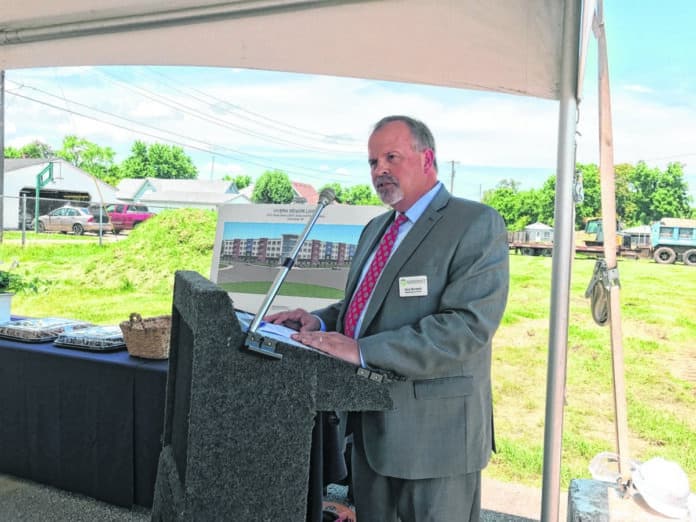
Gardant Management Solutions CEO Rod Burkett speaks during Thursday's groundbreaking ceremony of Vivera Senior Living of Columbus. Burkett's firm will provide various personal services for the elderly who will reside in the 114-unit affordable assisted living community being built at 1971 State St.

COLUMBUS, Ind. — A project creating an affordable assisted-living community that will rise above the State Street corridor where the Bartholomew County Annex building used to be is officially underway.

The four-story Vivera Senior Living of Columbus is going up on the 2.37-acre vacant lot near State and Mapleton streets, where the State Street School was originally constructed in 1928. Nearly 30 people attended a ground-breaking ceremony Thursday afternoon at the construction site, which has been a vacant lot since late 2015.

Apartments in the 84,500-square-foot building, which will include 52 efficiency units and 62 one-bedroom units, will be unique in Bartholomew County, said Robin Hilber, Columbus community development programs coordinator.

Please read Saturday’s edition of The Republic for more details.

Juneteenth celebration Saturday

Zoe Tucker

Juneteenth, the annual celebration of the official end of slavery, was rained out June 15. And now the rescheduled version will be 10 a.m. to 6 p.m. Saturday along Fourth Street in downtown Columbus.

The day was first celebrated in 1865, when Texas became the final Confederate state to free its slaves, three years after the Emancipation Proclamation, such was the slow pace of news and change in those days.

The event is free, and will feature food live music from performers such as Columbus singer-songwriter Zoe Tucker, information booths and more, according to organizers.

The Bartholomew County Area Chapter of the NAACP organizes the event. 

Since the day began being marked locally in 2001, area NAACP members have said that they see Juneteenth partly as a way to celebrate diversity in general and black culture in particular. Some years in the past, a religious observance and a musical celebration were conducted on separate days of the same weekend as the larger overall event.

Local organizations receive $64K in arts grants

Columbus Indiana Philharmonic Music Director David Bowden leads the orchestra in a warm up before the annual Salute concert next to the Bartholomew County Memorial for Veterans in Columbus, Ind., Friday, May 24, 2019. Mike Wolanin | The Republic

The Indiana Arts Commission has awarded 10 local organizations and entities, ranging from orchestras to cultural festivals, grants totaling more than $64,000 for the 2020 fiscal year.

The Columbus Indiana Philharmonic, with an annual budget of $1 million, landed the largest amount with $16,876, to be used as part of its general operating budget. Margaret Powers, Philharmonic executive director, said the funds are significant not only in dollars, but in acknowledging the challenge of arts-related fiscal health.

“It’s a recognition that arts organizations sometimes have a difficult task raising money for general operating expenses,” Powers said.

She pointed out that orchestral concert ticket sales account for only about 25 percent of the organization’s operating expense.

The professional orchestra’s budget and funding story is significant, especially at a time when many orchestras have struggled or disbanded.

The Columbus Area Arts Council will receive $11,042, which goes toward general operating expenses and general program support, according to Kathryn Armstrong, arts council executive director.

“One of the things we particularly appreciate about our partnership with the state (agency) is its effort in bringing more awareness that we’re a state filled with strong interdisciplinary arts programs with very creative people making Indiana even more interesting,” Armstrong said.

Our Hospice of South Central Indiana will use its $5,000 grant partly for fees for performers for its Broadway memories concert it successfully launched last summer to help patients with dementia via the national Music & Memory program. The 2019 concert is scheduled in September.

According to the arts commission, the Bartholomew County Public Library will use its $2,000 grant related to expenses for two art classes in conjunction with its 50th anniversary celebration of the Cleo Rogers Memorial Library building that is a part of the Bartholomew County Public Library.

In one class, participants will make fabric dolls in honor of late librarian Cleo Rogers. In another, participants will sketch the building and its surroundings.

Other agencies and their grant totals are:

Dancers Studio Inc., $7,356

Columbus Symphony Orchestra, $6,383

Columbus Scottish Festival. $5,000

Ethnic Expo, $5,000

Columbus City Band, $5,000

Ivy Tech Community College, $500

Lewis Ricci, a former executive director of the Columbus Area Arts Council, is executive director of the Indiana Arts Commission.

[sc:pullout-title pullout-title=”To see more” ][sc:pullout-text-begin]

To view the complete listing of organizations statewide that received grants from the Indiana Arts Commission, go online at in.gov/arts/2337.htm.

[sc:pullout-text-end]