Home Blog Page 322

Chicago Bears Pro Bowl center Drew Dalman is retiring after 5 seasons, AP source says

CHICAGO (AP) — Chicago Bears Pro Bowl center Drew Dalman is retiring after five seasons, a person with knowledge of the decision said Tuesday.

The person spoke to The Associated Press on condition of anonymity because he hasn’t publicly announced his plans. ESPN first reported the decision.

The 27-year-old Dalman played a big role in solidifying the interior of the offensive line after signing a $42 million, three-year contract last March. He made his first Pro Bowl after spending his first four seasons in Atlanta and helped Chicago win the NFC North at 11-6.

The only Bears player to participate in every offensive snap, Dalman was a key figure in the transformation of the line. The Bears also traded for All-Pro left guard Joe Thuney, signed guard Jonah Jackson and drafted Ozzy Trapilo, who emerged as the starting left tackle during the season.

Improved protection helped quarterback Caleb Williams go from being sacked a franchise-record and league-leading 68 times as a rookie to setting a Bears mark by throwing for 3,942 yards in his second year. With Dalman retiring and Trapilo expected to miss most of next season after tearing the patellar tendon in his left knee in the wild-card win against Green Bay, Chicago has two big holes on the offensive line. The NFL’s free agent negotiating period begins Monday and players can begin signing on March 11.

The Bears are looking to build on a breakthrough season in their first year under coach Ben Johnson. They won the NFC North for the first time since 2018 and advanced in the playoffs for the first time in 15 years by beating the Packers, before losing to the Los Angeles Rams in overtime.

___

Maaddi contributed from Tampa, Florida.

___

AP NFL: https://apnews.com/hub/NFL

With 100 days to go, World Cup faces new challenges with Iran war and Mexico violence

GENEVA (AP) — With 100 days to go until the World Cup, the Iran war has added a new layer of complexity to the tournament co-hosted by the United States, Mexico and Canada.

How the conflict will affect the world’s most watched sporting event is the latest issue facing organizers already grappling with cartel violence in one of Mexico’s host cities, scaled-back plans for fan festivals in the U.S. and criticism from fans against soaring ticket prices.

Officials of the qualified teams are meeting with FIFA staff in Atlanta this week. The tournament kicks off on June 11 when Mexico plays South Africa in Mexico City. It will be the biggest World Cup ever with 48 participating teams, up from 32 at the previous tournament in Qatar.

Here’s a look at some of the issues drawing scrutiny as the countdown began.

A backdrop of geopolitical tension

It’s not unusual for international politics to overshadow a global sports event like the World Cup — at least in the early stages before the soccer action takes over the headlines.

In 2022, Qatar’s treatment of migrant workers and the LGBTQ+ community drew headlines off the field. LGBTQ+ rights, the annexation of Crimea and the poisoning of a spy in Britain were in focus when Russia hosted the tournament in 2018.

In Brazil in 2014 and South Africa in 2010 there were concerns about crime and security.

The 2026 tournament looks set to kick off amid a backdrop of political tensions involving the U.S. and the participating nations.

Many have been hit by tariffs. Some are facing travel restrictions. Denmark, which can still qualify through playoffs in March, has been shaken by President Donald Trump’s calls for the U.S. to take over Greenland. And with 100 days to go, the U.S. was in a military conflict with Iran, one of the first teams to qualify.

Iran’s status at the World Cup is unclear

Iran is set to play two group stage games in Inglewood, California, and one in Seattle.

However, whether the Iranian team will come to the U.S. is uncertain.

“What is certain is that after this attack, we cannot be expected to look forward to the World Cup with hope,” Iran’s top soccer official, Mehdi Taj, said last weekend as the U.S. and Israel launched coordinated attacks that killed Supreme Leader Ayatollah Ali Khamenei and dozens more senior officials.

Still, Iran has not announced it is withdrawing from the tournament, which no team that qualified has done in the past 75 years. Iran, the second-highest ranked team in Asia, was drawn in a group with Belgium, Egypt and New Zealand.

FIFA did not immediately respond to a request on whether Iran federation officials attended the Atlanta workshop.

Fan festivals are being slimmed down

Fan festivals have been a key part of the World Cup experience in the past two decades. They offer a chance for thousands of fans without match tickets to take part in the World Cup atmosphere by coming together to watch games on a big screen.

Some of those plans are now being scaled back in the U.S.

New York/New Jersey eliminated its Fan Fest in Jersey City, New Jersey, even though it had started selling tickets for an event scheduled to be open every day of the tournament.

Planning to sell tickets was itself unprecedented for World Cup fan zones, which were free to enter since being launched at the 2006 edition in Germany.

Seattle cut down its original plan and rescheduled it for smaller venues and Boston trimmed its event to 16 days.

The chief operating officer of Miami’s FIFA World Cup host committee said during a congressional hearing on Feb. 24 that it might cancel its event if it did not receive federal funding within 30 days. Kansas City, Missouri, Police Deputy Chief Joseph Maybin said the city had an immediate need for federal funds to prepare security.

House Republicans said federal money may be held up by the partial government shutdown of the Department of Homeland Security, caused by Democrats insisting restrictions be placed on Immigration and Customs Enforcement agents.

Foxborough games threatened

The New England Patriots’ stadium in Foxborough, Massachusetts, is due to host seven World Cup games, starting with Haiti-Scotland on June 13 and ending with a quarterfinal on July 9. That is FIFA’s plan.

The Select Board of Foxborough has refused to issue a permit for World Cup matches at the stadium and set a March 17 deadline to be paid $7.8 million — what the town estimates will be the cost of police and other expenses. Foxborough said it was not part of FIFA’s hosting agreement with Boston.

Pushback against FIFA’s ticket prices

FIFA has about 7 million seats to fill for the World Cup matches and said last month it received 500 million ticket requests. FIFA president Gianni Infantino has proclaimed all 104 games are sold out and yet some fans received emails last week offering an extra 48-hour window for tickets sales.

FIFA’s prices in December ranged up to $8,680 per ticket. After criticism, FIFA said it will offer a few hundred $60 tickets for every game to the 48 national federations in the tournament. Those federations will decide how to distribute them to their most loyal fans who attended previous games.

Most seats on FIFA’s ticket resale platform — seeking to cut out the secondary market and earn FIFA extra 15% fees from buyers and sellers — are well past the $1,000 mark.

Cartel violence in Mexico

Mexico’s ability to co-host the World Cup has been under scrutiny after a surge in violence last week in the state of Jalisco following the military’s killing of a powerful cartel boss.

The state’s capital, Guadalajara, is set to host four matches during the group stage.

Mexico’s government insists the World Cup won’t be affected and President Claudia Sheinbaum said there’s no risk for fans coming to the tournament.

Infantino told Sheinbaum that he has full confidence in Mexico as a World Cup host.

The FIFA leader has repeatedly promised the 2026 World Cup will be the greatest and most inclusive.

___

AP Sports Writers Ronald Blum in New York and Tim Reynolds in Miami contributed to this report.

___

AP soccer: https://apnews.com/hub/soccer

Questions mount in Congress over Iran war’s costs, risks and exit plan

WASHINGTON (AP) — Tensions flared as questions mounted at the U.S. Capitol on Tuesday over the Trump administration’s shifting rationale for war with Iran as lawmakers demand answers over the strategy, exit plan and costs to Americans in lives and dollars in what is quickly becoming a widening Middle East conflict.

Trump officials arrived at the Capitol for a second day of closed-door briefings, this time with all members of the House and Senate as the administration tries to stave off a looming war powers resolution vote intended to restrict Trump’s ability to continue the joint U.S.-Israel campaign against Iran.

“The president determined we were not going to get hit first. It’s that simple,” Secretary of State Marco Rubio said in a testy exchange with reporters at the Capitol.

Rubio pushed back on his own suggestion a day earlier that Trump decided to strike Iran because Israel was ready to act first. Instead, he said Trump made the decision to attack this past weekend because it presented a unique opportunity with maximum chance for success.

“There is no way in the world that this terroristic regime was going to get nuclear weapons, not under Donald Trump’s watch,” he said.

The sudden pivot to a U.S. wartime footing has disrupted the political and policy agenda on Capitol Hill and raised uneasy questions about the risks ahead for a prolonged conflict and regime change after the killing of Iran’s Supreme Leader Ayatollah Ali Khamenei. At least six U.S. military service personnel have died so far.

The turn of events has intensified the push in Congress for the war powers resolution — among the most consequential votes a lawmaker can take, with the war well underway — as administration officials are telling lawmakers it will need supplemental funds to pay for the conflict. It comes at the start of a highly competitive midterm election season that will test Trump’s slim GOP control of Congress.

Senate Democratic Leader Chuck Schumer left the closed hearing said he was concerned of “mission creep” in a long war.

Senators demand answers, and some cheer Trump on

Senators spent the morning grilling Trump officials during an Armed Services Committee hearing over Rubio’s claim Monday that the president, believing that Israel was ready to act, decided it was better for the U.S. to launch a preemptive strike to prevent Iran’s potential retaliation on American military bases and interests abroad.

Sen. Angus King, the independent from Maine, said it’s “very disturbing” that Trump took the U.S. to war because Israel’s Prime Minister Benjamin Netanyahu wanted to bomb Iran. Past U.S. presidents, he said, “have consistently said, ‘No.’”

Defense official Elbridge Colby told senators the president directed the military campaign to destroy Iranian missiles and deny the country nuclear weapons.

Trump himself disputed the idea that Israel had forced his hand. In his own Oval Office remarks, he said, “I might might have forced their hand.”

Sen. Markwayne Mullin, a Trump ally from Oklahoma, said the president “did the world a favor.”

“How about we say, ‘Thank you, Mr. President, for finally getting rid of this nuisance,’” he said.

But Sen. Elizabeth Warren, D-Mass., demanded to know how this fits into Trump’s “America First” campaign promise not to commit U.S. troops to protracted military campaigns abroad.

Trump has suggested the war could drag on, and has not ruled out sending American troops into Iran.

“’America First’ and ‘peace through strength’ are served by rolling back — as the military campaign is designed to do — the threats posed,” Colby responded. “This is certainly not nation-building. This is not going to be endless.”

What’s next for the Iranian regime and its people

Questions are growing over who will lead Iran after the death of Khamenei, who has ruled the country for decades, as are worries of a leadership vacuum that creates unrest.

Democrats warned against sending U.S. military troops into Iran after more than two decades of war in Iraq and Afghanistan in the aftermath of the Sept. 11, 2001, attacks.

“I am more fearful than ever we may be putting boots on the ground,” said Sen. Richard Blumenthal, D-Conn., after the closed briefing.

“The reason why there’s so much consternation on our side is because President Trump has not given us a clear reason why he is in Iran,” said Sen. Kirsten Gillibrand, D-N.Y. “If he wants to declare war on Iran, that is the job and responsibility of Congress under the Constitution.”

Republicans insist it’s not for the Americans to decide the future of Iran.

“That’s going to be largely up to the Iranian people,” said Senate Majority Leader John Thune, a Republican.

Sen. Tom Cotton, the GOP chairman of the Senate Intelligence Committee, pointed to the aftermath of the U.S. attacks on Venezuela in January that ousted President Nicholas Maduro and elevated his vice president, Delcy Rodriguez, to power.

Cotton said on CBS over the weekend that he imagines “some leaders inside of Iran who might be jockeying to audition for the role of Iran’s Delcy Rodriguez.”

Trump, in calling for Iranians to use this opportunity to take back their country, has acknowledged the uncertainty.

“Most of the people we had in mind are dead,” Trump said Tuesday. He also panned the idea of elevating Reza Pahlavi, the exiled crown prince of Iran’s last shah, to take over in Iran.

Sen. Lindsey Graham, a Trump confidante, said over the weekend, “It’s about the threats, not about who’s in charge. If the next group in Iran continues to threaten America, they will meet the same fate.”

War powers resolutions become a consequential vote

Both the House and Senate are preparing to vote on war powers resolutions that would restrain Trump’s ability to continue waging war on Iran without approval from Congress.

Under the U.S. Constitution, it’s up to Congress, not the president, to decide when the country goes to war. But lawmakers often shirk that duty, enabling the executive branch to amass more power to send the military into combat without congressional approval.

“Why are we spending billions of dollars to bomb Iran?” said House Democratic Leader Hakeem Jeffries, who said there would be strong support from Democrats for the resolution.

But House Speaker Mike Johnson has said it would be “frightening” to tie the president’s hands at this time, when the U.S. is already engaged in combat.

Other lawmakers have suggested that if Congress does not vote to restrain Trump, it should next consider an Authorization of the Use of Military Force, which would require lawmakers to go on record with affirmative support for the Iran operation.

Former President George W. Bush sought, and received, authorization from Congress to launch the post-9/11 wars.

___

Associated Press writers Stephen Groves and Mary Clare Jalonick contributed to this report.

Trial against Meta in New Mexico highlights video depositions by top executives

SANTA FE, N.M. (AP) — Prosecutors began presenting never-before-seen video depositions of Meta executives at a trial in New Mexico on Tuesday to bolster accusations the social media conglomerate failed to disclose what it knows about harmful effects to children on its platforms, including Instagram.

New Mexico prosecutors are billing depositions from Meta CEO Mark Zuckerberg and Instagram leader Adam Mosseri as centerpieces of the state’s case against Meta, which owns Facebook, Instagram and WhatsApp. Prosecutors have accused Meta of violating state consumer protection laws.

Prosecutors say the dangers of addiction to social media as well as child sexual exploitation on Meta’s platforms weren’t properly addressed or disclosed by the company.

Meta attorney Kevin Huff pushed back on those assertions during opening statements on Feb. 9, highlighting efforts to weed out harmful content from its platforms while warning users that some content still gets through its safety net. He said Meta discloses the risks.

The New Mexico case and a separate trial playing out in Los Angeles could set the course for thousands of similar lawsuits against social media companies.

Zuckerberg testified last month in Los Angeles about young people’s use of Instagram and has answered questions from Congress about youth safety on Meta’s platforms.

During his 2024 congressional testimony, he apologized to families whose lives had been upended by tragedies they believed were caused by social media. But while he told parents he was “sorry for everything you have all been through,” he stopped short of taking direct responsibility for it.

Mosseri testified at the California trial that he disagrees with the idea that people can be clinically addicted to social media platforms.

Trump says ‘someone from within’ Iranian regime might be best choice to lead once war ends

WASHINGTON (AP) — President Donald Trump on Tuesday said that “someone from within” the Iranian regime might be the best choice to take power once the U.S.-Israel military campaign is completed — but said “most of the people we had in mind are dead.”

The president, who four days ago had emphatically called on Iranians to “take over your government” once the U.S.-Israel bombardment ends, appeared to drift further away from the idea that the war presents an opportunity to end the theocratic rule that has been in place since the country’s 1979 Islamic revolution.

Trump said that many Iranian officials his administration had viewed as potential new leaders for the country had been killed in the U.S.-Israeli campaign that killed Iranian Supreme Leader Ali Khamenei and many other top officials.

Trump has not publicly identified anyone whom he views as a credible future leader for Iran. And it’s unclear what, if any, outreach the White House had with Iranian officials since the war started.

“Most of the people we had in mind are dead,” he said in an exchange with reporters in the Oval Office. “Now we have another group, they may be dead also, based on reports. So you have a third wave coming. Pretty soon we’re not going to know anybody.”

Trump said Reza Pahlavi, the exiled crown prince of Iran’s last shah who is trying to position himself for a return should Iran’s Shiite theocracy fall, is not someone that his administration has considered in depth to take over leadership in Iran.

“It would seem to me that somebody from within maybe would be more appropriate,” Trump said, adding that it may make sense for “somebody that’s there, that’s currently popular, if there is such a person” to emerge from the power vacuum.

Trump’s comments came as he hosted German Chancellor Friedrich Merz for his first in-person engagement with a foreign leader since the U.S. and Israel launched the war against Iran.

Trump said he wanted to avoid a “worst case” scenario where “somebody takes over who’s as bad as the previous person.”

“That could happen. We don’t want that to happen,” Trump added. “You go through this, and then in five years you realize you put somebody in who was no better.”

The White House is trying to counter criticism

The White House has stepped up its push to counter criticism that it moved unnecessarily quickly to launch a war of choice against Iran.

Trump’s decision to strike last week followed lengthy negotiations by the president’s envoy Steve Witkoff and son-in-law Jared Kushner with the Iranians — talks the U.S. increasingly viewed as an effort to stall any progress.

After the most recent round of discussions in Geneva, Switzerland, last week, Witkoff and Kushner told Trump that reaching a nuclear agreement similar to one that former President Barack Obama struck in 2015 was possible, according to a senior administration official.

The official, who briefed journalists on condition of anonymity, described it as a potential “Obama-plus deal” and Witkoff and Kushner believed such an agreement would take months, but was possible.

Still, even as they expressed their willingness to pursue diplomacy and “fight for every point that we can” if that’s what Trump wanted, the negotiators stressed to the president that the Iranians were not willing to make a deal that would be satisfactory to the U.S.

Trump snaps at the UK’s Starmer

Meanwhile, Trump sharply criticized British Prime Minister Keir Starmer on Tuesday for Britain’s reluctance to join the U.S.-Israeli strikes on Iran.

“This is not Winston Churchill that we’re dealing with,” Trump said, blasting Britain’s reluctance to let U.S. warplanes use its bases.

Starmer had initially blocked American planes from using British bases for the attacks on Iran that started on Saturday. He later agreed to let the United States use bases in England and on Diego Garcia in the Indian Ocean to strike Iran’s ballistic missiles and their storage sites, but not to hit other targets.

Trump disputes that Israel forced his hand

The president also sought to push back on criticism from some of his staunchest allies over the decision to go to war — questions that grew louder after Secretary of State Marco Rubio said on Monday that the U.S. had decided to strike because “we knew that there was going to be an Israeli action.”

“And we knew that if we didn’t preemptively go after them before they launched those attacks, we would suffer higher casualties,” Rubio said.

But Trump rejected the notion that the White House had been dragged into the conflict by Israel. “We were having negotiations with these lunatics, and it was my opinion that they were going to attack,” Trump said. “If anything, I might have forced Israel’s hand.”

Merz said during his visit with Trump at the Oval Office that Germany is “looking forward to the day after” the Iran war is over.

He said Berlin wants to work with the U.S. on a strategy for when the current Iranian government no longer exists.

“We are having a high interest in common approach and common work and what we can do,” Merz said. “And this is this is important not just for the Americans,” he said. “This is extremely important for Europe and extremely important for Israel and their security.”

Merz also noted surging oil prices were damaging the world economy, laying down an argument for finding a quick endgame to the conflict.

The president acknowledged that oil and gas prices were going to rise as the U.S. remains engaged in the strikes — yet argued it would be fleeting.

“We have a little high oil prices for a little while, but as soon as this ends, those prices are going to drop, I believe, lower than even before,” Trump said.

The average price for a gallon of gasoline in the U.S. jumped 11 cents overnight Tuesday to about $3.11 in the United States, according to the AAA.

___

AP writers Kirsten Grieshaber in Berlin, Fatima Hussein and Michelle L. Price in Washington, and Jill Lawless in London contributed reporting.

Cardinals inform 2-time Pro Bowl QB Kyler Murray they plan to release him next week, AP source says

TEMPE, Ariz. (AP) — The Arizona Cardinals have informed two-time Pro Bowl quarterback Kyler Murray that they plan to release him at the beginning of the new league year on March 11, a person familiar with the decision told The Associated Press.

The person spoke to the AP on condition of anonymity because the move can’t be officially announced until next week.

Murray — who is owned at least $36.8 million in guaranteed money — will be free to sign with any team once he’s released.

The 28-year-old posted a goodbye message to Arizona’s fans on social media, expressing regret that he couldn’t have more success with the franchise. He led the team to the playoffs just once during his seven-year tenure — a loss in 2021.

“To everyone that supported me and showed kindness to my family and I during my time in AZ, from the bottom of my heart, thank you,” Murray posted. “I wanted nothing more than to be the one to end the 77 year drought for this organization, I am sorry I failed us. I wish this community and my brothers nothing but the best.

He continued: “I am no stranger to adversity, I am prepared for whatever’s next. I trust in God and my work ethic. I truly believe my best ball is in front of me and I look forward to proving it. Godspeed.”

Murray played in just five games last season — throwing for 962 yards, six touchdowns and three interceptions — before suffering a foot injury against the Tennessee Titans. The Cardinals initially thought Murray would only miss a few weeks, but backup Jacoby Brissett played well in his absence, creating an awkward quarterback controversy.

Murray was eventually placed on injured reserve and missed the rest of the season. The Cardinals finished with a 3-14 record and fired coach Jonathan Gannon.

Murray arrived in Arizona with huge expectations after winning the Heisman Trophy at Oklahoma in 2019, and at times he delivered.

He was the AP Offensive Rookie of the Year, providing multiple electrifying highlights such as the so-called “Hail Murray” in 2020, when he connected with DeAndre Hopkins for a game-winning touchdown against the Buffalo Bills on the final play of the game.

The pinnacle of his Cardinals’ tenure came in 2021, when the team jumped to a 10-2 record by early December. But Arizona would fade down the stretch, losing four of their final five games before getting bounced by the Los Angeles Rams 34-11 in the wild-card round.

___

AP NFL: https://apnews.com/hub/NFL

A trial seeks to tie Iranian paramilitary to alleged assassination plot in US

NEW YORK (AP) — While the U.S. fights a widening war in Iran, American prosecutors are airing claims that Iran’s paramilitary Revolutionary Guard was entangled in a foiled 2024 assassination plot that eyed then-candidate Donald Trump as a possible target.

The alleged scheme is at the center of a criminal trial that started in a federal court in New York last week, days before the Mideast combat that now looms in the background.

“This trial is happening in interesting times,” Judge Eric Komitee told lawyers this week in the case of Asif Merchant, a Pakistani national accused of trying to hire hit men to kill a U.S. politician. Merchant didn’t name a target but searched online for Trump rally locations, according to prosecutors, who introduced evidence Tuesday that Merchant’s laptop contained photos of both Trump and then-President Joe Biden at a time when they were rivals for the presidency.

An FBI agent testified Tuesday that Merchant told her he had a Revolutionary Guard “handler” and believed the handler would help bankroll the plan. Merchant’s lawyer suggested the purported statements might not be accurate.

Merchant, 47, has pleaded not guilty to attempted terrorism and other charges. His attorneys say prosecutors are trying to wedge evidence into a narrative that doesn’t fit.

Merchant’s ties to Iran

Merchant has children in Iran and has traveled there. His lawyers have portrayed his trips as religious pilgrimages and family time. But federal authorities have long suggested that he had ties to Iran’s theocratic government.

When Merchant was indicted in 2024, then-FBI Director Christopher Wray said the case was “straight out of the Iranian regime’s playbook.” Then-Attorney General Merrick Garland portrayed it as an example of “Iran’s lethal plotting against Americans.”

In court Tuesday, an FBI agent opened a window — though a narrow, constrained one — on the government’s basis for pointing a finger at Tehran.

It stems from what Merchant allegedly told agents in a July 2024 interview. The session wasn’t recorded, and the agents’ report on it is sealed. Only a few questions about it were allowed in court.

According to agent Jacqueline Smith, Merchant said one of his cousins introduced him to a Revolutionary Guard handler at some point in Iran. Formally called the Islamic Revolutionary Guard Corps, the force has been prominent in Iran under the country’s late Supreme Leader Ayatollah Ali Khamenei, who was killed in the U.S.-Israeli attack this weekend. The U.S. deems the Revolutionary Guard a “foreign terrorist organization.”

Merchant said he expected his handler would reimburse $5,000 that Merchant had gotten from his cousin and had given to the supposed hit men, who actually were undercover FBI agents, Smith told jurors. She said Merchant also relayed some advice from the handler: “If he noticed he was being surveilled, he should act normal.”

Defense lawyer Avraham Moskowitz underscored that the interview wasn’t recorded, and he described the agents’ report as “someone’s impression of what was said.”

“I disagree with that characterization,” Smith said, but acknowledged the sealed document wasn’t a verbatim account.

The interview was what’s known as a proffer session, generally a time when defendants or suspects and their lawyers explore the possibility of cooperating with authorities. Moskowitz noted, while jurors weren’t in the room, that proffers can produce a mix of things “that may be true and other things that are said that may not be true.”

While getting only a glimpse of that interview, jurors have seen and heard recordings of Merchant interacting with undercover FBI agents and with an acquaintance who flagged him to the agency in the first place.

A recorded talk about a killing

In one June 2024 recording that was played in court this week, Merchant told the undercover agents that he and associates in Pakistan were looking for people to steal documents, create protests at political events, “and the last thing is: Maybe you can, say, kill someone.”

“The third thing you wanted, like, that could be a big deal,” one of the agents observed. He dangled the possibility that “you want somebody’s wife killed?”

“No, no…. maybe it’s some political person, maybe some other person,” said Merchant, who later explained that he didn’t yet know exactly whom.

“Wow,” the agent said, adding: “That’s gonna cost.”

About a week later, Merchant was recorded meeting the agents at a Manhattan rooftop restaurant and then, in a nearby car, handing them $5,000 in rolled-up, rubber-banded $100 bills.

Trump points out alleged Iranian plots

Merchant was arrested in Texas on July 12, 2024, as he was packing to fly back to Pakistan, authorities said in court documents.

A day after Merchant’s arrest, a Pennsylvania man made an attempt on Trump’s life at a campaign event in Butler, Pennsylvania. Officials said it appeared the gunman acted alone but that they had been tracking a threat on Trump’s life from Iran, a claim that the Islamic Republic called “unsubstantiated and malicious.”

The president alluded to the alleged Iranian plots Sunday as he discussed Khamenei’s death.

“I got him before he got me,” Trump told ABC News.

Dior’s Jonathan Anderson finds his stride with a garden of earthly delights at Paris Fashion Week

PARIS (AP) — The sun was out over the glass-walled runway at the famed Tuileries Garden in the French capital on Tuesday, flooding Jonathan Anderson ‘s fall-winter 2026 collection for Dior with a golden light that invoked Impressionist paintings.

Among the celebrities at Paris Fashion Week packed into the glass walkways around the park’s octagonal basin — dotted with artificial water lilies in a nod to Monet — were Anya Taylor-Joy, Charlize Theron, Jisoo, Priyanka Chopra, Willow Smith, Emily Ratajkowski and Macaulay Culkin.

It was a fitting mood for a collection steeped in flowers, water and the art of being seen.

The greenhouse setting turned the surrounding Parisian strollers into an unwitting audience — an idea Anderson leaned into.

He said he had been thinking about the promenade, about people who dress up to go somewhere, and about his own status as a tourist in his adopted city.

A silhouette coming into focus

What emerged on the runway was Anderson’s most coherent women’s collection for Dior to date.

Deconstructed frock coats, peplum jackets and bustle skirts arrived in candied almond shades, Chantilly lace and metallic jacquards. Shrunken blazers sat above lampshade skirts in baby-soft shearling. Sculptural knits held their shape like origami.

The floral theme was everywhere — but it was developed through silhouette and fabric rather than slapped on literally.

Crinkled cardigans recalled the corolla of a bloom. Asymmetrically fastened skirts and dresses evoked petals. Even the crystal detailing on embroidered jeans carried a botanical echo.

Anderson reprised his Donegal tweed take on the house’s legendary Bar jacket, but made it longer and looser.

The spiral cage dresses that wowed at his recent couture show returned as clouds of soft pleated fabric.

With their houndstooth dark and light checks, hand-pleated jackets and coats showed signs of trompe-l’oeil, a technique to make the object appear three-dimensional.

Dotted Swiss ruffle skirts with long trains offered a youthful riff on Christian Dior’s iconic Junon gown.

There were ivory hammered silk track pants with covered bridal buttons, jeans with ribbon embroidery and plain robe coats worn as dresses — garments rarely given the spotlight on a runway.

Star power and royalty

The celebrity turnout was intense — and so were the regal echoes.

Dior has held its shows at the Tuileries since 2020 as part of a partnership with the adjoining Louvre Museum to help restore one of the oldest public gardens in Paris — originally commissioned by Queen Catherine de’ Medici and later redesigned for Louis XIV as a place to see and be seen.

On Tuesday, Anderson’s designs testified that he is steadily finding his version of that centuries-old tradition. Five collections in, the picture is getting clearer — even if the designer insists it will always remain a moving target.

Military families anxious about unknowns of Iran war, proud of their service members

CLARKSVILLE, Tenn. (AP) — In the military-heavy communities surrounding Fort Campbell, a sprawling U.S. Army base that straddles the Tennessee-Kentucky line, the war in Iran is on a lot of people’s minds.

The base is home to the 101st Airborne Division, known as “the Screaming Eagles,” which has been a key force in America’s major conflicts since World War II. After Sept. 11, 2001, tens of thousands of troops from the post started regular deployments to Afghanistan and Iraq. During troop surges in those countries, yearly combat casualties in the division surpassed some of its deadliest years in Vietnam.

The towns of Oak Grove, Kentucky, and Clarksville, Tennessee, surround the base and cater to the soldiers there with military clothing stores, barbershops and fast food restaurants. War memorials and monuments fill the cities’ green spaces. There are American Legion and Veterans of Foreign Wars posts and military support centers. At Austin Peay State University, in Clarksville, a third of the students are military or veterans.

‘Mixed emotions’ about the conflict

Juan Munoz is an Army veteran who spent time in Afghanistan and now works as a career counselor in Clarksville for people leaving the military. He said families in the area have “mixed emotions” about the new war. Many younger soldiers are excited to deploy, while their spouses, parents and siblings worry about their safety.

“You can’t ever give up the concern for your loved one, who’s potentially putting themselves in harm’s way,” he said. However, that concern doesn’t stop them from supporting the attack on Iran. “At the end of the day, they’re going to support their service member.”

Munoz said he thinks the war is a “great move,” because Iran is equipping our enemies, putting our troops and our allies in the region in danger.

“It’s what needs to be done,” he said.

Trust in Trump

Edward Bauman, a veteran with 23 years in the Army who deployed to Iraq, Kuwait and Afghanistan, spoke to a reporter on Monday outside an Oak Grove box store. He based his support for the war on his trust in President Donald Trump.

“My takeaway is there had to have been some reason for him to bomb them. I don’t think he would have just went out of his way to just, ‘I’m going to bomb these people’,” he said.

He does not believe Trump is taking America into another prolonged conflict in the Middle East.

“It’s not going to be another Afghanistan. It’s not going to be another Iraq. We’re not going to go in and try to occupy them,” he said.

Defense Secretary Pete Hegseth said on Monday that the conflict “is not endless” even as he warned that more American casualties are likely in the weeks ahead.

Many unknowns for families

Shannon Razsadin, CEO of the Virginia-based nonprofit Military Family Advisory Network, said there is “a good amount of stress and anxiety from the community just around the unknowns right now.”

In spite of the stress, she said, “They’re incredibly proud. Military families are proud of their service. And our military, our service members are prepared, and they are ready.”

Susan Lynn, a state representative in Mount Juliet, Tennessee, about 70 miles (110 kilometers) southeast of the Army base, is one of those proud but concerned family members. In 2020, she took to Facebook to thank Trump for not sending her son, who is enlisted in the Air Force, into “another war.” On Saturday, she posted that he has been deployed and asked for prayers.

“From the time my son was a little boy, he wanted to be in the Air Force,” Lynn said in a phone interview on Monday. “He’s extremely patriotic. He will do anything to support our commander in chief. And I feel the same way. That if our commander in chief has made this executive decision, that this is something we should do, then I will trust that.”

Some veterans oppose the attack

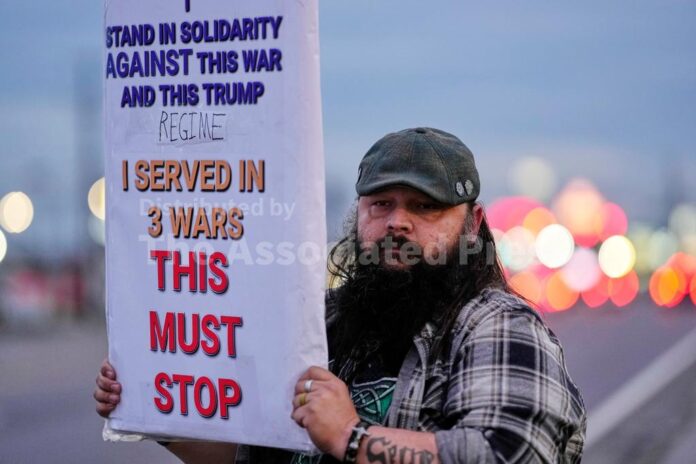
Meanwhile, Chris McFarland, another veteran who served out of Fort Campbell and deployed to Kuwait, Iraq and Afghanistan, has been making his opposition to the war in Iran well known. As soon as he learned of it, he had a sign made declaring “No more wars” and has been holding it on a major thoroughfare in Clarksville every day.

McFarland, who leads the nonprofit Veterans for All, which advocates for veteran healthcare, said he has seen some hostility from drivers during his protest, but also some people have pulled over to talk to him. Many want more information about what is happening.

They are ”in shock, confused, concerned,” he said.

McFarland does not mince words in describing his personal feelings about the attack on Iran.

“It is 100% unnecessary. It is unconstitutional. Literally, our own Congress didn’t even approve of this. This was done without anyone’s acknowledgement at 3:00 in the morning to murder people over in Iran.”

For many combat veterans like himself, he said the idea of a new war is bringing up bad memories.

“It just puts us right back in, right back at ground zero.”

___

Associated Press reporter Allen G. Breed in Wake Forest, North Carolina, contributed.

‘Deadliest Catch’ crewman Todd Meadows dies after falling overboard, Coast Guard says

JUNEAU, Alaska (AP) — A deckhand on the reality television show “Deadliest Catch,” which documents the lives of crab fishermen working in one of the world’s harshest environments, died after he was reported to have fallen overboard, the U.S. Coast Guard said Tuesday.

The Coast Guard received a notification shortly after 5 p.m. Feb. 25 from the Aleutian Lady that crew member Todd Meadows had fallen overboard about 170 miles (274 kilometers) north of Dutch Harbor, Alaska, Chief Petty Officer Travis Magee, a spokesperson with the Coast Guard’s Arctic District, said by email Tuesday.

“He was recovered unresponsive by the crew approximately ten minutes later,” Magee wrote. Efforts to resuscitate Meadows were unsuccessful, and the crew brought his body to Dutch Harbor, he said.

The Coast Guard is investigating.

Meadows, from Montesano, Washington, was in his first year as a cast member of the Discovery Channel show. He joined the series last May but no episodes for the new season have aired.

“We lost our brother,” Aleutian Lady Capt. Rick Shelford said in a social media post that did not detail how Meadows died. Shelford called it the “most tragic day in the history of the Aleutian Lady on the Bering Sea.”

Meadows was the newest member of the boat’s crew but quickly became family, Shelford wrote.

“Todd’s love for his children, his family, and his life was evident in everything he did. He worked hard, loved deeply, and brought joy to those around him,” Shelford wrote.

A statement released by the Discovery Channel called Meadows’ death “a devastating loss, and our hearts are with his loved ones, his crewmates, and the entire fishing community during this incredibly difficult time.”

An online fundraiser had brought in about $30,000 by Tuesday to assist Meadows’ family, including his three sons, and pay for funeral costs and other expenses. The fundraiser said Meadows, 25, died what doing what he loved best: crabbing on Alaska waters.

The death is the latest for cast members of the show detailing dangerous crab fishing on the Bering Sea. The show first aired in 2005.

In 2021, crewman Todd Kochutin, 30, died as a result of injuries he received while aboard the fishing vessel Patricia Lee, according to his obituary.

Several other cast members have died of substance abuse or natural causes. They include Capt. Phil Harris of the fishing vessel Cornelia Marie, who died in 2010 at age 53 following a massive stroke, NPR reported.

___

Thiessen reported from Anchorage, Alaska.