Home Blog Page 392

NASA’s Mike Fincke identifies himself as the ailing astronaut who prompted space station evacuation

NASA’s Mike Fincke identified himself Wednesday as the astronaut whose medical condition prompted the space agency’s first medical evacuation.

In a written statement, the 58-year-old spaceflight veteran revealed he was the ailing crew member last month aboard the International Space Station. He did not say what was wrong with him but explained that his condition quickly stabilized thanks to his crewmates and flight surgeons on the ground.

Fincke said he’s doing well now.

“Spaceflight is an incredible privilege, and sometimes it reminds us just how human we are,” he said in the statement.

Fincke launched with three others on a SpaceX flight last summer. Their mission came to an early end on Jan. 15, a week after he experienced what he called a “medical event that required immediate attention” by his fellow astronauts. The health concern also forced the cancellation of a planned spacewalk by Fincke and another NASA astronaut.

Following their splashdown in the Pacific, all four astronauts were taken to a San Diego hospital. They flew home to Houston the next day.

With the sick astronaut’s identity still a secret, Fincke said at a news conference a week after returning that the space station’s ultrasound machine came in handy during the medical crisis.

He elaborated Wednesday, stressing that his situation was not an emergency but that everyone wanted “to take advantage of advanced medical imaging not available on the space station.”

Fincke, a retired Air Force colonel who became an astronaut in 1996, has logged 549 days in space over four missions.

___

The Associated Press Health and Science Department receives support from the Howard Hughes Medical Institute’s Department of Science Education and the Robert Wood Johnson Foundation. The AP is solely responsible for all content.

Brooks Koepka returns to the Cognizant Classic for his first start there since 2022

PALM BEACH GARDENS, Fla. (AP) — There are countless comforts of home for Brooks Koepka this week when he plays the Cognizant Classic. That doesn’t mean everything is necessarily comfortable.

His son watched plenty of hockey from the Milan Cortina Olympics over the last few days, which means there was quite a bit of hockey playing inside the Koepka home. Evidently, Crew Koepka — in his defense, the kid isn’t even 3 yet — hasn’t exactly mastered the art of stickhandling. And his father learned that the hard way.

“Took a stick to the face the other day at the house, so that was interesting. It’s been a while since that happened. It definitely hurts,” Koepka said. “I feel Jack Hughes and his pain a little bit, but didn’t lose a tooth, thankfully.”

Hughes — after losing some teeth against Canada — scored the game-winning goal for Olympic gold last Sunday. Koepka would happily settle for a win this Sunday, in his third tournament since returning to the PGA Tour after nearly four years with Saudi-funded LIV Golf.

“Just want to put myself in contention here a few times before Augusta,” Koepka said, “and see where everything lies.”

Koepka is a Palm Beach County native, and this is his home tournament. He came to it as a little kid, carried the scoring sign for some players when he was learning the game, and now is about to play in it for the eighth time as a pro and the first time since 2022.

He’ll have plenty of friendly faces in the crowd on Thursday and Friday — some of them people he rarely gets a chance to see because of his schedule — and he’s hoping to stick around for the weekend at PGA National so he can see them on Saturday and Sunday as well.

“This is a true hometown event,” Koepka said. “Like I said, (I was) coming to it for years when I was a kid, and then I don’t think anybody in my family or really anybody has got more than like a 25-minute drive, my friends. It’s nice to be able to be this close to home and to have everybody come out.”

It’s a different tournament than when Koepka last played at PGA National.

First off, it was still The Honda Classic then. PGA National played to a par 70 in those days; par is 71 now. The winning scores the last three times Koepka played this event were 10 under, 6 under and 9 under; the winning scores in the last three years were 14 under, 17 under and 19 under — and Jake Knapp shot an opening-round 59 last year, something that didn’t seem remotely possible at PGA National just a few years ago.

“It was a little bit too easy last year, I thought,” said Ireland’s Shane Lowry, who now calls the Palm Beach area his full-time home and, like Koepka, will be sleeping in his own bed this week. “I don’t want to exactly see 59s around here. I hope the scoring is a little bit more difficult this year and it plays like it used to.”

There are no players in the field who are currently in the top 25 of the world rankings; Ryan Gerard, at No. 26, tops that list. Meanwhile, 11 different top 25 players — including four of the world’s top five — appeared in TGL matches on Monday and Tuesday night, just a few miles away from PGA National.

It’s been an issue for the Cognizant for years. The current tour schedule has it wedged into a spot that kicks off the Florida Swing — with Bay Hill and the Players coming up in the next two weeks.

“I’m sure every tournament, bar the signature events, don’t get the fields that they’d want,” Lowry said. “I think it is in a very tough spot in the schedule, probably one of the toughest spots in the schedule, and I don’t think it’s anything to do with the course. The reason players don’t play is players don’t want to play that much. It is a tough stretch of golf. … I do wish a lot of other players would play, but that’s their choices.”

Koepka couldn’t play it when he was with LIV. He seems very appreciative of the chance to be back.

“It’s a nice event,” he said. “It’s definitely weird staying at home. You just get so accustomed to living out of a suitcase or hotel or whatever. But it’s enjoyable. It’s nice to come back and just feel your own comforts when you get home.”

___

AP golf: https://apnews.com/hub/golf

Vrabel calls for increased staffing at NFL replay center to help cut down on mistakes

INDIANAPOLIS (AP) — New England Patriots coach Mike Vrabel called on the NFL to increase staffing at its replay command center to ensure reviews from all games are treated equally.

Vrabel spoke at the NFL scouting combine Wednesday and was asked about comments earlier this week by league executive Troy Vincent that there were a handful of mistakes made in replay last season in games played in the early Sunday afternoon window when as many as nine games were played at the same time.

“We need to make sure every game is treated the same — from the prime-time game on Sunday night to the prime-time game on Monday or Thursday or whether it’s one of those one o’clock games that is the lifeblood of our league,” said Vrabel, who is a member of the competition committee.

“So if it’s something we need to take care of in the offseason, staffing issues that need to be taken care of so that those things are looked at, we need to be really good at replay because there’s going to be mistakes on the field. … We have to get to a system in replay that’s as close to 100% accurate as possible.”

Vincent said earlier this week that out of the 171 plays that were called on replay or replay assist, there were only a handful that were mishandled. The majority of those came in the 1 p.m. ET window, when there are more games being played simultaneously.

“There were five after we kind of took a step back and breathed — four of them (were) in the 1 o’clock window,” Vincent said. “Just volume and you go, ‘Ah, if we had to do that one again, just looking at it.’”

At least one of those plays proved crucial in the playoff race. Vincent cited a replay review in a Week 14 game that overturned a ruling on the field of an interception thrown by Pittsburgh’s Aaron Rodgers. The decision cost Baltimore 46 yards in field position, and the Ravens eventually lost the game 27-22 when a potential go-ahead TD pass from Lamar Jackson to Isaiah Likely was ruled incomplete by replay.

That call was not one of the five Vincent referenced, but he did say it warranted more discussion about what is or isn’t a catch. A win in that game for Baltimore would have given the Ravens the AFC North title instead of the Steelers.

An increase in staffing at the replay command center during windows with more games would not solve all of the inequities in comparison to higher-profile games, which feature significantly more cameras used by the broadcasters.

San Francisco 49ers general manager John Lynch, a former broadcaster and a new member of the competition committee, said that needs to be addressed as well.

“I do think that’s something we want to strive for as a league,” Lynch said. “I think there’s some uniformity you can get by requiring teams to have fixed cameras and things. I know all those things are being discussed, but that is a reality that the one o’clock games, there’s multiple games going on at the same time. So, the New York headquarters, they’re not going to have all their attention on that game. And then within that, the element that I talked about just not having the amount of cameras and angles. That’s a reality and something that we have to figure out because every game is important in our league, not just the prime-time games.”

___

AP NFL: https://apnews.com/hub/NFL

Samsung rolls out more AI, new privacy shield mode with the new Galaxy S26 lineup

SAN FRANCISCO (AP) — Samsung on Wednesday unveiled its latest Galaxy smartphones, which boast an even bigger toolbox of artificial intelligence technology than the previous two generations and introduce a new privacy shield mode that blocks snoopy bystanders from sneaking a peek at the display screen.

The upgrades on the Galaxy S26 lineup — arriving in stores March 11 — will also include price increases of 10% to 13% on the basic and mid-tier models while the Ultra device will cost the same as last year’s version. The standard Galaxy S26 will sell for $899, while the Plus model will cost $1,099. That’s $100 more than what Samsung charged for the comparable devices released in each of the past two years. The Galaxy S26 Ultra remains at $1,299.

As has become commonplace for all new smartphones, Samsung has improved the camera and battery for the Galaxy S26 because those features weigh so heavily on consumers’ decisions on whether it’s worth upgrading from the devices they already have.

Samsung is also dangling a new reason to pony up for its most expensive Galaxy S26 with a built-in feature called “Privacy Display” that will only be available on the Ultra.

When the privacy protection option is turned on, the pixels on the Ultra change in a way that enables the display screen to only be seen when looking directly down at it. The screen appears off when viewed from the side, preventing “shoulder surfing” from people standing or sitting nearby. The controls can be set up so specific apps, such as those dealing with financial information or other sensitive information, will always open in the Privacy Display mode.

But Samsung continues to highlight AI as a marquee attraction on its Galaxy phones, amplifying on a theme that it began harping on two years ago when the company began to embrace the technology as a way to make its devices even more versatile and compelling.

“AI must become part of our infrastructure,” said TM Roh, Samsung’s CEO of device experience, during a showcase held in San Francisco. “You should be able to enjoy its benefits through the devices you use every day.”

Samsung is promising this year’s Galaxy lineup is loaded with AI that will act as multipurpose agents that fetches information and content so users won’t have to spend time doing it on their own.

“This is the agentic AI phone,” Roh said of the Galaxy S26.

As it has in the previous years, Samsung is leaning heavily on Google’s Gemini technology for its AI, but also is adding another assistant option from Perplexity, a rising star that is best known for running its own “answer engine” for finding online information.

The Galaxy S26 phones will also include more tools that can doctor photos taken on the devices, including one that automatically softens a subject’s skin tone if the selfie is taken with the phone’s front camera.

AI technology is being deployed on many other smart devices, including those made by Apple and Google, but it’s unclear if the strategy is resonating with consumers.

Although Apple has been promoting its own AI suite for nearly two years, the trendsetting company still hasn’t been able to deliver on all the features it has been promising. Apple’s AI shortcomings have become so glaring that it’s depending on Google to help smarten up i ts often bumbling virtual assistant Siri.

Despite all that, Apple’s iPhone has remained the world’s top-selling smartphone for the past three years — a mantle that Samsung last held in 2022, according to the research firm International Data Corp.

“AI is still not a sought-after feature among users,” said Paolo Pescatore, an analyst for PP Foresight. “The big opportunity is making AI feel like a daily habit rather than a party trick, with tighter integration across core apps. AI must be boringly useful. Less ‘look what it can do,’ more ‘this saves me time every day.’ ”

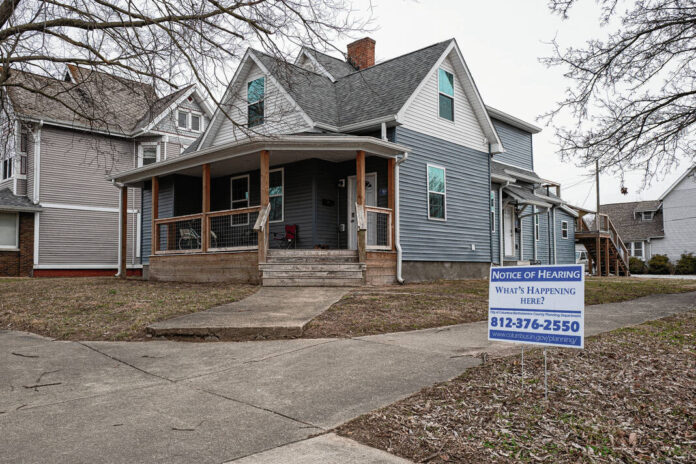
Columbus Board of Zoning Appeals denies request for shared housing facility on Pearl Street

Mike Wolanin | The Republic An exterior of the proposed recovery house at 803 Pearl Street in Columbus, Ind., Tuesday, Feb. 24, 2026.

The Columbus Board of Zoning Appeals denied a proposal requesting a shared housing facility for up to 14 individuals at 803 Pearl St. following several neighbors voicing their concerns about the proposal.

Applicant Brandon Nielsen appeared before the board Tuesday to request conditional use for a Level One recovery residence in a Residential: Established zoning district. The proposal requested to turn a multi-family home into a recovery facility that provides stable, supportive housing for individuals in recovery from substance use disorders, according to the staff report from the City of Columbus-Bartholomew County Planning Department.

Nielsen serves as the executive director of Gemini Recovery Services, which provides treatment for those recovering from substance abuse. Though the proposed facility would operate unassociated with Gemini Recovery Services, he proposed to operate it as housing for those in recovery.

The proposed facility would be broken up into three units, with eight people each in both the first and third unit. The on-site property manager would then be alone in the second unit. The house was also previously divided into three apartments, according to the staff report.

Following the public hearing, board member Charles Doup voted to deny the proposal based on not all criteria being met. The staff report states that it did not meet the criteria of “granting the conditional use will not be contrary to the general purposes served by the Zoning Ordinance, and will not permanently injure other property or uses in the same zoning district and vicinity.”

One concern raised in the staff report is the parking situation. Nielsen said in the report that there is onsite parking for up to five vehicles and on-street parking available as well. He also anticipated that a majority of possible tenants would not have a driver’s license or vehicles and would utilize public transportation. Transport would also be provided by Gemini Recovery Center to get to and from treatment.

“Right now there’s eight people there and two of them have a car. That’s probably the most cars that’s ever been there, probably the most that will ever be there, but it’s one of those things you never know,” Nielsen said. “But the majority of these guys do not have a license and (have) not had one for a very long time and most definitely cannot afford a car.”

Community members agreed that parking would be an issue. Susan Kell said the area is very congested and Eighth Street is a bus route. Nathaniel Gootee, who wrote a letter voicing his concerns to the board prior to the meeting, said parking is restricted to one side of the street and residents can only park within the same city block of their residence.

“… if this is approved, we would have a demand of 64 parking spots and only 50 are available per 110 linear feet per each side of the block around it,” Gootee said.

Concerns were also raised about the density of the facility. The staff report states that the applicant requested conditional use approval to operate the property as a shared housing facility for up to 17 individuals, but Nielsen clarified during the meeting that 17 is a little lofty and 14 is the maximum amount they could fit in there comfortably.

He said the first unit could hold about six people and the third unit, which would take up the second floor, could fit seven people. About eight people and an on-site manager currently reside in the home and no treatment is provided on site.

“Their housing is contingent on them being engaged in treatment and doing the things that they need to do and that’s regular check-ins, all that stuff, weekly screenings, there’s a lot of accountability there,” Nielsen said.

Attorney Jeff Rocker spoke before the board saying he was representing several neighbors. While he commended Nielsen for what he’s wanting to do, he believed it would face a challenge in being contextually appropriate in the area. No matter if it’s 14 or 17 people, he said the more people they pack into that single family home, the more intense of an impact that will have on the neighborhood, the land and the community.

“… we all have a footprint that we leave in the world, and I think respectfully this footprint is a little too heavy for an RE zone and I think because of that, what we’re going to see is it’s going to have an impact on the residents both psychologically as well as on the value of their homes… just because of that intensity of the use,” Rocker said. “Just because people that live next door are not going to be able to park on their own street anymore.”

Other concerns raised by neighbors included the facility’s proximity to a preschool and Central Middle School, the area’s history regarding drug use, assurance on qualifications and the importance of who’s operating the facility to monitor it. However, a few community members did indicate when speaking to the board that they were supportive of these kind of facilities.

“I have over 50 years work experience in mental health, so I’m not unsympathetic with the need for sober living recovery homes,” Kell said. “I don’t believe that this is the proper location for a sober living house of the nature that’s being proposed.”

All board members but Grant Hale voted to deny the proposal. Doup said all the testimony he heard that evening confirmed the denial was correct, but he urged the community to address the mental health issue in the community.

“It is totally inadequate, I have had experience, first hand experience, trying to deal with that kind of situation and it is a disgrace what Columbus, Indiana does for the mentally impaired, let alone the drug impaired,” Doup said. “So I’m charging you all that have any power at all to get busy and get that fixed.”

Trump’s portrayal of ‘golden age’ is out of sync with how Americans see economy

WASHINGTON (AP) — President Donald Trump sought in his first State of the Union address to sell Americans on the idea of a booming economy, falling prices, and soaring jobs, yet he faces a skeptical public with a much gloomier view.

Barely 12 hours before his speech, in fact, The Conference Board, a business research group, released its latest consumer confidence report. It showed that overall confidence in the economy remains historically low, and is barely above the level it plunged to in the depths of the COVID recession.

In February, its index ticked up to 91.2, which is noticeably below a four-year peak reached in November 2024 of 112.8. Americans remain dejected by high prices and see few jobs available, the survey found.

Other polling has yielded similar results: Only 39% of Americans approve of Trump’s economic leadership, according to the latest Associated Press-NORC Center for Public Affairs Research survey. And the University of Michigan’s consumer sentiment survey remains mired at recessionary levels.

Trump sought to overcome that gloom by pointing to economic data that paints a brighter picture, a tactic that President Joe Biden tried with little success. But on Tuesday night there were gaps between the president’s claims and the economic reality many Americans are facing.

“Inflation is plummeting, incomes are rising fast, the roaring economy is roaring like never before,” Trump said.

The economy grew last year, but more slowly

To begin with, the economy is growing but it is hardly “roaring.”

It expanded 2.2% last year, down from 2.8% in Biden’s last year and 2.9% in 2023. To be sure, most Americans were deeply dissatisfied with the price spikes under Biden that pushed inflation to a peak of 9.1% in 2022, a four-decade high.

A roaring U.S. economy typically looks more like the late 1990s, when growth topped 4% for four years in a row, or in the 1980s, when it rose by 3.5% or higher for six years in a row.

Consumers are still struggling with high prices

Inflation has slowed in the past year, but many Americans still cite high prices in surveys as a key reason they are unhappy with the economy.

Trump correctly noted that core inflation, which excludes the volatile food and energy categories, fell to a five-year low in January. Yet other price measures show that inflation remains stubbornly elevated: A gauge of core prices closely monitored by the Federal Reserve was 3% higher in December than a year earlier, above the Fed’s 2% target. It places less weight on housing costs, which have cooled, than the measure Trump cited.

Nearly half of the people responding to the University of Michigan’s consumer sentiment survey in February “spontaneously mentioned high prices eroding their personal finances,” Joanne Hsu, director of the survey, said in a statement.

Trump noted that the price of eggs has fallen sharply from its peak, which is true, but most necessities Americans rely on — groceries, rent, electricity — remain much more expensive than they were five years ago. And electricity prices rose another 6.3% just in the past 12 months.

Trump’s tariffs have also pushed up the cost of many imported items, including furniture, auto parts, tools, and clothes. And groceries such as ground beef, coffee, and bananas have risen sharply in the past year. Ground beef prices, for example, are up 17%.

Hiring ground nearly to a halt last year

One reason for the consumer gloom is likely the sharp slowdown in hiring last year. Employers added just 181,000 jobs in 2025 — or 15,000 a month – making it the worst year for job growth outside of a recession since 2002.

And despite Trump’s pledge to revive American manufacturing, factories lost 108,000 jobs in 2025 on top of the 202,000 lost in the last two years of the Biden administration. Auto and auto parts plants have cut nearly 74,000 jobs the past two years.

Trump’s tariffs are partially to blame because they force many factories to pay more for imported raw materials and parts. But high interest rates have also hurt manufacturers over the past couple of years. And many of them hired aggressively — perhaps too much — in 2021 and 2022 when the U.S. economy was roaring back from pandemic lockdowns. Automation also means that many factories need fewer workers.

Hiring did come in unexpectedly strong in January at 130,000 new jobs, and factories added jobs for the first month in more than a year.

Benefits of tariffs remain unclear

Trump suggested his tariffs have directly contributed to an economic boom for the U.S., but most Americans have likely seen little benefit.

“Moving forward, factories, jobs, investment and trillions and trillions of dollars will continue pouring into the United States of America,” Trump said.

Trump once again made his tariffs sound painless, insisting that they are paid by foreign countries. In fact, they are paid by U.S. importers who often try to pass the burden along to their customers through higher prices. Foreign companies might take a hit if they have to cut prices to maintain sales in the United States. But import prices haven’t fallen significantly, suggesting that overseas exporters aren’t feeling much pain.

A study by Harvard University economist Alberto Cavallo and two colleagues found that U.S. consumers were eating 43% of the higher tariff costs and that U.S. companies were absorbing most of the rest.

And so far Trump’s sweeping import taxes haven’t delivered much progress toward his goal of reducing the vast and longstanding U.S. trade deficit — the gap between what America sells to foreign countries and what it buys from them.

The U.S. trade deficit in goods such as automobiles and appliances — the focus of Trump’s protectionist policies — actually hit a record $1.24 trillion last year, increasing 2% from 2024.


The hotly contested Texas Senate race is setting spending records ahead of Tuesday’s primary

Candidates and political groups are pouring money into Texas’ hotly contested U.S. Senate race at a record pace, partly fueled by Democrat James Talarico’s fundraising and allies of Republican Sen. John Cornyn trying to save his long career.

Heading into Tuesday’s primary elections, the cost of advertising and reserved advertising time had topped $110 million, the most ever for a Senate primary, according to the ad-tracking firm AdImpact. The heavy spending in Texas is a preview of the money that is expected to flood this year’s midterm elections across the U.S. with control of Congress at stake.

Talarico faces U.S. Rep. Jasmine Crockett for the Democratic nomination and on Wednesday launched his final television ad before the primary. It attacks the Trump administration’s aggressive immigration enforcement tactics, describing U.S. Immigration and Customs Enforcement as “secret police.”

Talarico reported raising more than $21 million through last week. Crockett has raised nearly $8.6 million, though the majority was transferred from her House campaign account after she entered the race in December, three months after Talarico.

Crockett has positioned herself as the bigger fighter, and the tone of Talarico’s last ad contrasts with appeals he’s made to disaffected Republicans by discussing his Christian faith.

“We can transform this broken political system,” Talarico said during a rally Tuesday in Tyler in northeastern Texas, an area President Donald Trump carried by a wide margin in 2024.

Democrats haven’t won a Senate race in Texas since 1988, but Cornyn is facing the race of his career in the primary against Texas Attorney General Ken Paxton and U.S. Rep. Wesley Hunt.

The bulk of the spending in Texas, more than $75 million, has come from groups not tied to the candidates, according to AdImpact.

The vast majority of that is on the Republican side, with the spending by groups helping Cornyn’s bid for a fifth term approaching $57 million so far. The pro-Cornyn Texans for a Conservative Majority has dropped more than $22 million on anti-Hunt ads.

Cornyn’s official campaign committee has raised more than $11 million and two other groups bearing his name have spent another $10 million helping him.

Republicans expect Paxton to at least make a May 26 runoff, despite a low-key campaign until recently and years of legal problems.

Cornyn and the Senate’s GOP leaders worry that Republicans will have to spend tens of millions of additional dollars to keep the Texas seat if Paxton is the nominee.

“It is a strong possibility we cannot hold Texas if John Cornyn is not our nominee,” GOP Sen. Tim Scott of South Carolina said Wednesday on “Fox & Friends.”

Other Republicans disagree. Paxton was in Washington on Tuesday, attending President Donald Trump’s State of the Union address as the guest of Texas Republican Rep. Troy Nehls.

Paxton so far has raised about $6 million for his campaign, and Hunt, about $2 million, though he had about $3 million in his House campaign account when he entered the Senate race in October, according to reports filed with the Federal Election Commission.

But the Republican candidates’ collective campaign fundraising of $19 million doesn’t match what Talarico’s campaign has raised on its own, suggesting that outside groups will be crucial to helping the GOP retain the seat.

Talarico got a financial boost this month when his campaign said it raised $2.5 million in the 24 hours after late-night host Stephen Colbert pulled an interview with him for his nightly Feb. 16 broadcast, citing the demands of CBS lawyers. Contributions of less than $1,000 at that point don’t have to be reported until after the primary.

Crockett recently told supporters during a campaign stop that when she ran for the Texas House in 2020 — two years before winning her Dallas-area seat in Congress — she was outspent 5-to-1.

“People said, ‘There’s no way she’s going to win,'” Crockett said, tearing up. “I show up, authentically me. That makes some people cringe, but the people are tired of politics as usual.”

___

Associated Press journalist Bill Barrow in Atlanta contributed to this report.

Soaring cost of food and other staples squeezes Iranians as threat of US attack looms

TEHRAN, Iran (AP) — Every day, Iranians go to stores and find prices rising. Some post photos on social media of the shrinking contents of their shopping carts as they struggle to buy enough basic staples for their families. The mounting cost of living is an extra weight bearing down as Iranians prepare for a possible war with the U.S. and wrestle with the aftermath of protests that swept the country last month.

“Everybody is under pressure: merchants, civil servants, laborers,” said Ebrahim Momeni, a 52-year-old retired civil servant. “The weaker class of people is being crushed.”

Iran’s economy has struggled for years because of international sanctions and mismanagement.

It experienced some relief under a 2015 nuclear deal that lifted many sanctions, until U.S. President Donald Trump unilaterally withdrew from the accord in 2018. Since coming back into office more than a year ago, Trump revived a “maximum pressure” campaign, expanding sanctions that target Iran’s financial sector and energy exports. On Wednesday, his administration imposed new sanctions on 30 people and companies accused of enabling Iran’s production of ballistic missiles and drones, and illicit oil sales.

The pressure has accelerated the devaluation of Iran’s currency, the rial. In 2015, when the nuclear deal was signed, the rial traded at about 32,000 to the dollar. In late December, it was at 1.3 million to the dollar. On Wednesday, it had reached a new low at 1.65 million rials to the dollar — worsened by fears of a U.S. attack.

Lower classes desperate for relief as prices jump

Inflation has surpassed 46% compared with January of last year. Economists warn that the rial’s accelerating decline risks feeding a vicious cycle of higher prices and reduced purchasing power. They expect double-digit inflation to plague Iran’s economy — which also suffers from high unemployment among younger people — for years to come.

The plunging value of the rial was one trigger for protests that began in late December in Tehran’s main bazaar and then spiraled nationwide.

Prices for everyday items, from groceries to toiletries, are soaring.

Momeni said he makes about 700 million rial (about $540) a month, Just in the past month, a kilo (2.2 pounds) of red meat increased from 13 million rials ($10) to 22 million rials ($17). In the same period, the price of a liter of milk (a quarter of a gallon) doubled from 520,000 rials to 1.1 million, and a box of pasta from 340,000 to 570,000 rials.

“Those with lower incomes and fixed salaries are suffering because of the price hikes,” said Farhad Panahirad, a 44-year-old taxi driver. Together, he and his wife make about 600 million rials a month, he said.

Several people in the markets on Wednesday explained how they try to deal with rising financial pressures — they check social media every day to see news about the latest prices, or go shopping at night, when some produce is marked down to half price to get rid of inventory before it spoils.

Fearing the U.S. could launch strikes at any time, Iranians are also scrambling to purchase emergency supplies. That includes flashlights, small gas ovens, and tape for securing windows against explosions, said the owner of a tool shop in central Iran, who spoke on condition of anonymity for fear of retaliation.

Some try to purchase bulk amounts of beans, bread, rice and canned food despite the high prices. “I am not happy to buy this much stuff, but my wife said we had to be prepared for uncertainty in the coming days,” said Saeed Ebrahimi, 43, an electrical technician and father of two.

Even items such as washing machines, vacuum cleaners, and refrigerators have doubled in price, according to Iranian media.

War fears hang over the economy

Tehran-based economist Farbod Molavi wrote in the independent Dona-e-Eghtesad newspaper that prices are higher because of uncertainty in the market and the rising costs of raw materials. Iran is suffering from both a recession and high unemployment, he added.

Unemployment was officially around 7.8% in October, up from 7.2% for the same period in 2024, and runs as high as 20% among young people. About 24 million of the country’s population is between 15 to 34 years old, according to official statistics.

Acknowledging the suffering, the government in January began distributing payments of 10 million rials a month each to some 70 million people, about 75% of the population, to spend on food. It has promised to increase the payments if prices go higher.

But the strain appears likely to continue. Trump has threatened strikes on Iran if it doesn’t agree to a new accord curtailing its nuclear program. He has massed the largest buildup of warships and aircraft in the region in decades. The two sides have held two rounds of negotiations in recent weeks and a third is expected to be held in Geneva on Thursday.

Panahirad, the taxi driver, said he is pessimistic the negotiations will bring any relief for those struggling to buy food. “(Trump) is bullying them, to some extent. After all, he is a superpower and says what he wishes must be done,” he said,

“Wherever you go now people are talking about war. If you go to a bakery to buy bread you see people talking about war,” said Momeni. “This state of limbo is worse than war.”

FIFA’s Infantino has ‘complete confidence’ in Mexico to host World Cup games despite cartel violence

MEXICO CITY (AP) — The violence that erupted in Mexico after the death of a powerful drug lord has left many questioning whether the country will be able to co-host the World Cup in just over three months.

FIFA President Gianni Infantino thinks it can.

“Of course, we are monitoring the situation in Mexico these days, but I want to say from the outset that we have complete confidence in Mexico, in its president, Claudia Sheinbaum, and in the authorities, and we are convinced that everything will go as smoothly as possible,” Infantino said late Tuesday in a press conference in Colombia.

“Mexico is a great country, like in every country in the world, things happen; we don’t live on the moon or another planet,” Infantino added. “That’s why we have governments, police, and authorities who will ensure order and security.”

The Mexican army killed Nemesio Rubén Oseguera Cervantes, “El Mencho,” who led the Jalisco New Generation Cartel, on Sunday, sparking several days of violence. Cartel members burned cars and blocked roads in nearly a dozen Mexican states and authorities report that at least 70 people have died.

Four high-level soccer matches from the local leagues were postponed last Sunday, including one in the central city of Queretaro, where Mexico is scheduled to play against Iceland late Wednesday in a friendly match.

Thirteen World Cup matches are scheduled to be held in Mexico, including the opening game in Mexico City on June 11 between the co-host and South Africa. Guadalajara, the central hub for the Jalisco cartel, is scheduled to host four.

Colombia is set to play one game in Mexico City and one in Guadalajara.

“Our first two matches are in Mexico, but we know they will overcome this and move forward,” said Ramón Jesurún, the president of the Colombian Soccer Federation. “I have absolute and total confidence in my geopolitical thinking that this is an issue Mexico will overcome, and overcome very quickly.”

Other nations have expressed more concern. The Portuguese soccer federation said Tuesday that it was closely monitoring developments ahead of a planned friendly against Mexico in March. Jamaica is set to play New Caledonia in Guadalajara on March 26 in an intercontinental playoff semifinal, with the winner advancing to face Congo for a World Cup spot.

“The games are at the end of March, so we still have another month to see what happens; but it is making me very nervous, to be honest,” said Michael Ricketts, the president of the Jamaican Soccer Federation. “We will be listening out for CONCACAF and FIFA to give us instructions (on) whether they are playing the games or whether they are immediately looking for other options.”

Another Mexican city, Monterrey, will host a playoff where Bolivia plays Suriname and the winner faces Iraq for a spot in the tournament.

On Monday, Sheinbaum said there is “every guarantee” that the World Cup matches in Guadalajara will be played as planned and added that there was “no risk.”

“We are in regular contact with the presidency and the authorities in Mexico and we are monitoring the situation,” Infantino said. “The World Cup is going to be an incredible celebration”.

___

AP soccer: https://apnews.com/hub/soccer

Cal Raleigh not focused on trying for another 60-homer season in Seattle

PEORIA, Ariz. (AP) — Cal Raleigh has already gone deep this spring, yet the switch-hitting Seattle Mariners catcher isn’t focused on trying to hit 60 home runs again this season.

Raleigh, who had an MLB-leading 60 homers last year, hit a 427-foot homer against the Chicago White Sox in an exhibition game Tuesday. His first spring homer came in his third game.

“I think the elephant in the room is 60 home runs. That’s not something I’m setting out to do,” Raleigh told Seattle Sports this week. “To me, I’m just trying to be as consistent as possible, trying to do what I did last year.”

His 60 homers last season were the most for a player who was primarily a catcher, having started 119 games behind the plate and another 38 at designated hitter. The 29-year-old Raleigh, nicknamed “Big Dumper,” also had a career-high 125 RBIs and finished second in the American League MVP voting behind New York Yankees slugger and third-time winner Aaron Judge.

Judge and Raleigh are both set to play for Team USA in the World Baseball Classic, which begins pool play next week. Judge set the AL record with 62 home runs in 2022.

They are among only seven players with a 60-homer season, and Mark McGwire and Sammy Sosa are the only ones to do so in consecutive seasons (1998 and 1999). McGwire and Sosa are the only players with multiple 60-homer seasons, and Sosa had a third in 2001.

___

AP MLB: https://apnews.com/mlb