NEW YORK (AP) — As he watched the Boston Celtics play from the stands of TD Garden, one noise kept catching Adel Djellouli’s ear.
“This squeaking sound when players are sliding on the floor is omnipresent,” he said. “It’s always there, right?”
Squeaky shoes are part of the symphony of a basketball game, when rubber soles rasp against the hardwood floors as players jab step, cut and pivot and defenders move their feet to stay in front of their assignment.
Returning home from the game, Djellouli wondered how that sound was produced. And as a materials scientist at Harvard University, he had a way to find out.
Djellouli and colleagues slid a sneaker against a smooth glass plate over and over. They recorded the squeaks with a microphone and filmed the whole thing with a high speed camera to see what was happening under the shoe.
In a study published Wednesday in the journal Nature, they described what they found. As the shoe works hard to keep its grip, tiny sections of the sole change shape as they momentarily lose then regain contact with the floor thousands of times per second — at a frequency that matches the pitch of the loud squeak we hear.
“That squeaking is basically your shoe rippling, or creating wrinkles that travel super fast. They repeat at a high frequency, and this is why you get that squeaky noise,” Djellouli said.
The grip patterns on the soles may also play a role. When researchers slid blocks of flat, featureless rubber against the glass, they saw a series of chaotic, disorganized ripples but didn’t hear squeaks.
The ridge-like designs on the bottom of your shoes may organize the bursts to produce a clear, high-pitched sound.
Other researchers have studied these kinds of bursts before, but this sneaker study examines friction happening at much faster speeds. And for the first time, it links the speedy pulses with the squeaking sound they produce.
These insights don’t just serve to satisfy the curiosity of a basketball fan. They could also help answer important practical questions. “Friction is one of the oldest and most intricate problems in physics,” wrote physicist Bart Weber in an editorial accompanying the new research. Yet, despite its practical importance, he wrote, “it is difficult to predict and control.”
Understanding friction better could help scientists better understand how the Earth’s tectonic plates slide and grind during earthquakes, for example, or to save energy by reducing friction and wear.
It could also help eliminate moments off the court when squeaky shoes can be a little awkward or embarrassing, such as in a quiet office hallway.
This research doesn’t offer a fix, though the internet has plenty of advice that may be risky, including rubbing soap or a dryer sheet on the soles. But some of the insights from the study could help to design squeak-free shoes in the future.
For example, one additional experiment found that changing the thickness of the rubber could make the squeak sound lower or higher in pitch. In the future, could we fine-tune our shoes to squeak in a pitch so high we can’t even hear it?
“We can now start designing for it,” said Weber, who is with the Advanced Research Center for Nanolithography and the University of Amsterdam, in an interview. “We can start making interfaces that either do it if we want to hear this sound, or don’t do it if we don’t want to hear it.”
___
The Associated Press Health and Science Department receives support from the Howard Hughes Medical Institute’s Department of Science Education and the Robert Wood Johnson Foundation. The AP is solely responsible for all content.
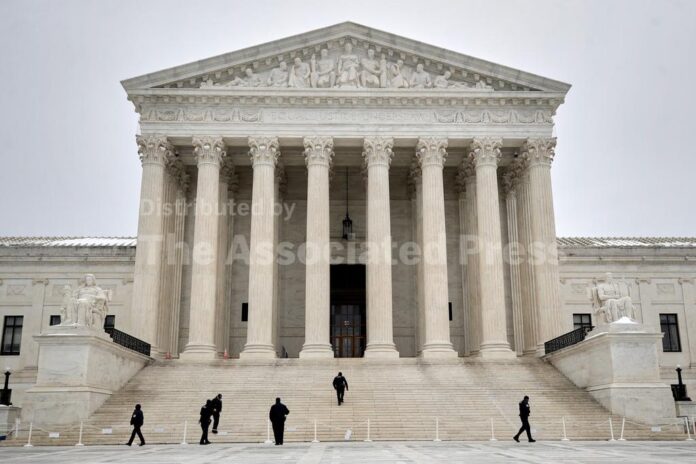
WASHINGTON (AP) — The Supreme Court on Wednesday ruled against a private prison company facing a lawsuit alleging immigration detainees were forced to work and paid only $1 a day in Colorado.
The unanimous ruling is a procedural defeat for the GEO Group, but it’s not a final decision. The company is fighting a lawsuit from 2014 alleging detainees in Aurora had to perform unpaid janitorial work and other jobs for little pay to supplement meager meals.
GEO defended its practices and argued that the case should be tossed out because it’s immune from lawsuits as a government contractor.
After a judge disagreed, the company asked the Supreme Court to allow it to quickly appeal the ruling. But the justices refused.
The Florida-based GEO Group is one of the top private detention providers in the country, with management or ownership of about 77,000 beds at 98 facilities. Its contracts include a new federal immigration detention center where Newark, New Jersey, Mayor Ras Baraka was arrested at a protest in May 2025, before the case against the Democrat was dropped.
Similar lawsuits have been brought on behalf of immigration detainees elsewhere, including a case in Washington state, where the company was ordered to pay more than $23 million.
BILLINGS, Mont. (AP) — A federal appeals court has overturned a judge’s finding that BNSF Railway contributed to the deaths of two people in a Montana mining town where thousands have been sickened by asbestos exposure.
Following a civil trial, a jury in 2024 awarded $4 million each to the estates of the two people who died in 2020. Their families blamed the railroad for allowing asbestos-contaminated mining material to accumulate in a rail yard in downtown Libby, Montana.
But the 9th U.S. Circuit Court of Appeals in an opinion issued Tuesday sided with BNSF, which argued that it was required under law to accept the vermiculite material for shipment and had been told it was safe.
The case in Helena, Montana, was the first of numerous lawsuits against the Texas-based railroad corporation to reach trial over its past operations in Libby. Current and former residents of the small town near the U.S.-Canada border want BNSF held accountable for its alleged role in asbestos exposure that health officials say has killed several hundred people and sickened thousands.
U.S. District Judge Brian Morris had instructed the Helena jury that it could find the railroad negligent based on its actions in the Libby Railyard. The jury did not find that BNSF acted intentionally or with indifference, so no punitive damages were awarded.
The vermiculite mined in Libby has high concentrations of naturally occurring asbestos. It was used in insulation and for other commercial purposes in homes and businesses across the nation.
After being extracted from a mountaintop outside town, the material was loaded onto rail cars that sometimes spilled the contents in the Libby rail yard. Residents have described piles of vermiculite being stored in the yard and dust from the facility blowing through downtown Libby.
Warren Buffett’s Berkshire Hathaway Inc. acquired BNSF in 2010, two decades after the vermiculite mine near Libby shut down and stopped shipping the contaminated mineral.
Looming over the proceedings is W.R. Grace & Co., a chemical company that operated the mountaintop vermiculite mine 7 miles (11 kilometers) outside of Libby until the mine closed in 1990. The Maryland-based company played a central role in Libby’s tragedy and paid significant settlements to victims, but avoided greater liability after declaring bankruptcy.
Attorneys for BNSF said the railway company was told repeatedly by W.R. Grace representatives that the product it was shipping through Libby was safe.
Federal prosecutors in 2005 indicted W.R. Grace and executives from the company on criminal charges over the contamination. A jury acquitted them following a 2009 trial.
The Environmental Protection Agency descended on Libby after 1999 news reports of illnesses and deaths among mine workers and their families. In 2009 the agency declared in Libby the nation’s first ever public health emergency under the federal Superfund cleanup program.
LONDON (AP) — The Speaker of the U.K.’s House of Commons said Wednesday he tipped off police that Peter Mandelson, the former ambassador to the U.S. who is facing accusations of leaking information to the late convicted sex offender Jeffrey Epstein, was a possible flight risk.
Mandelson was arrested Monday at his north London home on suspicion of misconduct in public office. He was released on bail early Tuesday morning after more than nine hours of questioning.
Lawyers for Mandelson, a former senior Cabinet minister, said the arrest was the result of a “baseless suggestion” that he planned to flee the country and was carried out despite an agreement that he would speak to London’s Metropolitan Police voluntarily whenever requested.
Speaker Lindsay Hoyle told lawmakers that he passed “relevant” information to police, without disclosing the source.
“To prevent any inaccurate speculation I’d like to confirm that, upon receipt of information, that I felt it was relevant I pass this on to the Metropolitan Police in good faith, as is my duty and responsibility,” Hoyle said. “It is regrettable this rapidly ended in the media.”
Hoyle added that it would not be appropriate for him to say anything further because the investigation into Mandelson was ongoing.
“Peter Mandelson’s overriding priority is to cooperate with the police investigation, as he has done throughout this process, and to clear his name,” his lawyers at the firm Mishcon De Reya said after his release.
Both men face allegations that they passed confidential government information to the disgraced financier. The claims surfaced after the U.S. Justice Department last month released a trove of more than 3 million pages of Epstein-related documents.
Mandelson, 72, appears to have sent Epstein, whom he referred to as his “best pal,” sensitive government information that could potentially influence markets when he was a senior minister in the British government in 2009 and 2010.
One internal government report discussed possibly selling government assets to raise money for the U.K. after the 2008 global financial crisis. He also appeared to tell Epstein — who died by suicide in a New York prison in 2019 — he would lobby other members of the government to reduce a tax on bankers’ bonuses.
Payment records suggest Epstein gave Mandelson or his husband, Reinaldo Avila da Silva, $75,000 in 2003 and 2004. Mandelson said he had no recollection of receiving that money and questioned the authenticity of bank statements. He has denied wrongdoing.
Mandelson does not face allegations of sexual misconduct.
The former Prince Andrew, now known as Andrew Mountbatten-Windsor, has also denied any wrongdoing over his links to convicted sex offender Epstein, but has not directly responded to the latest allegations stemming from the so-called Epstein Files.
CAPE CANAVERAL, Fla. (AP) — NASA moved its grounded Artemis moon rocket from the launch pad back to its hangar Wednesday for more repairs.
The slow-motion trek at Florida’s Kennedy Space Center was expected to take all day. The 322-foot (98-meter) Space Launch System rocket had spent a month at the pad ready for potential liftoff, but encountered a series of problems serious enough to require a return to the Vehicle Assembly Building, about 4 miles (6.4 kilometers) away.
Managers ordered the rollback over the weekend after the rocket’s helium pressurization system malfunctioned. Already delayed a month by hydrogen fuel leaks, the launch team had been targeting March for astronauts’ first trip to the moon in decades. But now the Artemis II lunar fly-around by a U.S.-Canadian crew is off until at least April.
All four astronauts were at the U.S. Capitol on Tuesday night for President Donald Trump’s State of the Union address as invited guests, since the flight delay means they no longer need to quarantine.
___
The Associated Press Health and Science Department receives support from the Howard Hughes Medical Institute’s Department of Science Education and the Robert Wood Johnson Foundation. The AP is solely responsible for all content.
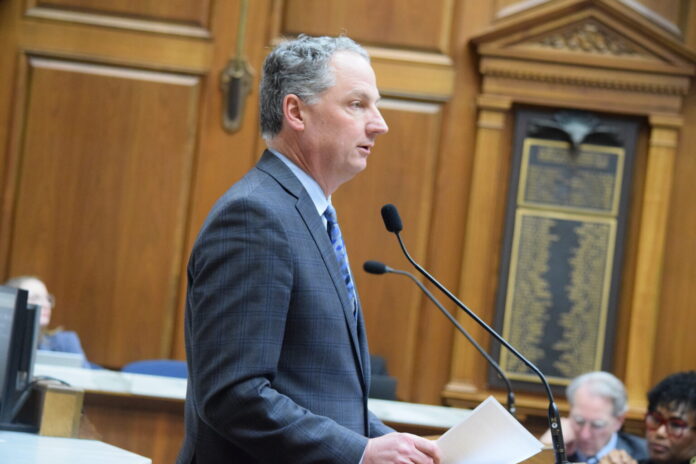
Republican House Speaker Todd Huston introduces a bill that could help relocate the Chicago Bears to Northwest Indiana during a House chamber discussion on Tuesday, Feb. 24, 2026. (Photo by Casey Smith/Indiana Capital Chronicle)
A narrowly divided vote to roll back portions of Indiana’s environmental code — plus a high-profile bid to lure the Chicago Bears across the state line — anchored a deadline-day push Tuesday as the Indiana House advanced a slate of bills and set up end-of-session negotiations across the rotunda.
Lawmakers also narrowly approved a controversial proposal to ban public camping. The measure split both parties and drew hours of emotional debate about whether the state should criminalize homelessness.
The measures were approved on the House’s third-reading calendar deadline and now head back to the Senate for final consideration. Any disagreements with House changes would send the bills to conference committees in the final days of session. The General Assembly is expected to finish legislative business on Friday.
One of the most contentious votes of the day came on Senate Bill 277, an environmental policy overhaul that passed the House 53-45, with 16 Republicans joining Democrats in opposition.
The proposal makes dozens of changes to Indiana’s environmental statutes, including replacing certain mandatory requirements with discretionary authority at the Indiana Department of Environmental Management.
Supporters argued the measure modernizes outdated language and gives regulators flexibility. Critics, meanwhile, have warned it weakens safeguards for air and water quality.
Rep. Beau Baird, R-Greencastle, who carried the bill in the House, repeatedly emphasized on Tuesday that the legislation does not eliminate environmental protections or strip IDEM of its enforcement powers.
“This bill modernizes portions of Indiana’s environmental statutes,” Baird said. “When you look at it in the entirety of the code, IDEM’s ability to enforce the law is kept intact.”
But Democrats repeatedly returned to the bill’s shift from “shall” to “may” in several sections of code — a change they said turns mandatory IDEM enforcement requirements into “optional” actions — arguing it would allow regulators to decline enforcement even when violations are identified.
Rep. Carey Hamilton, D-Indianapolis, noted Indiana has long lagged behind other states on environmental protections and warned the bill moves the state further in the wrong direction.
“We should be doing more, not less, to protect Hoosiers,” Hamilton said. “How does weakening the agency that should be protecting Hoosiers from toxic emissions make our communities safer?”
Rep. Sue Errington, D-Muncie, additionally cited more than 1,400 public comments submitted during recent state environmental rulemaking, the “vast majority” of which expressed concerns about clean air and water.
“This bill is coming for the wrong reason at the wrong time,” she said. “Taxpayers expect their money to be spent to protect them.”
Rep. Kendell Culp, R-Rensselaer, a farmer, speaks in support of Senate Bill 277 on Tuesday, Feb. 24, 2026, in the Indiana House chamber. (Photo by Casey Smith/Indiana Capital Chronicle)
Rep. Carolyn Jackson, D-Hammond, questioned the bill’s elimination of IDEM’s pollution prevention division, arguing residents need faster — not weaker — regulatory response.
“When it comes to polluting the air and the water, especially in Northwest Indiana, we want IDEM to be able to come in immediately,” Jackson said.
Rep. Kendell Culp, R-Rensselaer, who described himself as the chamber’s only swine farmer — and the only member who currently holds an IDEM permit — said he operates under extensive state and local environmental rules already.
“We are a highly regulated industry — extremely,” Culp said, describing IDEM permitting requirements, nutrient management plans and local ordinances governing agricultural operations. He said farmers have a strong incentive to protect land and water because their livelihoods depend on it.
“Farmers are the original environmentalists,” Culp said, pointing to widespread use of cover crops and buffer zones along waterways. “I don’t need IDEM or any other government agency to tell me that protecting our water is the right thing to do.”
Bears stadium plan advances with bipartisan support
The House also approved Senate Bill 27 in a 95-4 vote, pushing forward the proposal that seeks to help finance a new Chicago Bears stadium and surrounding development in Hammond.
House Speaker Todd Huston, R-Fishers, said the bill mirrors the funding models used for Lucas Oil Stadium in Indianapolis, relying on locally generated revenue — including food and beverage taxes — to back bonds for the project.
“The bottom line is this project will be paid for by those who benefit from this investment,” Huston said, though the Republican leader has yet to say how much the project is expected to cost, overall. “This isn’t just a sports venue. It’s a transformational opportunity for the region and the state.”
Even so, Illinois Gov. J.B. Pritzker said earlier Tuesday there is “broad agreement” in Illinois on a competing proposal. He questioned, too, how Indiana taxpayers feel about the tax increases outlined in fiscal analyses of the Hammond plan.
House Speaker Todd Huston, R-Fishers, beams on the chamber floor following the vote tally on Senate Bill 27 on Tuesday, Feb. 24, 2026. The bill seeks to lure the Chicago Bears to Northwest Indiana. (Photo by Tom Davies/Indiana Capital Chronicle)
Rep. Earl Harris Jr., D-East Chicago, framed the plan as a “rare” economic development opportunity for Northwest Indiana.
“This bipartisan legislation represents a once-in-a-generation opportunity for the region — and frankly the entire state,” Harris said.
He pointed to construction jobs, transportation investment and retail growth tied to the project.
Several lawmakers from Lake County and surrounding areas also highlighted the region’s existing infrastructure, including rail lines, interstate access and the Gary airport, as positioning Indiana to capture economic activity currently flowing into Illinois.
“Opportunities like this do not come often,” Harris said.
Four lawmakers opposed the bill — Reps. Andrew Ireland, Ryan Dvorak, Matt Pierce and Tim Wesco.
Public camping ban narrowly passes
After passionate debate, the House also approved Senate Bill 285 — a proposal to ban long-term public camping on state and local property — in a 53-44 vote, with bipartisan opposition.
The bill establishes a new Class C misdemeanor for “street camping” but includes multiple procedural steps and defenses before charges can be filed. Law enforcement must first assess whether a person qualifies for emergency mental health detention, issue a warning, provide information about shelter and services, and wait at least 48 hours before considering charges.
Rep. Alex Zimmerman, R-North Vernon, the bill’s sponsor, said it was designed to address homelessness “in a compassionate manner” and give local governments another tool to respond to encampments.
“This bill is not going to solve all things,” Zimmerman said. “This bill is giving a tool in the toolbox.”
Democrats disagreed, though. They argued Tuesday that the measure criminalizes people for sleeping outdoors when they have nowhere else to go.
“Senate Bill 285 makes it a crime to sleep outside on public land,” Rep. Blake Johnson, D-Indianapolis, said. “We’re not talking about vandalism, we’re not talking about violence — we’re talking about sleeping. Let that sink in.”
Johnson said the bill forces an untenable choice for unhoused people with mental illness: involuntary commitment or criminal charges.
“We do not solve homelessness by making it illegal to be homeless,” he continued.
Democrats also raised concerns about the bill’s impact on veterans, domestic violence survivors and minors. They warned the legislation contains no age exemption and could allow children to enter the juvenile justice system for sleeping outdoors.
“All this bill is doing is creating more criminals,” said Rep. Cherrish Pryor, D-Indianapolis. “It’s not solving a problem. It’s creating criminals, because the person doesn’t have money to pay for somewhere to live, and this is just simply shameful.”
Other lawmakers cited data showing many counties lack shelters or mental health services and held that the bill sends people into the criminal justice system without providing housing alternatives.
Supporters countered that Senate Bill 285 includes multiple off-ramps, including defenses when no shelter beds are available within five miles and diversion programs that can lead to automatic expungement if a case is dismissed.
“This does not start and end with arrest,” Zimmerman said in closing. “I would not have sponsored this bill if it were just going straight to charging a crime.”
Other bills move along, too
Several other Senate measures cleared the House with less discussion.
Senate Bill 78, restricting student cellphone use during the school day, passed 82-13. Rep. Jake Teshka, R-North Liberty, said the measure responds to growing concerns about classroom distraction. Rep. Vernon Smith, D-Gary, said schools that have adopted similar policies report improved attention and fewer behavioral issues.
A township consolidation measure, Senate Bill 270, also advanced in a 61-35 vote a day after the House adopted amendments that softened consolidation thresholds and limited assessor eliminations. Rep. Hal Slager, R-Schererville, called it a middle ground between eliminating townships outright and preserving those that meet performance metrics, saying it could reduce overhead for taxpayers without dismantling effective local services.
Senate Bill 88, which adds “success sequence” concepts — including finishing high school, securing full-time employment and waiting until marriage to have children — to certain instructional standards in K-12 schools, passed 67-29. Much of Tuesday’s debate centered around how schools would teach the material and the inclusion of the Classic Learning Test as a college entrance exam option.
Senate Bill 282, regulating compounded drugs and medical spas, cleared the House 93-4. Bill sponsor Rep. Brad Barrett, R-Richmond, said the measure prioritizes patient safety and strengthens oversight by existing regulatory boards. But pharmacy compounding advocates said the bill was “rushed” and could restrict patient access to customized medications.
The Indiana Capital Chronicle covers state government and the state legislature. For more, visit indianacapitalchronicle.com.
Sen. Scott Baldwin, R-Noblesville, defends his Indiana National Guard “military police” bill on Tuesday, Feb. 24, 2026. (Photo by Leslie Bonilla Muñiz/Indiana Capital Chronicle)
Legislation creating a “military police force” of Indiana National Guard members — to be deployed around the state at the governor’s behest — overwhelmingly passed the Senate on Tuesday despite bipartisan opposition.
The Senate also approved more than three-dozen other bills — dealing with housing deregulation, commercial truck driving, health care and more — ahead of a key third-reading deadline on Tuesday.
Members would have to complete army or air military police training and Indiana-specific law enforcement instruction. They’d also need security clearances and clean records.
Gov. Mike Braun could authorize the force to exercise those policing powers throughout the state after providing “reasonable” notice to local law enforcement. He’d coordinate with them “as circumstances permit.”
Sen. Vaneta Becker, R-Evansville, said she and a caucus colleague held a third house this month. A handful of constituents supported the bill and about 100 opposed it.
“I think, you know, they were probably colored by what happened in Minnesota, and that concerns me as well in this bill,” she said, referencing an ongoing, lethal federal immigration enforcement operation in that state. “I know it’s not the intent, but it happened. Two people were killed that shouldn’t have been.”
Becker said she turned to her sheriff. Evansville is the seat of Vanderburgh County, where Noah Robinson serves as sheriff.
“This is his quote,” she told senators. “‘There’s a reason you separate military and the police. One fights the enemies of the state; the other serves and protects the people. When the military becomes both, then the enemies of the state tend to become the people.’ … I intend to vote ‘no.’”
Sen. Scott Baldwin, House Bill 1343’s sponsor in the Senate, emphasized that the military police idea predates “Operation Metro Surge,” and that those fatalities happened in a different “under a completely different set of circumstances.”
In his view, the bill adds safeguards via the training and other requirements.
The governor can already “deploy the state police or the National Guard nearly broadly for almost anything right now,” Baldwin said. “… This is professionalization and an increased level of training for a force that can already be mobilized.”
“On Indiana’s worst day, the National Guard is going to be there … alongside the state police and local law enforcement,” he concluded. “This legislation is nothing other than preparing Indiana for its worst day.”
The bill passed on a vote of 38-10. Sen. Greg Walker, R-Columbus, voted for the bill.
All the bills referenced here were amended in the Senate, meaning that the House must consent to the edits, or delegates from both chambers must work out a compromise, before the bills go to Gov. Mike Braun’s desk. The session ends Friday.
Deregulating housing, education
Senators advanced three House Republican priority bills tackling regulations and state boards in the span of four minutes on Tuesday morning — with no discussion beyond brief summaries provided by the proposals’ Senate sponsors.
Thick stacks of documents sit on senators’ desks on Tuesday, Feb. 24, 2026, as the 2026 legislative session nears its end. (Photo by Leslie Bonilla Muñiz/Indiana Capital Chronicle)
A previous version of House Bill 1003 targeted 63 boards, commissions, committees and councils for elimination at the end of this year. Senate amendments dialed that number back to 41 and delayed the eliminations until July 2027 to allow for possible changes during next year’s session.
The Senate version retains the state’s Natural Resources Commission, which the House-backed bill would’ve scrapped.
Another contentious action remains in the bill, however: elimination of the Fire Prevention and Building Safety Commission, with its building code responsibilities shifting to the Indiana Department of Homeland Security.
Also approved was a measure continuing a multi-year effort to strip unused or outdated language from Indiana’s education code. Senators approved House Bill 1004 in a vote of 28-20.
CDL limits, public records and carbon sequestration
New language folded into House Bill 1200 would require commercial driver’s licensees to pass a skills exam in English to operate a commercial truck in Indiana. Drivers could also lose their CDLs if they lack legal immigration status.
Sen. Liz Brown, the Senate sponsor, offered her colleagues a poem: “There once was a bot named ‘Chat’ whose need for info was bad; if you want the data, you will now use CAPTCHA, or else the county can say nah.”
Senators flip through thick stacks of yellow documents while listening to debate on Tuesday, Feb. 24, 2026, as the 2026 legislative session nears its end. (Photo by Leslie Bonilla Muñiz/Indiana Capital Chronicle)
Despite sustained local opposition to all things carbon dioxide storage, the Senate approved legislation requiring the Department of Natural Resources to pursue primacy over the well permits for those projects. The U.S. Environmental Protection Agency currently reviews them.
House Bill 1368, which also outlines a state-level regulatory scheme, moved on a 29-19 vote.
Care for young and old Hoosiers
Another measure would require the state’s Department of Child Services to publicly release more information about child abuse fatalities through a beefed-up annual report and to news media. House Bill 1257 passed out of the Senate on a unanimous, 48-0 vote.
Tuesday was the deadline for bills to receive votes in the opposite chamber from which they originated. Lawmakers have through Friday — the planned end of the legislative session — to finalize their proposals.
Deputy Editor Tom Davies contributed.
— The Indiana Capital Chronicle covers state government and the state legislature. For more, visit indianacapitalchronicle.com.
NEW YORK (AP) — Luke Grimes thought he’d said goodbye to stoic Kayce Dutton. The universe of “Yellowstone” had other ideas.
In the hit show’s fifth and final season in 2024, Dutton rode off into the proverbial sunset at peace, building a new life ranching on his own terms with his wife and son.
“I thought, ‘This is it,’” says Grimes. “I love the way this ends for him. He kind of got what he always wanted, which is just a simple life.”
Luckily for fans — somewhat less so for Dutton — that simple life is upended as Grimes once more slips into the role for the prime-time spinoff “Marshals,” which premieres Sunday on CBS and streams on Paramount+.
In an artful piece of writing, showrunner Spencer Hudnut takes Dutton from a neo-Western family drama to a Western law enforcement procedural, giving him a badge and having him join a band of U.S. Marshals in Montana.
“We wanted to make it feel organic and we wanted there to be enough of the sort of ethos of ‘Yellowstone’ in there that the original fans could have something to hold on to getting into the show, but then have it have somewhere to go that felt like its own thing,” says Grimes.
‘Demons to conquer’
During the pilot, Dutton meets with an old comrade from his days as a Navy SEAL who gradually recruits him into their four-person Marshal team.
“May look like God’s country but the devil’s running free out here,” Dutton’s friend tells him. “I’m guessing you got your own demons to conquer, and I could sure use another door-kicker.”
“Marshals” allows the show’s creators to explore the military backstory of Dutton, a combat veteran with Special Forces skills. In the first episode, viewers will see Dutton smartly unlock a cellphone with a dead man’s eyes, a talent that wasn’t exploited on the Taylor Sheridan-led “Yellowstone.”
“We barely scratched the surface of that,” says Grimes. “In a way, it was kind of a blessing because we have all that stuff to explore now without it feeling like we just made some stuff up.”
Grimes says Dutton looks beyond the ranching life to take the job as a U.S. Marshal as a way to come out of his shell, help people and recover from personal tragedy.
“Clearly he’s making an effort to do something different here and change his life and change his son’s life at the same time,” says Grimes. “Because whatever dream that he had is over now, he’s never getting it back.”
A non-traditional procedural
The series also stars Logan Marshall-Green, Arielle Kebbel, Ash Santos and Tatanka Means, as well as familiar faces from “Yellowstone,” including Gil Birmingham, Moses Brings Plenty and Brecken Merrill as Dutton’s son.
Hudnut says the show has twists and turns each week but isn’t a regular crime-of-the-week show: “CBS really wanted this to be a non-traditional procedural, which really allowed us to lean heavily into character.”
“Marshals” joins a slate of potential future “Yellowstone” spinoffs, including “6666,” “1944” and “The Madison.” Three other “Yellowstone” spinoffs — including “1883,” “Lawmen: Bass Reeves” and “1923” — have already debuted.
Grimes gets to spend more time inside the mind of fan favorite Kayce Dutton, a watcher and a protector who only speaks when absolutely necessary and, when he does, only speaks the truth.
The actor says creating Dutton’s persona reflects what Grimes liked watching while growing up, namely actors who told a story without overdoing it, with still excellence, like Paul Newman.
“He could sort of just sit there and have a flicker in his eye and you knew what he was saying,” Grimes says. “I just was always drawn to those kinds of actors who could do a lot with a little. And so, maybe, that’s just me trying to sort of emulate my heroes in a way.”
Good and bad
“Marshals” promises plenty of action each week, with the team battling gangs, drug cartels, race warriors, human traffickers and polluters, among others. The pilot kicks off with a bombing.
“This show is some good people going after the bad people. And if you like that sort of thing, it’ll be right up your alley,” Grimes says.
The series also marks both Grime’s rise to lead a prime-time TV network show for the first time and also his debut as a producer. He jokes that he’s a little closer to how the sausage is made.
“I’ve been working professionally as an actor since I was 20 and I’m 42 now, so it’s been 22 years,” he says. “I’ve had plenty of time to think about if I ever do get the opportunity to be No. 1 on the call sheet of something that’s a big investment for some company, then I’ll know how to handle it, not only learning my craft, but by watching professionals be professional.”
Grimes, a new father, also has an album coming out in April, but won’t be able to tour this year due to his commitments. Fans can hear one of his new songs playing over the emotional final scene of the pilot.
Hudnut says he’s proud to extend the “Yellowstone” legacy, which has attracted Old West lovers, whether they’re urban dwellers or rugged, outdoor types.
“Really, at its heart, it’s a show about family. It’s a show about legacy,” he says. “There’s something in there that we can all relate to, whether it’s being the father or being the son or being a sibling.”
The Jaguars and the Washington Commanders on Tuesday were named hosts for three games scheduled for London in 2026. Jacksonville will play back-to-back games across the pond in October, with one at historic Wembley Stadium and the other at Tottenham Hotspur Stadium.
The Commanders also will host a game at Tottenham, the official home of the NFL in Britain.
Specific dates and opponents will be announced later.
The Jaguars are making the move because stadium renovations will reduce capacity in Jacksonville to 42,507 this fall. The Jaguars will be fully displaced in 2027, with most of their home games to be played in Orlando. They can play up to three home games internationally that season.
This will be the third time in four years that the Jags have played consecutive games in London, but they were the home team for one and the visiting team for the other in those previous ventures.
Jacksonville swept Atlanta and Buffalo in London in 2023 and split with Chicago and New England in 2024. The team lost to the Los Angeles Rams at Wembley Stadium last year.
“My immediate takeaway was London is undoubtedly our home away from home,” Jaguars coach Liam Coen said. “We have a passionate and knowledgeable fan base in London, built over time and still growing, and we’re making a positive impact with fans throughout the United Kingdom as well.
“That’s something our entire organization, starting with our ownership, has worked very hard to achieve and takes great pride in further developing each season.”
The Jaguars have played an NFL-leading 14 games in London since 2013, including 11 at Wembley and three at Tottenham. They are 7-7 in those. They scheduled two home games in Britain in 2020 but shuttered those plans because of the pandemic.
Washington has played twice overseas, including a 27-27 tie with Cincinnati in 2016. The Commanders lost to Miami in overtime in the NFL’s first game in Madrid last year.
San Francisco and the Rams are slated to play in Australia. The 49ers will be the visiting team for that one and the home team for a game in Mexico. Detroit is the home team for a game in Germany. New Orleans is the home team for a game in France. Dallas is the home team for a game in Brazil. And the home team for a game is Spain has yet to be announced.
By WILL WEISSERT, MICHELLE L. PRICE and MATT BROWN Associated Press
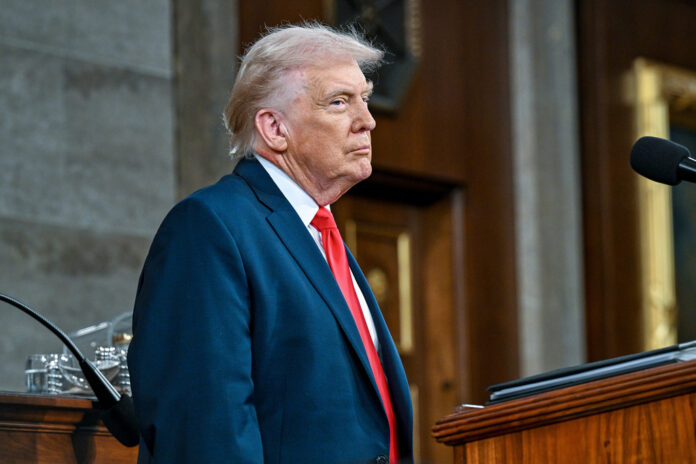
WASHINGTON (AP) — President Donald Trump declared during a marathon State of the Union on Tuesday that “we’re winning so much” — insisting he’d sparked an economic boom at home and imposed a new world order abroad in hopes it can counter his sliding approval ratings.
Trump’s main objective was convincing increasingly wary Americans that the economy is stronger than many believe, and that they should vote for more of the same by backing Republicans during November’s midterm elections. In all, Trump spoke for a record 108 minutes, breaking — by eight minutes — the previous time mark from his address before a joint session of Congress last year.
The president largely avoided his usual bombast, only occasionally veering off-script — mostly to slam Democrats. As he did during such addresses in his first term, Trump relied on a series of surprise special guests to dramatically punctuate his message. They included U.S. military heroes and a former political prisoner released after U.S. forces toppled Venezuelan President Nicolás Maduro.
Trump drew some of the loudest applause of the night when he invited the Olympic gold medal-winning U.S. men’s hockey team into the House chamber.
“Our country is winning again. In fact, we’re winning so much that we really don’t know what to do about it. People are asking me, ‘Please, please, please, Mister President, we’re winning too much. We can’t take it anymore,'” Trump said before introducing the team.
The hockey players, wearing their medals and “USA” sweaters, drew a bipartisan standing ovation. Trump pointed to the Democratic side of the chamber and quipped, “That’s the first time I ever I’ve ever seen them get up.”
In a made-for-TV moment, the president announced he would be awarding the Presidential Medal of Freedom, America’s highest civilian honor, to the hockey team’s goaltender, Connor Hellebuyck. He also bestowed the Purple Heart on Andrew Wolfe — a National Guard member who was shot while deployed on the streets of the nation’s capital. Wolfe made his first public appearance since then during the speech.
That scene recalled a similar surprise announcement in 2020, when Trump gave the Medal of Freedom to conservative radio host Rush Limbaugh during his State of the Union speech.
Trump vowed to plow ahead, using “alternative” laws to impose the taxes on imports and telling lawmakers, “Congressional action will not be necessary.” Trump argued that the tariffs are paid by foreign countries, despite evidence that the costs are borne by American consumers and businesses. “It’s saving our country,” he said.
The only Supreme Court justices attending were Chief Justice John Roberts, as well as Justices Brett Kavanaugh, Amy Coney Barrett and Elena Kagan. Trump greeted them personally before the speech, despite last week slamming Coney Barrett — who he appointed to the high court in his first term — for siding with the majority against his tariffs.
Democrats also stood for Trump vowing to halt insider trading by members of Congress. But Rep. Mark Takano, a California Democrat, yelled, “How about you first!” Rep. Rashida Tlaib, a Michigan Democrat, called out, “You’re the most corrupt president!”
When some heckling continued, Trump proclaimed, “You should be ashamed of yourselves.” Later, he pointed at Democrats and proclaimed, “These people are crazy.”
Democratic Rep. Al Green was escorted from the chamber early in the speech, after he unfurled a sign of protest that read “Black People Aren’t Apes!” That was an apparent reference to a racist video the president posted that depicted former President Barack Obama and First Lady Michelle Obama as primates in a jungle. Green was also removed during Trump’s address last year.
The president, meanwhile, was mostly optimistic and patriotic, but Trump struck a darker tone in large swaths of his speech to warn about the dangers posed by immigrants. He invited lawmakers from both parties to “protect American citizens, not illegal aliens” and championed proposals to limit mail-in ballots and tighten voter identification rules.
There also are persistent fears that tariffs stoking higher prices could eventually hurt the economy and job creation. Economic growth slowed in the last three months of last year.
It is potentially politically perilous ahead of November elections that could deliver congressional wins to Democrats, just as 2018’s blue wave created a strong check to his administration during his first term.
On Tuesday, Trump blamed his predecessor, former President Joe Biden, along with Democratic lawmakers in the chamber, saying they were responsible for rising prices and health care costs, two issues his political opponents have repeatedly raised against him.
“You caused that problem,” Trump said of affordability concerns. He added a moment later, “They knew their statements were a dirty, rotten lie.”
Trump also said he’d press tech companies involved in artificial intelligence to pay higher electricity rates in areas where their data centers are located. Such data centers tend to use large volumes of electricity, potentially increasing the cost of power to other consumers in the area.
Another notable off-script moment came as Trump was referencing prescription drug prices, saying, “So in my first year of the second term — should be my third term — but strange things happen,” prompting at least one chant in the chamber of “Four more years!”
Virginia Gov. Abigail Spanberger, who delivered the Democratic response to Trump’s speech, slammed the president’s aggressive immigration policies, his widespread cuts to the federal government and his tariffs.
“Even though the Supreme Court struck these tariffs down four days ago, the damage to us, the American people, has already been done. Meanwhile, the president is planning for new tariffs,” she said. “Another massive tax hike on you and your family.”
A warning to Iran
Trump’s address came as two U.S. aircraft carriers have been dispatched to the Middle East amid tensions with Iran. Trump said, “My preference is to solve this problem through diplomacy.”
“But one thing is certain, I will never allow the world’s number one sponsor of terror — which they are, by far — to have a nuclear weapon,” he added.